What Is a Deal Desk and When Does a B2B Business Need One?
Without structured governance, complex enterprise negotiations erode gross margins and overwhelm sales leadership.

A deal desk is the team, or function, that reviews and approves non-standard sales transactions: discounts beyond rep authority, custom payment terms, non-standard contract clauses, or special pricing for unusual order volumes. While the term originated in US enterprise software companies, the role exists in every B2B business. In wholesale distribution and manufacturing, it often goes by names like the approval committee, pricing committee, or simply "manager approval."
The deal desk does not negotiate directly with the buyer. It determines whether the commercial terms negotiated by the sales rep make financial sense for the company.
What a Deal Desk Does
- Approves exceptions. Discounts, payment terms, freight allowances, and custom terms exceeding sales rep authority.
- Validates true margins. Before approving, it evaluates cost of goods, taxes, freight, and net payment terms across the entire order, not just the headline discount percentage.
- Standardizes commercial responses. Similar requests receive consistent decisions, reducing internal disputes among reps and friction with customers.
- Logs justification. Every approval captures the rationale, creating clear audit trails to refine commercial policies later.
- Refines pricing policy. An exception that happens repeatedly should become a standard rule, or be eliminated entirely.
When a B2B Operation Needs a Deal Desk
When the same exception requests recur constantly. If sales managers spend their days reviewing similar discount requests, decisions should be centralized using consistent criteria.
When gross margin varies widely across sales reps. Large differences in average margin among reps serving similar customer profiles indicate that exceptions are decided by individual discretion rather than company guidelines.
When large deals stall. Approval workflows scattered across email, text messages, and phone calls slow down the high-value transactions that matter most.
When selling through multiple channels. B2B customer portals, field sales reps, inside sales, and AI commerce agents all need the same definitive answer for the same pricing exception.
Why the Deal Desk Becomes a Bottleneck
Why does approval take so long? Because the request arrives without context, forcing the approver to chase down customer history and cost data.
Why does it arrive without context? Because the quote was negotiated offline, outside the core transaction system, and the approval request is merely a message with a number.
Why does everything require approval? Because approval thresholds are not properly calibrated, leaving reps unable to finalize even routine, low-risk quotes on their own.
Why does this cost revenue? Because a customer waiting on pricing approval will simply purchase from a competitor who responds immediately.
The root cause: while modern teams ask what is a deal desk meant to accomplish, it was built to evaluate pre-assembled deals, yet spends its time manually reconstructing sales context.
Deal Desk Best Practices
1. Keep routine orders out. A deal desk should only review deals that truly exceed sales rep authority levels. If it reviews almost every quote, your baseline thresholds are set too low. We explain how to calibrate them in how to structure discount approval tiers.
2. Evaluate the complete order. Approvals must be based on total order net margin, including landed product costs, taxes, and freight, rather than looking at isolated line-item discounts.
3. Require clear rationale. Competitive pressure, annual commitment, new customer acquisition, or clearing dead inventory. Without documented rationale, commercial policy cannot be refined.
4. Establish strict response SLAs. Minutes for standard orders, hours for complex custom contracts. Clear turnaround commitments keep sales reps from circumventing the formal process.
5. Review exceptions quarterly. Any exception recurring frequently for the same underlying reason should be formalized into standard policy with dedicated delegation of authority limits.
Integrating the Deal Desk into Your Sales Workflow
When commercial approvals happen directly within the transaction workflow, the deal desk stops acting like a backlogged email inbox. An order exceeding predefined parameters holds automatically, routes immediately to the designated approver with complete margin context and buying history, and returns approved back into the live cart where the rep and customer are transacting.
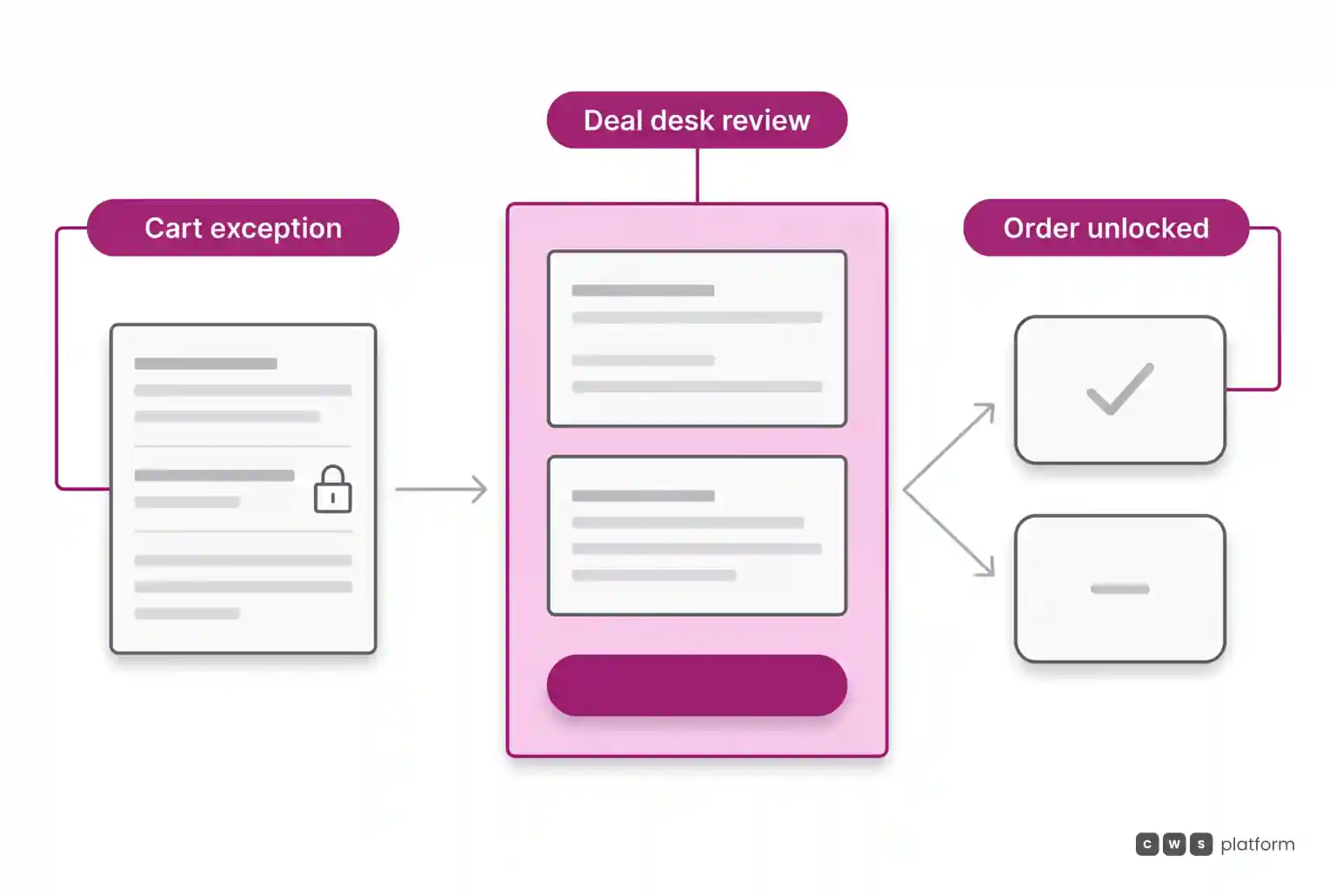
In CWS Platform, any line item exceeding authorized discount thresholds is held until the sales rep logs the business justification. The order then routes to approvers with the recorded reason, and approvers must likewise document rationale for any rejected concession. You can see how this operates on our guided selling page.
Next Steps
Review how many discount approvals your managers handled over the past 30 days and measure average turnaround time. If the vast majority involved routine, low-dollar orders, your primary bottleneck is not the deal desk, it is miscalibrated rep authority.
Frequently Asked Questions
What is a deal desk?
A deal desk is the business team or function responsible for reviewing and approving non-standard sales transactions, such as excessive discounts, non-standard contract language, or special payment terms.
What is the difference between a deal desk and approval thresholds?
Approval thresholds establish the commercial limits within which individual sales reps can operate independently. The deal desk is the centralized function that evaluates transactions exceeding those limits.
Who should sit on a deal desk?
Cross-functional members from sales operations, finance, and pricing. In mid-market distribution or manufacturing businesses, a commercial sales manager with direct visibility into order margins and credit lines often handles the role.
How do you prevent a deal desk from slowing down sales?
Calibrate rep authority thresholds so routine transactions never reach the queue, ensure every request arrives with complete margin context, mandate clear business justification, and enforce strict approval SLAs.
Read More
- Discounts, approvals and traceability
- Unauthorized Discounts: How to Detect When Reps Give Away Margin Under the Radar
- Operating Costs in Distribution: Where Hidden Inefficiencies Lie and How to Cut Them
About This Publication
A publication by CWS Platform (cws-platform.com).
"responsive, technically engaged, and willing to work through complex commercial rules (negotiated pricing, credit, customer-specific conditions) rather than pushing generic answers"
Want to see this in your operation?
Real B2B operations already run on it.