What an ERP Is, What It Does, and What It Doesn't Solve in B2B Sales
Why pushing your ERP to manage front-end negotiations creates operational drag, and how to decouple sales from systems of record.

ERP stands for Enterprise Resource Planning. It is the core business management software that integrates a company's fundamental departments into a single place: finance, general ledger, tax compliance, inventory, purchasing, manufacturing, and billing. When an invoice is generated, inventory decrements, accounts receivable updates, and accounting records the transaction, all stemming from the exact same data point. That is the role of an ERP: serving as the enterprise source of truth.
Understanding what an ERP does well also helps clarify what it was never designed to handle.
What an ERP System Does
Finance and Accounting. Accounts payable, accounts receivable, cash flow management, bank reconciliations, and general ledger entries generated automatically from daily operations.
Tax and Compliance. Sales tax calculation, tax filing preparation, invoicing, and regulatory reporting across multiple jurisdictions.
Inventory and Purchasing. Stock balances across warehouses, stock intake, shipments, vendor purchase orders, and cycle counts.
Billing and Order Processing. Approved purchase orders convert into finalized invoices, release inventory, and trigger customer billing.
Manufacturing and Production. Production orders, bill of materials (BOM), raw material tracking, and landed cost calculations.
The core benefit is integration. Without an ERP, every team relies on disconnected spreadsheets, and the numbers never align.
ERP in Supply Chain and Logistics
In supply chain operations, the ERP tracks inventory across distribution centers, manages inventory allocation for open orders, handles branch transfers, and generates shipping documentation. It serves as the baseline for understanding what stock exists, where it sits, and what is already committed. How quickly those stock levels sync with front-facing sales channels determines whether a customer sees real-time inventory or yesterday's numbers.
What the ERP Fails to Solve in B2B Sales
The ERP was architected to strictly record decisions the business has already executed. B2B sales occur prior to that moment, directly within customer negotiations, which reveals clear functional boundaries:
It was not built for customer self-service. The ERP user interface is designed for internal back-office teams trained on part numbers and operational exceptions. A professional buyer who wants to place an order independently needs a completely different user experience.
It records transaction outcomes, not the negotiation process. The ERP stores the final order price, but loses the commercial context: requested discounts, approval tiers, justification, and who signed off.
Every new commercial rule turns into an IT project. Changing a discount matrix or payment terms inside the ERP requires complex customization within the same system that protects critical financial and tax records.
It struggles across omnichannel sales touchpoints. Customer portals, field sales reps, independent brokers, marketplaces, and autonomous AI agents all require access to the exact same commercial policy in real time.
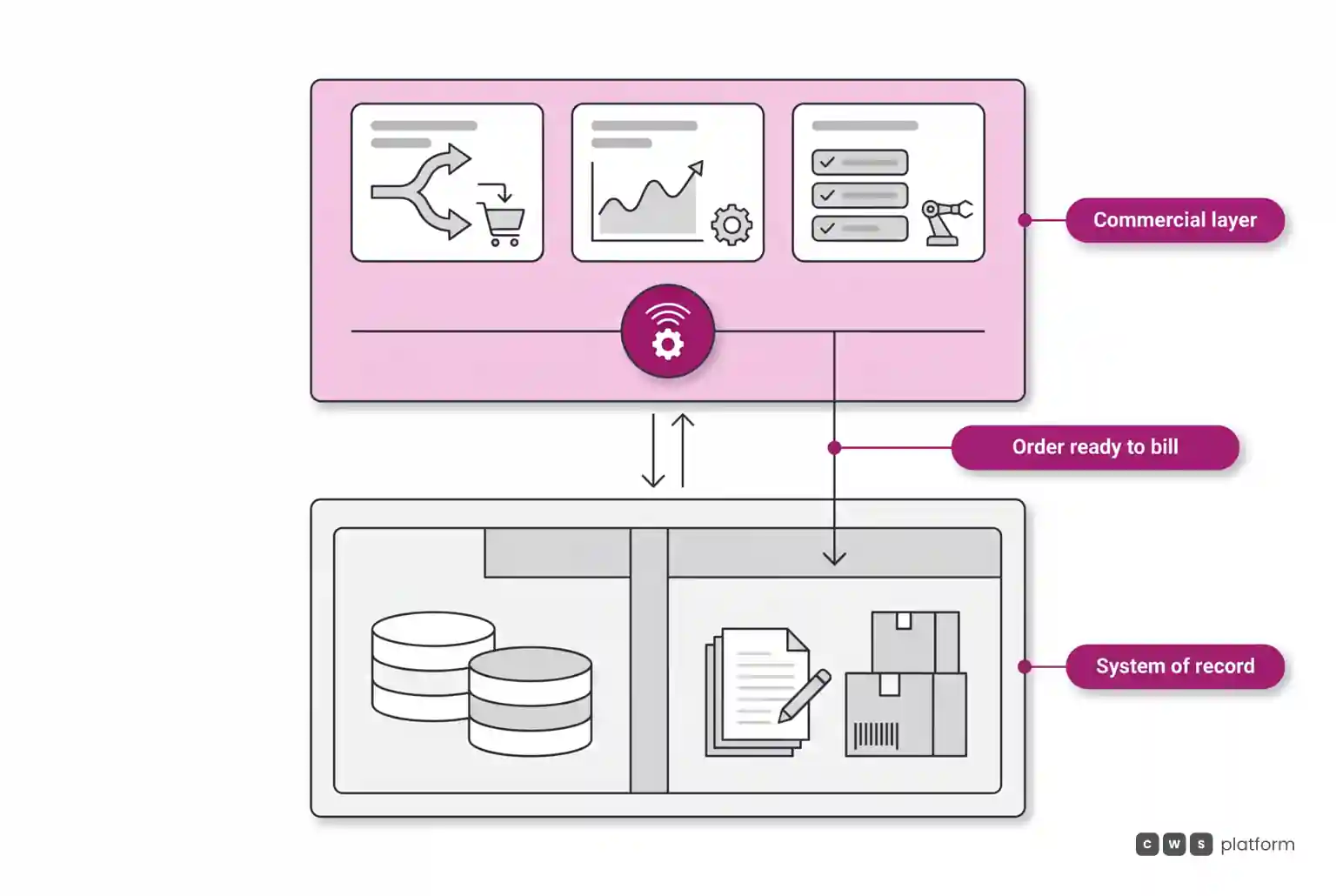
Because of these constraints, modern architectures rely on the ERP as the system of record, placing a dedicated commercial layer on top of it. We explore this structural choice in ERP sales module or dedicated B2B platform? and detail the modernization path in how to modernize B2B sales without replacing your ERP.
ERP and B2B Commerce Platforms: Who Does What
| The ERP | The B2B Platform |
|---|---|
| Stores master accounts, base price lists, inventory, and credit lines | Shows each customer their specific contract pricing and terms |
| Generates finalized invoices and runs accounting entries | Calculates real-time sales tax and shipping during checkout |
| Records finalized, approved orders | Enforces commercial policies throughout the negotiation process |
| Serves internal back-office teams | Serves buyers, sales reps, distributors, and AI agents |
Where CWS Platform Fits In
CWS Platform does not replace your ERP. It acts as the commercial orchestration layer sitting directly on top of your existing back-office systems, fully connected through open APIs and webhooks. It ingests account data, pricing, stock levels, and credit limits, enforces real-time commercial logic throughout the purchasing workflow, and sends validated, audit-ready orders straight back to the ERP for fulfillment. Explore the complete technical architecture on the APIs and integrations page.
Next Step
Identify every commercial decision that currently forces a rep to open the ERP: checking customer-specific pricing, verifying physical inventory, assessing credit availability, or requesting margin approval. Every single one represents a transaction a customer or sales rep could execute autonomously, provided they have clear business rules and synchronized data.
Frequently Asked Questions
What is an ERP?
ERP (Enterprise Resource Planning) is a centralized enterprise management system that connects core operational units, including finance, accounting, inventory management, procurement, manufacturing, and billing, into a unified, shared database.
What is an ERP system and what does it do?
It is the core platform that records and connects daily business operations. It automates financial tracking, manages stock across warehouses, processes accounts payable and receivable, maintains ledger balances, and streamlines business workflows without duplicate cross-departmental data entry.
How does an ERP support logistics and distribution?
In logistics, an ERP tracks stock by warehouse, reserves product for approved orders, coordinates inventory transfers between facilities, and produces shipping manifests. It gives operators visibility into total on-hand stock, physical locations, and allocated units.
Can an ERP handle B2B digital sales on its own?
An ERP handles final order capture and billing, but its interface was not designed for customer self-service or multi-tier negotiation governance. The industry standard architecture maintains the ERP as the primary system of record while deploying an integrated B2B digital commerce platform to power sales portals, field reps, and external sales channels.
Further Reading
- How to turn commercial policies into automated business rules
- B2B digital commerce fundamentals (definitions)
About This Publication
Published by CWS Platform.
"responsive, technically engaged, and willing to work through complex commercial rules (negotiated pricing, credit, customer-specific conditions) rather than pushing generic answers"
Want to see this in your operation?
Real B2B operations already run on it.