Wholesale Distributor Marketplace: Moving Beyond Third-Party Platforms
Stop losing margins on open platforms by orchestrating your own multi-vendor ecosystem for commercial buyers.

Traditional distributors face an escalating dilemma in sales digitalization: when entering third party open platforms, companies often discover that their distributorship gains volume on public marketplaces while bleeding margin along the way. In those environments, relationships with longstanding accounts are mediated by third party rules, products become commoditized, and commercial policies get lost in a race to the bottom on price. The opposing path is a wholesale distributor marketplace: a proprietary digital channel operated by the team that truly knows the account portfolio.
Preserving value along the supply chain does not mean abandoning digital channels, it means reversing your position. Instead of surrendering customer accounts and product assortments to third party aggregators, the distributor takes control of its own channel and brings trusted partners into it, strictly under its own commercial terms.
TL;DR
- Operating as an ordinary vendor on third party platforms strips distributors of direct buyer relationships.
- In a proprietary marketplace, distributors expand assortment with partner vendors without taking inventory risk.
- Buyers must be able to check out with a multi vendor cart where each seller maintains its own freight, net terms, and volume discounts.
- Multi location corporate accounts need the ability to purchase on behalf of distinct branches without separate onboarding or approval workflows.
How Can B2B Distributors Lead Their Supply Chain Through a Proprietary Channel?
A distributor's competitive edge has always rested on three core assets: regional proximity to commercial buyers, the ability to extend trade credit, and logistics capabilities configured for fractional or scheduled replenishment. When operations migrate to generic public platforms, these differentiators lose their value because algorithmic search rules prioritize penny pinching price wars above all else.
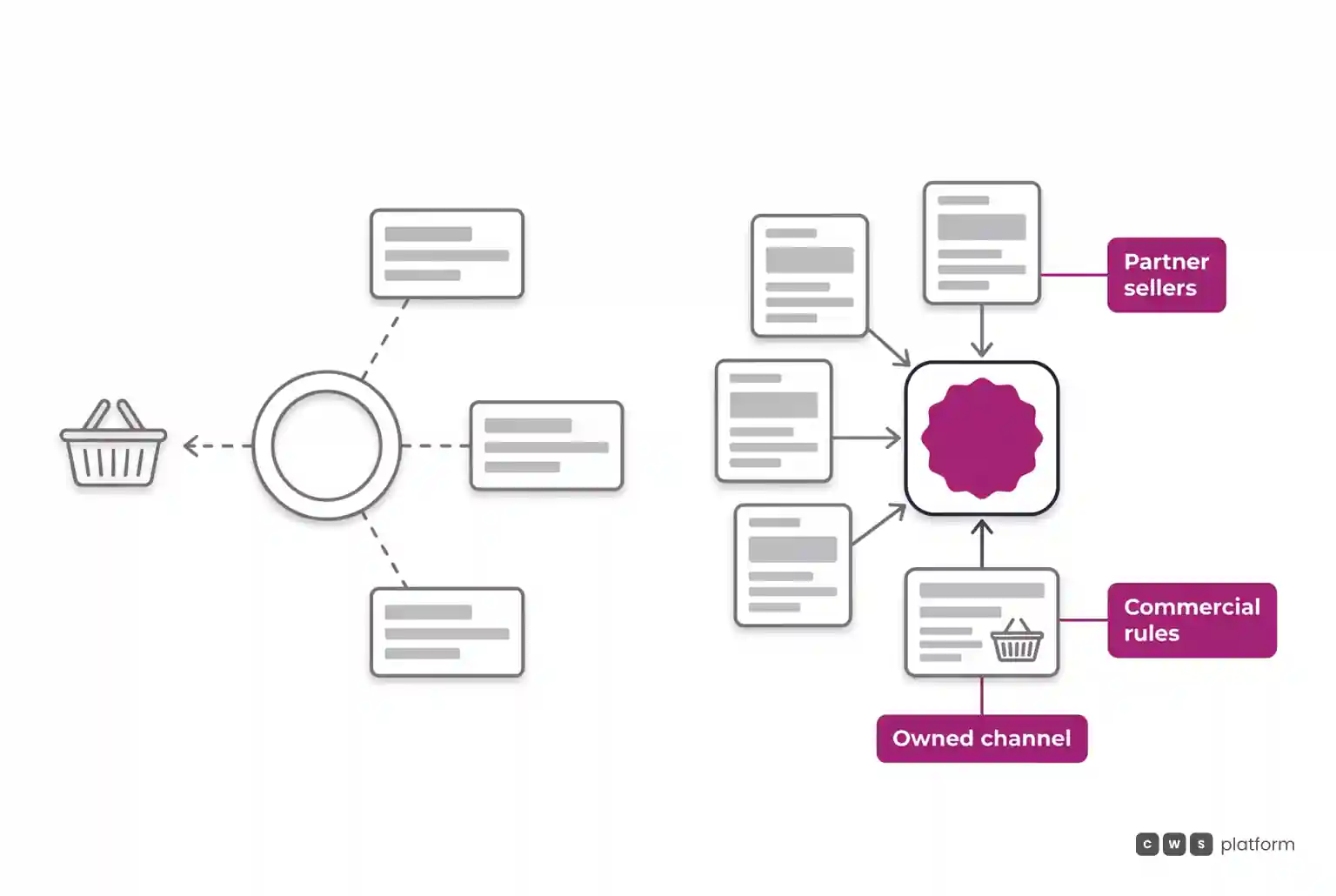
To lead, distributors must turn their current customer base and supplier vendor agreements into a proprietary ecosystem. That means opening up digital shelf space for complementary manufacturers and vendors to sell directly to established buyers through a B2B multi-seller framework. The distributor shifts from being merely an inventory warehouse owner to becoming the central coordinator of commercial trust across the industry.
Under this model, the entire buyer journey stays under direct corporate control: trade credit limits, net terms, invoicing workflows, and customer specific price schedules remain managed by internal teams rather than dictated by external algorithms.
What Changes When the Distributor Owns the Channel
- Broader catalog depth without carrying extra inventory: partner vendors and complementary manufacturers fulfill slow moving long tail SKUs directly from their own warehouses.
- Routine orders shift to digital self service: standard reorders and contract replenishment move online, freeing account reps to focus on strategic, high touch enterprise deals.
- A consolidated procurement hub: corporate procurement teams can purchase across multiple preferred suppliers in one location instead of maintaining separate logins and billing setups.
- Consistent commercial governance across every line item: contract pricing tiers and pre approved discount ceilings apply uniformly to all third party vendors inside the portal.
This transition gains real momentum when leadership recognizes that you are trying to build a marketplace when what you really need is a sales ecosystem. Sustained value comes from coordinating buyers and suppliers under dependable commercial rules, not from launching an uncurated product catalog.
Multi-Vendor Carts and Branch-Level Purchasing
The ultimate proving ground for a proprietary digital portal is the checkout experience. If procurement buyers must place isolated, fragmented orders for each separate seller, the channel fails to deliver expected convenience. Conversely, if the distributor invoices every single line item under its own balance sheet, it takes on legal, financial, and tax liabilities outside its core business. The model that works keeps a unified checkout where each vendor preserves its own shipping rates, payment arrangements, and custom tier discounts.
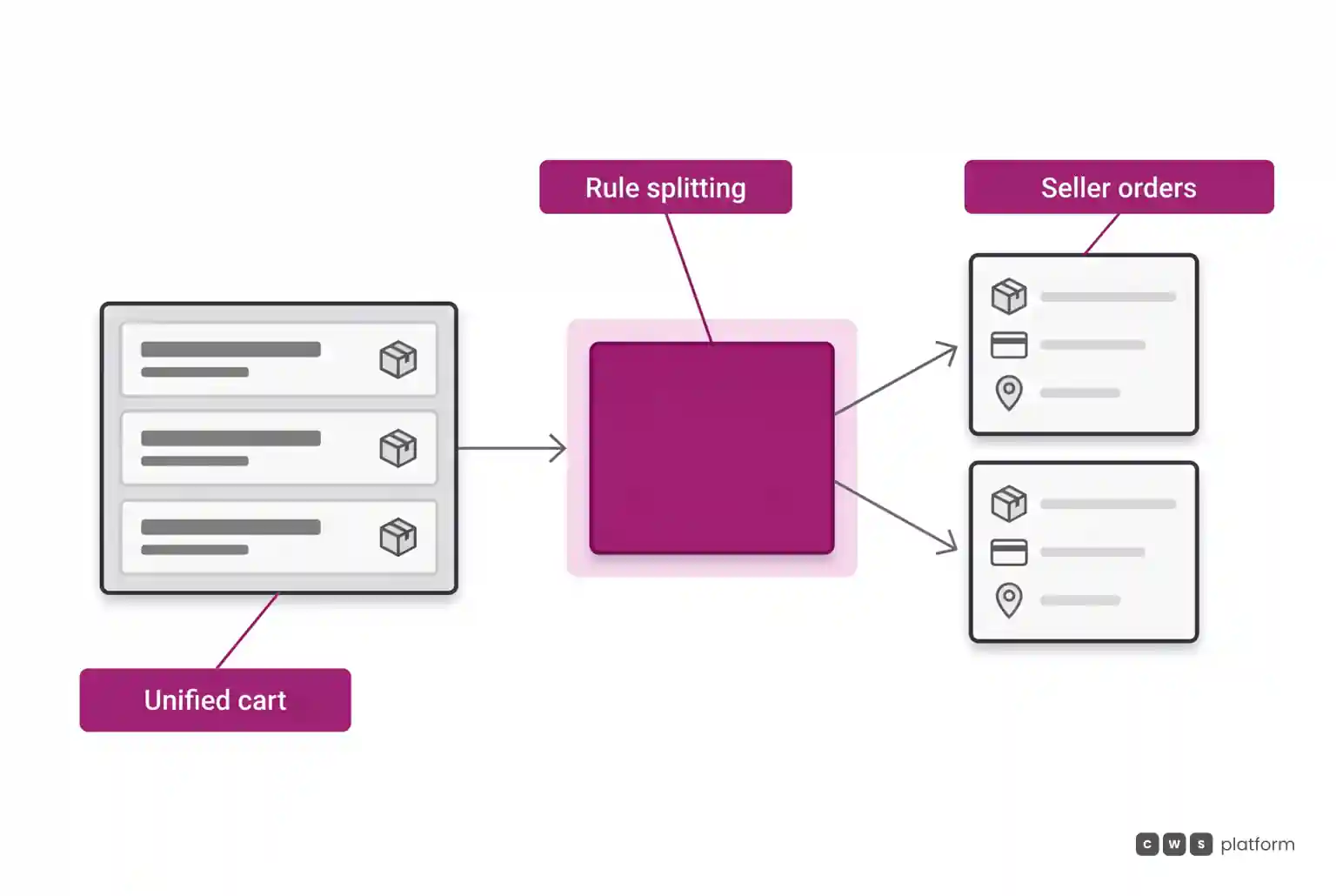
The second operational requirement involves complex buyer organizational structures. B2B wholesale distributor marketplace accounts frequently manage parent headquarters alongside job sites, regional branches, and warehouse facilities, each with distinct delivery addresses, tax exemptions, and routing requirements. Professional buyers must be able to purchase on behalf of various subsidiary branches from a single unified corporate account.
This operational efficiency also applies to regular replenishment, as outlined in our analysis on how to lower recurring contract reorder costs without surrendering procurement governance.
Two foundational technical components complete this architecture. First, commercial business logic originates inside core accounting and inventory systems, meaning it must sync cleanly via enterprise ERP integration without exposing back office databases to external tampering. Second, every fulfillment location, whether an owned branch distribution center or a dropship supplier facility, functions as an autonomous operational node with its own catalog, regional freight rules, and local inventory levels, all governed by the parent company's master business logic.
What CWS Platform Delivers for Distributor Operations
CWS Platform provides enterprise infrastructure for a governed B2B Marketplace. Inside the platform, multiple vendors sell through a shared checkout experience where each partner maintains separate freight matrices, payment terms, and negotiated volume discounts, while enterprise price negotiations happen simultaneously across differing approval tiers. Corporate accounts can place orders across multiple branches in a single session. Payment processing handles automated split payouts across independent vendor accounts, complete with custom platform commission handling.
The Cost of Inaction
Postponing the rollout of a proprietary digital ecosystem leaves distributors exposed to two aggressive pressures: upstream manufacturing brands attempting to sell direct to end users (D2C), and commoditized open marketplaces capturing accounts through sheer self service convenience.
Keeping daily commercial workflows chained to manual emails, disconnected spreadsheets, and sluggish offline credit checks drives up customer service costs per order. Over time, efficiency focused corporate buyers will gravitate toward automated, frictionless platforms, leaving legacy distributors to handle only the most operationally demanding, low margin specialty orders.
Strategic Principles for Operating a Proprietary Distributor Channel
- Protect your negotiated pricing models: translate hard won account relationships and complex contract tiers into your digital portal instead of flattening products into anonymous price wars.
- Preserve independent seller commercial terms: shipping rates, net terms, and volume discount limits remain managed by each respective vendor, even inside a unified checkout cart.
- Support enterprise organizational structures: empower corporate purchasing teams to assign orders across regional branch accounts, subsidiaries, and job sites from a single login.
- Keep trade terms under your direct governance: credit approval thresholds, custom price lists, and margin ceilings remain firmly managed by your internal leadership.
FAQ
What is a wholesale distributor marketplace?
It is a proprietary digital sales channel owned and operated by a distributor, where the company sells its own core catalog alongside complementary partner vendors and manufacturers, all governed by the distributor's commercial policies.
How do buyers check out with items from multiple vendors?
Through a unified checkout cart where each independent seller preserves its own fulfillment methods, payment terms, and custom discounts. Buyers can negotiate tiered pricing based on authority thresholds and finalize the entire transaction in one place.
Can enterprise clients with multiple regional branches order from a single account?
Yes, provided the software architecture supports branch level hierarchy purchasing. Orders are automatically routed to the proper delivery locations and billed correctly without requiring separate buyer onboarding.
About This Publication
This article examines digital transformation strategies for B2B distributors seeking to maintain commercial governance through proprietary platforms. Published by CWS Platform, developers of enterprise software for complex B2B commerce operations and multi vendor negotiation governance.
"responsive, technically engaged, and willing to work through complex commercial rules (negotiated pricing, credit, customer-specific conditions) rather than pushing generic answers"
Want to see this in your operation?
Real B2B operations already run on it.