The portal shows a better offer. Why does the network keep paying more?

For whoever runs the network
The network director sets which stores show first for each buyer profile.
In the Marketplace Management Platform (Marketplace Center), the ranking applies per profile: customer, buyer or sales rep. The network's rule, not each store's habit, decides who shows first.
Illustrative scene with a real CWS Platform screen in a demo version. People, stores and on-screen data are fictitious.

For the store that buys from the network
On her phone, the store owner builds the shelf restock in a single list, comparing who takes each part.
Buying stops going to the usual supplier out of habit: the list shows who takes each part at the best lead time, and whatever is left she compares before closing.
Illustrative scene with a real CWS Platform screen in a demo version. People, stores and on-screen data are fictitious.

For whoever buys for the branches
On the product page, the main offer is the one the network's rule picked, with who sells and prepares it.
The purchasing office buyer doesn't have to hunt for the best offer item by item: the rule picks by lowest price or nearest store, and the other offers stay alongside.
Illustrative scene with a real CWS Platform screen in a demo version. People, stores and on-screen data are fictitious.

For whoever places the order
The confirmed order shows each source with its own prep time.
One order, split by who sells: the network sees where each item came from and on what terms, which is what it needs to show the partner the savings that reached the stores.
Illustrative scene with a real CWS Platform screen in a demo version. People, stores and on-screen data are fictitious.
By challenge · Network buying
The savings show up on screen and not on the invoice. Each store keeps buying from its usual supplier, and no one can show the partner how much the network really saved.
The best offer on the portal only becomes savings when buying is steered to it. On CWS Platform, the Marketplace Management Platform (Marketplace Center) picks the main offer by the network's rule, the same item from different suppliers shows up together, and the anchor buyer buys for its branches on the same portal. Closing the gap between the possible price and the price paid becomes an operating job, with a lever for each cause.
Where the savings leak today
Buying isn't steered
Without a network buying policy, each store sticks with its usual supplier, even with a better offer one click away.
The same item is scattered
The catalog doesn't bring the same item from different suppliers together, and the best offer hides in another listing.
No one curates the offers
Stale or off-market offers stay live, and stores learn to distrust the portal.
Two measures, side by side
Potential savings are the gap between what the network used to pay and the best offer available. Realized savings are the gap between what it used to pay and what it paid. Tracking both, by store, by product family and by supplier, shows where the savings were left on the table and why, and makes the supplier partnership auditable.
Illustrative example, not customer data. Picture a network of 300 repair shops buying replacement parts through the portal. If every order went to the best offer, the network would pay much less; but half the shops repeat their usual supplier, and the price paid stays close to the old one. The offer exists; the savings never arrive.
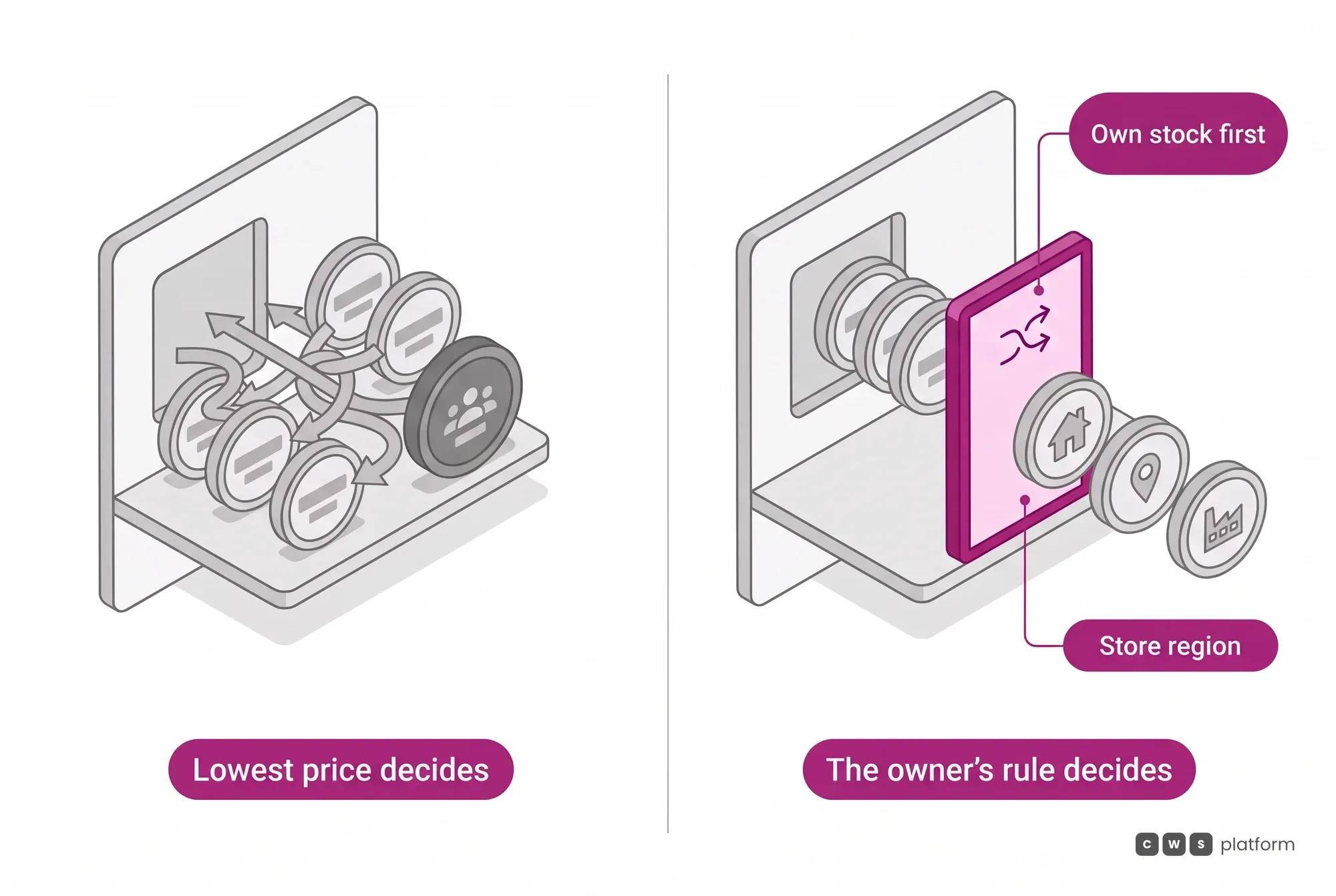
Main offer by rule
From the buyer's address, the rule picks the first offer.
The main offer goes to the lowest price or the nearest store, within the radius the network sets for comparing prices across stores, and the other offers stay alongside. Stores don't have to hunt for the best offer item by item: it already comes first.
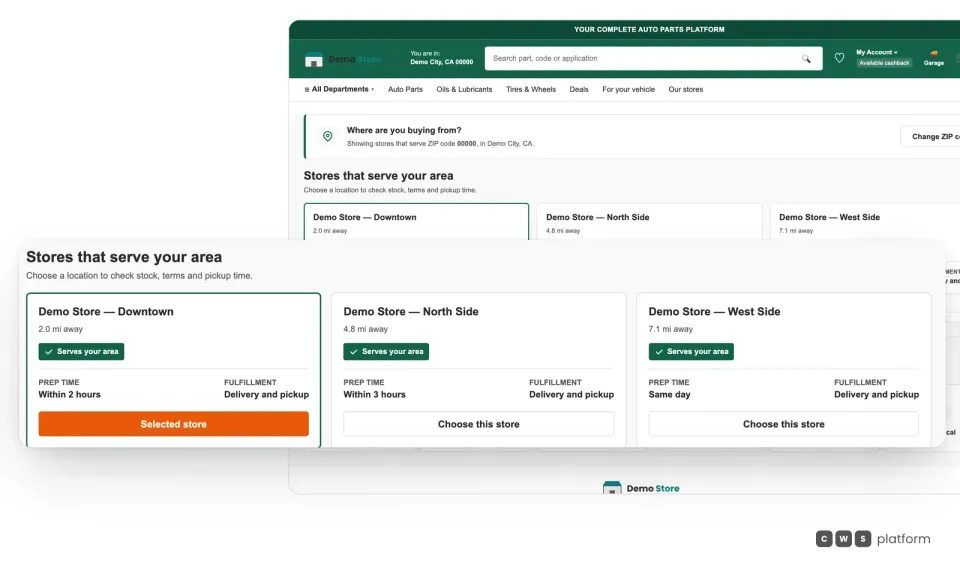
The four levers
- Buying policy. The network's anchor buyer, or its purchasing office, buys whatever the portal carries through the portal, and predictable volume brings more suppliers competing on price.
- Main offer by rule. Lowest price or nearest store, store priority and partner stores as backup, set by whoever runs the network.
- A catalog that unites the item. In Product Catalog & MDM (Catalog Engine), there is one catalog and each item shows how many stores in the network sell it.
- Curation with an owner. Someone with a target takes stale offers down and brings in the missing supplier. Without an owner, the portal exists and the savings don't grow.
Steered buying
The network's service desk buys on the store's behalf, on the same portal.
In Assisted Selling Platform (Sales Hub), whoever serves the network identifies the store and places the order for it, under the same portal rules. The store that still phones in its orders starts buying at the offer the network picked, without changing its habit overnight.
Want to know where your network's savings are left on the table?
Tell us how the network buys today, how many stores use the portal and who the largest buyer is, and a specialist walks you through the levers with your case.

Persona · Chief financial officer
The better offer on the portal became the price we pay, not just a promise.
The network's buying policy sends each order to the offer the rule picks, not to the usual supplier.

Persona · Buyer
I buy the way I always have, and the network's main offer is already up front.
The same item from different suppliers shows up together, and I choose who to buy from without calling anyone.
What usually gets in the way, and how it works
Forcing stores onto the portal doesn't stick
The policy starts with the anchor, not the whole network. The other stores join when they see they buy better.
Does the usual supplier lose out?
It stays on the portal and owns its price. If its offer is the best by the rule, it comes first.
What about offers that aren't just price?
The rule can give the main offer to the nearest store, prioritize stores and use partners as backup when stock runs out.
Frequently asked questions
What are potential and realized savings?
Potential savings are the gap between what the network used to pay and the best offer available on the portal. Realized savings are the gap between what it used to pay and what it actually paid. Realized savings fall short when buying isn't steered to the best offer.
Why don't stores pick the best offer on their own?
Because repeating the usual supplier is less work. Without a buying policy, without a main offer picked by rule and with the same item scattered across listings, finding the best offer is left to each store.
How is the main offer picked?
By the rule of whoever runs the portal: lowest price or the store nearest to the buyer, with a minimum radius for comparing prices, and the store priority the network sets. The other offers stay alongside, under see more offers.
Does this apply to any industry?
It applies to every network that buys together: auto parts repair shops and dealers, ag co-ops and input dealers, building-materials buying groups, franchises. The mechanism is the same; the catalog and the anchor buyer change.
Go deeper
- Network purchasing portal: the network buying together, on the manufacturer's portal.
- Marketplace Management Platform (Marketplace Center): main offer, partner and competing stores.
- Governed marketplace: who sells, what they list and how offers compete.
- Auto parts: repair-shop and dealer networks.
- All challenges: customer price lists, discount approval, payment terms and more.
See where your network's savings leak
Tell us a bit about your operation and a CWS Platform specialist will reach out within one business day, no strings attached.