Credit-First B2B Checkout (Checkout & Payments)

Management · Approval manager
An order outside the rule waits in the queue, with reason and margin.
Whatever goes beyond the store's rule goes for approval before it becomes a transaction. The manager approves or rejects each order, level by level, with the coded reason.
Illustrative scene with a real CWS Platform screen in a demo version. People, stores and on-screen data are fictitious.

On the portal · Reseller buyer
She closes on invoice within her company's limit and sees what is left.
Credit is a payment method: limit, open balance and available credit show in the checkout, with the terms negotiated in the account's contract.
Illustrative scene with a real CWS Platform screen in a demo version. People, stores and on-screen data are fictitious.

On the portal · Shop owner
She picks the payment date and sees the price on that date.
The price on that date shows next to today's price, with the deferral interest from the store's table, and an order within the available limit is approved on the spot.
Illustrative scene with a real CWS Platform screen in a demo version. People, stores and on-screen data are fictitious.

At the workshop · Technician
The coupon goes into the summary, and each store shows subtotal and shipping.
Before paying, the summary splits the deliveries by store and shows the coupon discount in the grand total, the same way the order will be invoiced.
Illustrative scene with a real CWS Platform screen in a demo version. People, stores and on-screen data are fictitious.
Deterministic module
B2B buys on terms, not with a card on every order. When the digital checkout does not know how to handle credit, the order does not close. The Credit-First B2B Checkout treats credit as a native payment method, and validates the whole order before confirming it, under the rule the store has set.
What it is
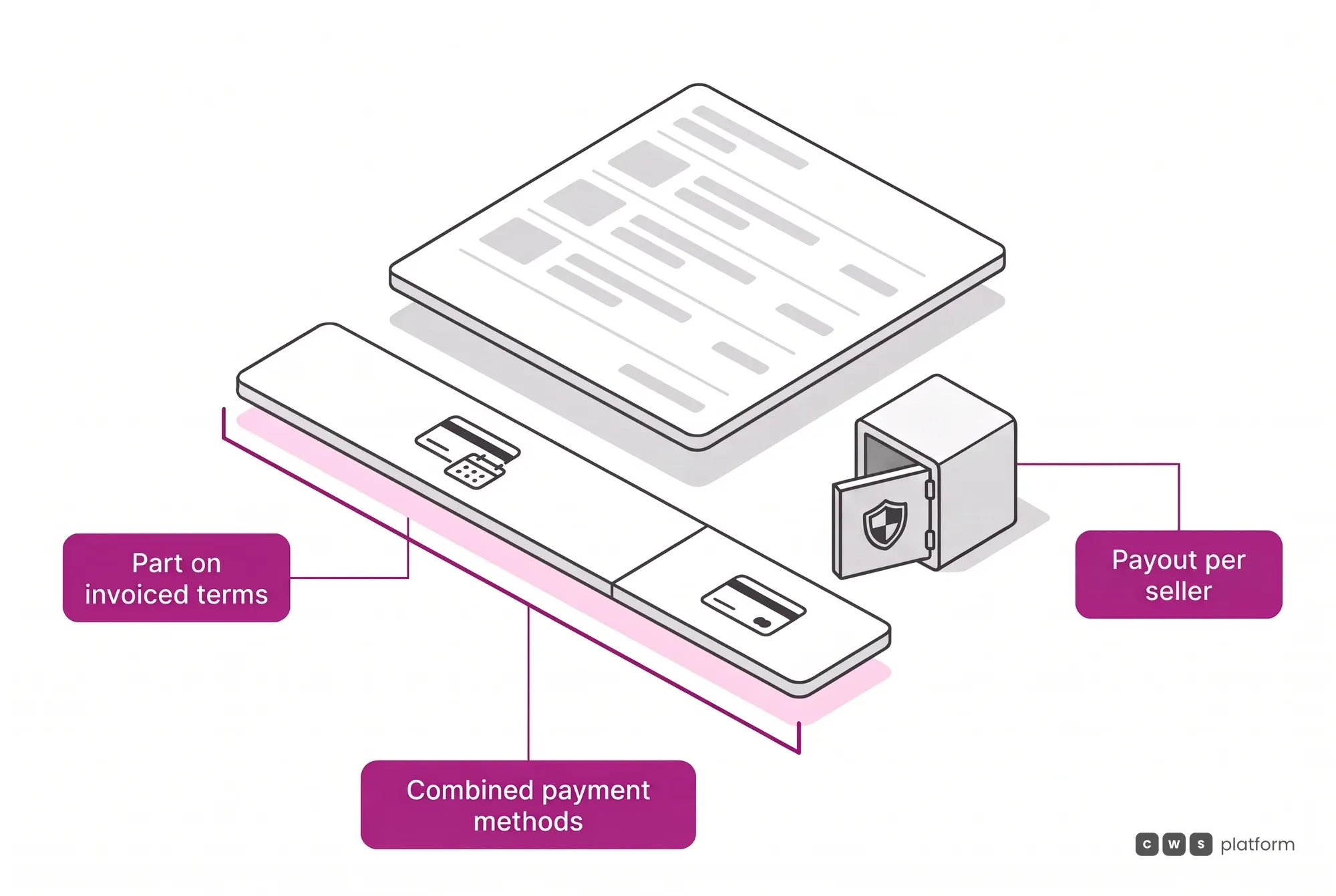
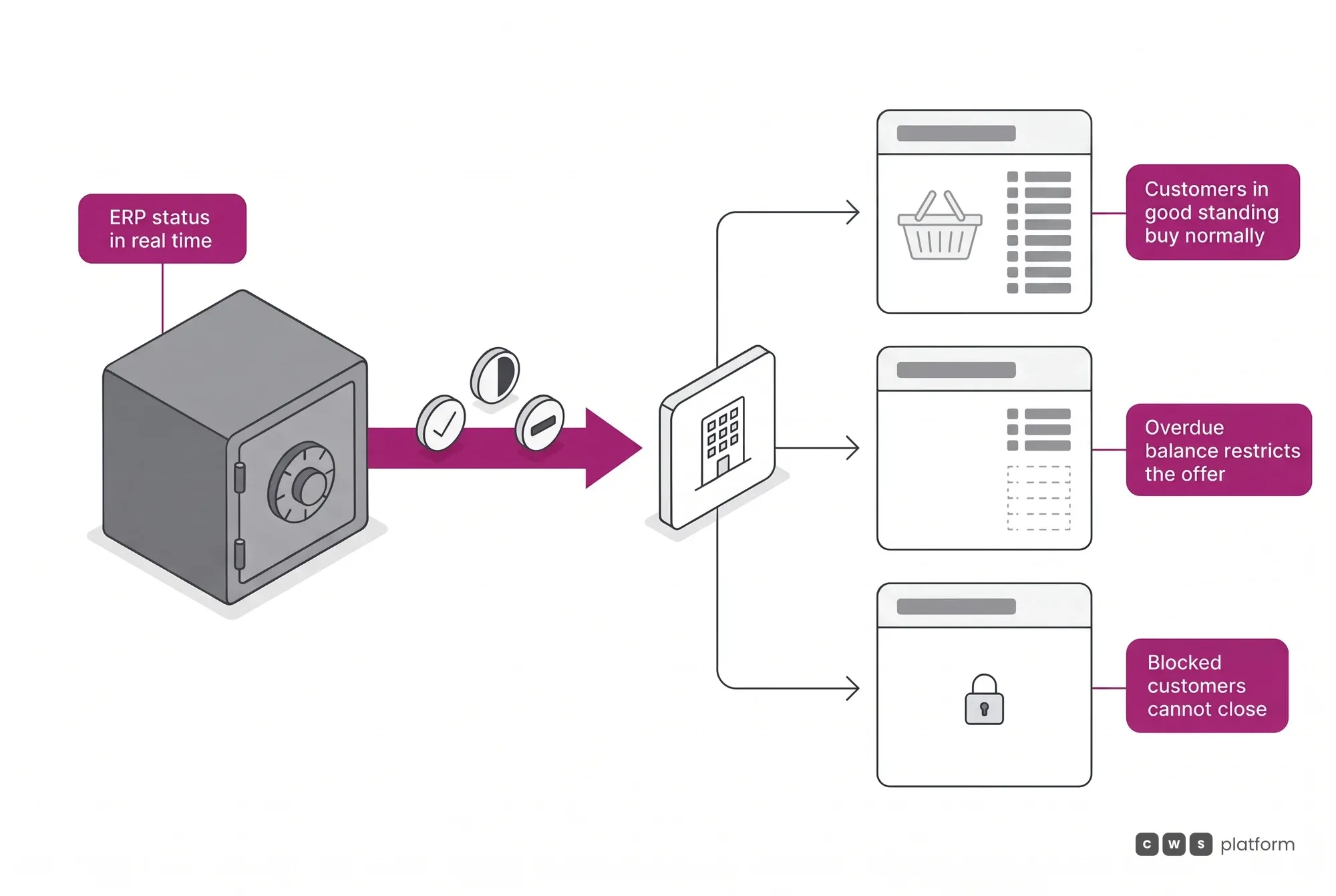
The close of the negotiation, where the negotiated agreement becomes a transaction. Credit as a native payment method, with Net Terms 30/60/90 and configurable payment-on-terms methods, with editable dates and number of installments, multi-split across sellers, combination of payment methods and Barter in agribusiness. With several suppliers in one cart, the parent order controls the aggregated cart, and each supplier configures its own payments independently, within the general criteria set by the portal owner. Delinquent and blocked tags integrated with the ERP in real time. Card data never passes through the platform.
If you want to sell on terms through the portal, the whole flow is on B2B payment terms.
B2B checkout on terms in 1 minute
The capability no one replicates
Credit as negotiation, native
Credit comes in as a variable of the agreement, not as a separate app tacked on afterward.
And how does the market do it?
In the market, B2B credit is usually a standalone app; here it is the heart of the checkout.
4-Point Checkout Validation
Stock, credit, tax and price checked at the same time.
And when credit falls short?
Credit validation is configurable: the store decides by rule whether insufficient credit blocks the order, sends it for approval or completes it as paid, so risk is handled in the flow, not afterward.

Persona · Chief financial officer
I no longer check credit after the order: it closes already validated at checkout.
At checkout on CWS Platform, credit is a native payment method, and stock, credit, tax and price are checked together before the order is confirmed.

Persona · Buyer
I close the order on terms within my limit, without going back to the sales rep.
In Checkout & Payments, the credit limit is the customer's current account, with balance and statement, and can be combined with card or bank slip.
Each item's taxes, calculated by the store that serves you.
In the product list, the buyer opens each item's taxes before checking out: ICMS ST, IPI, ICMS, PIS and COFINS and the total, calculated by the branch that serves their company. The same calculation carries into shipping and checkout, inside the 4-Point Checkout Validation.
It governs the payment dimension
The native payment methods6
Each has its own approval flow, and that difference is what separates a B2B checkout from an adapted retail one. They can be combined in a single order, and what is offered is filtered by the profile and financial status of whoever is buying.
- Credit limit
- Approved by credit validation rather than by a gateway.
Why does it weigh so much in B2B?
It is the dominant B2B payment method, and its absence is the most common reason a buyer goes back to the sales rep.
- Bank slip
- Approved after bank clearing.
And reconciliation?
The order waits for the buyer's payment cycle without anyone having to track reconciliation by hand.
- Instant transfer
- Instant approval.
When is it the one left?
It is usually the method that remains when a customer has an outstanding balance, which is why it is never the only door.
- Credit card
- Automatic gateway approval, with fraud screening in the gateway layer.
And the card data?
Card data never passes through the platform.
- Barter
- In agribusiness, grain settles the order after physical and tax validation of delivery.
And the grain balance?
The balance is managed per customer, like a current account in grain.
- In-store
- Manual confirmation by the counter operator.
And the order that starts online?
The order starts digital and closes in person, without becoming two orders in two systems.
The levels of split, which are different things3
The market uses one word for three mechanisms that behave differently. Conflating them is what makes a checkout look sufficient in a demo and fail in production.
- Cart split
- Items in one order ship from different sellers or warehouses and generate independent invoices, each with its own tax document and tracking.
And if one part is late?
A delay in one does not block the others.
- Split delivery
- One order is delivered in parts, to different addresses or dates, with freight, tax and approval thresholds calculated per fraction.
- Combined payment methods
- One order paid with more than one method at once.
When does final approval land?
Each method is processed on its own, and final approval only lands once all of them confirm.
When the sale does not end on screen3
- Pickup and counter
- The buyer builds the order digitally and completes it in the shop, with payment confirmation in the hands of the in-person operator.
- Quote that becomes an in-person sale
- The quote built during remote service is the same one that closes at the counter, with the pricing and governance that already applied.
- Saved carts
- They work as an instant quote, with correct pricing, verified stock and governance applied, and can be sent as a link for the buyer to complete on their own.
Credit and payment terms under rules8
What separates a checkout that accepts terms from a checkout that governs B2B customer credit.
- Credit limit as a current account
- The limit is the customer's current account, with balance and statement, granted in the admin panel or kept in sync by the ERP through integration.
Per store or across headquarters?
It can apply per store or across the whole headquarters: the customer uses it at any branch, and each store receives its own debit to reconcile.
- Insufficient credit, decided by rule
- An order with enough balance is approved automatically.
And the order without balance?
Without it, the store chooses by rule whether the order is blocked, held pending approval or completed as paid.
- Layered payment terms
- Payment, type, term and due date are set up in layers, with value bands, interest or discount, average term and an ERP integration code.
Can a customer group be blocked?
Each term accepts allowed and blocked customer groups, for example to stop delinquent accounts or give a group longer terms, and forbidden combinations with other terms.
- Credit combined with other methods
- The credit limit can be combined with card or bank slip, with the option of using up the whole limit first.
And when paying at the counter?
When paying at the counter, the customer splits the amount across several methods and terms, each with its own interest or discount band.
- Payment date that recalculates the price
- The chosen payment date recalculates the price, with an early-payment discount or late-payment interest.
Can payment days be blocked?
Payment days can be blocked, such as month-end and holidays, and the calendar can be hidden, read-only or editable for customer and sales rep.
- Receivables calculator
- The sales rep enters the amounts and dates of checks or receivables, the platform calculates the average term and picks the payment term whose day range matches.
- ERP tax before closing
- Each item's tax can be calculated by the customer's ERP before the order closes, using the same integration as the final close, and the simulation comes out as a PDF to serve as a quote.
- Several suppliers, one cart
- The parent order controls the aggregated cart, and each supplier configures its own payments independently, within the general criteria set by the portal owner.
How is the amount split?
The amount is split per store, following the contract between marketplace and store, with special commission by SKU or category.
Before checkout, the price already shows per payment method.
In the Credit-First B2B Checkout (Checkout & Payments), the upfront Pix discount and the installments apply from the product page on: the price block shows the was/now price, the Pix price and the interest-free installments.
Payment methods
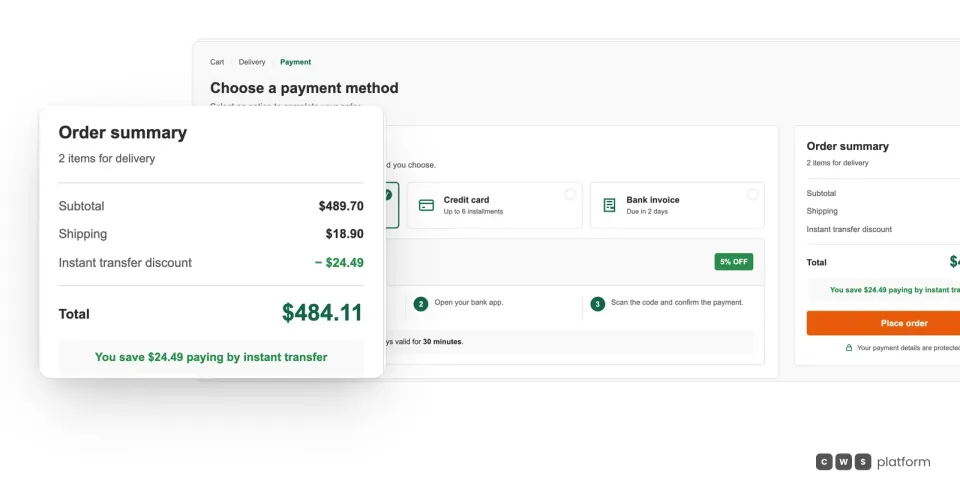
The total already reflects the payment method you choose.
In the Credit-First B2B Checkout (Checkout & Payments), each payment method shows its own terms, and the order summary already applies the chosen terms to the total: with instant transfer, the discount shows on its own line and the saving right below.
In operation
Imdepa · auto parts distribution
The buyer assembles an order of more than 250 SKUs in the B2B customer portal and the platform calculates taxes, freight and the pre-approved credit in seconds. Credit risk is validated within the flow, not checked in separate stages afterward.
Read the Imdepa case →APIs for this module
What this module does in the panel can also be done by your system. These are its groups in the public API reference.
The endpoint groups and events for this module.
Credit Limit
Endpoints to create and manage credit limit types and assign them to customers.
Webhooks and callbacks
- Tax calculation callback
Synchronous call: your ERP returns the taxes per item.
Frequently asked questions
Can you sell B2B on terms with the CWS Platform?
Yes. The Credit-First B2B Checkout (Checkout & Payments) has Net Terms 30/60/90 as a native payment method, with a credit limit validated in real time alongside stock, tax and price, in the 4-Point Checkout Validation. The credit limit works as the customer's current account, with balance and statement, and can apply per store or across the whole headquarters.
How does the order avoid advancing with the wrong credit or tax?
The 4-Point Checkout Validation checks stock, credit, tax and price at the same time before confirming. Credit validation is configurable: the store decides by rule whether an order without enough balance is blocked, sent for approval or completed as paid. Item-level tax can be calculated by the customer's ERP before the order closes. The delinquent and blocked tags come from the ERP in real time.
Does it work for agribusiness with Barter?
Yes. The Agro Commerce Suite treats grain as a payment method (Barter), with CIF and inverted FOB and fractional delivery by property.