Shipping & Fulfillment (Logistics Engine)
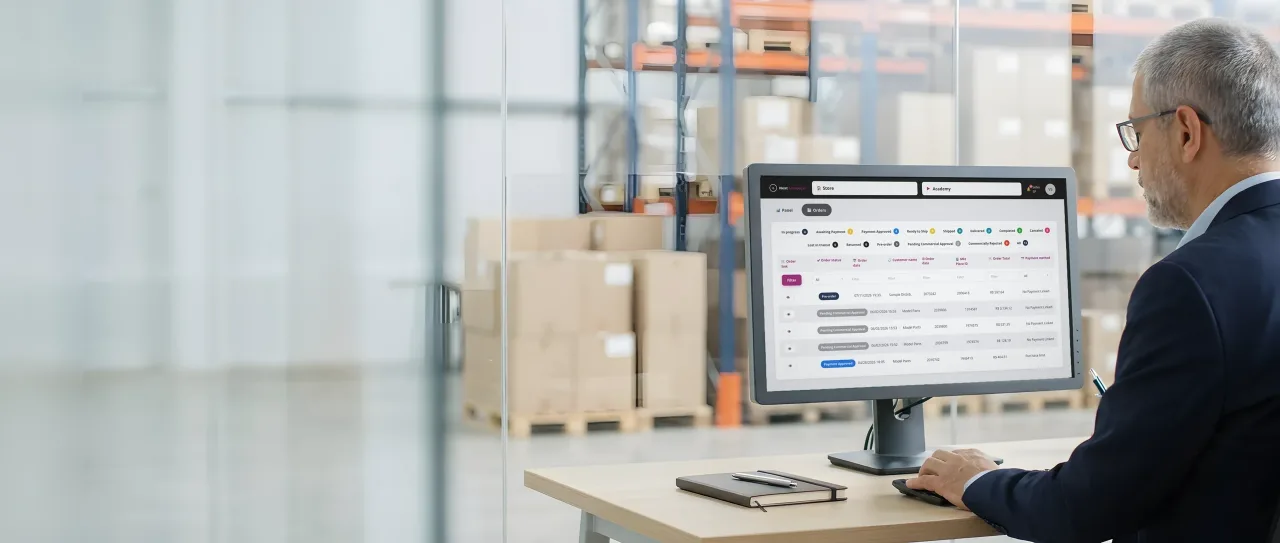
Management · Sales director
Orders ready to ship, shipped and delivered, in one panel.
Each order shows where it stands in delivery, and operations filters by status, customer or payment method without asking the shipping team.
Illustrative scene with a real CWS Platform screen in a demo version. People, stores and on-screen data are fictitious.

In the sales session · B2B sales rep
In the customer's checkout, each store's delivery with its own preparation time.
The sales rep closes on the customer's behalf, checks the address and the order's deliveries and can split them when the customer needs it.
Illustrative scene with a real CWS Platform screen in a demo version. People, stores and on-screen data are fictitious.

On the portal · Reseller buyer
On the tire page, delivery or pickup, and the stores where it can be picked up.
Each pickup address is tied to a warehouse, so the option only shows where the item is.
Illustrative scene with a real CWS Platform screen in a demo version. People, stores and on-screen data are fictitious.

At the workshop · Technician
The part shows the branch's stock and who sells and delivers it.
With the store chosen, freight is calculated from the origin warehouse's address, and the technician knows where the part comes from before buying.
Illustrative scene with a real CWS Platform screen in a demo version. People, stores and on-screen data are fictitious.
Deterministic module
The margin the pricing policy protects usually leaks later, in freight. Quotes made outside the order, freight discounts with no approval threshold and delivery dates promised by feel turn fulfillment into the blind spot of the negotiation — precisely where the customer judges the service hardest.
What it is
The module that answers how the item leaves and how it arrives. It orchestrates the logistics of a multi-warehouse operation: it splits the cart by distribution center, derives freight pricing from the origin warehouse and the regional rule, and carries the result into the order itself, alongside tax and credit. Where the Distributed Inventory (Inventory Hub) says where the item is, this is where it is decided how it travels and what that costs. It is also where you define where each item can be sold: blocking a SKU, manufacturer or category by postal code or city, the service area of each marketplace store by postal code range, and the states served, set separately for business and individual buyers.
The capability nobody replicates
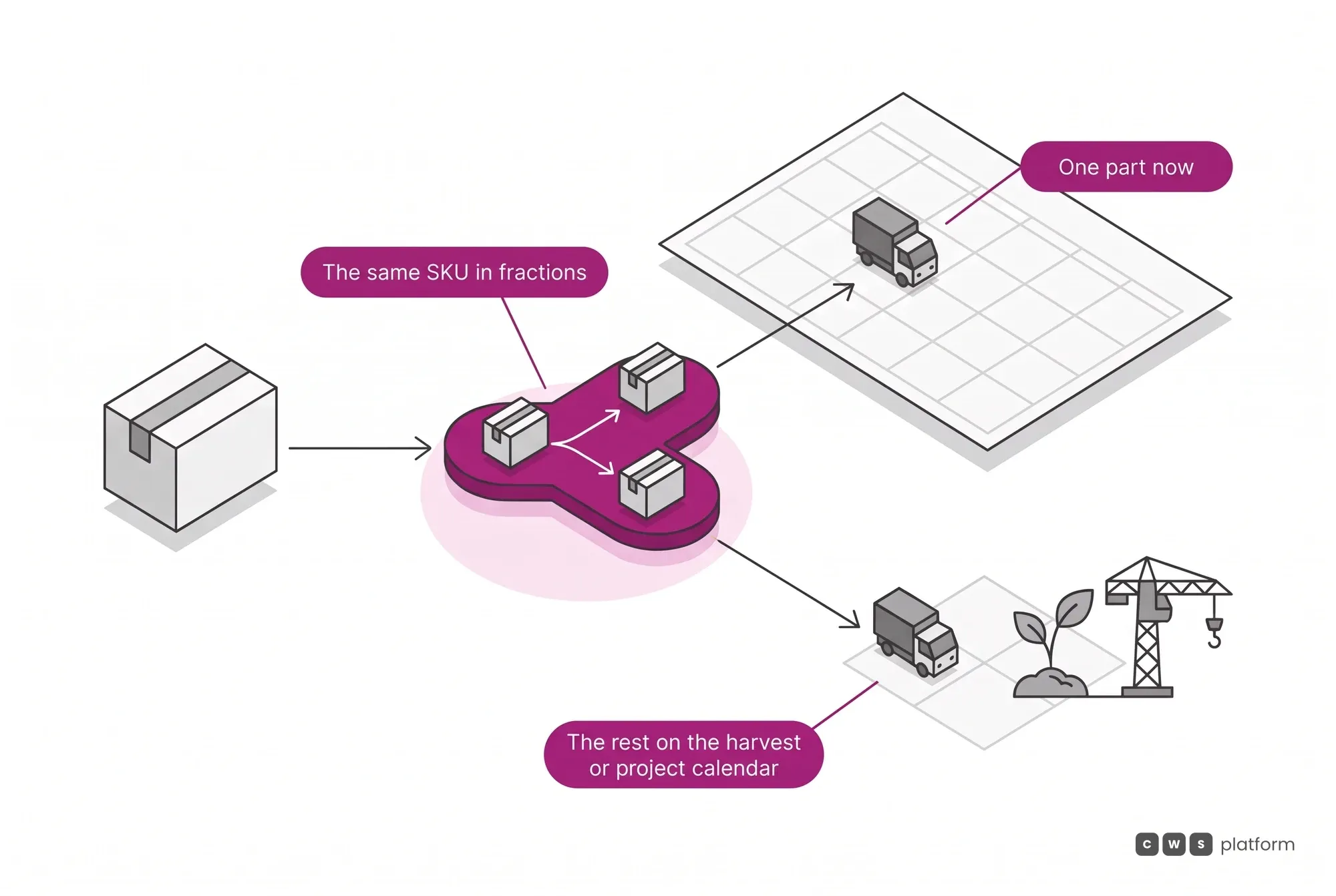
Split delivery per SKU unit
The same SKU can ship on different dates, by different methods, to different addresses, with freight and tax computed independently for each split.
And how is each split tracked?
It is what lets input delivery match the harvest calendar or a construction schedule, without breaking the order into several. Each split becomes a child order with its own status, tracked separately through delivery, and the minimum freight value is checked split by split.
A freight threshold separate from the price threshold
Freight Negotiation Thresholds govern freight concessions as their own parameter, under the Commerce Rules Engine (CDL Workspace).
Why keep it apart from price?
The market habit is to treat freight as a free field once the discount is approved, and that is where the margin walks out. Here the rep has one limit up to which they grant a freight discount alone and another above which the change is blocked, as an amount or a percentage of the order's total freight.

Persona · Operations director
I no longer quote freight in a side spreadsheet: it comes by rule, inside the order.
Logistics Engine splits the cart by distribution center and derives freight from the origin warehouse, with a freight approval threshold of its own.

Persona · Construction buyer
I get one part now and schedule the rest around the build, all in one order.
In Logistics Engine, split delivery ships the same item on different dates or to different addresses, with freight and tax per split, without breaking up the order.
Who carries it, and who you choose
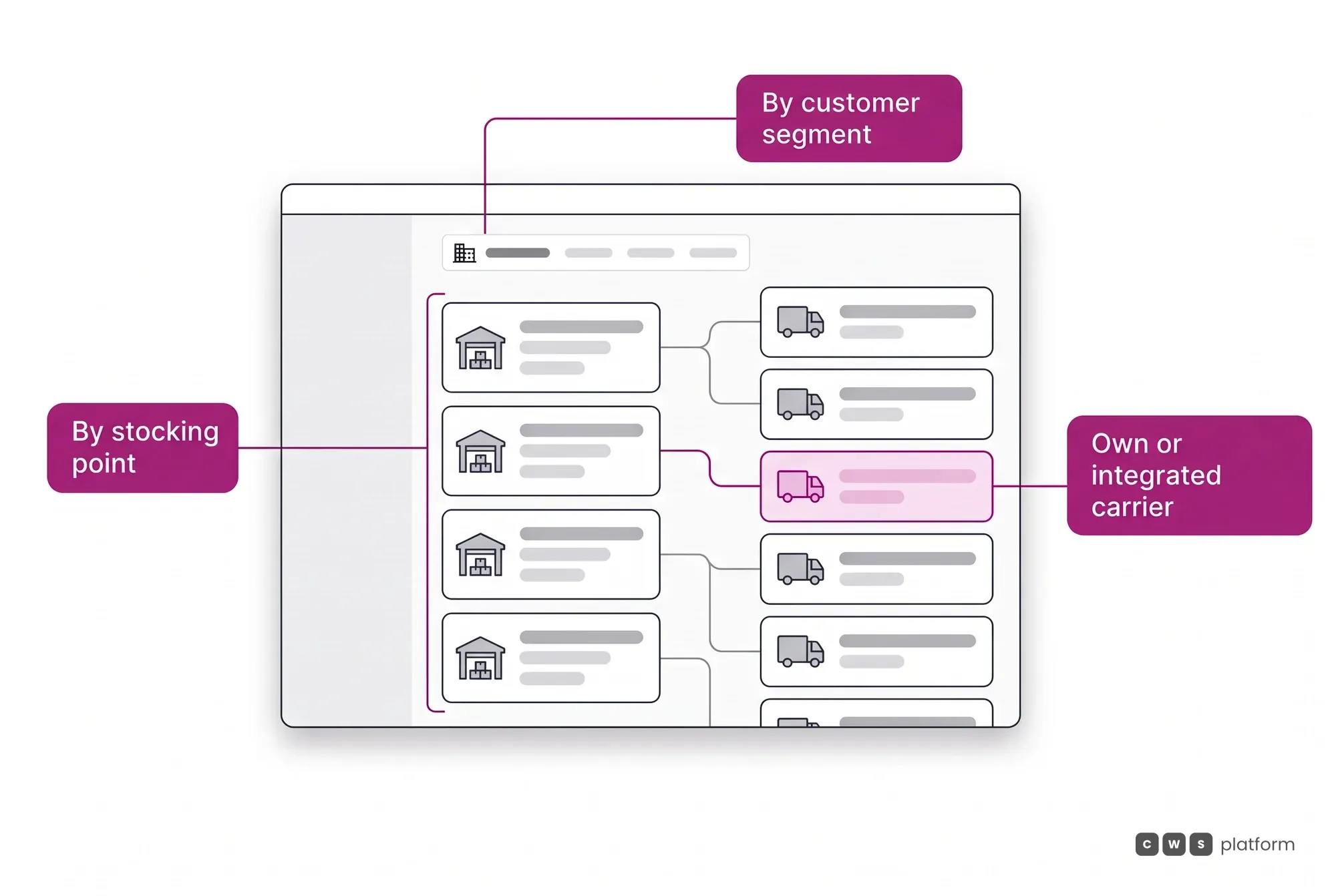
The network is not imposed. You connect the available freight integrators, register your own or a third-party carrier with specific conditions, and set that per stocking point, per customer segment and per warehouse. Each carrier can be shown only to the customer, only to the sales rep, only to the buyer or to everyone, so a pickup reserved for the sales rep never shows up in the customer portal. CIF and FOB are native and can be set up in several ways: shipping lead times in the stock spreadsheet, delivery modes and pricing, and combined pricing, logistics and payment rules. Scheduling, dispatch time and tracking codes follow the choice, and tracking, through the direct Correios integration, another integrated carrier or a link to your own system in the tracking field, is the condition for the order to show as shipped in order management.
Freight integrations
Frenet, Intelipost and Correios, plus the option of configuring your own carrier per stocking point, with the freight table loaded by spreadsheet per carrier and warehouse, as a fixed amount or a percentage of the order.
And the freight auction?
There is also the freight auction: carriers bid within 24 hours, the customer picks the offer and only then pays, and on a multi-seller order each part gets its own auction.
Delivery modes
In operation
A distributor with distribution centers in several states quotes freight by regional rule, weight and order value, not in a side spreadsheet. The buyer assembles a cart drawing on three different centers, sees the cost of each part with the correct tax for its origin, chooses to receive one split now and schedule the rest in a window that respects the carrier's and the warehouse's delivery capacity, with freight pricing varying by period when the store sets it that way, and the sales rep grants the freight discount their threshold allows, on the record. The order closes with price, date and responsibility settled on the same screen.
And what does this have to do with the AI Agents?
It is the same argument as the other negotiable dimensions: delivery stops being a conversation and becomes an executable parameter, identical for the human sales rep and for the AI Agents.
Store pickup
By ZIP code, the buyer sees the stores, the distance and the pickup price.
In Shipping & Fulfillment (Logistics Engine), each pickup address is linked to a warehouse. On the product page, the pickup modal searches by ZIP code and lists the stores that carry the item, with each one's distance and price.
Frequently asked questions
A cart with items from different warehouses becomes how many freight charges?
As many as there are distribution centers involved. The cart is split automatically by center, freight pricing stays tied to the origin warehouse of each part, and the origin postal code is what drives the tax calculation for that split. The buyer still sees a single order.
Can the customer pick up at a store instead of having it delivered?
Yes, and pickup is configured store by store. Each point defines opening hours, available days, maximum distance from the buyer's postal code and the warehouse it is tied to, and the platform prioritizes points in the order you set. Delivery mode is a parameter, not a development project.
Can the sales rep grant a freight discount during the negotiation?
Yes, within the Freight Negotiation Thresholds. Freight has its own approval threshold, separate from the price threshold, because governing product discounts well while leaving freight open turns freight into the exit door for the margin the pricing policy just protected. The threshold can be set as an amount or a percentage and applies to the sum of the order's freight discounts: up to the first limit the rep grants it alone, between the first and the second the order goes to approval with a recorded reason, and above the second the change is blocked.