B2B pricing engine: Contextual Pricing (Pricing Engine)

Management · Operations director
Every price rule with its own priority, by role, customer and price table.
Rules are layers with a priority, written once in the panel. The price the portal and the sales rep show is the one the rule decides, with no manual recalculation.
Illustrative scene with a real CWS Platform screen in a demo version. People, stores and on-screen data are fictitious.

On the portal · Shop owner
The shop owner browses the catalog and already sees her own price, not the list price.
The price type comes with the login: every item in the list already shows the price derived for her account, next to the list price.
Illustrative scene with a real CWS Platform screen in a demo version. People, stores and on-screen data are fictitious.

At the workshop · Technician
The same part from two distributors, each with its own price and terms.
In a governed marketplace, every store's offer comes out of the same pricing engine, under each distributor's rule, and the technician chooses without calling anyone.
Illustrative scene with a real CWS Platform screen in a demo version. People, stores and on-screen data are fictitious.

On the portal · Buyer at an auto parts chain
Each item's tax, calculated by the branch that serves her company.
The tax rule is one of the price variables: ICMS ST, IPI and the rest are in before closing, and the price shown is already the price that closes.
Illustrative scene with a real CWS Platform screen in a demo version. People, stores and on-screen data are fictitious.
Deterministic module
Your revenue grows and margin disappears, eroded by stacked discounts and by a price table that keeps up with neither contract nor region. Contextual Pricing is the B2B pricing engine that treats price as the starting point of the negotiation, not as a fixed value, and protects margin by architecture.
In short
A B2B pricing engine calculates the price of each order from its context instead of reading a fixed list. On CWS Platform that is Contextual Pricing (Pricing Engine): it derives the price from product, source warehouse, customer profile and tax rule in milliseconds, and blocks stacked discounts by architecture, with configurable locks and a mandatory Reason Code when a concession goes to approval.
- Configurable locks keep discount, contract, price and coupon from going past the limits you set. Source: Discount Stacking Prevention in the glossary.
- Reps negotiate from that price without leaving their approval limits. Source: sales rep software (Sales Hub).
- In a governed marketplace, every store's offer is priced by the same engine. Source: B2B marketplace platform.
- Tracbel recorded around US$24.4 million in digital revenue in 2025, with margin rising alongside catalog discovery. Source: Tracbel case.
Figures converted from Brazilian reais at R$5.00 = US$1.00.
Per-account pricing without a side spreadsheet is the first criterion in the guide to choosing a B2B ecommerce platform. On the challenge page, price list management shows that criterion at work, from the rule to the order.
What it is
The engine that derives the price in milliseconds from multiple variables at once: the product, the source warehouse, the customer profile and the tax rule. Price types by identity apply wholesale or retail automatically at login, with support for future price lists, temporal validity and the best automatic coupon. In agribusiness, price is indexed to a commodity with a validity of minutes. It is where a company's B2B pricing strategy becomes pricing governance enforced on every order, with clear precedence: the contract applies above the rule, and the rule above the store's standard price.
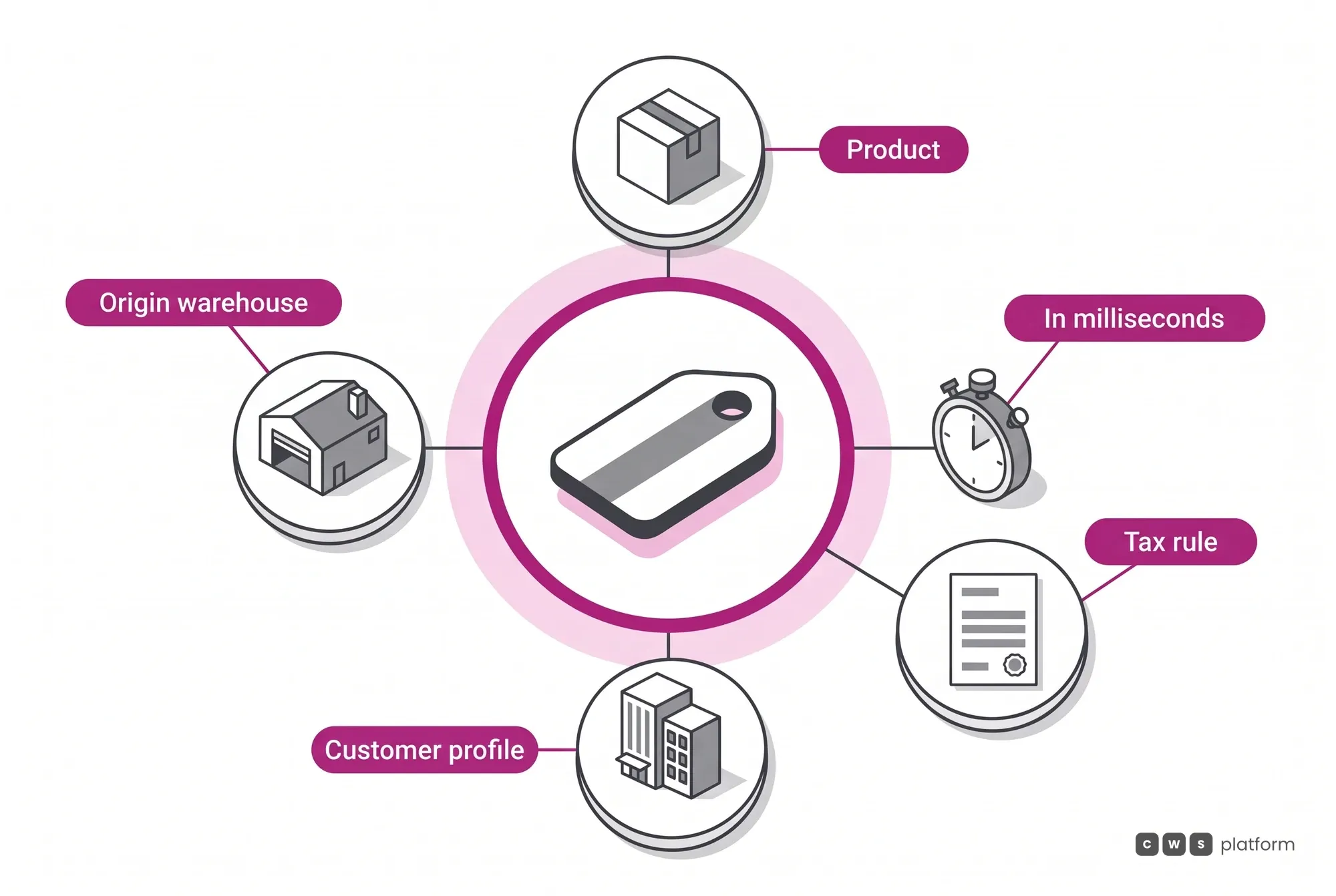
The pricing engine in 1 minute
A single source of truth for the value is impossible. For the rule, it isn't.
Good data engineering says the same fact shouldn't diverge across systems. That's right. But a B2B price isn't a fact the way a tax ID is a fact.
A part shipping from a California warehouse into California doesn't cost what it costs shipping to New York, because freight lands inside the delivered cost. Different prices for the same SKU, all of them correct, at the same moment. Volume, terms, payment method and contract each move the result again.
A B2B price is the output of a function, not a stored value. Companies that insist on storing one end up flattening the table, and pay for it on every sale that would have accepted more. What must be single is the place that records who can charge what, to whom, shipping from where, on what terms — and that place is the Commerce Rules Engine (CDL Workspace).
The capability no one replicates
Discount Stacking Prevention
Configurable locks keep discount, contract, price and coupon from going past the limits you set, and one of the possible settings is having the sales rep's manual discount automatically cancel the coupons. Margin is protected by architecture and not by auditing afterward, with a mandatory Reason Code when a concession goes to approval.
Price is negotiable, not fixed
The price moves within Approval Workflows. No one treats stacking prevention as an architectural concept; in the market, B2B usually uses fixed tables per organization, with no native authority limits.
It governs the dimension that pays the bill
It operates under the Commerce Rules Engine (CDL Workspace): every pricing rule applies the same to the human sales rep in guided selling and to the AI Agents.
The dimensions price resolves at once8
This is not a cascade of rules applied in sequence. The dimensions are processed simultaneously, and the result is a single price, the same one for the portal and for the seller.
- By customer
- Price types tied to the profile. A reseller tax ID reaches the wholesale table, an individual sees the retail price, and the switch happens at login.
- By region
- The origin postcode determines the tax calculation, so the same item carries a different price depending on the state it is invoiced from.
- By warehouse
- The origin of the stock defines the price. The logistics cost and the tax rule of the distribution center enter the calculation, not a step after it.
- By seller
- In a marketplace, each seller prices over the shared catalog, under the central governance of the Marketplace Management Platform.
- By contract
- Price lists with controlled validity, with a start and an expiry date. The negotiated agreement applies on its own within the agreed window.
- By category and manufacturer
- Price tags segment by catalog attribute, which allows a dedicated condition for one manufacturer's line without creating a new table.
- By cluster and account base
- Commercial groups configured in the Commerce Rules Engine, such as reseller or rural producer, carry their own terms.
- By volume
- Progressive discounting with a progress bar, which shows the buyer how far the next tier is instead of letting them find out at the end.
Pricing that is already scheduled4
- Future price lists
- The list is loaded in advance and activates on its own on the date. In operations with harvests, seasonality or time-bound agreements, nobody needs to be awake at the turn.
- Price tags
- Configuration markers that segment by a trait of the product, the operation or the commercial context that does not fit the standard dimensions.
- Fixed and to-be-fixed pricing
- In agribusiness, the quote can be locked at closing or left open to be fixed later. These are two distinct regimes, and the engine treats each as such.
- Hidden pricing
- There are operations where price only appears to an authenticated, qualified visitor. Hiding it is a configuration, not a customization.
Pricing governance: what the engine enforces8
Margin erosion starts where nobody wrote the rule down. These are the guarantees behind margin management on every order, with no side spreadsheet.
- A price waterfall with explicit precedence
- The contract overrides the pricing rule, and contracts do not stack: when two apply to the same customer, the higher-priority one wins. Among rules, non-cumulative ones apply by priority and cumulative ones apply on top of the result. Outside the contract terms, the store's standard price applies.
- Contracts with a precise scope
- A contract fixes the SKU price for all customers or for a slice by tax ID, customer group or customer type, can be limited by marketplace, destination state and branch, has start and end date and time, and is loaded by spreadsheet or API.
- B2B tax criteria inside the rule
- A pricing rule can apply by state tax registration, ICMS taxpayer status, industry code (CNAE), product tax code (NCM), origin and destination state pair, customer and product tags and minimum quantity. Markup and margin are written into the rule, as a discount or surcharge in percentage or value.
- Discount lock at the source
- Rules and contracts can stop the sales rep from adding any further discount on the resulting price. The contract price reaches the order exactly as negotiated, which protects price realization.
- Dynamic volume pricing
- The rule kicks in when the cart reaches the item's minimum quantity and drops off if the quantity falls below it, with no one recalculating by hand.
- Headquarters and branches on one policy
- A rule created at marketplace level is replicated to the selected stores, scoped by store, category, product tag, customer group and stock, with exclusions. Branches use headquarters' customer groups without the customer list being copied or exposed to them.
- Price from the store nearest the customer
- The buyer pays the price of the store nearest the delivery address even when the order ships from the distribution center. When the address changes, the price is recalculated and the buyer is alerted.
- Season, campaign and payment date in the price
- Future price lists by harvest season or campaign set validity and a payment window, and the contract tied to them can carry its own early-payment discount rate and late-payment interest rate. Limited-time offers use the same contract setup, with was/now display.
Discount lock
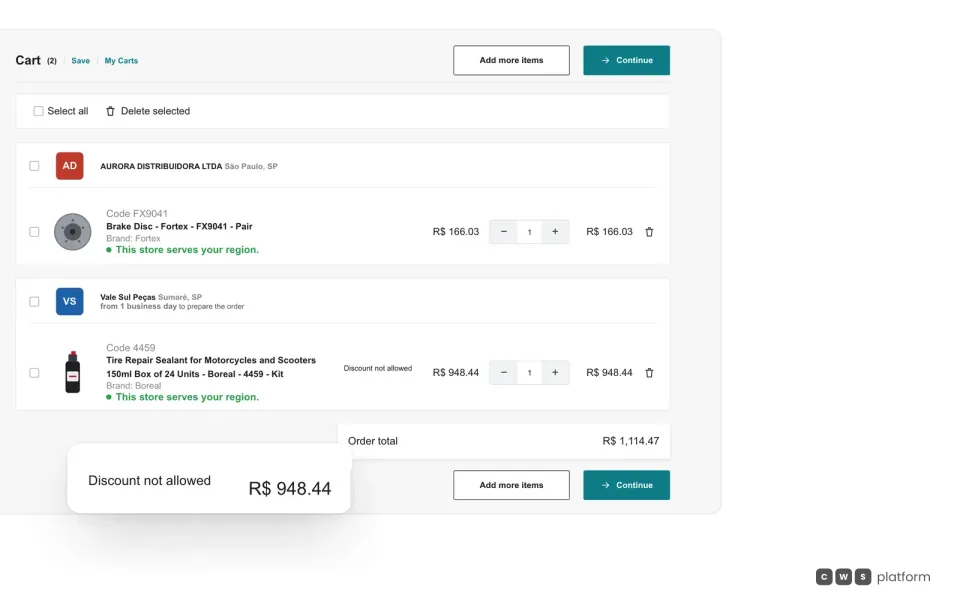
The rule that locks the discount shows on the item.
In Contextual Pricing (Pricing Engine), the price rule or the contract can block any further discount on the resulting price. The item reaches the cart with the lock in plain sight, and no one stacks a discount on top of it.
Tax belongs inside price formation
In an interstate operation, tax changes the price, not the invoice. When it is calculated afterwards, the number the buyer saw in the catalog is not the number they will pay, and the digital channel becomes a quote to be checked with a sales rep. Here the tax rule is one of the variables in the derivation, within price formation, so the price that shows up is already the price that closes. It is also why the Credit-First B2B Checkout verifies price, stock, credit and tax at the same time: the four were resolved together.
In operation
Tracbel · Volvo dealer
+10 points of margin
of operating margin on orders placed via the portal (Tracbel, named best Volvo dealer in the world, Volvo Gold 2025).
With 100% of the portfolio available, about 131,000 SKUs, the buyer began to see the entire catalog and to buy what they did not know existed. Removing the friction changed buying behavior, and margin rose along with it.
Read the Tracbel case →APIs for this module
What this module does in the panel can also be done by your system. These are its groups in the public API reference.
Contracts
Endpoints to manage fixed-price contracts for customers or customer groups.
Frequently asked questions
Is the price on the CWS Platform fixed?
No. The Contextual Pricing (Pricing Engine) generates the starting price of the negotiation, derived from product, warehouse, customer profile and tax rule. It is negotiable within Approval Workflows and protected by Discount Stacking Prevention.
How does the CWS Platform protect margin from stacked discounts?
By architecture. Discount Stacking Prevention applies configurable locks that keep discount, contract, price and coupon from going past the limits you set; one of the possible settings is having the sales rep's manual discount cancel out the automatic coupons. Pricing rules and contracts can also block any additional rep discount on the resulting price, and a Reason Code is mandatory when a concession goes to approval and when it is commercially declined, so every exception has a record and a justification.
Can the same SKU have a different price by customer and by warehouse?
Yes. The price is derived by profile (individual or company), source warehouse and tax rule in milliseconds, with no divergence between the portal and the sales rep.
What is a B2B pricing engine?
A B2B pricing engine calculates the price of each order from the context of the sale instead of reading a fixed value from a list. In B2B that context is who is buying, which warehouse ships, which tax rule applies, the volume and the terms, so the same item can have several correct prices at the same moment.
How does dynamic pricing work in B2B?
In B2B, dynamic pricing changes with the customer and the context of the sale, not just with a list updated from time to time. On CWS Platform, Contextual Pricing derives the starting price by profile, warehouse and tax rule, the rep or the buyer negotiates from it within Approval Workflows, and Discount Stacking Prevention keeps discounts from piling up unchecked.
Is Contextual Pricing a CPQ?
Not in the classic sense. CPQ is the category that configures the product, prices it and produces the quote; Contextual Pricing covers the price, the approval limits and the concession trail live in the Commerce Rules Engine, and the proposal is put together with the rep in the Assisted Selling Platform (Sales Hub). In the CRM model the equivalent means assembling CPQ, approvals and pricing rules separately; here they are born together.
What is B2B pricing?
It is the price that results from the conditions of each sale, not a single list value. In B2B, the same item has different correct prices depending on who buys, which warehouse ships it, which tax rule applies, the volume and the payment terms. On the CWS Platform, Contextual Pricing calculates that price on the order, and the same rule applies to the portal, the sales rep and the AI Agents.
What's the best way to manage B2B reseller pricing?
With rules tied to the reseller's profile instead of a side spreadsheet. On the CWS Platform, identity-based price types apply wholesale terms at login, and customer groups are rules configured in the Commerce Rules Engine. A rep's manual discount overrides automatic coupons instead of stacking on them, with a mandatory Reason Code.
What's the best contract pricing ecommerce platform for B2B?
One that treats the contract as a customer rule with a validity period, not as a document. On the CWS Platform, Contextual Pricing applies the negotiated terms on the order, with future price lists and time-bound validity, together with the source warehouse and the tax rule; any concession beyond the agreement goes through Approval Workflows with a recorded reason.

Persona · Sales director
Every customer sees their own price, and discounts stopped stacking.
Contextual Pricing (Pricing Engine) derives the price from product, warehouse, customer profile and tax rule, and configurable locks prevent stacked discounts.

Persona · Reseller buyer
The price I see in the catalog is already the price that closes, with nothing to check later.
In Contextual Pricing (Pricing Engine), the tax rule is part of price formation, and the digital channel stops being a quote to be checked.