Portals · new ecosystem revenue
Your network's attention and data are worth money to the people who sell to it
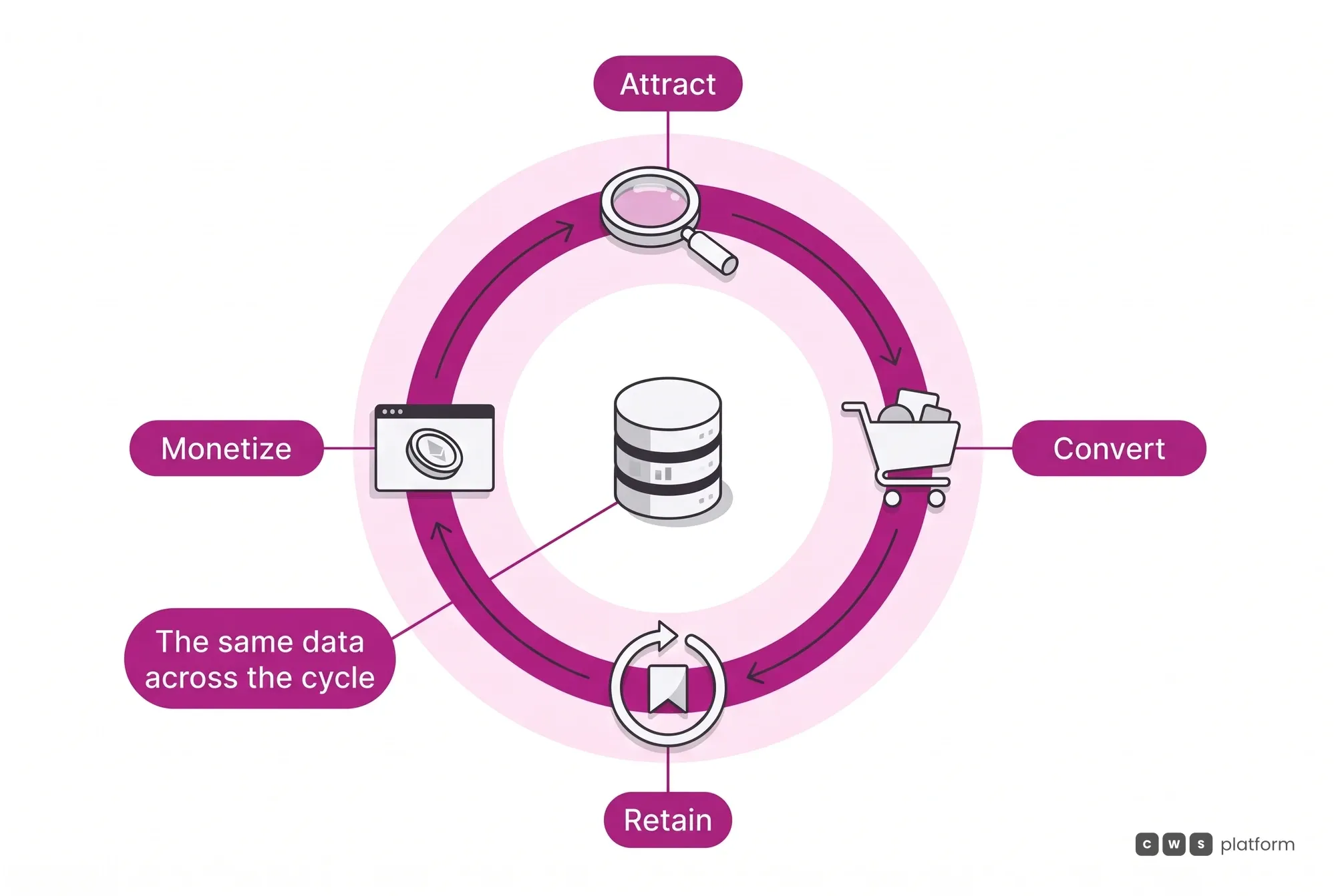
When the network buys on one portal, suppliers and manufacturers start paying for two things: reaching every store and understanding what they buy. It is new revenue for the network owner, helping fund the ecosystem's operation, as long as the buying rule and privacy law stay intact.
Why this doesn't happen today
Campaigns cost a lot before they sell
Negotiating funds, pushing the rule to every store and reconciling in spreadsheets weeks later kills the small, targeted campaign.
Suppliers can't reach the network
To reach every store, they depend on visits, printed catalogs and the rep who remembers to pitch the new line.
The network's data is scattered
Each store buys through a different channel, and no one can tell suppliers what the network looks for, buys and stops buying.
Revenue 1
Media: suppliers pay to reach the network
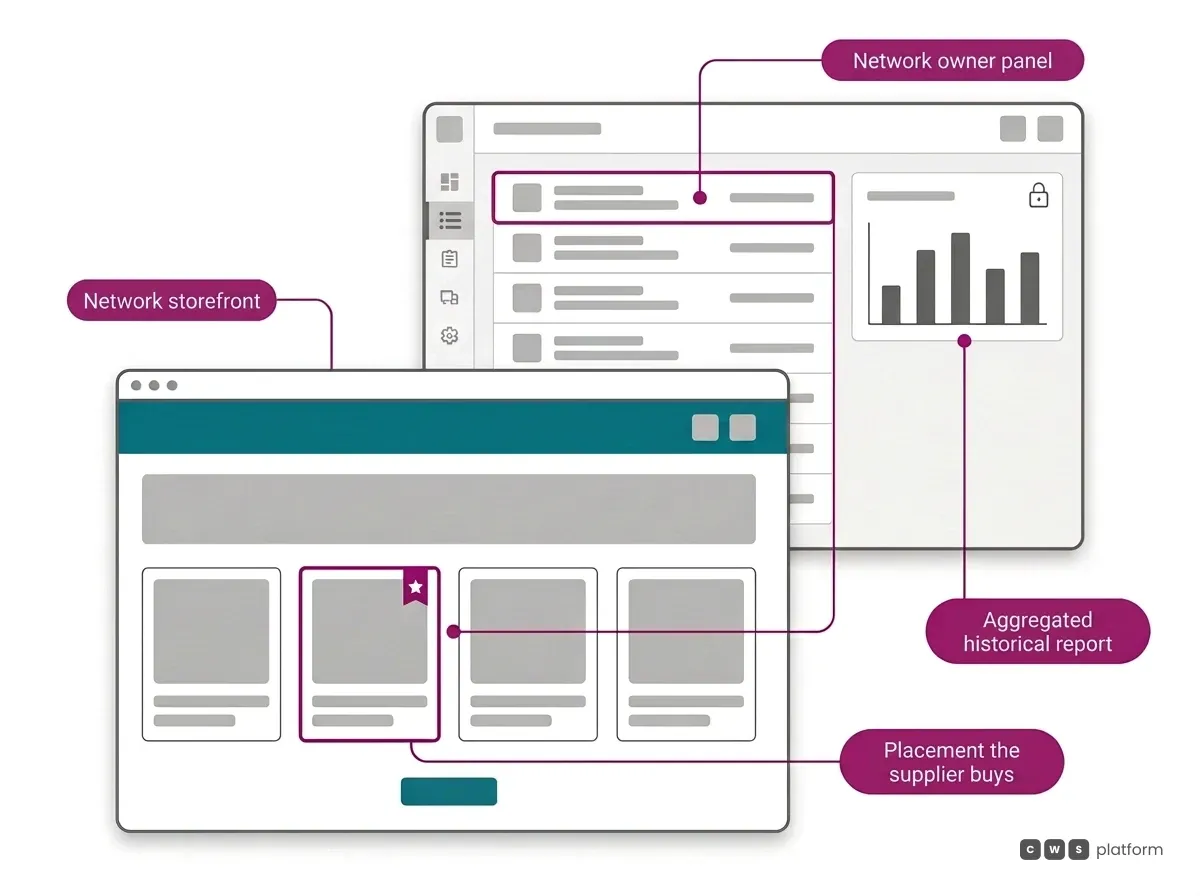
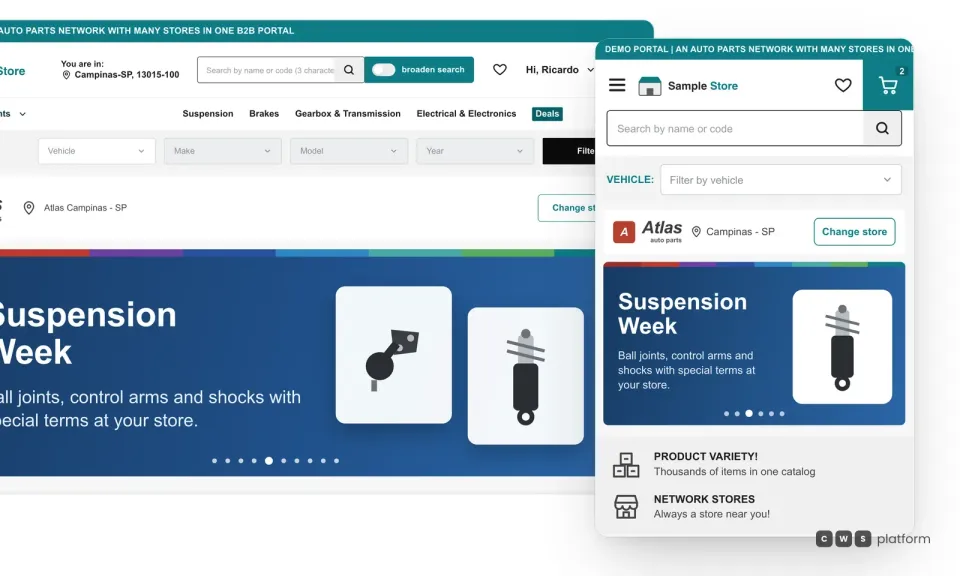
The network portal concentrates buyers' attention, every store, every day. Formats vary by product type and stock position: sponsored products for a launch, a campaign page for a new line, a banner for a group of stores, a clearance spot for slow movers. In the No-Code Storefront Builder (CMS Builder), the portal's home has a sponsored-products carousel; in the Merchandising & Promotion Engine (Marketing Suite), banners and coupons can apply to a single customer group.
One rule protects the network's trust: placements buy visibility, and the main offer still comes from the Marketplace Management Platform (Marketplace Center) rule, by lowest price or nearest store. Sponsorship buys the shelf, not the order.
Media space
The supplier's campaign goes to the top of the network portal.
The top banner is set up in the portal, on desktop and mobile, and can apply only to the group of stores the campaign wants to reach. The supplier pays for the shelf; the network owner decides where it goes.
Joint campaigns become routine
With the campaign set up as a rule (store group, coupon, price, period), the cost of running it drops to the point where a small campaign pays off. A manufacturer and the supplier of a complementary item run a campaign just for one region's stores, for two weeks, with no spreadsheet sent store by store.
Simultaneous promotions by branch, by store or for the whole portal run in the same module, and each logged-in store sees its own group's campaigns.

Persona · Supplier, marketplace seller
I reach the whole network when I launch a new line.
The placement is paid, but the offer that wins the order is still the one the network's rule picks.

Persona · Marketing director, retail chain
A joint campaign with a supplier is no longer a weeks-long project.
Coupons, banners and store groups are set up in the network portal, with no IT ticket.
Revenue 2
Data: subscription reports for suppliers and manufacturers
The data the network generates by buying on the portal becomes a product, sold by the network owner as small monthly subscriptions. The raw material is what operations already record: order, item, supplier, region and, in a fitment catalog, the vehicle or machine. CWS Platform keeps this data structured and delivers it through the API to the BI of whoever builds the report.
Historical average price
By region and product family, always aggregated and for a closed period.
Stockouts
What the network looks for and doesn't find on the portal, by category and region.
Brand share
Each brand's weight within its category, without identifying stores.
Demand by application
By vehicle, machine or crop, so suppliers can plan lines and stock.
Privacy and antitrust: the rules that aren't negotiable
- Aggregated and anonymized. No report ever identifies a person, a store or an individual supplier. Anonymized data is not personal data under Brazil's LGPD, unless the anonymization can be reversed (art. 12).
- An explicit contractual basis. The contract with the network's stores and suppliers says what is shared, with whom and why.
- Prices only historical and aggregated. Following the 2009 SDE and CADE primer on cartels in unions and associations, no report carries current or future prices, live price lists or planned increases.
The same revenue, in different industries
Illustrative examples, not customer data.
Auto parts
A filter manufacturer sponsors the maintenance category on a repair-shop network's portal during a line launch, and subscribes to the demand-by-vehicle report.
Agribusiness
A seed company features its hybrids to a co-op's dealers at the start of the season, and follows historical input prices by region.
Building materials
A tile manufacturer buys placement for a buying group's stores in the regions where it has stock, and subscribes to the stockout-by-category report.
Want to design your network's new revenue?
Tell us how many suppliers sell to your network and what they ask for most, and a specialist shows the media and data formats that fit your operation.
Frequently asked questions
What is retail media on a network portal?
It is the placement suppliers and manufacturers buy to reach the network's stores: sponsored products, a banner for a group of stores, a campaign page. It is the logic of retail media networks, applied to a network that buys B2B.
Does sponsorship change which offer wins the order?
It shouldn't, and on CWS Platform they are separate settings. A placement buys visibility; the main offer still comes from the network's rule, by lowest price or nearest store. If sponsorship bought the order, the network's savings would turn into media revenue and the network would stop trusting the portal.
Is selling network data allowed under privacy law?
Anonymized data is not personal data under Brazil's LGPD, unless the anonymization can be reversed (art. 12). Even so, the contract with stores and suppliers has to say what is shared, with whom and why, and no report may identify an individual store or supplier.
Can I sell price reports to suppliers?
Only historical, aggregated prices. Antitrust guidance for trade associations, such as the 2009 primer from Brazil's SDE and CADE on cartels in unions and associations, warns against sharing current or future prices among competitors. This month's prices, live price lists or planned increases stay out of every report.
Go deeper
- Network purchasing portal: the network buying together, the base for both revenues.
- Merchandising & Promotion Engine (Marketing Suite): campaigns, coupons and banners by group.
- Marketplace Management Platform (Marketplace Center): the rule that picks the main offer.
- Governed marketplace: who sells, what they list and how offers compete.
Design your network's new revenue
Tell us a bit about your operation and a CWS Platform specialist will reach out within one business day, no strings attached.