B2B Marketplace with Sellers: SAP Commerce Cloud vs. CWS Platform
Architectural comparison for multi-vendor operations balancing catalog governance, trade credit, and complex pricing.

Editorial note: architectural comparison between SAP Commerce Cloud and CWS Platform in a multi-seller B2B marketplace scenario. Every fact regarding SAP Commerce Cloud is drawn directly from its public documentation, with the corresponding reference provided.
Operating a B2B marketplace brings together multiple suppliers, manufacturers, and distributors within a unified transactional channel designed for business buyers, dealers, and corporate accounts. The complexity of this model goes beyond simply listing products on a shared storefront. It requires preserving the commercial autonomy of each independent seller while the marketplace operator maintains strict fiscal, financial, and logistical governance over the entire ecosystem. When evaluating platforms for this journey, executives such as the VP of Commerce, CEO, and CFO weigh fundamentally different architectural approaches, contrasting architectures like SAP Commerce Cloud with CWS Platform.
The central friction point lies in orchestrating customized contract pricing, distributed inventory across multiple warehouses, trade credit terms, and split settlements within a single checkout. When an underlying commerce engine treats transactional business rules as static database records, the operator is inevitably forced into manual reconciliation or continuous conflict between external channel partners and internal sales teams.
The architectural foundation determines whether the B2B marketplace scales sustainably or generates compounding operational costs with every new seller brought into the network.
The Scenario: Multi-Seller B2B Marketplace with Centralized Governance
In a multi-seller B2B marketplace model, the operator acts as an orchestrator across an extended supply chain where industrial manufacturers, master distributors, and regional wholesalers sell raw materials, components, or finished goods directly to commercial buyers, corporate accounts, or repair centers. Each vendor operates under distinct sales tax liabilities, localized margin strategies, designated payment terms, and inventory distributed across physical warehouses across the country. For the commercial buyer, the portal must deliver modern digital procurement convenience, enterprise-wide search, and reliable fulfillment commitments.
For the VP of Commerce, the core challenge is delivering a frictionless customer journey without restricting the autonomy of registered sellers. The CEO must ensure that expanding the catalog assortment does not undermine relationships with traditional dealer networks or trigger destructive channel conflict. Meanwhile, the CFO monitors the precision of split-payment processing, real-time credit underwriting to mitigate financial risk, and full compliance with state and local tax regulations across multi-location shipments.
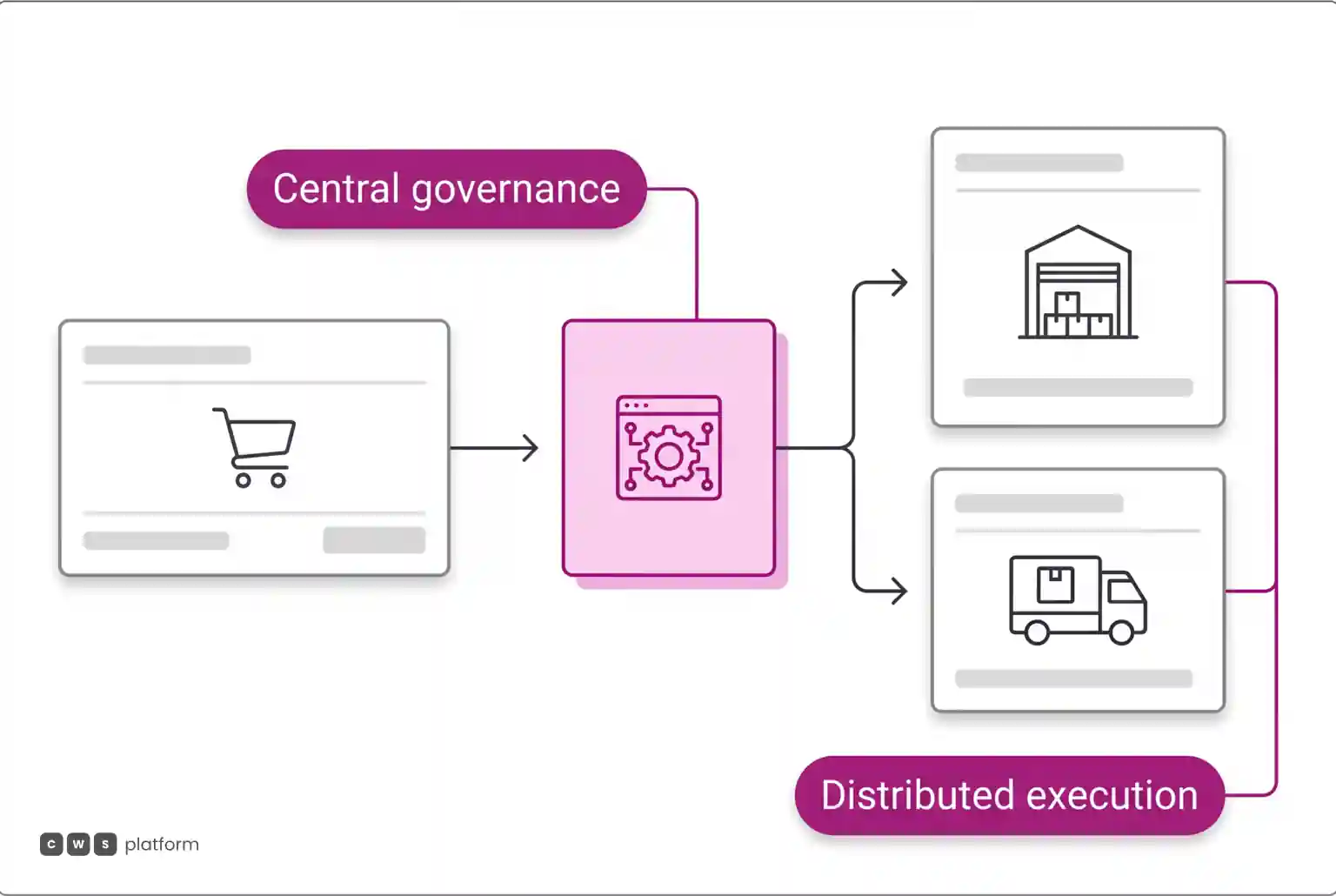
The long-term viability of the marketplace depends on balancing decentralized execution at the edge with centralized transactional governance at the core.
The Six Non-Negotiable Decisions Forced by This Scenario
Structuring an enterprise multi-seller marketplace demands explicit architectural decisions across six mission-critical business areas:
1. Who controls individual seller pricing. The platform must evaluate dynamic pricing matrices based on origin warehouse, destination sales tax nexus, buyer corporate profile, volume thresholds, and pre-negotiated master contracts. If a platform forces a single static price sheet, it effectively blocks sellers operating on tight margins and volatile regional freight costs.
2. How the operator bills and disburses funds. The settlement engine must split order value, calculate operator commissions, and define vendor disbursements precisely at checkout. Relegating split payments to post-order offline spreadsheets inflates administrative overhead and leads to vendor disputes.
3. Who underwrites buyer trade credit. Offering net terms requires verifying buyer corporate credit lines at checkout, establishing whether credit risk rests with the individual vendor, the marketplace operator, or a third-party trade credit provider. Lacking synchronous credit authorization exposes the operator to runaway credit limits and bad debt.
4. Whose inventory the buyer actually sees. Real-time catalog availability must mirror current stock levels across geographically distributed fulfillment centers, eliminating reliance on stale batch imports. Displaying inaccurate inventory leads to commercial backorders, cancellations, and damaged buyer trust.
5. How multi-seller catalogs unify into a single view. Organizing multi-vendor catalogs requires consolidating matching items under a unified master record while running clean buybox logic based on land-cost pricing, geographic proximity, and fulfillment SLA. Uncontrolled duplicate listings fragment the catalog, degrading search for technical SKUs.
6. How direct channels coexist with the seller network. Running a direct corporate sales channel alongside an external vendor network requires clear account-locking rules and transparent transaction ownership. Without system safeguards that protect internal field reps and regional distributors, the marketplace will cannibalize existing distribution channels.
The Operational Bottlenecks: In the Words of Teams on the Ground
Day-to-day operations among industrial distributors and B2B sellers reveal clear practical friction points:
"Every commercial account has custom contract pricing. Our platform cannot handle that on the web."
"Buyers build massive orders only to abandon the cart at checkout because net 30 invoice billing is not supported."
"A customer places an order, we are out of stock, and they turn to a competitor. Our supplier had stock ready to ship, but our portal had no way to route the order."
"The exact same item shows three different prices: our B2B customer portal, our direct digital storefront, and third-party enterprise marketplaces."
Where SAP Commerce Cloud Fits Best in This Scenario
For enterprise marketplaces, SAP offers SAP Commerce Marketplace Management, an enterprise SaaS extension powered by the third-party Mirakl application integrated with SAP Commerce Cloud through SAP-certified APIs and interfaces (SAP and Mirakl Marketplace Management). In this configuration, SAP documents automated vendor onboarding workflows with standardized acceptance or rejection rules, drag-and-drop catalog taxonomy mapping, and automated SLA enforcement that hides vendor inventory if performance drops below defined thresholds. At checkout, it handles order splitting, in-store pickup routing, and granular multi-vendor pricing and payments tailored for enterprise B2B workflows (SAP Commerce Marketplace Management).
SAP Commerce Cloud operates as a modular platform deployed on public cloud infrastructure (version 2211), as detailed in the SAP Commerce Cloud Public Cloud documentation. Its technical architecture is built on extensions that encapsulate underlying business logic, custom data models, and Backoffice customizations, alongside AddOns that inject UI components into the presentation tier. Data and transactional services are exposed through RESTful APIs via Omni Commerce Connect (OCC), as outlined in the SAP Commerce Cloud architecture documentation.
For the presentation layer, the platform provides the SAP Commerce Cloud composable storefront, an open-source Angular web application detailed in the Composable Storefront documentation. This decoupled storefront communicates with the core system via the Commerce REST API, allowing engineering teams to build and deploy front-end modifications independently through standard CI/CD pipelines whenever back-end services remain unchanged, as covered in the Composable Storefront build guide.
Deep back-end integration with SAP S/4HANA or legacy SAP ERP environments is supported by SAP Cloud Integration and official integration packages, as documented in the SAP Commerce Integration with ERP portal. This integration pattern relies on standard extensions like odata2webservices and integrationbackoffice within the localextensions.xml file to ingest price conditions and discounts via OData adapters at the InboundPriceRow and InboundDiscountRow endpoints. For enterprise order orchestration and inventory allocation, advanced sourcing modules can be attached, as documented in the SAP Order Management integration guide.
In the transaction flow, the Open Payment Framework supports standardized authorization, capture, refund, and reauthorization capabilities with low-code configuration options for third-party payment service providers (SAP Commerce Cloud payments and promotions). Catalog pricing can run synchronously against back-end systems or via delta replication, configured in the administrative cockpit, as detailed in the SAP pricing replication documentation.
How CWS Platform Is Built: Distributed Governance and Commercial Execution in the Same Core
CWS Platform supports shared multi-seller ecosystems natively through its Marketplace Management Platform (Marketplace Center), which unifies seller onboarding, buybox orchestration, and the coexistence of first-party and third-party catalogs. In a multi-vendor B2B procurement portal, the primary operational building block is the individual warehouse or fulfillment node. Each stocking point maintains dedicated freight tables and lead times, price rules can be scoped per fulfillment location, and independent sellers configure payment terms within the operator's central compliance rules.
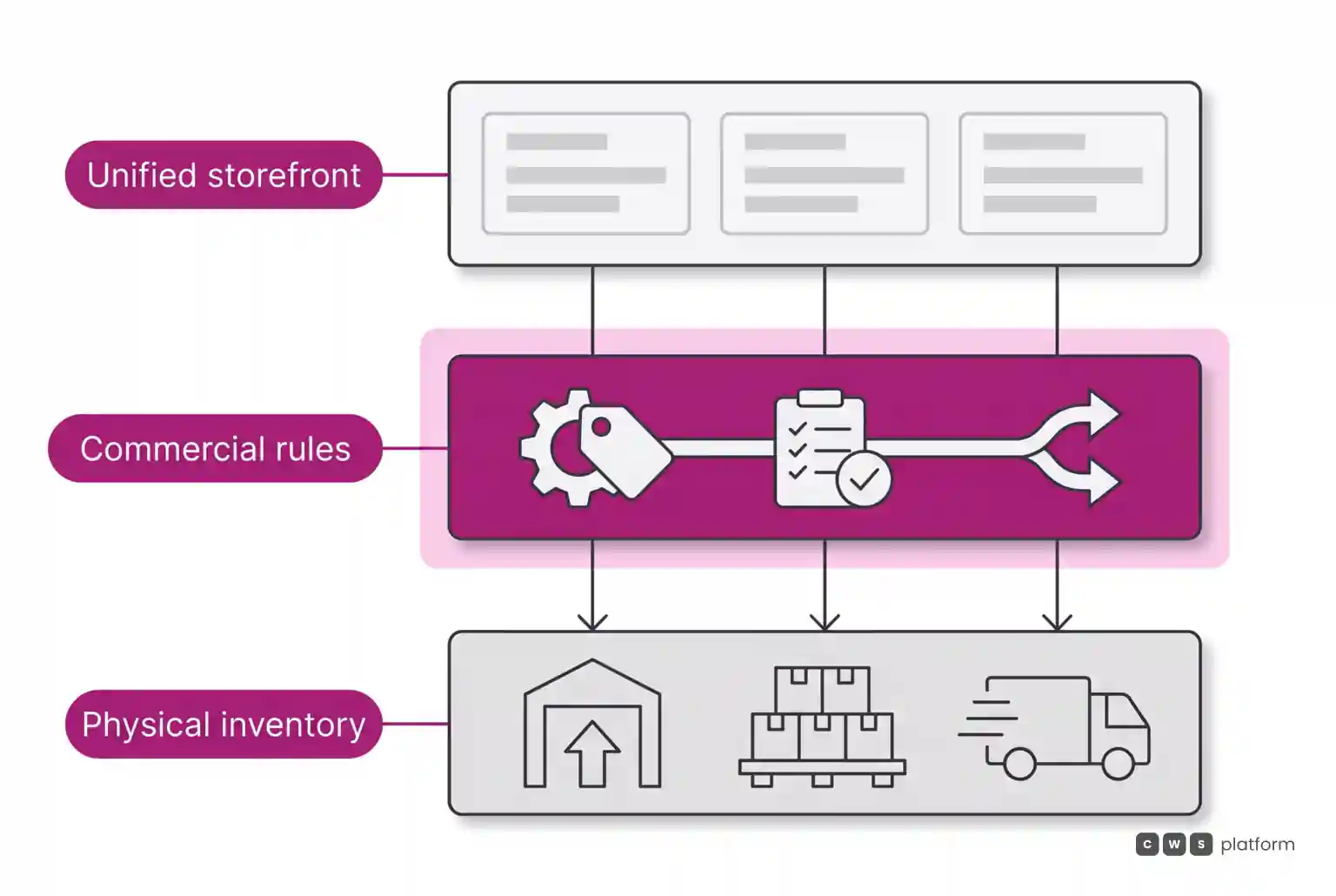
To resolve pricing discrepancies across participants, the Contextual Pricing (Pricing Engine) calculates the net price for every SKU in real time using a deterministic evaluation hierarchy: pre-negotiated customer contract terms override contextual rules, which in turn override baseline price books. Contextual pricing rules can evaluate tax origin/destination jurisdictions, product tax codes (such as UNSPSC or custom classification codes), and buyer business categories, while corporate contracts can be scoped to specific channels, states, or client operating divisions. When multiple suppliers offer identical SKUs, the Marketplace Center applies buybox logic to surface the winning offer based on lowest net price or shortest geographic transit distance, while presenting alternative vendor offers in a secondary comparison drawer.
Multi-party payment routing and enterprise invoicing are driven natively by the Credit-First B2B Checkout (Checkout & Payments). Gross order value splits across participating sellers according to agreed operator agreements, supporting flat platform fees by fulfillment model or category-specific take rates. The platform handles B2B trade credit as an integrated balance linked to the corporate account, supporting net terms. When sufficient credit is available, orders approve instantly; if an order exceeds the credit line, platform rules determine whether it routes for credit team approval. In multi-seller carts, vendors maintain payment method options within the operator's framework, and a single checkout can split funding across credit lines, ACH transfers, and corporate purchasing cards.
Multi-origin logistics are orchestrated by the Shipping & Fulfillment (Logistics Engine), splitting shipping rates, delivery estimates, and fulfillment methods based on actual dispatch locations. Concurrently, the Order Management System (OMS / Seller Center) guarantees operational autonomy for vendors: customer orders split automatically into child orders by merchant and fulfillment center. Sellers manage only their respective sub-orders, trigger vendor-branded tracking notifications, and handle cancellation requests according to the operator's global permission rules. System updates sync back to enterprise ERP systems through event webhooks and REST APIs, preserving transaction status across the fulfillment lifecycle.
The CWS Platform architecture focuses on driving down the cost to serve across complex distribution networks. By enabling individual sellers to maintain operational autonomy within a centrally governed rules engine, organizations eliminate administrative friction and expand their vendor ecosystems with high operating leverage.
Operational bottlenecks, root causes, and architectural solutions:
| Operational Bottleneck | Root Cause | Architectural Solution |
|---|---|---|
| "Customer-specific contract pricing cannot be reflected on our portal" | B2B transactions involve dynamic variables like sales tax nexus, payment terms, and delivery zones, but legacy tools model them as static database records. | A contextual pricing engine evaluates buyer contracts and jurisdictional tax rules at checkout, delivering precise net pricing for every buyer and warehouse combination. |
| "Buyers abandon checkout because terms and invoice billing are unavailable" | Most off-the-shelf checkouts assume retail card payments, lacking integrated credit underwriting and net terms for corporate buyers. | The platform integrates corporate credit lines directly into checkout, validating real-time credit capacity and payment schedules before order creation. |
| "We lose sales to stockouts but cannot afford to buy more inventory" | Legacy systems assume an enterprise can only sell stock sitting inside its own four-wall fulfillment centers, driving chronic backorders. | The architecture models third-party inventory as virtual warehouses with automated order routing, expanding the catalog without warehouse carrying costs. |
| "The same product shows inconsistent prices across digital channels" | Independent storefronts, sales portals, and remote teams run on siloed databases, producing pricing conflicts and eroding trust with buyers. | A centralized commercial rules engine keeps contract terms consistent between digital self-service and assisted sales, protecting company margins. |
Where the Architectures Truly Diverge
The fundamental difference between these two architectural patterns centers on how multi-stakeholder commercial logic is maintained within the application stack.
In the SAP Commerce Cloud model, multi-seller operations rely on SAP Commerce Marketplace Management, requiring a third-party Mirakl application connected via APIs (SAP and Mirakl Marketplace Management), while core pricing, payments, and master order records remain inside Commerce Cloud and its ERP connectors. This means integrating two distinct SaaS environments, with distinct contractual scopes, implementation overhead, and ongoing rule synchronization demands.
In CWS Platform, seller management, dynamic pricing, corporate trade credit, and order routing reside within the same unified engine. Commission schedules, buybox parameters, pricing hierarchies, and buyer credit lines are governed directly through the administrative console or programmatic APIs.
SAP Commerce Cloud's license terms record two limits that enter a marketplace's math:
- limitation recorded in the vendor's documentation on March 1, 2026: the GMV-based license is not reduced by returns, refunds, or cancellations ("will not reduce the GMV amount", https://assets.cdn.sap.com/agreements/product-use-and-support-terms/cls/en/sap-commerce-cloud-supplement-english-v3-2026.pdf).
- limitation recorded in the vendor's documentation on March 1, 2026: memory and database have a ceiling per GMV or order tier, and three consecutive months above it require buying scalability add-ons or the next tier ("SAP will require the Customer to purchase", https://assets.cdn.sap.com/agreements/product-use-and-support-terms/cls/en/sap-commerce-cloud-supplement-english-v3-2026.pdf).
| Decision Area | SAP Commerce Cloud (Documented Mechanism) | CWS Platform |
|---|---|---|
| Where seller pricing is calculated | Calculated synchronously with back-end ERP systems or replicated via delta pricing uploads, bypassing real-time catalog pricing lookups | Calculated dynamically at checkout via a strict hierarchy: customer contract, contextual rule, base price sheet; scoped by warehouse, tax jurisdiction, and business classification |
| How payments and commissions split | Marketplace Management documentation specifies order splitting and granular B2B payments; Open Payment Framework handles auth, capture, and settlements through third-party payment providers | Automatically splits order value across vendors via digital merchant agreements, with support for variable operator commissions by transaction type, product category, or SKU |
| Where B2B trade credit is managed | SAP Commerce Cloud, cloud ERP edition offers account-based invoicing with connectivity to SAP Cloud ERP managed by SAP | Trade credit managed as a corporate balance per account or parent entity, allocated in the console or synced with external ERPs via API |
| How distributed inventory is exposed | Using SAP Order Management, product pages consume cached data via the Product OCC API or real-time calls via the ProductAvailabilities API with showRealTimeStockInPDP | Displays available-to-promise inventory and maximum preparation capacity per fulfillment location, updated via real-time REST APIs and webhooks |
| How external sellers access the platform | Managed via Marketplace Management powered by Mirakl: automated onboarding workflows, taxonomy mapping tools, and vendor SLA enforcement | Invited directly with predefined commercial permissions to sell through a unified multi-seller checkout, setting localized freight and terms within marketplace rules |
Ultimately, engineering leaders choose between operating the marketplace through a specialized third-party application integrated into Commerce Cloud and ERP layers, or unifying seller management, pricing rules, credit facilities, and order processing inside a single core.
When SAP Commerce Cloud Is the Right Choice for This Scenario
SAP Commerce Cloud is well-suited for organizations where global corporate mandates, established infrastructure, and legacy enterprise architectures define the technology strategy:
Marketplaces focused on onboarding and governing large volumes of independent sellers. This architecture fits teams prioritizing automated seller credentialing and standardized catalog ingestion at scale. For Marketplace Management with Mirakl, SAP documents automated vendor approval workflows, drag-and-drop catalog mapping, and automated inventory suppression for vendors failing SLA thresholds (SAP Commerce Marketplace Management).
Global enterprises standardized on SAP S/4HANA with existing enterprise agreements. Choose this route if the organization runs global core supply chain and accounting processes through SAP S/4HANA and requires pre-built integration via the SAP Integration Suite. The SAP Commerce Cloud Integration with ERP package maps complex pricing condition techniques like PPR0 and KA02 using OData adapters and documented routes (SAP Commerce Integration portal).
Enterprise projects requiring an in-house decoupled Angular storefront. This approach serves teams whose corporate IT governance mandates custom front-end applications maintained by dedicated internal engineering teams. Composable Storefront delivers open-source, Angular-based JavaScript libraries that interact with commerce services exclusively through OCC REST APIs, as detailed in the Composable Storefront architecture documentation.
Operations deploying advanced sourcing integrated with the SAP Cloud Application Event Hub. Choose this pattern when enterprise order routing relies on the specialized SAP Order Management for Sourcing and Availability suite. This architecture handles enterprise-wide availability, multi-node order routing, and inventory reservations, distributing lifecycle events via the SAP Cloud Application Event Hub (SAP Order Management specifications).
When CWS Platform Is the Right Choice for This Scenario
CWS Platform is the strategic choice when an operator needs distributed operational autonomy for sellers and lower transaction costs without endless software development sprints.
Operations requiring warehouse-level regional autonomy with central oversight. Choose this approach when external partners need autonomy over localized inventory nodes, regional freight carriers, and territory-specific catalogs. Modeling individual branches and warehouses as the core operational unit allows vendors to execute regional fulfillment rules while the platform enforces central commercial standards.
Marketplaces requiring integrated trade credit and split settlement at checkout. Choose this pattern when B2B buyer conversion relies on native corporate credit lines, net terms, and multi-party payment reconciliation. A single order can blend corporate terms, ACH transfers, and commercial cards, checking buyer credit balances automatically against rules configured in the management console.
Hybrid distribution models where field sales reps and partner vendors collaborate on orders. Select this architecture when sales reps and customer service teams need to assemble quotes and draft carts on behalf of commercial accounts with customer-specific pricing. The assigned account rep remains linked to the order, draft carts can be shared with procurement teams for review or sign-off, and discounts beyond pre-set limits route through multi-tier approval workflows.
Ecosystems expanding virtual catalogs through supplier drop-shipping. Use this approach to sell inventory held across vendor facilities without stockouts or inventory carrying costs. Using REST APIs and event-driven webhooks connected to vendor systems, the platform routes split orders directly to the correct fulfillment location while maintaining full compliance and tracking visibility.
Enterprises retaining their SAP ERP as the single system of record. Choosing CWS Platform for the multi-seller marketplace does not require replacing your existing ERP. Order payloads route to the ERP via webhooks immediately after checkout, buyer credit lines can be synchronized bidirectionally via API, pricing rules support external ERP IDs, and line-item taxes can run through enterprise calculation services before order submission. SAP S/4HANA continues to handle general ledger accounting and physical invoicing, while CWS provides the agile multi-seller commercial layer.
Where to Go from Here
If you are evaluating which high-level architecture matches your operational model before selecting individual software vendors, review the seven questions that separate B2B commerce architectures.
If your immediate priority is addressing the operational pain points outlined in this scenario, read When the Catalog Becomes Chaos and When More Volume Does Not Mean More Margin for vendor-neutral, deep-dive analysis.
Brands mentioned in this article

- SAP Commerce Cloud
Trademarks and logos belong to their respective owners. Mention does not imply partnership or endorsement.
"responsive, technically engaged, and willing to work through complex commercial rules (negotiated pricing, credit, customer-specific conditions) rather than pushing generic answers"
Want to see this in your operation?
Real B2B operations already run on it.