B2B Pricing Strategies: Moving from Base Cost to Customer-Specific Rates
Why static list prices erode operating income and how dynamic contract pricing preserves profitability.

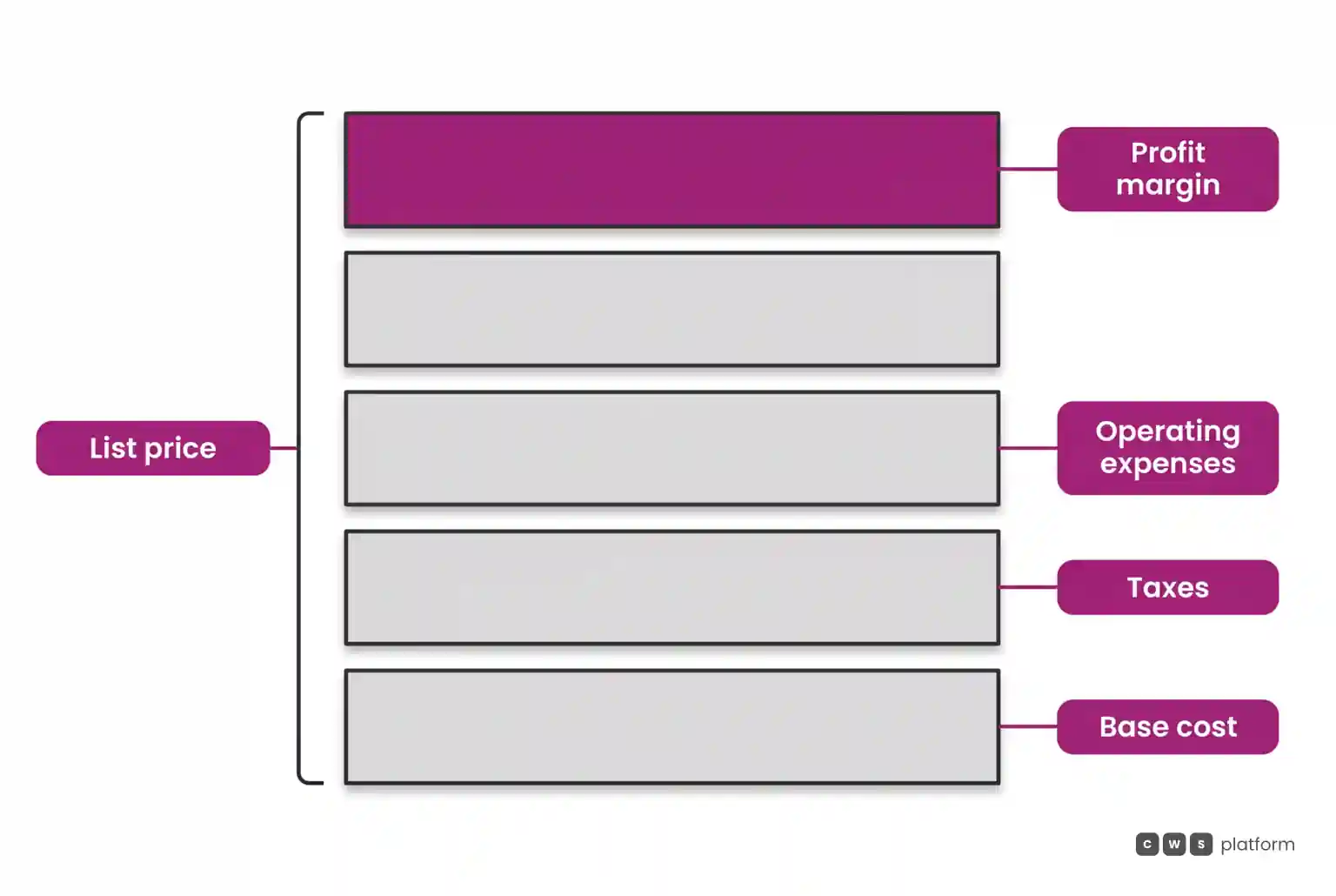
Pricing strategy is the calculation that connects product cost to the price charged to the customer, incorporating taxes, operating expenses, and the desired profit target. In B2B, the formula never stops at a single list price: it branches out into pricing by account, geography, sales channel, and order volume, because serving different customers incurs distinctly different costs.
Robust pricing allows sales teams to offer discounts while knowing exactly how much profit they concede. Effective margin management depends on this visibility.
The components of the selling price
- Product cost. Landed cost, including purchase or manufacturing costs plus inbound freight.
- Taxes and compliance. State sales tax, local surcharges, or tariffs, which shift depending on shipping origin, destination, and product classification.
- Variable expenses. Sales commissions, outbound freight, payment processing fees, and the cost of capital tied to payment terms.
- Fixed overhead. The allocation of operating infrastructure (headcount, software, facilities) that every sale must support.
- Margin. The target profit on the transaction.
How to calculate your selling price
1. Through markup. Multiply the cost by a multiplier that absorbs taxes, operating expenses, and target profit. A standard formula to establish this multiplier is:
markup = 1 ÷ (1 − (taxes% + variable expenses% + fixed overhead% + target margin%))
selling price = cost × markup
For instance, using illustrative figures: if taxes, expenses, and target margin total 40% of the selling price, the markup is 1 ÷ 0.60, roughly 1.67. A product with a landed cost of 100 will retail for approximately 167.
2. Through competitive benchmarking. Start with current market rates and verify whether the resulting unit economics remain viable.
3. Through value based pricing. Set rates based on the business outcome delivered to the buyer, such as immediate inventory availability, delivery speed, technical support, or flexible net terms.
In practice, B2B organizations combine all three methods: markup sets the floor, market competition sets the reference point, and perceived value justifies the premium.
Why theoretical prices fail to reach the order
Why is realized order margin lower than planned? Because the baseline calculation only establishes list price, while the purchase order reflects custom discounts, negotiated freight terms, and extended payment schedules.
Why do orders diverge so heavily from list? Every B2B account negotiates distinct commercial terms, prompting sales reps to modify deals ad hoc.
Why does this slippage go unnoticed? Strategic pricing models live in disconnected spreadsheets, while actual transaction profitability only surfaces after invoicing and financial close.
Why does this matter? Price is the sharpest operational lever for profitability. A classic McKinsey study analyzing S&P 1500 companies revealed that a 1% improvement in average realized price, assuming constant sales volume, generated an approximate 8% increase in operating profit (The power of pricing, McKinsey Quarterly, 2003).
The root cause: baseline rates are calculated in one environment, but executed in another.
From list price to customer specific pricing
1. Price each SKU individually. Factor in landed cost, tax liabilities, operational overhead, and profit targets, utilizing markup as the absolute price floor. Consistent margin management requires protecting these baselines at the product level.
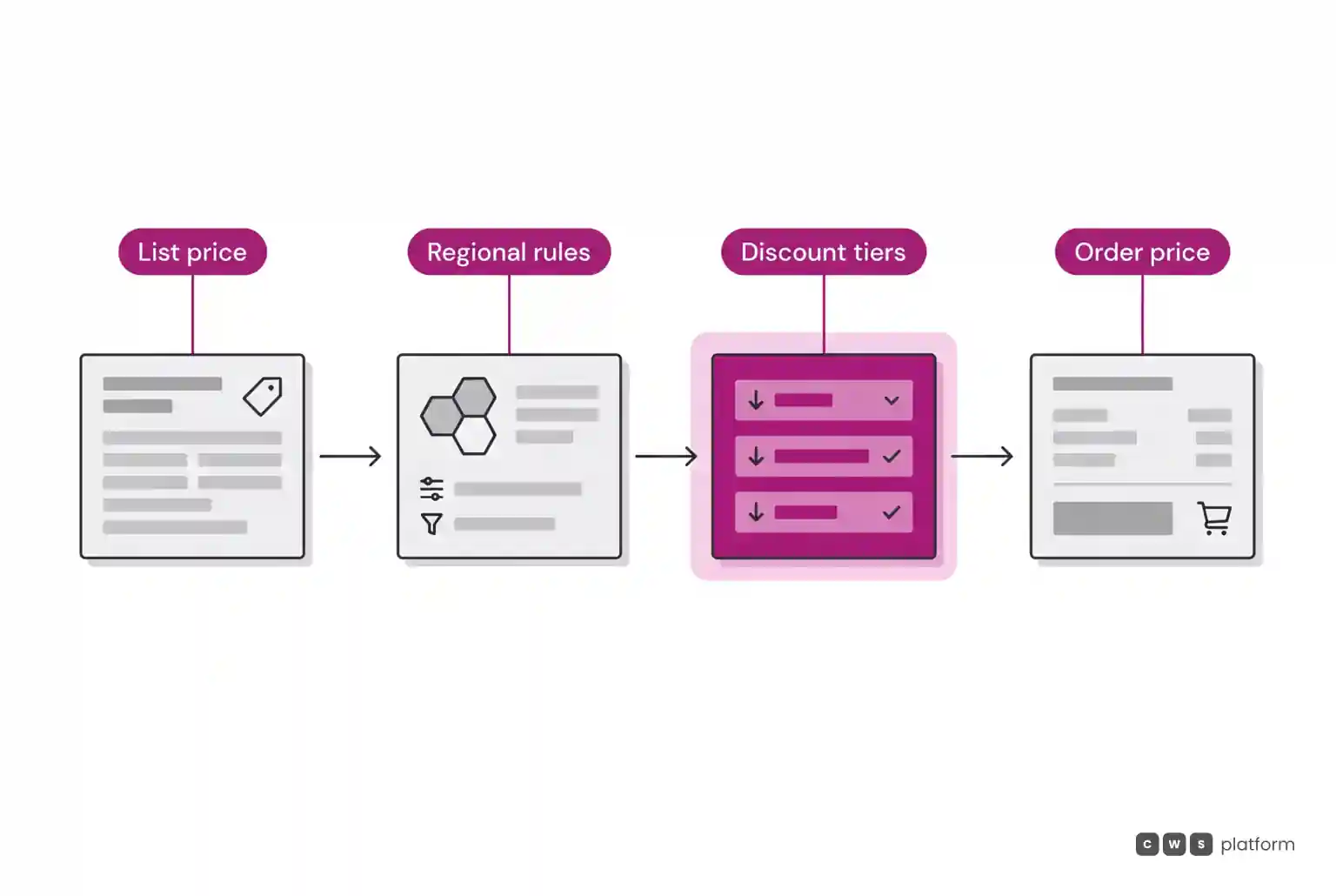
2. Segment by account and geography. Structure price books or dynamic pricing rules by customer tier, master service agreement, and destination state, since tax rules and freight costs fluctuate by location.
3. Establish discount authority thresholds. Define the exact discount band each organizational level can authorize without eroding bottom line returns. We detail this framework in what is approval workflow authority.
4. Push pricing logic into transactional channels. The commercial policies modeled in your financial plans must match the live rates displayed on the B2B portal and accessed by field reps during negotiations.
5. Track profitability on every order. Continuously evaluate target versus realized margin across individual accounts and sales reps to ensure reliable margin management across your pipeline.
Pricing execution in CWS Platform
Within CWS Platform, price books, discount rules, and customer contracts can be configured directly inside the system or synchronized from your ERP via API. Pricing rules execute independently or in cascades, backed by contractual safeguards. Taxes calculate automatically based on delivery jurisdictions, while discounts, custom price agreements, and promotional codes operate within strict, configurable boundaries. Buyers access contracted pricing on self-service portals, and sales reps leverage the exact same logic during deal negotiations. Explore the full architecture on our customer specific pricing page.
Next step
Select your top ten revenue generating SKUs and cross-examine the target margin modeled during pricing setup against the actual average margin realized across orders from the previous quarter. The variance highlights how much capital leaks between your list price and the finalized order.
Frequently asked questions
What is B2B price calculation?
It is the process of building a final customer price from raw product cost by incorporating relevant taxes, variable selling costs, fixed overhead allocations, and target profit margins.
How do you calculate selling price using markup?
Sum the percentage shares of taxes, overhead expenses, and desired profit relative to the selling price. Determine your markup multiplier by dividing 1 by (1 minus that combined percentage), then multiply your product cost by this factor.
What is the difference between markup and margin?
Markup is the percentage or multiplier applied on top of cost to establish a selling price. Margin is the percentage of the final selling price that remains as profit. A 50% markup over cost does not yield a 50% gross margin on the sale.
How should B2B organizations manage price setting?
Establish baseline prices per SKU, segment by customer tier, territory, and channel, enforce role based discount authorization bands, and deploy these business rules directly into digital ordering channels while auditing realized order margins.
Read also
- Customer specific pricing in B2B: how to deliver negotiated terms without spreadsheets
- What is B2B: how commercial operations shift when selling to businesses
About this publication
A publication by CWS Platform. Visit cws-platform.com for more insights.
"responsive, technically engaged, and willing to work through complex commercial rules (negotiated pricing, credit, customer-specific conditions) rather than pushing generic answers"
Want to see this in your operation?
Real B2B operations already run on it.