Assisted Sales and Digital Counter: SAP Commerce Cloud or CWS Platform?
An architectural comparison of margin guardrails, shared carts, and approval tiers in B2B commerce

Editorial note: Architectural comparison between SAP Commerce Cloud and CWS Platform in the Assisted Selling and Digital Counter scenario. Every fact about SAP Commerce Cloud comes from its public documentation, with the source link alongside.
In business-to-business trade, counter sales and assisted commercial service demand strict synchronization between the sales representative and the buyer. When an organization evaluates SAP Commerce Cloud against alternative commercial architectures, the central question does not concern the UI catalog, but rather where business logic execution, margin control, and shopping cart sharing actually live.
Enterprise assisted selling demands that inside sales reps stop acting as mere order entry clerks and instead perform as governance-driven negotiators. Following B2B ecommerce best practices, if every discount concession, payment term adjustment, or credit line release depends on phone approvals or recalculations across separate systems, the operation loses velocity and quietly erodes profitability.
Understanding the boundary between architectures that delegate calculation to distributed enterprise suites and platforms that execute transactions natively in context determines sales channel sustainability and frontline team efficiency.
The Scenario: Real-Time Counter Negotiation and Enterprise Assisted Selling
The assisted selling and digital counter scenario encompasses commercial interactions where sales reps, inside sales agents, or counter reps work directly with corporate buyers to assemble complex orders. Instead of operating in silos, the buyer and the representative require mutual visibility into selected line items, regional availability, and the financial impact of each commercial choice.
In this model, the representative acts equipped with real-time credit data, negotiated price lists, and account-specific tax rules. Every quantity update or request for custom terms must comply with predefined guardrails, preventing informal concessions from eating into distributor or manufacturer operating margins.
The experience must converge toward a fluid workflow: quotes that convert into transactional purchase orders without manual re-keying, immediate enforcement of payment terms based on account health, and representative autonomy bounded by strict system authorization tiers.
The Six Decisions Forced by the Scenario
Structuring assisted selling technically requires six architectural decisions essential to enforcing governance and channel productivity:
1. Who approves off-matrix concessions. Authority tier definition establishes whether discounts granted during negotiations follow rule-based workflows linked to representative roles with formal audit trails, or occur via informal exceptions across external communication channels.
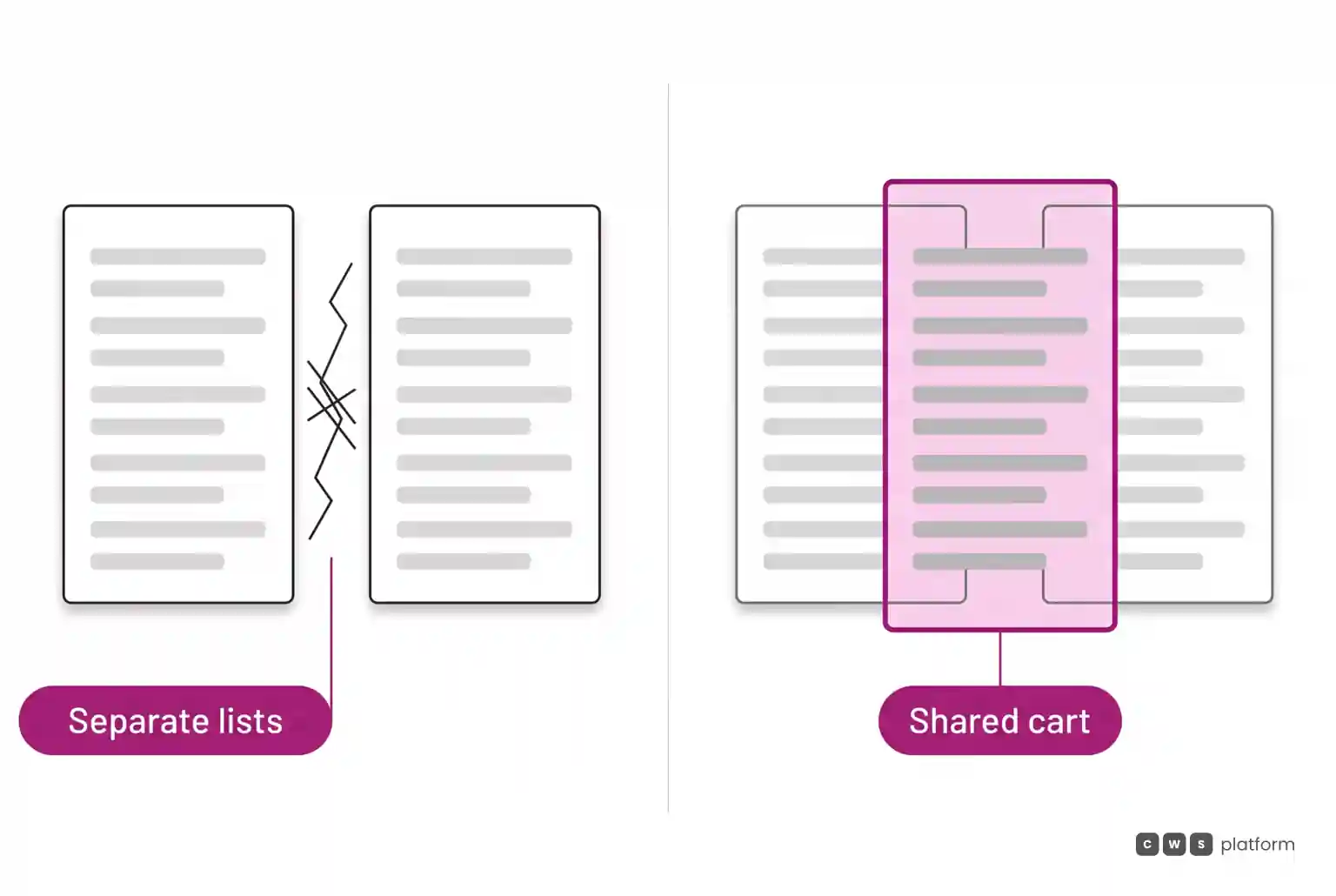
2. How rep and buyer build the same order. Cart collaboration dynamics determine whether buyer and seller interact over a single transactional data structure with instant synchronization, or whether the rep manually re-enters specifications received via emails, chats, or spreadsheets.
3. What the rep knows about the customer in the moment. Account visibility determines whether credit limits, past-due balances, and historical purchasing patterns appear instantly during the call, or require tedious cross-referencing across disconnected reports and modules.
4. Who sees which customer. Account partitioning establishes whether each representative has access restricted strictly to their assigned territory and account book, or if the system exposes accounts and transactions managed by other reps.
5. What prevents discount stacking. Profitability controls determine whether the platform stops unauthorized stacking of tiered discounts, contract pricing, and promotional codes before order submission, or if margin leakage is only discovered after invoicing.
6. What reps stop doing manually. Workflow automation determines whether white-space opportunity discovery and initial quote drafting are driven by automated background analytics, or if sales reps spend valuable selling hours assembling routine, manual quotes.
What Breaks Today, in the Voice of Operations
Frontline friction across inside sales and counter teams illustrates the practical fallout of these structural choices:
The complaint "To close one complex order, I have to open five different systems" reflects Decision 3 and Decision 2, exposing the operational drag of switching tools to verify credit limits, branch inventory, and pricing policies. A study by Harvard Business Review (Rohan Narayana Murty et al.), 2022 found knowledge workers switch between applications roughly 1,200 times per day, losing critical focus and time during continuous context shifts.
The feedback "Discount approvals are complete chaos; everyone approves differently" highlights the challenge of Decision 1 and Decision 5, where missing automated approval hierarchies leaves pricing governance open to subjective, unaudited decisions. Adhering to pricing discipline is critical; as noted by McKinsey & Company, 2025, a 1% price improvement correlates with an 8.7% increase in operating profit without volume loss.
The observation "My gross margin looks acceptable, but net margin is underwater" captures the core issue of Decision 5, demonstrating how unmonitored stacking of promotional allowances and extended payment terms drains bottom-line profits.
The frustration "The system crashes right when the counter has a line out the door" reflects the severe cost of downtime during peak volume. As an industry benchmark, Uptime Institute, 2026 reported that 57% of enterprise IT and data center respondents stated their most recent serious outage cost more than $100,000.
Finally, the concern "Revenue depends entirely on three hundred reps remembering to call the right accounts" points directly to Decision 6, where the account book lacks automated pipeline intelligence. In institutional research, McKinsey & Company, 2024 found that sales reps spend only about 20% of their time directly engaging customers, compared to market benchmarks that recommend one-third to one-half.
What SAP Commerce Cloud Handles Well in This Scenario
SAP Commerce Cloud structures assisted sales through the Assisted Service Module (ASM), a component that allows customer service agents and sales reps to operate directly on the digital storefront used by buyers. The agent navigates the identical storefront interface, leveraging ASM core capabilities. Using the 'asagent' role, the rep searches for the buyer by account ID or cart ID and completes checkout on their behalf, as detailed in the ASM SSO documentation.
Corporate call center integrations can be established via the SAP CRM Interaction Center, launching authenticated storefront sessions using single sign-on (SSO), according to SAP Commerce CRM. For unregistered buyers, the rep can create a customer profile or proceed as a guest. Furthermore, headless assisted sales are supported by exposing services through the assistedservicewebservices extension with OAuth2 authentication, as covered in SAP Commerce documentation.
In complex enterprise quoting workflows, Request for Quote (RFQ) paths connect the transactional storefront to SAP CPQ via SAP Cloud Integration. This configuration locks the commerce cart, transmits account data and line items to the quoting environment where discount guardrails and pricing logic govern the proposal (SAP CPQ), and routes the final quote back to convert into an ERP-integrated sales order. It also leverages SAP Variant Configuration and Pricing for complex manufactured-to-order products.
How CWS Platform Builds It: Native Assisted Negotiation, Approval Tiers, and Unified Operational Context
CWS Platform supports digital counter sales by integrating assisted selling tools directly into the transactional commerce engine. Through the Assisted Selling Platform (Sales Hub) module, sales reps conduct business inside the primary portal. Reps simply open "New Interaction," identify the account by company name, tax ID (EIN), or customer number, and transact on their behalf without requiring customer credentials. Reps can also manage multiple customer interactions simultaneously. Within this session, all account-specific conditions apply automatically: contract price books, pricing rules, shipping addresses, and available customer credit limits.
To eliminate manual order re-entry in assisted sales, the Real-Time Shared Cart aligns rep and buyer within the exact same transactional cart. Updates made by one party appear for the other upon page refresh, supported by instant messaging to negotiate line items dynamically. Sales reps can also save the cart and share a direct link, allowing the buyer to review, edit, check out independently, or send back to the rep for final processing.
Strict governance over discounts and pricing concessions is enforced deterministically in code via the Commerce Rules Engine (CDL Workspace). Each representative is governed by three thresholds: personal approval threshold (orders exceeding it trigger review workflows), line-item discount locks, and total order discount locks. When a discount exceeds a rep's limit, they must supply an approved Reason Code. The order then routes through multilevel approval hierarchies with dated audit logs and notes. If a quote falls below the hard minimum margin floor, the system blocks submission entirely. Every concession preserves author identity and justification.
Commercial policy evaluation runs in real time via Contextual Pricing (Pricing Engine), resolving precedence across active customer contracts, conditional parameter rules, and master wholesale price lists. To prevent discount stacking, guardrails are fully configurable: baseline contract pricing can restrict sales reps from adding manual discounts, and coupon redemption can be blocked whenever line items already enjoy contract pricing or promotional rules.
Net terms follow four-level commercial rules, with payment terms set per customer and the credit limit checked at checkout, maintaining alignment with negotiated agreements. In parallel, the Customer Intelligence Panel displays transaction history, credit availability, and account context in one click, while territory partitioning ensures reps only see their assigned accounts. Furthermore, the Sales Copilot AI agent runs within Sales Hub to handle operational groundwork (account ranking, margin and churn risk alerts, draft quotes), leaving commercial decision-making in the hands of the sales rep.
A cornerstone metric in B2B ecommerce best practices is transaction cost reduction: bringing contract pricing, credit limit, and approval authority into the same flow, with tax looked up in the ERP, eliminates intermediaries and manual workflows that slow order conversion at the sales counter.
Where friction originates, and how architecture resolves it:
| Operational Pain Point | Root Cause | Architectural Resolution |
|---|---|---|
| "I have to toggle through four or five applications for a single complex quote" | Daily workflows force reps to cross-reference product catalogs, credit balances, regional inventory, and tax tables across separate systems, inflating handling time. | Centralizes customer master data, custom price books, and line-item credit balances within the single negotiation interface where the order is placed. |
| "Discount approvals are chaos; every manager approves using different rules" | Off-matrix pricing relies on informal messaging, verbal agreements, and offline workarounds lacking systematic audit trails. | Enforces automated, role-based approval hierarchies linked to rep permission tiers, requiring validated Reason Codes for all overrides. |
| "Gross margins look acceptable, but our net profit is underwater" | Uncontrolled stacking of contractual pricing, customer discounts, and regional promotions silently destroys product profitability during checkout. | Executes deterministic rules engine locks that programmatically prevent cumulative discounts between contract tiers and promotional codes. |
| "White-space opportunities are missed unless reps remember to follow up manually" | Account activation depends entirely on individual rep memory, causing dormant accounts and lost repeat replenishment revenue. | Provides analytics that detect account dormancy, assemble suggested replenishment orders, and trigger automated alerts in the sales workspace. |
Where the Architectures Truly Diverge
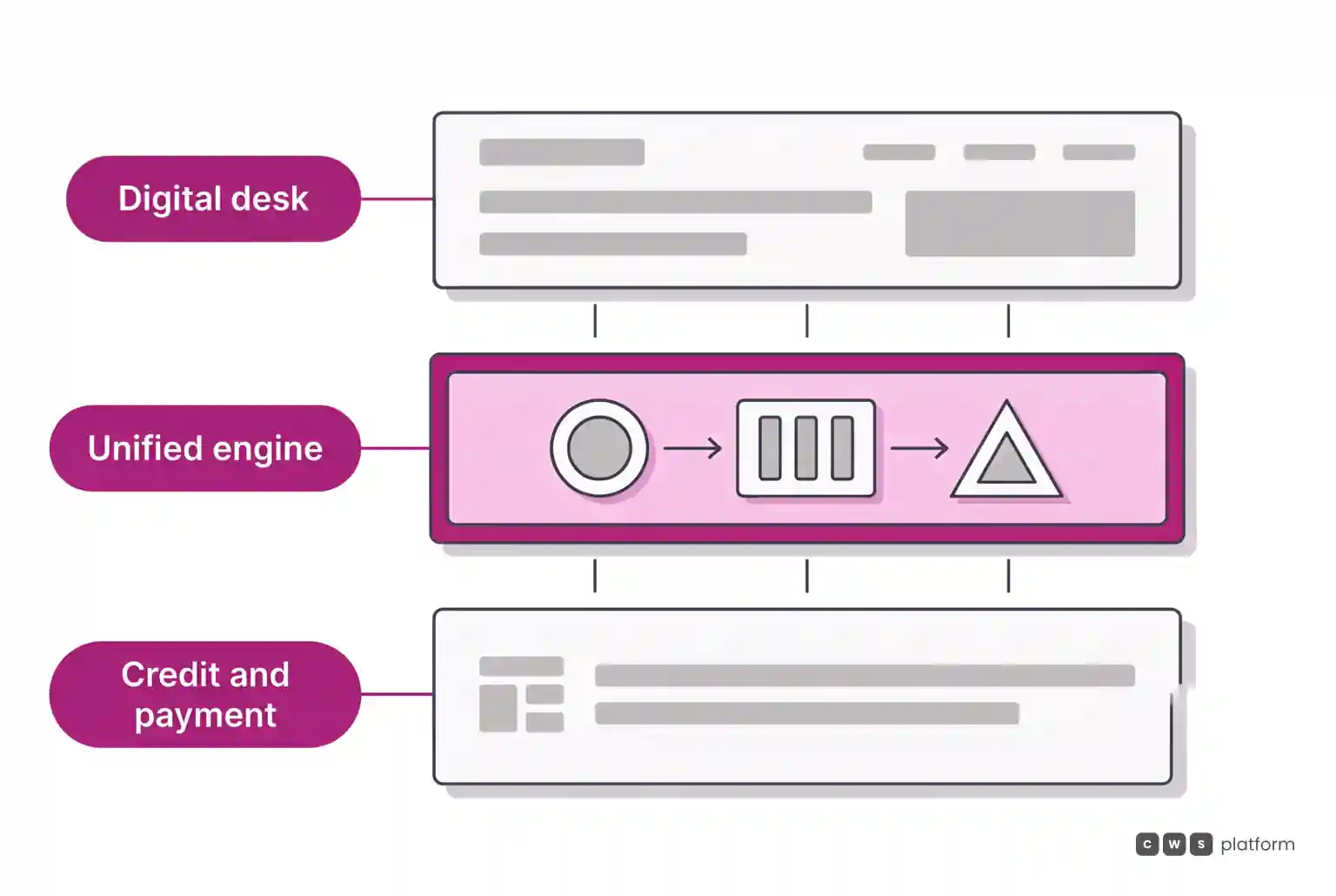
The architectural divergence centers on where commercial logic execution resides. In SAP Commerce Cloud, assisted sales runs on the storefront via ASM; pricing quotes with discount guardrails are governed in SAP CPQ, connected to Commerce via SAP Cloud Integration (SAP CPQ and Commerce Integration); and catalog pricing can be calculated synchronously against the ERP or replicated via database tables (Pricing via ERP). This setup constitutes a best-of-breed model composed of specialized applications communicating across middleware.
In an integrated transactional architecture aligned with B2B ecommerce best practices, commercial policies, credit limits, and anti-stacking controls execute directly within the core platform during checkout. The sales rep negotiates inside the buyer portal, allowing the cart to reach checkout with contracts, dynamic pricing rules, authorization tiers, and credit checks already validated. Line-item sales taxes can be retrieved via ERP or tax engine APIs prior to order finalization.
SAP's own documentation records a limit on orders created directly in S/4HANA:
- limitation recorded in the vendor's documentation on September 9, 2026: in synchronous order creation with S/4HANA, only the Account payment type is accepted ("Account payment type is the only supported payment type.", https://help.sap.com/docs/SAP_COMMERCE_INTEGRATIONS/47ad58c1a27447949aad8addbee46fca/dd3c227d5863456c9e6d242c06adbf52.html?locale=en-US&state=PRODUCTION&version=2211).
| Decision Factor | SAP Commerce Cloud (Documented Capabilities) | CWS Platform |
|---|---|---|
| Where rep and buyer collaborate on negotiations | The rep operates within the customer storefront via Assisted Service Module (ASM), launching sessions natively or via SSO from SAP CRM Interaction Center (SSO in ASM). | Rep and buyer collaborate on a unified cart updated on page refresh, complete with integrated messaging to negotiate terms. |
| When discount authorization tiers are enforced | In the RFQ quoting flow, discount guardrails are evaluated within SAP CPQ, integrated via SAP Cloud Integration (SAP CPQ and Commerce Integration). | At point of entry: individual approval limits, item-level locks, and order-level locks; exceeding thresholds triggers multilevel approvals with Reason Codes. |
| Where credit line management lives | In the Cloud ERP edition, account purchases, dynamic pricing, available inventory, and order status are checked via real-time lookups to SAP Cloud ERP as source of truth (Cloud ERP edition). | Per-customer credit limit, synchronized with the ERP via API; configurable to block, send for approval, or approve. |
| How policies prevent discount stacking | Promotion engine handles rules, conditions, and actions, alongside single-code and multi-code digital coupons (Pricing and Promotions). | Configurable margin locks: prioritized non-cumulative rules, restrictions on manual discounts on top of contracts, and coupon suppression on negotiated prices. |
| Scope of customer account access | Reps take the 'asagent' role during assisted sessions (SSO in ASM); standard documentation does not outline native customer territory partitioning for reps. | Territory assignment by rep, account domain/tax ID, or customer tier; storefront can enforce a single assigned rep per corporate account. |
In summary: SAP assisted sales unites specialized products (ASM on the storefront, SAP CPQ for enterprise quoting, and ERP integrations), which works well for organizations standardized on that tech stack. CWS embeds shared carts, contextual pricing, margin locks, and credit validation natively within the sales rep workspace.
When SAP Commerce Cloud Is the Right Choice for This Scenario
Adopting the enterprise suite architecture fits enterprises that have distinct ecosystem dependencies and established operational models:
Organizations with support centers anchored in SAP CRM. Choose this architecture when your assisted selling processes rely on workflows already embedded in the SAP CRM Interaction Center. Frontline agents launch commerce sessions via SSO and pull customer records using unified enterprise IDs, following paths detailed in SAP Commerce CRM.
Engineer-to-order manufacturing and deep product configuration. Choose this architecture when quote creation involves complex bills of materials (BOMs) and heavy multi-tier industrial configurations. The integration with SAP CPQ allows companies to leverage SAP Variant Configuration and Pricing across integration buses to resolve advanced product dependencies.
Standardization on Angular-based composable storefronts. Choose this architecture when corporate enterprise architects mandate modular user interfaces built exclusively on Angular frameworks. The suite offers the SAP Commerce Cloud composable storefront, connecting cleanly to core commerce APIs via Omni Commerce Connect (OCC).
Enterprises already live on SAP Cloud ERP. Choose this architecture when the organization operates SAP Cloud ERP and wants customer pricing, ATP inventory, and order statuses retrieved directly from the ERP via SAP-managed connectors. The Cloud ERP edition requires SAP Finance Base, Finance Premium, or Finance Base and Supply Chain Base, is licensed in tiers of 10,000 orders/year, and promotes standardized deployment timelines of roughly 12 weeks (SAP).
When CWS Platform Is the Right Choice for This Scenario
CWS Platform is the preferred choice when an organization requires operational speed on the commercial frontline, strict margin protection, and high representative autonomy at the sales counter.
Distributed distribution networks with regional inventory and local rules. Choose this architecture when individual branch locations require regional autonomy without sacrificing centralized corporate oversight. Branch locations inherit the core catalog and extend it with localized offers (custom SKU codes, branch pricing, warehouse-specific inventory). Custom contracts can be restricted by branch, parent customer classifications apply automatically across branch rules, and account credit lines can be defined per store or enterprise-wide.
Digital sales counters with direct term negotiations and split payments. Choose this architecture when each customer has its own payment terms and credit limit, applied right in the assisted sale. For example, credit limits can be combined with credit cards or ACH payments, while custom payment schedules and milestone invoicing adhere strictly to the merchant's business rules.
Collaborative quote creation with shareable transactional links. Choose this architecture when outside reps or inside sales teams need to construct an order and hand off final authorization to customer procurement. Reps assemble items across designated regional fulfillment nodes and email or text a direct link for checkout, ensuring the rep remains attributed to the resulting order.
High-volume wholesale distribution needing predictable software costs. Choose this architecture when digital sales expansion must not be penalized by variable take rates or GMV percentage fees. The software pricing model relies on license tiers and computing consumption rather than charging a percentage of revenue, safeguarding operating margins as transaction volumes scale.
Choosing CWS for assisted sales does not require replacing your SAP ERP. The core ERP remains the authoritative system of record: it syncs inventory counts and credit limits via REST APIs, calculates line-item taxes through enterprise tax APIs prior to checkout, and ingests completed orders without manual touchpoints, carrying the exact payment term integration IDs. Enterprises running SAP S/4HANA or SAP Cloud ERP retain their ERP investment while running assisted sales on CWS, relying on API-first connectors tailored to their environment.
Where to Go from Here
If your team is evaluating which model aligns with operational goals rather than choosing between specific vendors, read The Seven Questions That Separate B2B Commerce Architectures.
If your immediate focus is resolving underlying operational friction, our guides on When Selling More Does Not Mean Making More and When Integration Bottlenecks Paralyze Growth explore these business challenges in depth, without vendor bias.
Recommended Reading
Brands mentioned in this article

- SAP Commerce Cloud
- McKinsey & Company
Trademarks and logos belong to their respective owners. Mention does not imply partnership or endorsement.
"responsive, technically engaged, and willing to work through complex commercial rules (negotiated pricing, credit, customer-specific conditions) rather than pushing generic answers"
Want to see this in your operation?
Real B2B operations already run on it.