AI for Technical Parts Lookup: What to Audit Before Upgrading Your Model
Why product discovery failures stem from unstructured catalog data, not LLM capabilities

TL;DR
- An AI agent locating parts in a catalog is only as accurate as the underlying data allows: if your master records do not link the SKU to its application and cross references, upgrading the LLM will not fix it.
- AI models change every few months. A broken catalog can linger for years, and it is the single factor that determines answer quality.
- Before debating which model to deploy, verify four fundamentals: the part has fitment data, cross references are mapped, price and inventory match what an inside sales rep sees, and commercial rules are explicitly documented.
- Properly supported, the agent eliminates manual catalog searches for your sales team, freeing up valuable time for actual negotiation.
When deploying AI for distributors to handle part lookup, the first step is not selecting a foundation model. It is verifying whether your product catalog contains what the agent needs to succeed: fitment for every SKU, cross-reference interchange codes, real-time customer pricing and inventory, and structured commercial rules. With these in place, the agent can interpret an imprecise buyer request and surface the right part. Without them, it simply hallucinates with complete confidence.
What a Catalog AI Agent Does in Practice
In technical aftermarket and industrial distribution, inside sales reps spend a significant portion of their day on one task: receiving a vague inquiry ("the drive belt for that older compressor model", a smartphone photo, or an OEM competitor part number) and hunting it down in the catalog. They toggle between the ERP, manufacturer spec sheets, interchange spreadsheets, and often pick up the phone to call an application engineer.
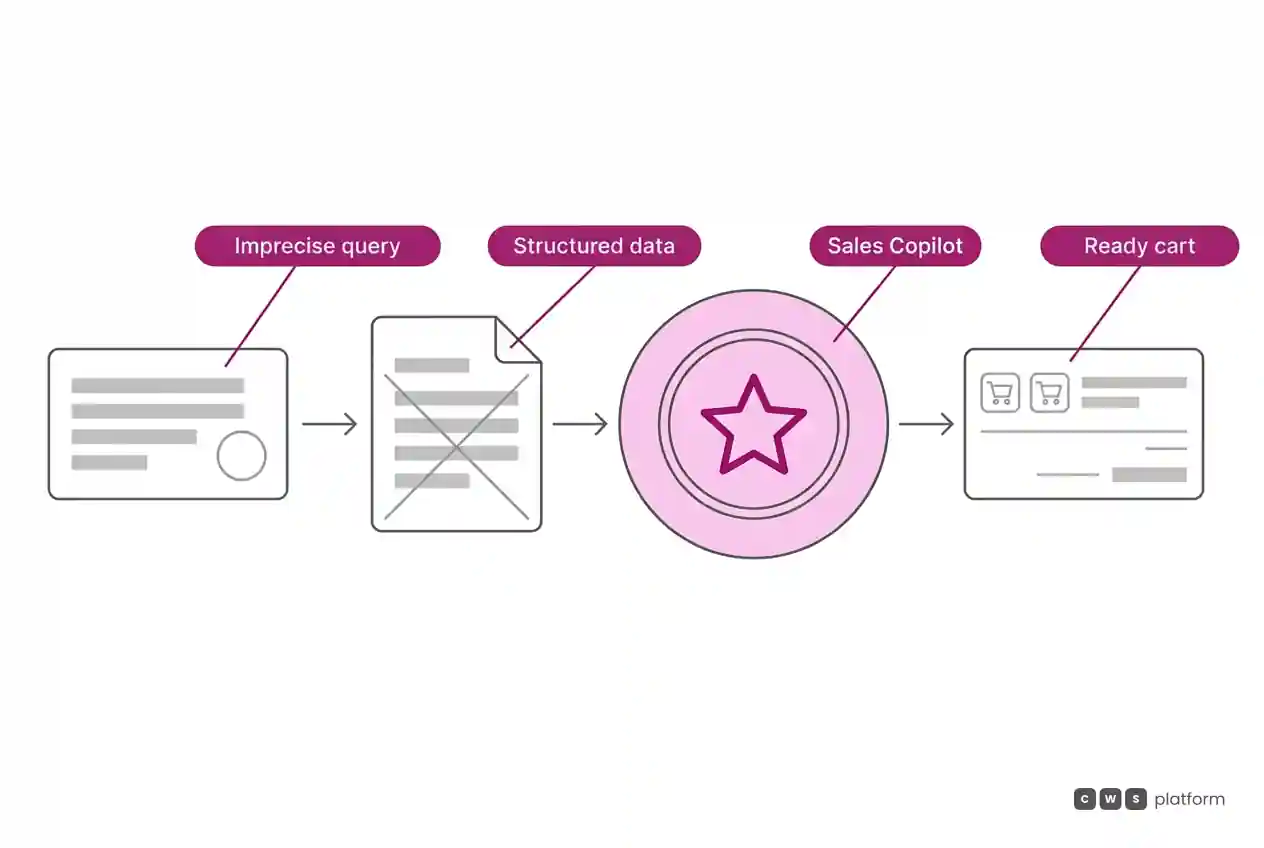
A sales agent embedded into your product catalog automates this lookup process. It reads the customer inquiry, cross-references it against your item master, recommends the exact part along with interchangeable alternates, and populates the cart. This workflow cuts out manual lookup and directly connects structured product data to commercial execution: the customer inquiry converts into a quote or order without eating up rep time.
This operational efficiency is precisely why the 6 AI Agents from CWS Platform were engineered: to offload repetitive catalog lookups so your sales team can focus on closing deals.
Why Changing the AI Model Does Not Fix Bad Product Data
While teams debate which large language model to embed into their customer portal, the core bottleneck already exists without any AI involved: displayed pricing and stock levels conflict with what an inside rep quotes over the phone, and fitment data is nowhere to be found.
A newer model understands natural language prompts better. However, it cannot invent product data that does not exist in your ERP or PIM. If an item lacks application data, the agent has two undesirable options: state that it does not know, or guess. Guessing is far worse, because the hallucination sounds just as authoritative as an accurate response.
This is an architectural issue, not an algorithmic one. Customer-specific contract pricing, warehouse availability, and regional tiering require a single source of truth. Without it, the agent quotes one figure, the rep quotes another, and the buyer learns to bypass the portal and call inside sales directly. This budget and timeline pitfall is analyzed in why B2B AI projects run over budget.
Four Audits Before Launching Your Agent
1. Application and fitment data. Pull one hundred fast-moving SKUs and verify whether each has clear application data attached (equipment make, model, year, capacity, operating specs). Wherever this is missing, the agent will guess.
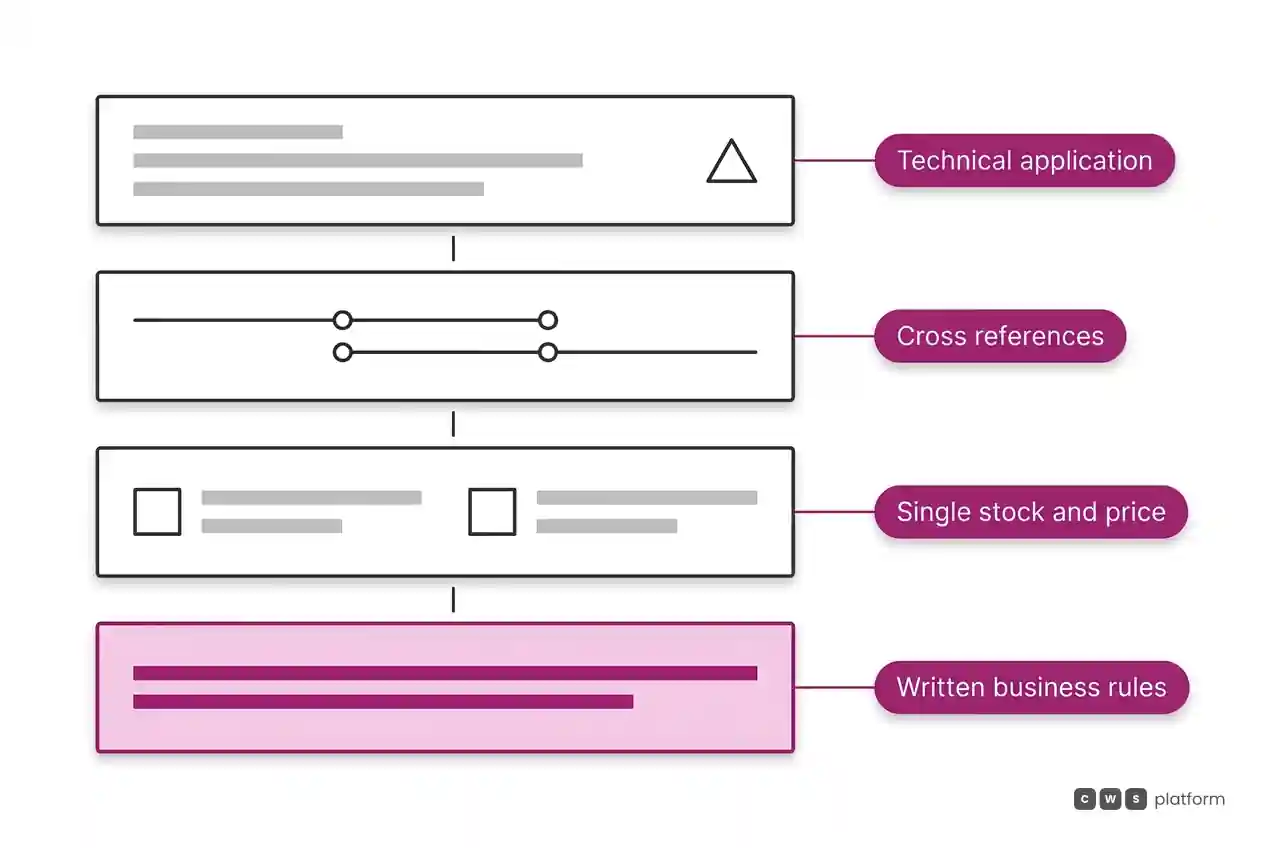
2. Cross-reference interchanges. Ensure competitive cross references and superseded part numbers are populated and up to date: original equipment manufacturer (OEM) numbers, aftermarket brands, legacy revisions. This enables the agent to suggest an in-stock substitute when a customer asks for a competitor code.
3. Account-level pricing and availability. Have a senior inside sales rep audit ten portal responses against what they would quote over the phone. If the portal figures deviate from the rep screen, your conversational agent will inherit that discrepancy.
4. Documented commercial rules. Maximum discount thresholds, freight policies, customer-specific product exclusions. If these rules exist solely in the tribal knowledge of veteran reps, the agent cannot execute them. For an analysis on setting operational guardrails, see when an AI agent negotiates on your behalf, who sets the boundaries.
How to Measure Agent Accuracy
Avoid measuring success through vanity chat volume. Evaluate actual order outcomes:
- Post-order correction rate. The percentage of orders generated by the agent that required manual intervention, returns, or adjustments by a rep or the customer.
- Human escalations. Questions the agent deflected to your sales desk. These pinpoint specific data gaps and serve as an immediate backlog for your catalog team.
- Rep search time. If internal inquiry handling time decreases, the implementation of AI for distributors is delivering its primary objective.
Break these metrics down by product category rather than looking at aggregate company averages. An agent might perform flawlessly on hydraulic filters yet fail on bearings, and high-level metrics will mask that gap.
Next Step
Before selecting an LLM architecture, run the four catalog audits on one hundred SKUs. The findings will reveal whether your operational bottleneck stems from the model or your product records, which almost always shifts deployment priorities. To see what modern tooling can accomplish on structured catalog data, explore AI Agents from CWS Platform.
Frequently Asked Questions
Can AI locate parts in a catalog using freeform customer descriptions?
Yes, provided your product catalog includes fitment, interchange numbers, and structured technical attributes. The agent matches the unstructured prompt against these parameters. Without structured data, it will guess, delivering incorrect recommendations with absolute confidence.
Does upgrading the AI model improve part search accuracy?
A more advanced model improves natural language understanding, but it cannot create missing product attributes. If cross references and application data are missing from your database, a new model will make the same underlying errors as an older one.
What catalog data should distributors clean up before deploying a sales agent?
SKU application details, updated cross-reference matrices, account-specific pricing and warehouse inventory, and explicit commercial sales rules. These four foundations are mandatory for reliable AI for distributors.
How do you evaluate the performance of a catalog AI agent?
Track order return and correction rates, the volume of queries escalated to inside sales, and the reduction in manual lookup time for sales reps. Always analyze performance by product line rather than relying on an overall portal average.
About This Publication
Published by The Cost of the Sale blog at CWS Platform, covering practical applications of AI across B2B industrial distribution and technical catalogs. Specific client names and proprietary operational metrics are omitted.
"responsive, technically engaged, and willing to work through complex commercial rules (negotiated pricing, credit, customer-specific conditions) rather than pushing generic answers"
Is your catalog getting in the way of the sale?
Request an assessment of your operation or talk straight to a specialist, whichever you prefer.
I'd rather get the next articles on catalog management
A weekly roundup of new articles on catalog management, only in weeks when there is one. No spam, and you can leave in one click.