AI Product Images in B2B Catalogs: How to Audit Quality by Category
Why aggregate accuracy metrics hide expensive technical errors and how to build category-level validation workflows

TL;DR
- Vision AI agents that catalog products (identifying items, extracting attributes, enhancing imagery) should never be judged by an overall accuracy score.
- Aggregate averages hide critical failures: an agent may perform near perfectly on standardized retail boxes while consistently failing on visually similar industrial components.
- Test category by category using representative samples, and deploy a second evaluation agent (a critic agent) to flag inconsistencies.
- Category-level performance dictates where automated systems can run unattended, where human review is required, and where manual workflows must remain.
To evaluate images and product data generated by vision systems, assess quality category by category rather than relying on a blended accuracy metric. Build a benchmark sample for each product line, compare model output against human-verified ground truth, and use a critic agent to triage suspect records. These category benchmarks clearly indicate where AI for distributors can operate autonomously and where human oversight remains essential.
Why Aggregate Metrics Mislead
During initial rollouts of image-based cataloging agents, the first executive report typically highlights a single metric: the overall success rate. If that number sits above 90%, leadership often assumes the system is ready for production.
The issue lies in blending radically different categories into one baseline. A vision model easily identifies a can of chemical additive featuring prominent, high-contrast branding. That same model struggles to differentiate two roller bearings whose only distinction is an etched imperial measurement. When an inventory mix skews heavily toward packaged goods, the aggregate score looks great, while costly errors on technical components are completely masked.
The viability of vision cataloging agents cannot be measured through high-level rollups. What matters is identifying exactly where the logic breaks.
How to Run Category-Level Benchmarks
1. Group your catalog by visual complexity. Separate packaged retail items, unbranded raw components, parts distinguished only by dimensional specs, and items with subtle color or finish variations. Segment by visual recognition challenges, not merely by ERP merchandising taxonomies.
2. Build representative test sets. Pull several dozen SKUs per family, intentionally including edge cases, worn finishes, and ambiguous labeling alongside clean examples.
3. Establish verified ground truth. Secure clean reference data for every test SKU, audited by product specialists who know the physical parts. This serves as the benchmark against which the agent is scored.
4. Track business-critical errors separately. Move beyond simple pass-fail tallies. Distinguish errors that trigger customer returns (incorrect thread pitches, mismatched voltages, swapped part numbers) from cosmetic defects (vague marketing copy, imperfect background clipping).
The Critic Agent: An Automated Auditor
An effective architectural safeguard involves placing a secondary agent in the loop to audit the primary system. This critic agent analyzes the source image, the extracted product attributes, and category validation rules to flag discrepancies: specs that contradict visible markings, physically impossible dimensions, or generic descriptions that lack required technical specifications.
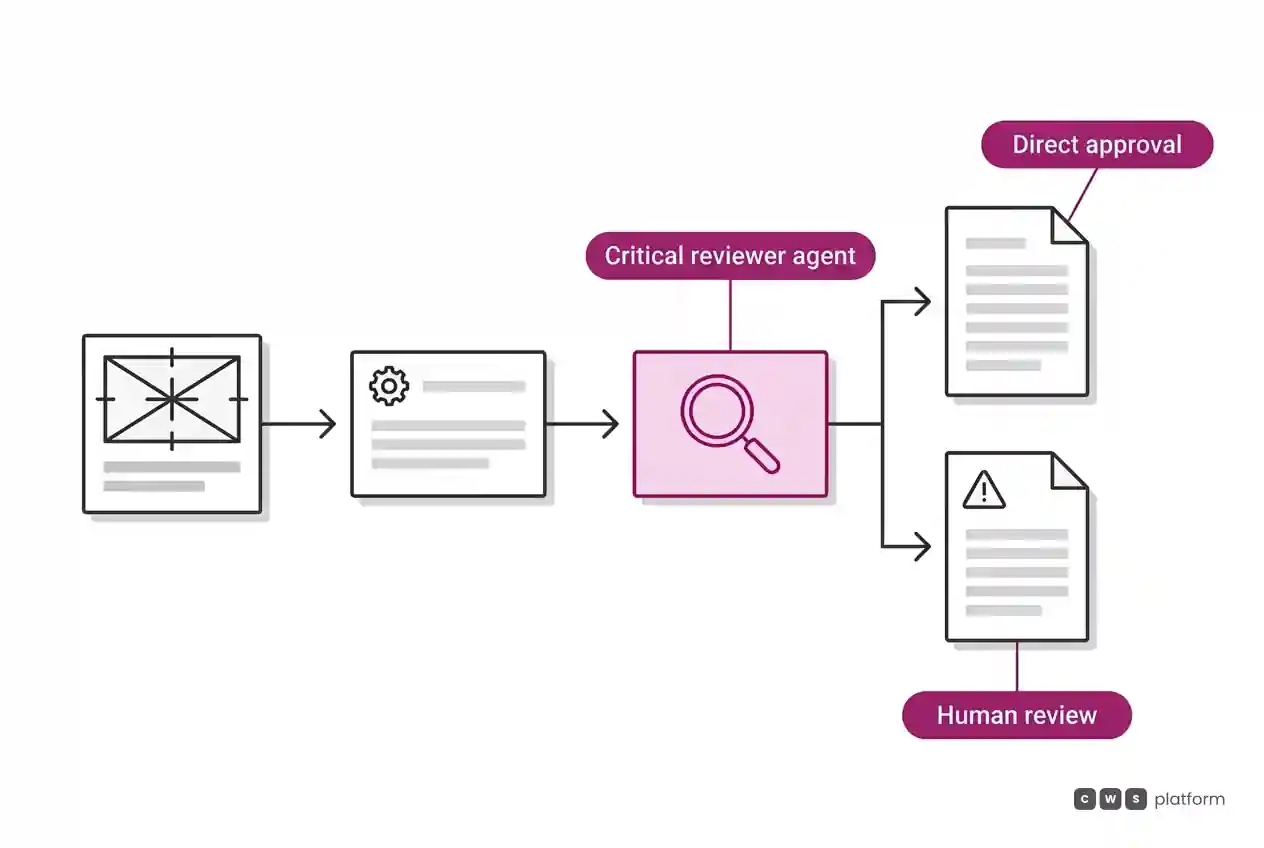
Refining this critic agent, paired with rigorous category segmentation, pinpoints operational blind spots and guides prompt engineering. In practice, this delivers two immediate advantages: it slashes human labor by only routing flagged records to specialists, and it highlights exactly which product categories require fine-tuning.
Tracking Image Provenance and Traceability
Any product asset generated, retouched, or expanded via synthetic vision pipelines requires an audit trail: source photography used, transformation models applied, and exact prompt parameters. For industrial distribution, an asset that looks convincing but contains subtle errors (a hydraulic fitting rendered with the wrong thread type, an electrical plug showing an extra pin) guarantees incorrect orders. Maintaining image provenance ensures full traceability when operational defects appear, maintaining a clear boundary between physical photography and synthetic renderings.
Determining Production Autonomy
Once category evaluations are complete, assign each product line to one of three operating tiers:
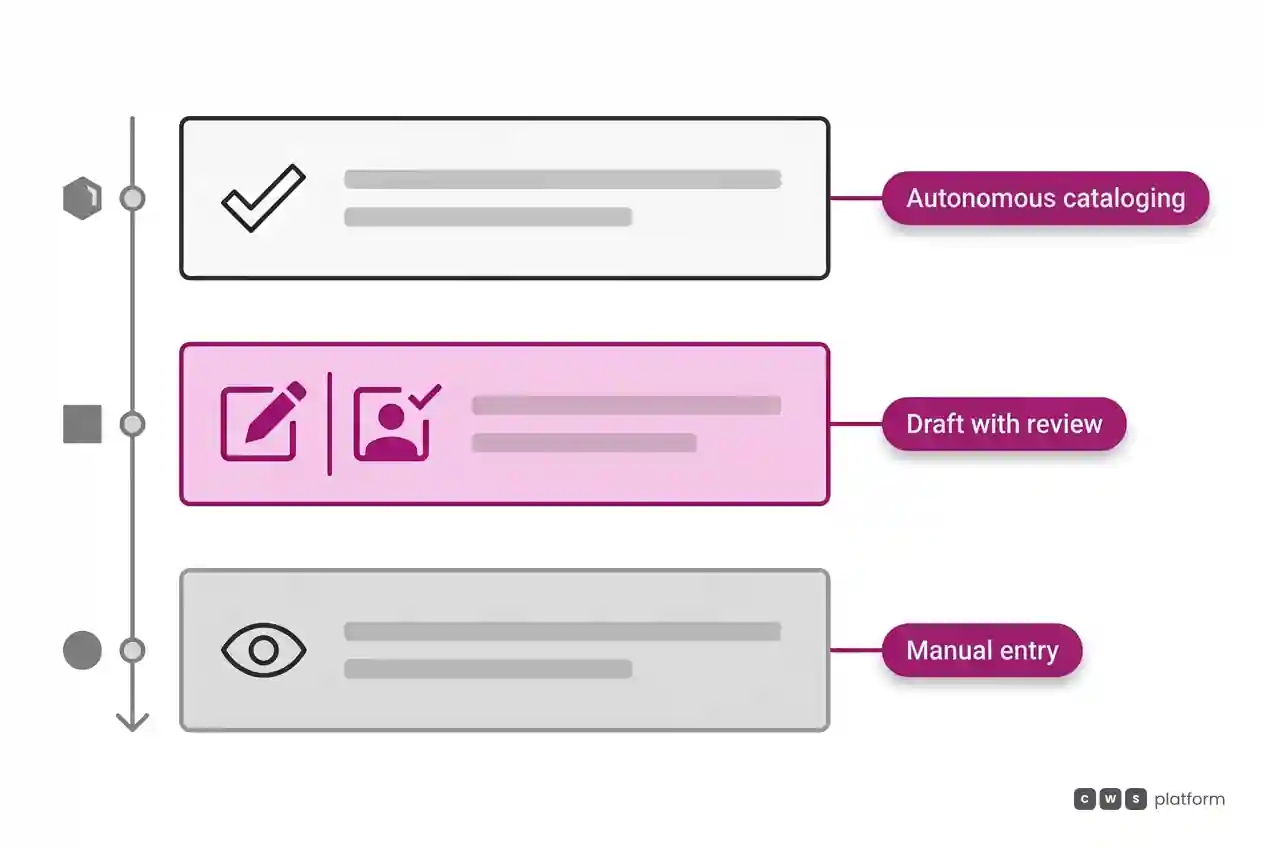
- Autonomous. Low, predictable rates of critical errors: the primary agent processes the SKU, the critic agent signs off, and operations teams touch only flagged outliers.
- Draft with Human Review. The model handles attribute extraction and metadata drafting, but a human specialist verifies every record prior to ERP sync. This maintains high throughput while protecting data integrity.
- Manual Only. Product groups where vision models produce frequent, high-consequence mistakes remain fully human-managed until underlying models or prompt structures improve.
Re-running these benchmarks with every model update or prompt revision is mandatory. A system update that improves consumer electronics recognition might degrade performance on structural hardware. Only structured category evaluations capture these regressions.
Next Steps
Direct your technical teams to report vision model quality across at least five distinct product categories, separating operational return risks from cosmetic flaws. If leadership only receives a single combined accuracy metric, you lack the data needed to scale. Learn how CWS Platform structures catalog automation and visual pipelines on our AI images and catalog page.
Frequently Asked Questions
How should businesses evaluate product images generated or enriched by vision AI?
Evaluate models across isolated categories using test samples that feature complex edge cases. Compare results against verified ground truth, isolating critical errors that lead to warehouse returns from minor cosmetic flaws.
What is a critic agent in vision-based catalog pipelines?
A critic agent is a secondary language-and-vision model that audits the primary agent's output. It detects mismatches between source photos and extracted attributes, routing only questionable entries to human specialists.
Can wholesale operations rely on AI for distributors to catalog inventory autonomously?
Yes, but selectively. Autonomous processing should only apply to categories where high-cost errors are consistently near zero. Complex or mission-critical product lines should keep specialists in the loop to approve drafts.
Why is image provenance necessary for AI-generated catalog assets?
To provide traceability whenever an asset misrepresents technical specifications. In commercial and industrial channels, a slightly inaccurate visual leads directly to misordered inventory, failed installations, and costly returns.
Recommended Reading
- The Agent Entered the ERP, but the Implementation Never Ends
- When an AI Agent Negotiates on Your Behalf, Who Sets the Boundaries?
- AI and Autonomous Agents in B2B Sales
About This Publication
This article outlines implementation patterns observed during catalog automation deployments by CWS Platform. It contains no confidential client data or proprietary performance metrics.
"responsive, technically engaged, and willing to work through complex commercial rules (negotiated pricing, credit, customer-specific conditions) rather than pushing generic answers"
Is your catalog getting in the way of the sale?
Request an assessment of your operation or talk straight to a specialist, whichever you prefer.
I'd rather get the next articles on catalog management
A weekly roundup of new articles on catalog management, only in weeks when there is one. No spam, and you can leave in one click.