B2B Ecommerce with Sales Reps: SAP Commerce Cloud vs CWS Platform
How to align digital self-service with field sales without channel conflict or margin leakage.

Editorial note: architectural comparison between SAP Commerce Cloud and CWS Platform in a B2B portal scenario with an active sales force. Every fact about SAP Commerce Cloud comes from its public documentation, with links alongside.
The decision to launch a digital purchasing channel in companies with an established sales team exposes a critical architectural dilemma between platforms like SAP Commerce Cloud and native collaborative commerce engines. If the portal is designed merely as an isolated self-service storefront, the sales team views the system as a direct threat to their pipeline, creating immediate adoption friction and triggering internal channel conflict over order attribution.
For Commerce Directors, CFOs, and CEOs, executing successful B2B ecommerce best practices means transforming the channel into a collaborative workspace shared between buyer and rep rather than an isolated transactional silo. When the digital channel absorbs complex pricing rules, approval hierarchies, and payment terms without disintermediating the sales rep, the operation scales while safeguarding negotiated margins.
Evaluating the right architecture for this scenario requires understanding where business rules live, how pricing and credit governance are executed at checkout, and how sales rep attribution remains tied to the corporate account lifecycle.
The scenario: B2B portal integrated with an existing sales force
In a typical distribution or manufacturing operation with multi-territory revenue, buyers place recurring orders while sales reps focus on prospecting, contract renegotiations, and inside sales. The corporate goal when introducing digital commerce is not to replace human reps, but to eliminate administrative overhead so they can focus on consultative selling. Implementing solid B2B ecommerce best practices ensures this transition strengthens rather than fractures field operations.
However, B2B commercial dynamics involve strict contractual commitments. Every client operates under custom commercial terms tied to their purchasing history, state-level sales tax exemptions, agreed payment terms, and open credit lines. If the portal fails to calculate these variables accurately at runtime, the buyer abandons the cart and calls or emails their rep, forcing internal teams to rekey quotes manually.
According to research from McKinsey & Company, 2024, B2B sales reps typically spend only 20% of their time in direct contact with clients, compared to benchmarks of one-third to one-half, noting an implementation where generative AI freed up 10% of reps' time. When the portal works alongside reps, self-service tracking reveals where buyers hit roadblocks, empowering the team to step in and close the deal.
The six decisions this scenario forces
Structuring this model requires clear answers across six architectural decisions that define how self-service and field reps coexist:
1. Who owns the order when the buyer purchases unassisted. Revenue attribution must be native to the enterprise account lifecycle. When the customer account is assigned to an account executive and commission attribution covers digital purchases, an unassisted self-service order placed via the portal ceases to threaten sales compensation.
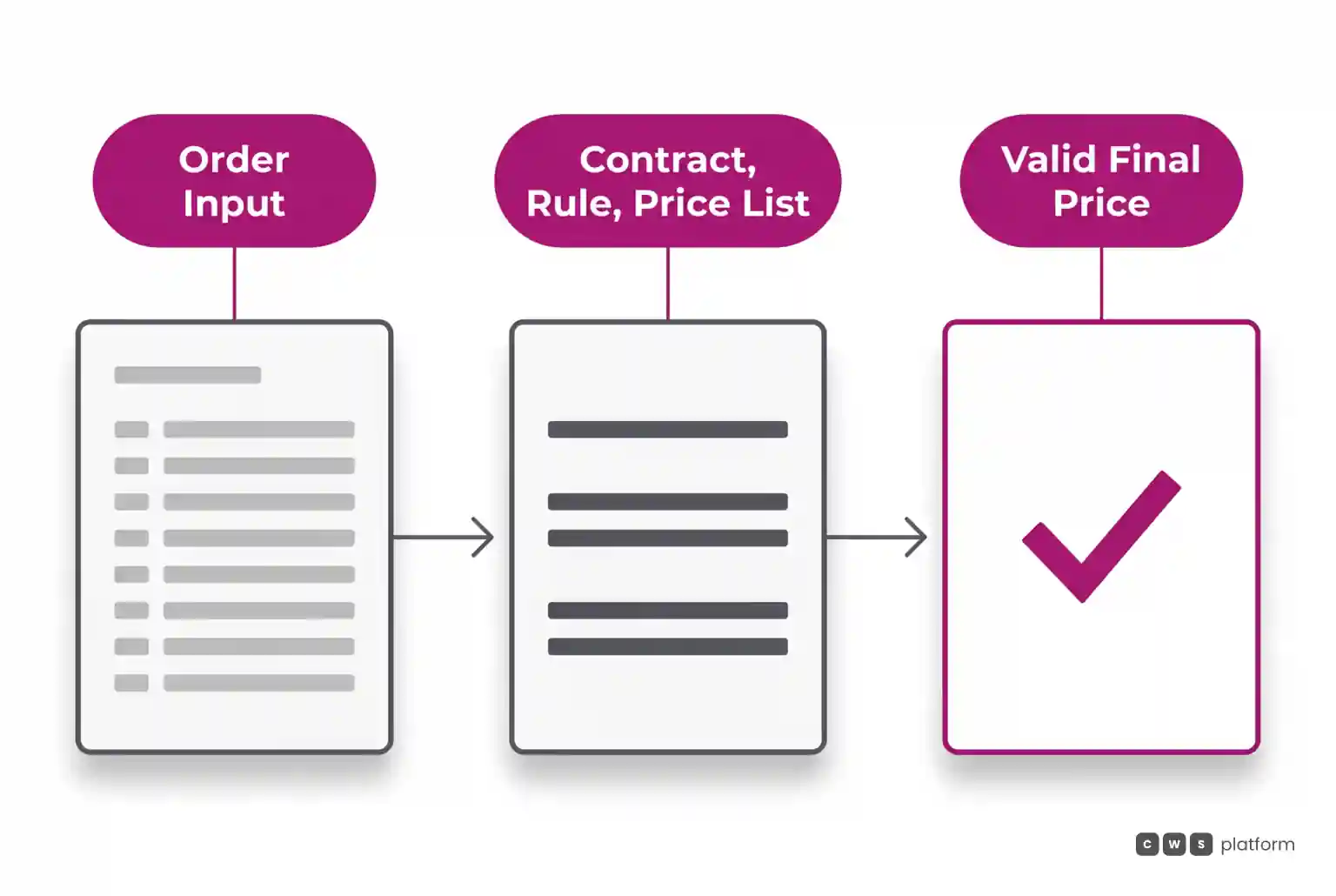
2. Where negotiated pricing lives. Pricing engines must reconcile corporate contracts, commercial rules, and regional price lists, with tax calculated separately by the ERP. If the buyer only sees a generic MSRP catalog, the transaction stalls and the buyer defaults back to manual phone orders.
3. Who approves off-catalog discounts. Granting custom terms requires a transactional engine that enforces gross margin guardrails and tier-based approval limits. Commercial concessions must be approved directly within the system flow, capturing standardized business justifications rather than relying on unmonitored messaging threads.
4. How rep and buyer collaborate on the same cart. The digital buying environment must support concurrent cart editing between customer and rep. Customer experience breaks down when reps must manually transcribe an emailed shopping list instead of working directly inside the session the buyer started.
5. What the checkout accepts. Order validation must verify real-time inventory, pricing, trade credit balance, and sales tax within a single transaction. Approving net terms and consuming credit lines directly within the checkout flow prevents approved orders from getting held up in manual credit department queues.
6. Who updates commercial policies and how fast. Business teams must own commercial parameter maintenance under complete audit trails. Agility drops whenever launching a regional promotion or adjusting discount limits requires opening IT engineering tickets and waiting on code deployments.
The operational friction points
In field conversations with commercial and operational leadership, resistance to digital channels surfaces through recurring concerns:
The complaint "My reps claim the portal will cut into their commissions" reflects compensation anxiety, exposing a breakdown in decision 1 where the digital channel fails to attribute self-service orders to the assigned rep.
The frustration "Every client has custom pricing, and nobody can get it working on the site" highlights the breakdown in decision 2, showing how the inability to process contract rates, customer tiers, and localized taxes online forces buyers to abandon carts for manual quotes.
The observation "Discount approvals are chaos. Everyone approves things differently" points to the gap in decision 3, where the lack of structured margin controls creates rogue discounting without audit trails.
The red flag "Our gross margins look fine, but our net margins are leaking" illustrates the compounding impact of decisions 3 and 5, where unmanaged discount stacking and unchecked credit limits drain bottom-line profitability.
What SAP Commerce Cloud solves well in this scenario
SAP Commerce Cloud is built on a modular enterprise cloud architecture designed for large corporate ecosystems. For organizations requiring a decoupled presentation layer and transaction logic, the platform provides a composable storefront built on Angular that connects to commerce services via the Omni Commerce Connect (OCC) REST API layer. The solution packages enterprise capabilities across adaptive search, promotions, and distributed order management.
For assisted sales, the platform documents the Assisted Service Module (ASM), enabling customer service agents to navigate the customer-facing storefront on behalf of buyers. Agents can look up accounts using customer IDs or active cart IDs, and emulate sessions using dedicated OCC request headers or single sign-on from SAP CRM Interaction Center. Authenticated agents can also manage guest carts and spin up dedicated sessions via assisted service web services.
For complex quoting, the platform integrates with SAP CPQ using SAP Cloud Integration middleware. This architecture temporarily locks the portal cart while an XML quote request processes through the enterprise sales engine, mapping sales organizations, distribution channels, and external ERP identifiers. For configure-to-order manufacturing and complex product engineering, the quoting engine can offload deep logic to SAP Variant Configuration and Pricing running on SAP BTP.
Master data and policy synchronization with the enterprise back-end relies on the SAP Commerce Cloud Integration with ERP package. This integration uses OData adapters and local extensions to sync pricing and discount conditions from the ERP into the digital storefront, offering programmatic extension points for custom enterprise workflows.
For B2B self-service, SAP documents buyer-initiated quotes, converting approved estimates into live orders, purchasing against active contracts, multi-stage approval workflows, bulk CSV order uploads, and fast reordering (source). In the cloud ERP edition, real-time pricing, inventory availability, and order status sync directly with SAP Cloud ERP. The engine can calculate pricing synchronously with the ERP back-end or read delta-uploaded price tables (source), organizing promotions around condition-action rules integrated with SAP Omnichannel Promotion Pricing (source).
How CWS Platform builds it: unified commercial governance and native negotiation
CWS Platform approaches B2B digital commerce from the premise that an online portal is not merely an isolated storefront, but an end-to-end commercial operations engine. Field sales enablement is powered by the Assisted Selling Platform (Sales Hub), where inside reps and field agents access an integrated workspace upon login. Reps identify corporate accounts by company name, EIN, or tax ID, order on the client's behalf, and manage multiple concurrent service tabs. The session automatically enforces account-specific contract terms, shipping locations, credit lines, and custom price lists without requiring the buyer to be logged in.
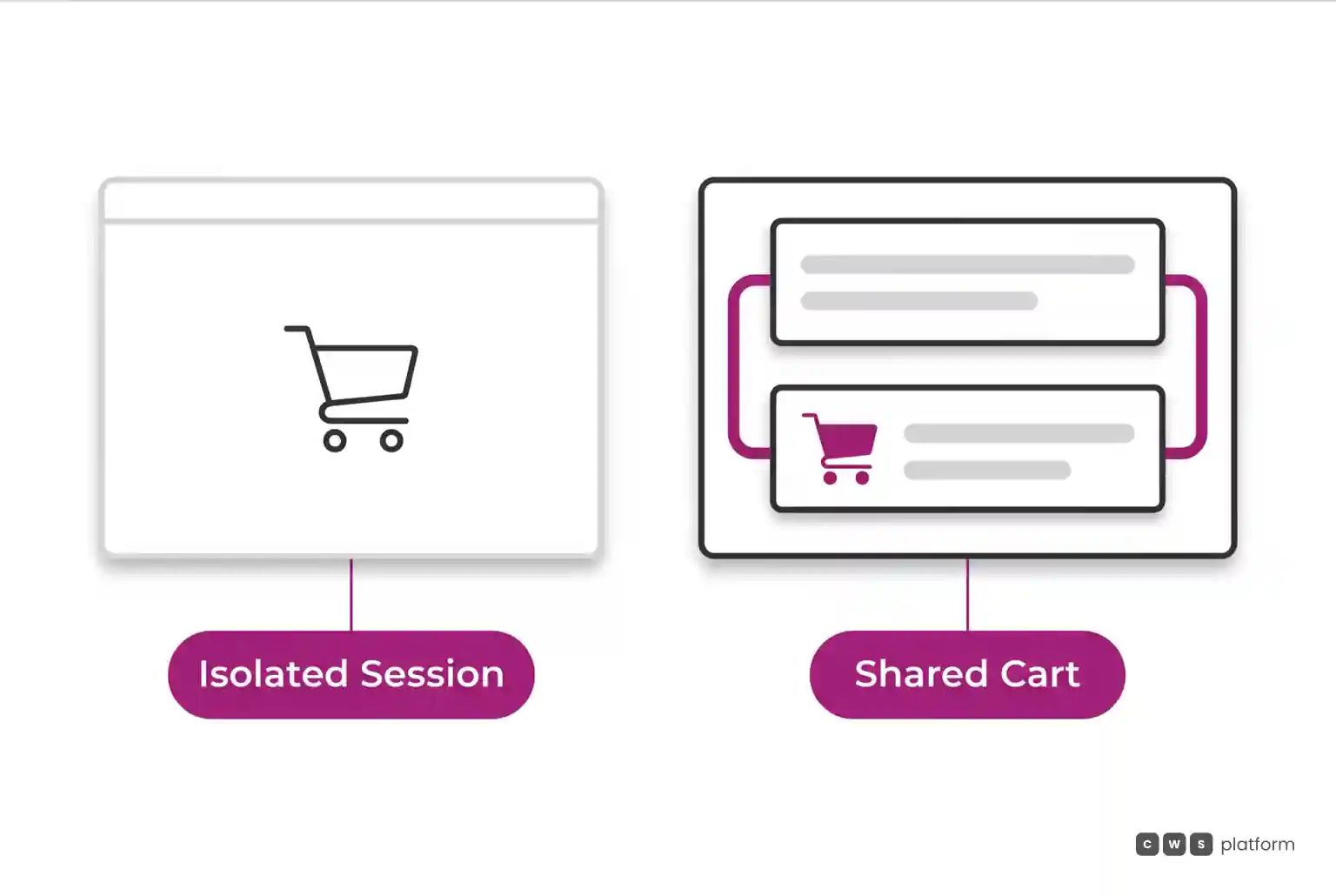
This synergy relies on a shared collaborative cart. Rep and buyer can work inside the exact same order: changes made by one party display for the other on page refresh, while an integrated messaging drawer allows real-time negotiation and cart adjustments. Routine reorders move off the rep's desk entirely, freeing the sales team to focus on strategic client relationships and high-value negotiations. This seamless collaboration is central to modern B2B ecommerce best practices.
Transaction totals calculate through Contextual Pricing (Pricing Engine), which evaluates prices in strict precedence order: custom customer contracts override contextual pricing rules, which in turn override the standard price sheet. Rule eligibility can evaluate customer profile, industry code, product classification, and origin and destination state. When multiple non-cumulative rules compete, the highest priority rule wins, and specific contracts can lock down any additional rep discounting. Line-item tax calculations call the client's ERP tax engine or third-party tax API.
To protect net margins without creating order processing backlogs, the Commerce Rules Engine (CDL Workspace) automates multi-tier approval workflows at checkout. If a rep's manual discount breaches their pre-assigned margin threshold, the system enforces a standardized justification reason and routes the order up the organizational approval matrix. The order then flows through the Credit-First B2B Checkout (Checkout & Payments), which manages terms and checks the open credit balance at checkout; depending on store policy, an order over the limit is blocked, sent for approval, or finalized. From there, clean orders pass to the OMS and back to the ERP for picking, shipping, and invoicing.
The definitive architectural benchmark across these models is transaction cost reduction. Following proven B2B ecommerce best practices, when the platform executes contractual terms, checks credit lines at checkout, and allows reps and buyers to collaborate inside the same shopping cart, fulfillment cycles accelerate and manual rekeying disappears.
Operational pain points and architectural resolutions:
| Pain Point | Root Cause | Architectural Resolution |
|---|---|---|
| "My reps claim the portal will cut into their commissions" | The sales team views the digital channel as a threat when unassisted self-service orders bypass rep attribution and commission payroll. | The account portfolio binds accounts to specific reps, identifies the servicing rep on every order, and supports configurable commission attribution. |
| "Every client has custom pricing, and nobody can get it working on the site" | Enterprise commercial terms involve complex sales tax rules, tier structures, and volume commitments that standard storefront engines cannot evaluate on the fly. | The engine computes contract, rule, and catalog in strict order, filtered by customer profile, product classification, and origin and destination state. Item tax calculates via ERP tax APIs. |
| "Discount approvals are chaos; everyone approves things differently" | The lack of automated margin rules at checkout leads to offline, unmonitored discount approvals that bypass audit compliance. | The system blocks margin exceptions that exceed preset thresholds and routes orders into multi-tier approval paths with mandatory standardized business reasons. |
| "Our gross margins look fine, but our net margins are leaking" | Compounding unmanaged discounts, promotional codes, and non-standard payment terms silently erodes net margins despite healthy top-line gross numbers. | Business rule engines eliminate unauthorized benefit stacking and validate revolving credit limits before orders clear checkout. |
Where the architectures truly diverge
The fundamental divergence between these architectures lies in how the digital channel positions the sales rep relative to customer self-service.
SAP Commerce Cloud prioritizes self-service depth and relies on external orchestration for complex quoting, combining Commerce Cloud with SAP CPQ through SAP Cloud Integration. CWS approaches the problem from the opposite direction: rep and buyer collaborate directly inside the same cart under identical pricing, approval, and credit guardrails executed natively within the platform.
SAP's own documentation records two limits in order integration with S/4HANA:
- limitation recorded in the vendor's documentation on September 9, 2026: the SAP S/4HANA Order Management module is supported only on the composable storefront and does not cover scenarios with SAP S/4HANA Product Variant Configuration ("supported only on the SAP Commerce Cloud, composable storefront", https://help.sap.com/docs/SAP_COMMERCE_INTEGRATIONS/47ad58c1a27447949aad8addbee46fca/63eab6b625fe43b3a3e637b14eb0e6be.html?locale=en-US&state=PRODUCTION&version=2211).
- limitation recorded in the vendor's documentation on September 9, 2026: in synchronous order creation with S/4HANA, multiple B2B cost centers are not supported ("Multiple B2B cost centers aren't supported.", https://help.sap.com/docs/SAP_COMMERCE_INTEGRATIONS/47ad58c1a27447949aad8addbee46fca/dd3c227d5863456c9e6d242c06adbf52.html?locale=en-US&state=PRODUCTION&version=2211).
| Decision | SAP Commerce Cloud (documented mechanisms) | CWS Platform |
|---|---|---|
| Rep attribution and commission ownership | Reps interact with storefront sessions through the Assisted Service Module, retrieving accounts by customer ID or cart ID, including SSO from SAP CRM Interaction Center (source, source). | Account portfolio assigns accounts directly to designated reps; servicing reps are logged per order with configurable commission rules. |
| Execution of negotiated contracts and pricing | Synchronous pricing lookups to the ERP back-end or delta-uploaded price tables (source); real-time pricing and stock queries against SAP Cloud ERP in the cloud ERP edition (source). | Native engine executes contract > price rule > catalog hierarchy, matching rule eligibility on ship-to state, commodity codes, and customer classifications. |
| Shared cart (updates on page refresh) | Online quote requests and negotiation directly on the B2B storefront (source); with SAP CPQ, the portal cart locks and routes as a quote to the sales team (source). | Rep and buyer collaborate in the same shared cart, updated for both on reload, with an integrated chat drawer; carts can also be sent via direct links. |
| Checkout credit authorization | Cloud ERP edition supports net terms and purchase on account with terms loaded from SAP Cloud ERP (source); credit balance check mechanics are not detailed in consulted documentation. | Native revolving trade credit balances: accounts with sufficient credit auto-approve; credit overages pause for review based on store policy; split tenders supported. |
| Discount governance and approval hierarchies | Multi-stage approval paths for purchase-on-account workflows (source); discount guardrails managed via SAP CPQ (source); condition-action promotion rules (source). | Rep-level discount limits (approval, item lock, order hold) and tiered approvals defined in the CDL workspace, capturing mandatory standardized reasons. |
| Back-end ERP integration approach | Packaged SAP Commerce Cloud Integration with ERP running on SAP Cloud Integration, leveraging OData extensions to sync pricing and discounts (source). | REST APIs (accounts, contracts, price rules, credit limits) and event webhooks (orders, account updates, session start); line-item tax calculation calls ERP APIs. |
Architectural alignment depends on your core focus: self-service with native SAP ERP parity, or collaborative selling where buyer and rep work inside the same cart under unified business rules.
When SAP Commerce Cloud is the right fit for this scenario
SAP Commerce Cloud is the optimal fit in the following enterprise environments:
Organizations running SAP Cloud ERP seeking complete ecosystem parity. Choose this architecture when SAP Cloud ERP is already your core system of record and immediate native parity is your top priority. The SAP Commerce Cloud, cloud ERP edition checks pricing, inventory availability, and order status in real time against the ERP, natively enabling net terms, customer-specific pricing, and quote-to-order flows. SAP targets standard deployment timelines of roughly 12 weeks (source). Prerequisites include active subscriptions for SAP Finance Base, Finance Premium, or Finance Base and Supply Chain Base, with licensing structured around blocks of 10,000 orders/year under 1-to-3-year contracts.
Complex configure-to-order products and custom engineering. Choose this architecture when products require engineer-to-order manufacturing workflows and variant configurations that demand an enterprise-grade configurator. SAP CPQ handles quotes exceeding 10,000 lines, enforcing commercial eligibility and discount guardrails (source) while integrating with SAP Variant Configuration and Pricing on SAP BTP (source). Approved quotes convert back into active orders on the storefront (source). Adhering to these B2B ecommerce best practices ensures clean data flow across complex configurations.
Custom front-end presentation with a dedicated engineering team. Choose this architecture when your organization commits to developing and maintaining an in-house storefront using internal frontend engineering teams. The composable storefront provides a decoupled Angular web application distributed as open-source libraries that communicate with the commerce engine via Omni Commerce Connect REST APIs (source).
Self-service as the primary channel inside an existing SAP Cloud ERP stack. Choose this architecture when buyers will handle quote generation, contract purchasing, multi-tier approvals, bulk CSV reordering, and replenishment completely unassisted using data sourced directly from SAP ERP, and assisted sales is not a project requirement (source). If operational needs only call for self-service order and invoice tracking, the SAP B2B Self-Service Portal serves this scope without requiring a product catalog, active shopping cart, or checkout flow.
When CWS Platform is the right fit for this scenario
CWS Platform is the ideal choice when your business strategy focuses on empowering commercial teams, launching faster, and configuring sales rules without custom coding.
Field sales teams collaborating directly with buyers. Choose this architecture when your sales team needs to partner with buyers on finalizing orders rather than competing against the digital storefront. Reps can build, save, and share cart links directly with buyers; buyers can review, check out on their own, or return the cart to the rep to complete, with the rep's attribution preserved on the order. Corporate accounts bind cleanly to specific sales reps with configurable commission management. Implementing these collaborative touchpoints reflects essential B2B ecommerce best practices.
Multi-location distribution and branch operations. Choose this architecture when operations span multiple branches, fulfillment centers, or operating entities with localized pricing, payment methods, and credit limits. Master contracts can be scoped to specific locations or states, pricing rules created at corporate can replicate across selected distribution centers, each branch can run independent merchant accounts, and credit lines can be isolated to a single branch or pooled company-wide.
Business team autonomy over approval thresholds and credit policies. Choose this architecture when commercial leaders need to adjust discount approval tiers, gross margin floors, and payment term rules via visual configuration rather than developer sprints. Once CWS enables the capability for the store, commercial operations teams manage, test, and activate parameters directly in the CDL workspace.
API-driven ERP integration with a turn-key storefront. Choose this architecture when your integration strategy relies on clean REST APIs (customers, contracts, price books, credit balances) and event webhooks, eliminating the ongoing maintenance of custom frontend codebases. The storefront renders dynamically using a robust, highly optimized multi-tenant template.
Choosing CWS for your digital commerce portal does not mean replacing your ERP. If your organization runs SAP, your ERP remains the authoritative system of record: CWS ingests customers, contracts, and credit lines via REST APIs, calculates line-item taxes against ERP endpoints prior to checkout, and routes clean orders for back-end fulfillment, ensuring final invoice generation stays within the ERP. Contract tables and rule sheets natively accept your external ERP identifiers for customers, warehouses, and SKU variants.
Next steps
If you are still evaluating which architectural pattern best matches your distribution model before choosing a software vendor, review the seven questions that differentiate B2B commerce architectures.
If your immediate challenge is solving the commercial and operational bottlenecks behind this operational shift, explore our detailed analyses on When Selling More Does Not Mean Earning More and When Sales Channels Compete Against Each Other, which break down these organizational challenges independently of specific software vendors.
Recommended reading
Brands mentioned in this article

- SAP Commerce Cloud
- McKinsey & Company
Trademarks and logos belong to their respective owners. Mention does not imply partnership or endorsement.
"responsive, technically engaged, and willing to work through complex commercial rules (negotiated pricing, credit, customer-specific conditions) rather than pushing generic answers"
Want to see this in your operation?
Real B2B operations already run on it.