From Marketplace to Direct Channel: The ON-OFF-ON Model
Stop renting customers from marketplaces: acquire on third-party platforms, deliver excellence, and retain them on your direct B2B portal.

TL;DR
- The ON-OFF-ON model uses the marketplace to acquire the customer (ON), delivers an offline fulfillment experience that makes the brand memorable (OFF), and provides advantages on the direct channel that the marketplace cannot match, ensuring the next purchase happens direct (ON).
- The goal is to stop renting the customer. On a marketplace, you pay a commission on every single order and never own the relationship.
- This is executed entirely within marketplace policies, which typically prohibit diverting buyers during the transaction. The strategy is not diversion, it is brand recall combined with a clearly superior value proposition on your direct channel.
- In B2B, that superior value proposition already exists: tiered volume pricing, trade credit terms like net 30, quick reorder lists, and specialized technical support, features standard marketplaces do not support.
The ON-OFF-ON model treats the marketplace as an acquisition channel: sell on the marketplace (ON), execute an outstanding physical delivery and unboxing experience (OFF), and offer procurement capabilities on your direct digital portal that marketplaces lack, motivating buyers to return directly (ON). When executed within platform rules, this strategy trades continuous reorder commissions for a one-time customer acquisition cost.
Every business selling on marketplaces knows the math. Volume grows, commission totals grow right alongside it, and the buyer placing their third order remains the marketplace's customer. The seller pays on every repeat transaction just to access a buyer they already know.
Why Selling on Marketplaces Is Renting
On a marketplace, sellers rent audience reach, paying for it through commissions, sponsored placement ads, and strict fulfillment mandates. What they do not get is the relationship: buyer contact data, purchase histories, and open communication lines remain owned by the platform operator.
For the initial acquisition, that tradeoff makes sense. For repeat orders, the seller continuously buys back access to an existing account. The margin drain that occurs along this path is detailed in your distributor gains volume on marketplaces while losing margin.
The Three Stages of the ON-OFF-ON Model
ON: Acquire on the marketplace. Leverage the marketplace for what it does best: discovery by buyers who do not know your brand yet. Maintain clean catalog listings, aggressive pricing on entry-level SKUs, and reliable fulfillment metrics.
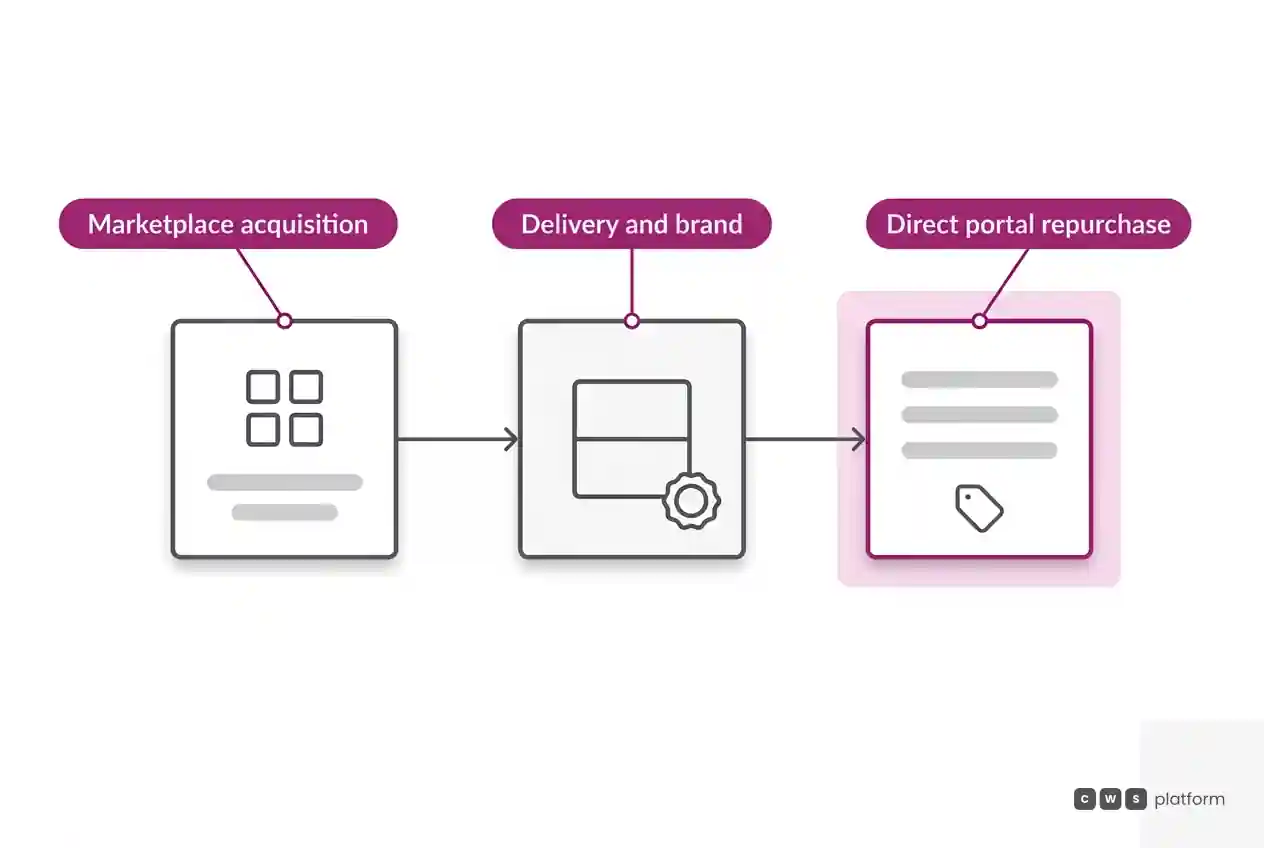
OFF: Build brand recall in physical fulfillment. The memorable impression happens during delivery: on-time arrival, professional packaging, accurate items, clean documentation, and clear brand visibility on products and packaging. While strictly complying with platform terms (which forbid packaging inserts soliciting off-platform sales), you ensure the buyer clearly identifies your brand so they can search for it later.
ON: Deliver superior value on the direct channel. When buyers search for the brand, they should find a direct B2B channel offering clear procurement advantages for recurring orders. In B2B, these advantages are compelling:
- Volume tiers and account-specific price sheets, which horizontal marketplaces do not support.
- Trade credit and net terms (such as net 30), essential for commercial purchasing departments.
- Quick-order lists and replenishment schedules for recurring monthly restocks.
- Dedicated technical support and access to an assigned account representative.
- Streamlined commercial invoicing and tax documentation structured for corporate procurement workflows.
When the Model Makes Sense
The ON-OFF-ON model works best when three conditions are met:
- Repeat demand exists. Consumables, MRO supplies, or replacement parts purchased on a regular basis by the same buyer.
- The buyer is a business. B2B purchasing managers care deeply about credit terms, volume discounts, and frictionless repeat ordering, areas where a dedicated portal outperforms a consumer marketplace.
- The direct channel is ready. Driving traffic to a direct site fails if the portal lacks customer-specific pricing, real-time inventory visibility, or credit approval workflows.
If products are one-off purchases or sales target individual retail consumers without repeat demand, remaining strictly on the marketplace may be the right approach.
How to Measure Success
- First-time marketplace buyers who place their second or third order through your direct portal.
- Customer Acquisition Cost (CAC), comparing the first-order marketplace commission against acquisition costs across other outbound channels.
- Direct reorder share, calculated as the percentage of repeat purchases made direct by accounts originally acquired on marketplaces.
Using major platforms to capture baseline demand instead of competing head-to-head with them reflects the principle that marketplaces are an output channel, not the final objective. Supporting direct trade credit, customized price matrices, and frictionless reordering requires a purpose-built B2B digital commerce portal like CWS Platform.
Next Step
Identify business accounts that purchased more than once from your marketplace listings over the past six months. Analyze what they bought and their purchase frequency. If the data shows routine reordering of consumable SKUs or replacement parts, determine what your direct portal offers them that the marketplace cannot. That value proposition forms the engine of your third ON.
Frequently Asked Questions
What is the ON-OFF-ON model?
It uses marketplaces for initial customer acquisition (ON), delivers an offline fulfillment experience that establishes brand recall (OFF), and provides specialized B2B ordering advantages on a direct portal so repeat purchases shift direct (ON).
Can sellers redirect marketplace buyers to their own website?
Only within each platform's terms of service, which prohibit diverting buyers away during an active transaction. The compliant approach relies on building strong brand recognition through product delivery and providing structural commercial benefits on the direct portal that marketplaces do not support.
Is selling on marketplaces viable for B2B distributors?
Yes, as a cost-effective acquisition engine for net-new accounts, especially through entry-level SKUs. For repeat business from enterprise accounts, direct ordering portals provide better operating margins and tailored purchasing features.
What advantages does a direct B2B channel hold over a marketplace?
Direct ownership of the buyer relationship: custom price matrices, volume discounts, net terms, automated replenishment lists, and dedicated account support, all without paying per-order marketplace fees.
Read Also
- Buy box dynamics in B2B marketplaces: why lowest price should not be the sole factor
- Building a viable B2B marketplace: four foundational operational requirements
- B2B Marketplaces
About This Publication
Published by O Custo da Venda, a CWS Platform publication analyzing B2B marketplaces and direct digital sales channels. Does not reference proprietary client data or private performance figures.
"responsive, technically engaged, and willing to work through complex commercial rules (negotiated pricing, credit, customer-specific conditions) rather than pushing generic answers"
Is every order costing your operation more?
Request an assessment of your operation or talk straight to a specialist, whichever you prefer.
I'd rather get the next articles on the cost of each order
A weekly roundup of new articles on the cost of each order, only in weeks when there is one. No spam, and you can leave in one click.