Estimated Pricing in B2B Orders: When to Use It and How to Inform Buyers
Prevent checkout friction and invoice discrepancies when line-item costs depend on post-order variables

TL;DR
- An estimated price is the provisional value shown on a B2B order when the final amount depends on unknown variables: actual weight, custom dimensions, foreign exchange, freight quotes, or conditional approvals.
- Its purpose is to keep purchasing moving. Used without clear guardrails, it turns into an invoice surprise that sends the customer straight back to offline channels.
- The buyer needs to see four things: an explicit estimated flag, what can change, how much it can vary, and when it will be confirmed.
- The operating standard is a written tolerance threshold: within range, the order processes automatically; outside it, the buyer re-approves.
Use estimated pricing on B2B orders whenever the final total relies on information available only after order placement, such as catch weight, custom cuts, settlement-day currency rates, or custom freight quotes. Keep the buyer informed by flagging the line item as estimated, stating what can change, defining the acceptable tolerance band, and specifying confirmation timing. Estimated pricing keeps procurement moving forward. A clear confirmation rule protects trust.
Without this capability, digital portals face two poor alternatives: hide pricing and force an offline quote, or display a fixed price that changes on the invoice. The first option pulls orders out of digital self-service. The second damages buyer confidence in the platform.
When pricing cannot be locked at checkout
Common scenarios across B2B operations include:
- Catch weight or dimensional goods. Coils, metal sheets, bulk materials, cabling. The customer orders 1,000 lbs, but the shipped quantity scales to 1,024 lbs.
- Made-to-order products. Custom cutting, assembly, or configuration where material costs settle after final engineering specs.
- Index-linked pricing. Items tied to foreign currency benchmarks or commodity indices that fluctuate until billing.
- Freight quotes required. Oversized freight, non-standard delivery routes, or dedicated flatbed shipping.
- Conditional terms. Tiered volume rebates or extended payment terms awaiting commercial credit review.
In every case, the buyer wants reasonable cost certainty immediately without stalling their purchasing schedule for an email exchange.
What the procurement buyer needs to see
1. The estimated badge. The figure must be clearly flagged as provisional directly on the line item, not buried in footer legal disclaimers.
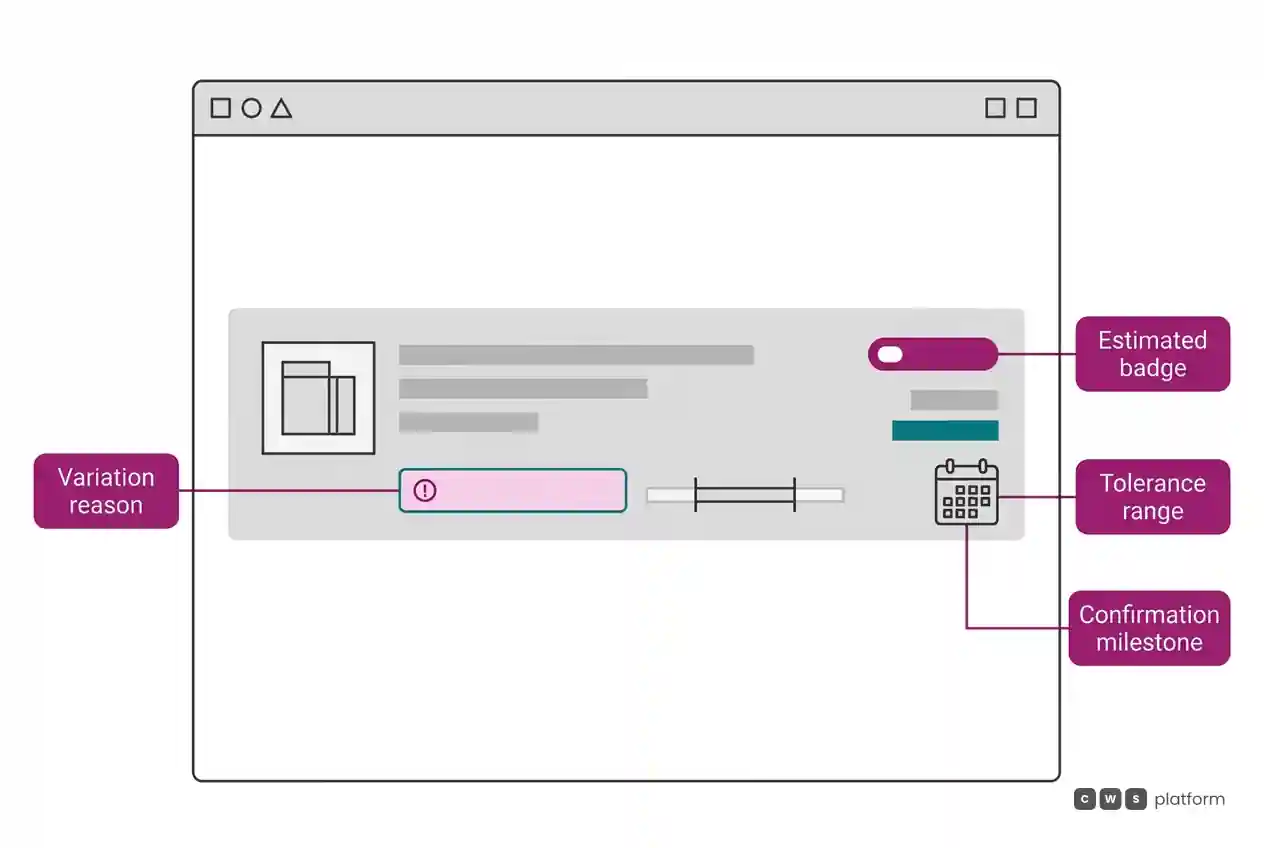
2. The change driver. "Actual weight upon fulfillment," "freight carrier quote pending," or "forex rate at invoicing." A single concise sentence tied directly to the SKU.
3. The variance threshold. How much the price can move up or down. This specific parameter allows the buyer to secure internal spend authorization.
4. The confirmation milestone. At pick-and-pack, carrier dispatch, or invoice creation, alongside the notification channel used.
Corporate procurement agents work within strict sign-off limits. If purchase orders deviate without pre-agreed ranges, the buyer faces internal audit exposure.
Tolerance rules that eliminate order rework
The operational engine behind estimated pricing is an explicit tolerance threshold. For example, an overage of up to 5% driven by catch weight processes automatically; anything exceeding 5% routes back to the purchasing agent for formal acceptance.
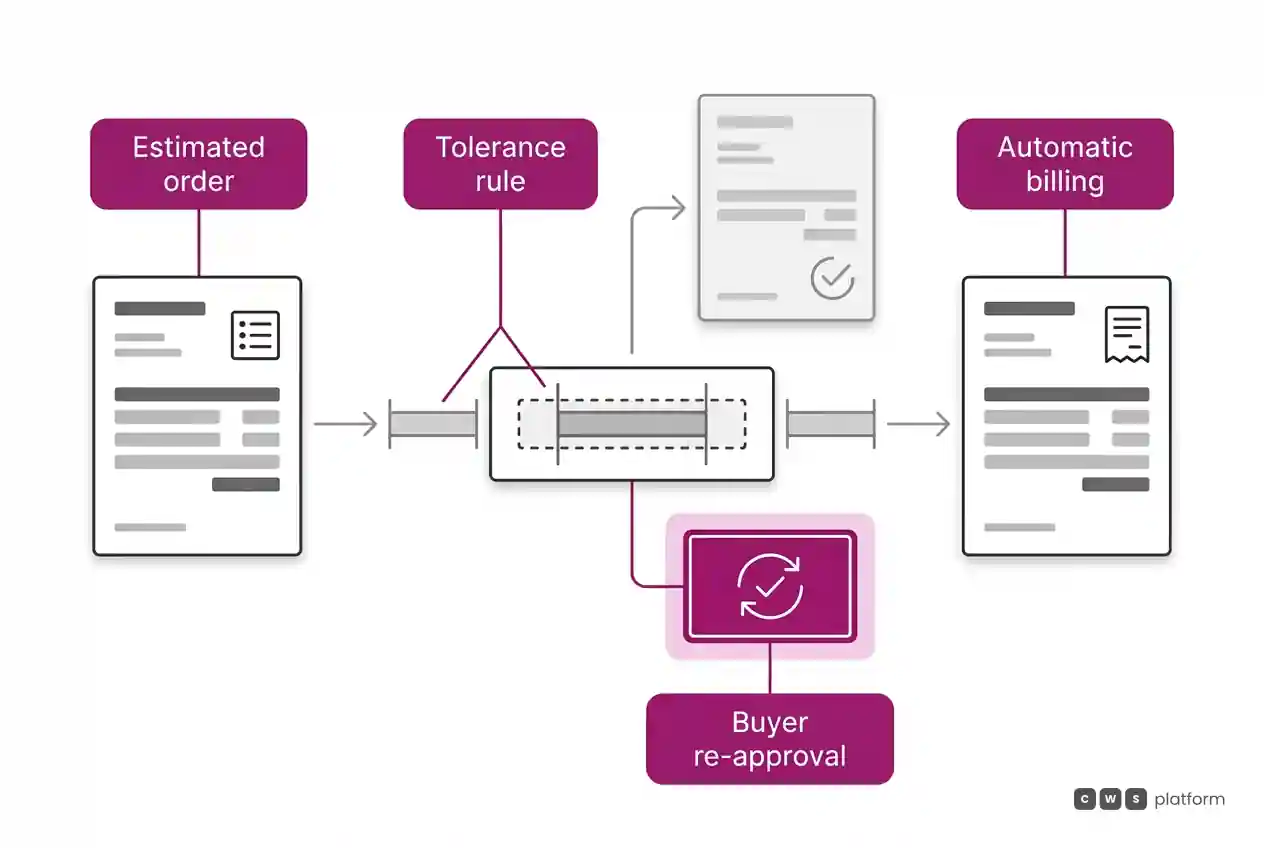
In live enterprise deployments, tolerance parameters are segmented by estimation driver rather than applied globally. Catch weight operates under one margin. Freight quotes require another. Conditional credit approvals carry zero tolerance: they either clear as submitted or require immediate buyer intervention.
Lacking tolerance parameters, nominal pennies trigger support calls. Setting tolerances too broad turns provisional estimates into unacceptable open-ended commitments.
Order processing and invoice reconciliation
Estimated pricing requires enterprise architectures to log two distinct values per line item: estimated total and final confirmed total, complete with variance reason codes. This addresses three core operational issues:
- The procurement team monitors variances and underlying drivers in the customer portal before the final invoice drops.
- Accounts payable matches purchase orders to invoices automatically, avoiding manual line-item reconciliation.
- Sales operations tracks SKUs with severe estimation discrepancies to refine base pricing algorithms.
When calculations require complex merchant workflows, digital buying aligns closely with a structured RFQ process where commercial variables get verified before acceptance, as detailed in a quotation is a proposal of business rules. Adjusting the digital purchase path to support non-final values follows the principles outlined in what to review in B2B checkout design.
Logging estimated versus confirmed values alongside tolerance-triggered buyer approvals is executed through the OMS on CWS Platform, while variable formula logic is powered by the Pricing Engine.
Next step
Audit catalog items and commercial conditions where the order value shifts between checkout and settlement. For each scenario, define the underlying business driver, the acceptable tolerance percentage, and the operational point of final confirmation. This operational matrix serves as your digital portal functional specification.
Frequently asked questions
What is an estimated price on a purchase order?
It is a temporary figure presented when the final billing total depends on data settled post-order, such as actual unit weight, freight quotes, or settlement currency rates.
Can suppliers bill a different amount than the order confirmation?
Yes, provided the variance was contractually governed: the buyer saw the provisional status, understood the pricing variable, agreed to the tolerance limit, and received confirmation alerts. Outside that threshold, standard practice requires re-authorization.
How should platforms inform buyers that line totals may change?
Mark the price explicitly as estimated on the line item, articulate the exact variable factor, specify the percentage range, and identify the confirmation trigger and notification channel.
How does estimated pricing differ from a standard RFQ process?
In a standard RFQ process, commercial terms and final rates are negotiated prior to order issuance. With estimated pricing, the purchase order is issued immediately, and final values settle post-checkout within explicit buyer-approved guardrails.
Read also
About this publication
Published by the Cost of the Sale blog from CWS Platform, covering pricing architectures and order processing in B2B commerce. References no specific client data or proprietary performance metrics.
"responsive, technically engaged, and willing to work through complex commercial rules (negotiated pricing, credit, customer-specific conditions) rather than pushing generic answers"
Is every order costing your operation more?
Request an assessment of your operation or talk straight to a specialist, whichever you prefer.
I'd rather get the next articles on the cost of each order
A weekly roundup of new articles on the cost of each order, only in weeks when there is one. No spam, and you can leave in one click.