Mandatory Updates: Who Pays for Customization at Each Version in SAP, Salesforce, and Adobe
What the public documentation records about versions, end of support, and migration, and how CWS Platform treats updates.

Every commerce platform evolves, and evolution has a price that rarely appears in the commercial proposal: the work of carrying to the new version everything the company customized in the previous one. For the CTO, this work is an item of calendar and of budget, and knowing who carries it out changes the maintenance bill.
This text gathers what SAP, Salesforce, and Adobe publish about their version and migration cycles, and describes how CWS Platform treats the same point. Every fact about the three comes from their public documents, with the original excerpt and the address next to it.
What each vendor publishes about the version cycle
The SAP Commerce Cloud documentation records four points:
- limitation declared by the vendor, recorded in its release notes on September 9, 2026: the Cloud Portal does not allow builds against an update release that is no longer listed as current ("The Cloud Portal will not allow builds against an update release no longer listed", https://help.sap.com/docs/SAP_COMMERCE_CLOUD_PUBLIC_CLOUD/12be4ac419604b01aabb1adeb2c4c8a2/1c6c687ad0ed4964bb43d409818d23a2.html?locale=en-US&state=PRODUCTION&version=v2211).
- limitation recorded in the vendor's documentation on September 9, 2026: continuing to run an unsupported version can put the customer in breach of the SAP contract and lead to its termination ("you could be in breach of your SAP contract", https://help.sap.com/docs/SAP_COMMERCE_CLOUD_PUBLIC_CLOUD/0588d7af89fc491cb274bbc1c737acce/62bdca92a2224177a50cf37ab6d502e3.html?locale=en-US&state=PRODUCTION&version=v2211).
- limitation declared by the vendor, recorded in its release notes on September 25, 2026: the update to JDK 21 and Spring Framework 6.2 requires adjusting custom extensions, with manual code review even when the provided automation is used ("manual code review and updates are necessary", https://help.sap.com/docs/SAP_COMMERCE_CLOUD_PUBLIC_CLOUD/75d4c3895cb346008545900bffe851ce/9efd1f6212134dec8236a146cac4c98a.html?locale=en-US&state=PRODUCTION&version=v2211).
- limitation declared by the vendor, recorded in its release notes on September 9, 2026: SAP explains that it deprecated the Accelerator UI because its tight coupling to the Commerce Cloud code often results in difficult and costly upgrades ("tight dependencies often result in difficult and costly upgrades", https://help.sap.com/docs/SAP_COMMERCE_CLOUD_PUBLIC_CLOUD/7e47d40a176d48ba914b50957d003804/1f1c6885781a4267a99c5d619d1f1edd.html?locale=en-US&state=PRODUCTION&version=v2211).
The Adobe Commerce documentation records three:
- limitation recorded in the vendor's documentation on September 18, 2026: the security-only transitional period for versions 2.4.4, 2.4.5, and 2.4.6 is a one-time exception and will not be extended beyond the published dates ("The security-only transitional period is a one-time exception.", https://experienceleague.adobe.com/en/docs/commerce-operations/release/planning/lifecycle-policy).
- limitation recorded in the vendor's documentation on September 18, 2026: versions 2.4.4 to 2.4.7 will not support MySQL versions released after 8.0, and Adobe advises migrating the database to MariaDB ("strongly advised to migrate their database servers", https://experienceleague.adobe.com/en/docs/commerce-operations/installation-guide/system-requirements).
- limitation declared by the vendor, recorded in its release notes on August 12, 2026: starting with version 2.4.9, PHP 8.2 and 8.3 are no longer supported ("PHP 8.2 and PHP 8.3 are no longer supported.", https://experienceleague.adobe.com/en/docs/commerce-operations/release/notes/adobe-commerce/2-4-9).
Salesforce's documentation for B2B Commerce records two:
- limitation recorded in the vendor's documentation, consulted on October 9, 2026: to complete a store's migration to LWR, all Aura components must eventually be replaced ("all Aura components must be replaced eventually", https://developer.salesforce.com/docs/commerce/lwr-migration/guide/prepare-for-migration.html).
- limitation declared by the vendor, recorded in its release notes, consulted on October 9, 2026: since Summer '25, B2B Commerce for Visualforce receives only patch notes ("maintains only patch notes for B2B Commerce for Visualforce", https://help.salesforce.com/s/articleView?language=en_US&id=commerce.b2b_commerce_release_notes.htm&type=5).
In each of the three, the documentation describes changes of technical base that the customer needs to follow, and what was customized needs to be reviewed when they arrive.
How CWS Platform treats updates
On CWS Platform, all customers run the same version of the platform, and there is no framework change or upgrade project on the customer side. Commercial policy sits in parameters of the Commerce Rules Engine (CDL Workspace), on the principle of configuration over code, and the portal is assembled without code, on a single parameterized template.
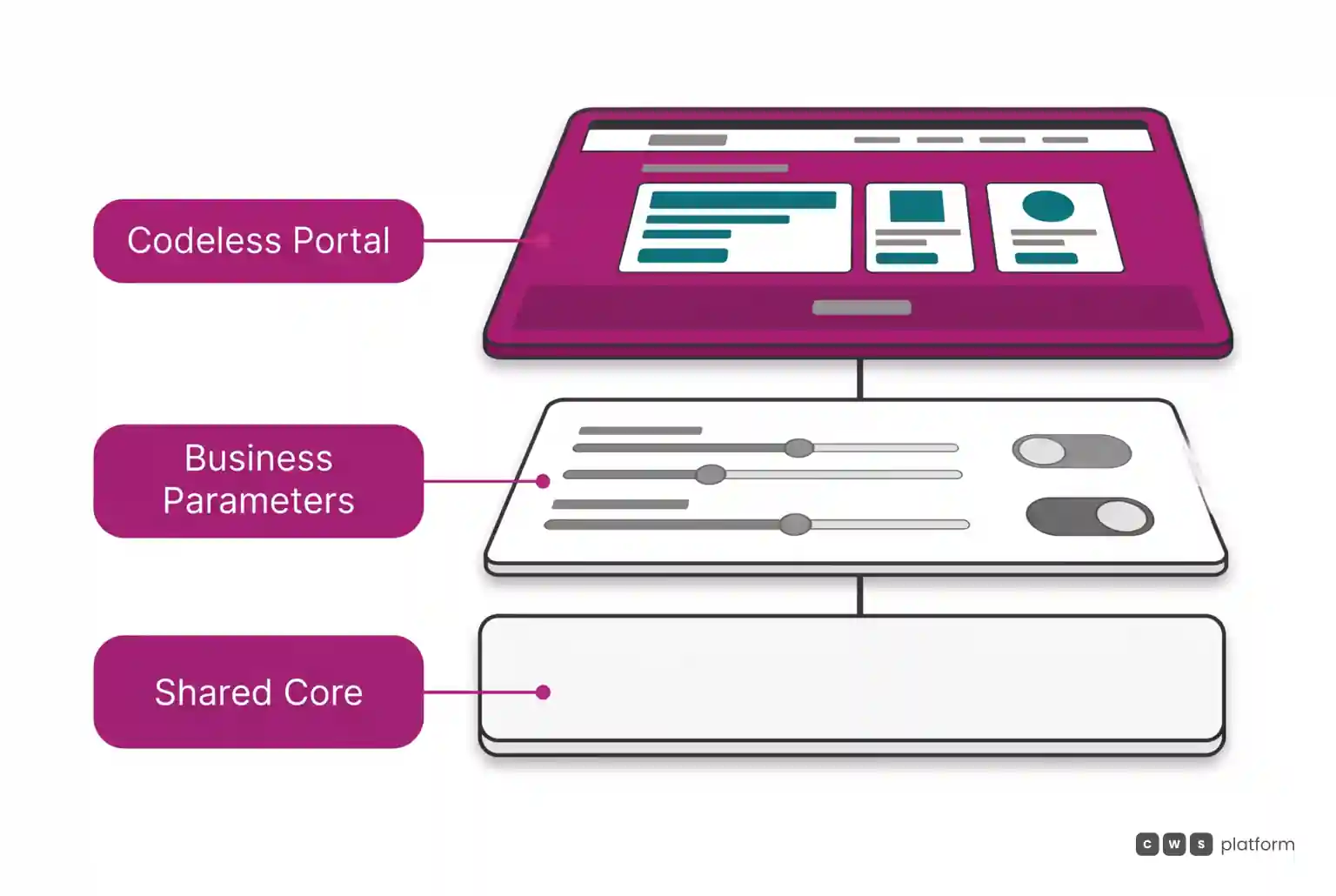
Moving from the v1 pricing model to v2 requires only validation by the customer, with no project on the customer's side.
| question | what the vendors publish | CWS Platform |
|---|---|---|
| How the version evolves | Current releases and end-of-support dates that the customer follows, depending on the vendor. | All customers run the same version of the platform. |
| What happens to what was customized | Extensions and components need to be reviewed or replaced when the technical base changes. | There is no framework change on the customer side. |
| Where commercial policy lives | In extensions, components, and flows maintained by the customer, depending on the vendor. | In parameters of the Commerce Rules Engine (CDL Workspace), changed by configuration. |
What to ask before signing
The decision is not which model is the right one, but how much of your engineering calendar you accept dedicating to the vendor's version cycle. Three questions help: until when the version in production receives fixes; what part of our code needs to be reviewed in the next version; and who carries out the update, our team or the vendor's.
How many times, in the last three years, did your team stop a business delivery to update the platform?
When it makes sense to stay in the SAP, Salesforce, or Adobe ecosystem
Nothing above is, by itself, a reason to change platforms. There are scenarios in which staying in the ecosystem is the right decision.
A company already standardized on SAP. When the organization operates under global corporate guidelines and contracts already signed with the vendor, the edition connected to the back end synchronizes master data and invoices in a structured way, on the clean core strategy.
A commercial operation built on Salesforce. When pipeline, territories, and revenue splitting among teams already live in Sales Cloud, keeping commerce in the same ecosystem preserves that design.
A purchasing structure delegated to the customer, on Adobe. When the buyer company needs to manage its own divisions, users, and purchasing roles, the company accounts of Adobe Commerce resolve this natively.
Where to go from here
If your question is still which architecture fits your operation, and not which vendor to choose, the path is the seven questions that separate B2B commerce architectures.
Brands mentioned in this article
- Salesforce
- SAP Commerce Cloud
- Adobe Commerce
Trademarks and logos belong to their respective owners. Mention does not imply partnership or endorsement.
"responsive, technically engaged, and willing to work through complex commercial rules (negotiated pricing, credit, customer-specific conditions) rather than pushing generic answers"
Want to see this in your operation?
Real B2B operations already run on it.