B2B Customer Portal Launched but Nobody Uses It: Driving Post-Go-Live Adoption
Why commerce tech fails to gain traction without operational alignment, hands-on enablement, and phased rollouts

TL;DR
- A B2B portal that goes live and sits unused almost never suffers from a technology flaw. It suffers from an adoption flaw: customers and sales reps do not know what changed, nor why they should change.
- Every delivered enhancement must reach daily operations through training. Short, hands-on workshops focused on real user workflows align usage, process, and understanding of what the portal actually does.
- Phased rollouts mitigate risk: start with a few operating units, interview active users, make adjustments, and only then expand.
- When a critical integration is delayed, a temporary workaround keeps operations running while the permanent solution is built.
When a B2B portal launches and nobody uses it, the breakdown usually stems from adoption, not the system itself. The solution involves three pillars: connecting every delivered feature directly to the frontline team through brief, practical workshops; rolling out in phases by starting with a small footprint and gathering feedback before scaling; and keeping daily business moving with interim workarounds whenever a critical integration falls behind schedule.
Why a Delivered Portal Fails to Become a Used Portal
Across implementations, the same pattern unfolds repeatedly. The project team delivers the portal, IT celebrates the go-live, and three months later orders still arrive via phone calls, text messages, and email attachments. The immediate temptation is to assume the customer "does not want digital." In reality, the root cause is almost always different:
- The customer does not know they can use it. They received an automated welcome email with credentials, buried among dozens of daily messages, and never logged in.
- The sales rep does not understand what changed. They keep keying in orders the traditional way because nobody demonstrated how the portal makes their job easier.
- The internal operations team does not know how to leverage new capabilities. Improved catalog navigation, updated freight calculation rules, and portfolio reporting features are live, yet no one on the operational front lines learned how to run them.
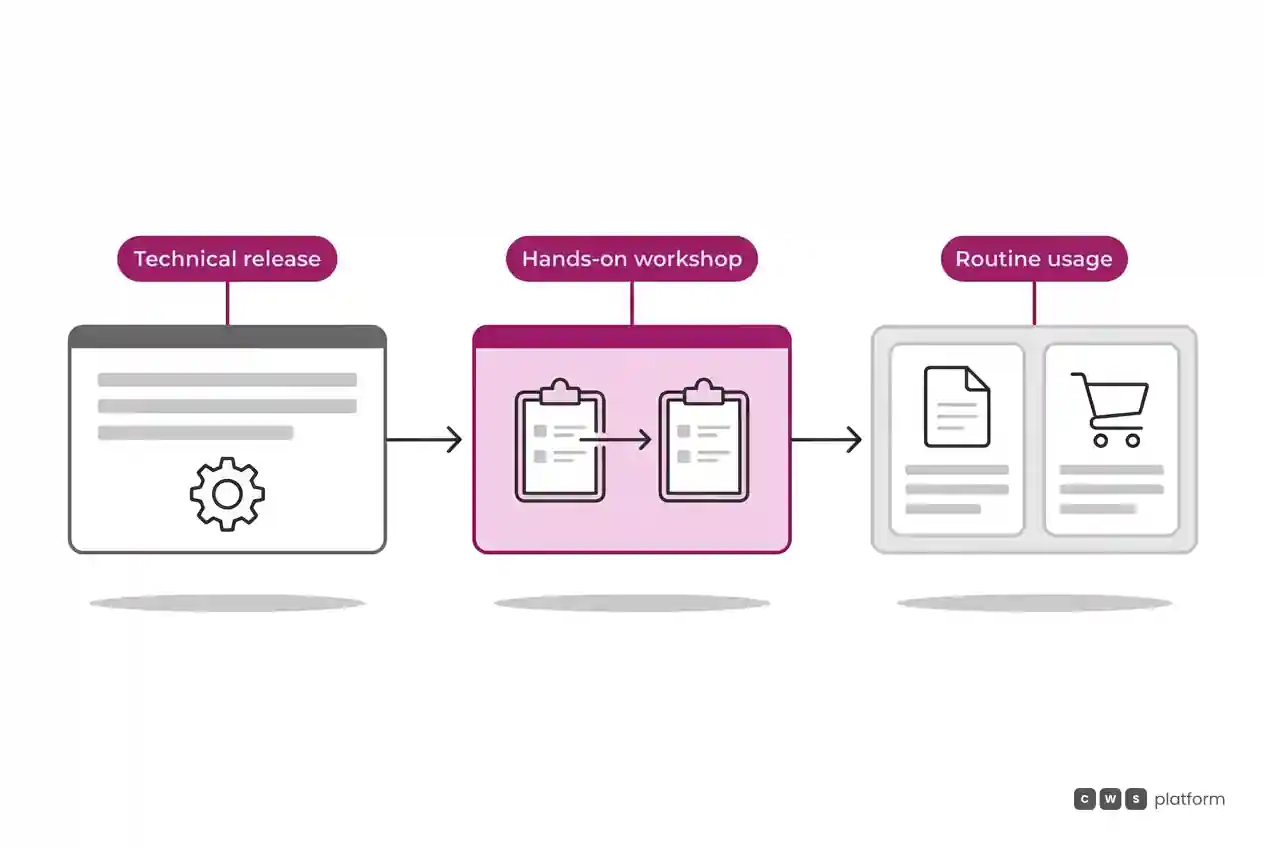
Portal enhancements require dedicated training to translate into daily operations. Without that bridge, the software investment stays locked in the cloud while day-to-day business remains stuck at the order desk.
Workshops as the Adoption Layer
An effective workshop is never a generic tour of every screen. It is a targeted, brief session designed for a specific operational role, built around their actual day-to-day tasks.
For sales reps. A one-hour session showing how to track account activity, build quotes for clients, and view orders that buyers submit directly. The focal point is personal upside: less manual data entry, more time to negotiate and close business.
For client buyers. A twenty-minute walkthrough, ideally with their assigned account rep present, placing an actual live purchase together. Walking through a first real order together is worth far more than any PDF user guide.
For the internal support team. Each new functional release (a business logic rule, a reporting tool, a catalog adjustment) gets a dedicated micro-session with the operators running it. Targeted sessions align daily usage, business processes, and baseline understanding of newly delivered capabilities.
A reliable operational rule: if a feature was deployed without an accompanying workshop, assume it has not yet reached everyday business practice.
Phased Rollouts: Starting Small on Purpose
Switching on the portal for all accounts, sales territories, and regional distribution centers on the same day compounds operational risk and throttles learning. A phased implementation strategy does the exact opposite:
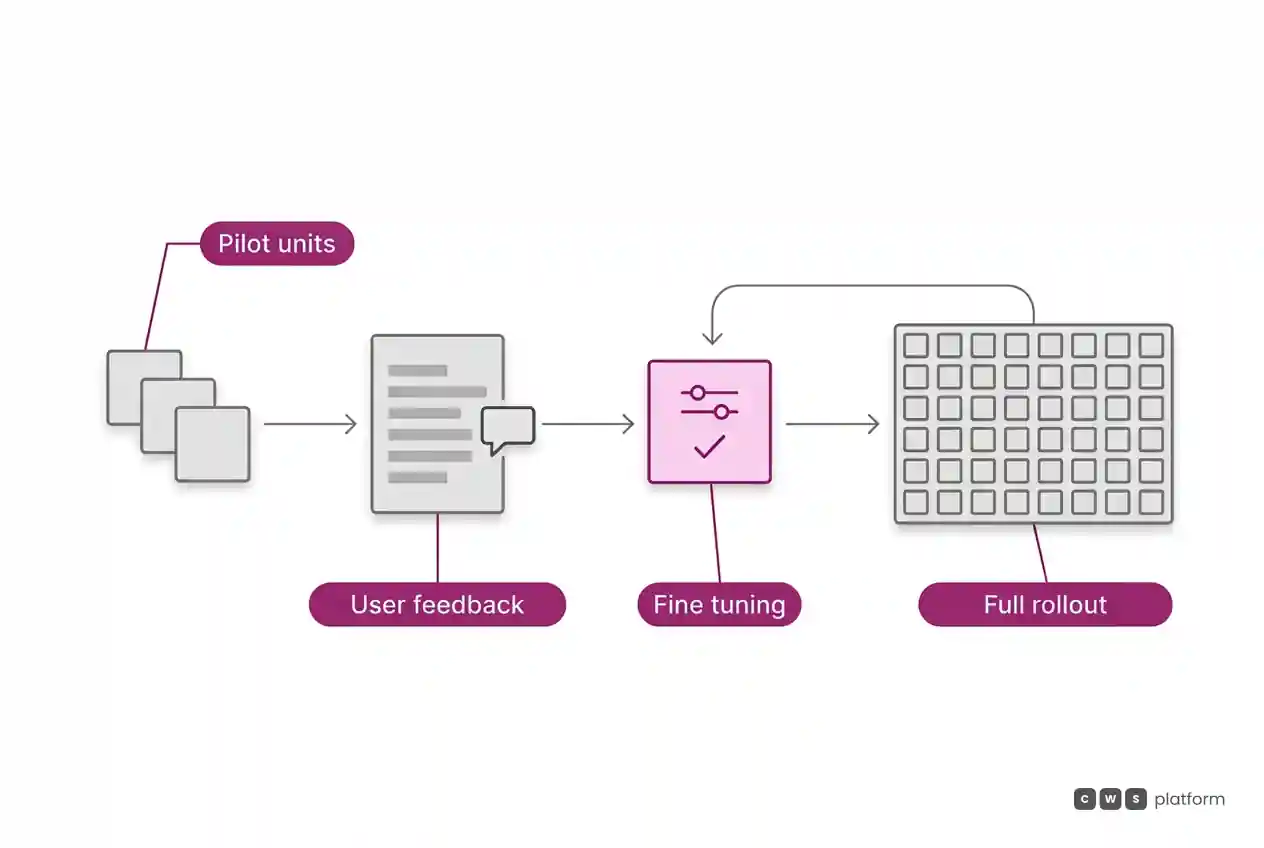
- Initial pilot units. Launch with one or two regional branches, or a defined cohort of accounts managed by an engaged account executive.
- User interviews. After two to three weeks of live purchasing, interview both buyers and internal reps: identify friction points, off-platform workarounds, and requests that still required manual phone support.
- Targeted adjustments. Resolve the friction identified in interviews before exposing the broader customer base to the same bottlenecks.
- Expansion. Roll out the next wave, leveraging an onboarding curriculum that has already been tested and refined.
Piloting with select operating units and gathering direct user feedback curtails risk before full deployment. Furthermore, the operational lessons gathered during wave one become the core onboarding collateral for subsequent phases.
When Integrations Run Late, Operations Must Keep Moving
Sometimes the final hurdle blocking platform adoption is technical: ERP syncing, real-time freight quoting, or automated credit limit checks. Delivering the ultimate API-driven connection often hinges on an external vendor, a third-party integrator, or an internal IT capacity window that keeps slipping.
Under those conditions, critical workflows can remain functional through an interim workaround while the final integration awaits development resources. That might mean a scheduled batch file transfer, a controlled manual verification checkpoint, or a simplified business rule. Any interim solution must have a clear owner, a firm deadline, and documented procedures so it does not turn into a permanent crutch. Still, a controlled workaround is far better than stalling digital adoption across the entire account base. A structured integration sequence by operational priority is covered in systems integration in B2B sales.
Measuring Portal Adoption After Go-Live
- Customers placing their first order, measured against total accounts granted platform access.
- Customers placing second and third orders, which indicates repeat behavioral change.
- Rogue orders received through legacy channels (phone calls, texts, manual emails) from accounts with active logins.
- Delivered features lacking workshop training, tracked as an ongoing backlog risk for the implementation team.
Next Steps
Review every feature deployed to your portal over the past six months and flag those launched without interactive end-user training. Those overlooked releases are your most cost-effective lever for driving immediate adoption. To see how reps and buyers collaborate within a unified digital environment, visit the B2B digital sales portal page.
Frequently Asked Questions
Why do customers avoid using a B2B portal after launch?
Most often, accounts do not know they have access, never received support during their first order, or work with sales reps who still prefer offline ordering. The breakdown is an adoption failure, not a software failure.
What is the best way to train business buyers on a B2B portal?
Through brief, hands-on sessions, ideally guided by their account manager, placing an actual production order together. Guided first-order experiences build confidence far better than a documentation manual.
What is a phased B2B portal rollout?
It is the strategy of launching first to a limited set of accounts or regional branches, gathering feedback, refining the process, and only then expanding. It curbs deployment risk and turns early operational lessons into onboarding templates for later phases.
How do you track B2B portal adoption?
By measuring initial order activation rates, monitoring recurring reorders from active accounts, and auditing how many manual orders still bypass the platform from enabled clients.
Read Also
About This Publication
This article outlines implementation patterns observed during B2B portal deployments led by CWS Platform (cws-platform.com). It does not reference specific client accounts or proprietary outcome metrics.
"responsive, technically engaged, and willing to work through complex commercial rules (negotiated pricing, credit, customer-specific conditions) rather than pushing generic answers"
Does your implementation never end?
Request an assessment of your operation or talk straight to a specialist, whichever you prefer.
I'd rather get the next articles on implementation
A weekly roundup of new articles on implementation, only in weeks when there is one. No spam, and you can leave in one click.