B2B Portal Go-Live Checklist: Must-Haves vs. What Can Wait
How to isolate hard blockers from post-launch enhancements so your B2B eCommerce launch does not derail revenue or operations.

TL;DR
- A B2B portal can go live without everything in place, but not without what is critical: working payments and trade credit, correct customer access, pricing and inventory verified for your most complex accounts, orders flowing directly into the ERP without manual rekeying, and clear ownership for issues during the first month.
- Advanced commercial rules, like order multiples, tiered volume discounts, and part number search restrictions, can roll out later as continuous enhancements, provided a temporary manual workaround is agreed upon.
- A checklist only protects you if it acts as a hard stop: any open critical item postpones the launch date, with zero last minute exceptions.
- The practical rule is to split your checklist into two buckets, "blockers" and "enhancements", and formally sign off on the first.
Before going live with a B2B portal, everything capable of generating a wrong order, a lost payment, or a locked out customer must be fully operational: payment terms and credit lines, account onboarding and permissions, verified pricing and stock, automated order injection into the ERP, and a dedicated hypercare support plan for the first month. Features that refine the ordering experience without causing fulfillment errors can wait for future releases, provided your team establishes an agreed upon manual workflow in the meantime.
Launch date pressure is inevitable. Sales already announced it, executive leadership wants to see the platform live, and the systems integrator has another project lined up. This exact scenario is why your checklist must have the authority to block the launch, not just act as a reminder.
What Blocks Go-Live
Payments and credit. Every payment method offered on the portal must be tested end to end, including refunds, declines, and ACH reversals. Available credit limits must be checked dynamically at checkout to block orders that exceed thresholds. Unreconciled payments are the most expensive defects to clean up post launch.
Customer access and account hierarchy. The right buyers must be able to log in with accurate corporate identifiers, correct subsidiary or location assignments, and assigned user roles. They must only see what belongs to them: custom pricing, past orders, invoices, and payment statements. A client viewing another company's price sheet is not a usability issue, it is a critical security incident.
Pricing and contract terms. Verify logic against your most complex accounts rather than standard scenarios: customers with custom contracted tiers, multi location purchasing agreements, or active promotional allowances. Testing with the average account always passes.
Inventory. Multi warehouse and regional distribution center balances must match the ERP, with refresh intervals explicitly documented and communicated to your sales team.
ERP order flow. An approved portal order must land in the ERP with identical pricing, terms, and line items, requiring zero manual re-entry. In addition, fulfillment statuses (invoiced, shipped, tracking number) must sync back to the portal in real time.
Month one hypercare support. Clearly designate who supports buyers who encounter order errors, set explicit SLAs, and define who fixes technical issues. Without strict ownership, every platform glitch immediately turns into an escalation call to the field rep.
What Can Wait
Across distribution and wholesale digital commerce implementations, a familiar pattern emerges: advanced capabilities such as order pack multiples, tiered volume discounting, and restricted catalog search by part number often deploy iteratively after launch rather than on day one. This phased approach works well, provided three conditions are met:
- An established manual workaround exists. While dynamic tiered discounting is pending release, inside sales reps manually adjust quotes within their approval thresholds, and the customer expects this process.
- The missing feature does not cause order errors. If lacking order pack multiples means a buyer can order 7 individual units of an item only shipped in cases of 6, this ceases to be a post launch enhancement and becomes a critical launch blocker.
- Each item has an assigned owner and hard deadline. Deferred features must carry concrete target dates and dedicated engineering resources so they do not languish indefinitely on a backlog.
How to Turn the List into a Hard-Stop Checklist
1. Separate items into two distinct buckets. "Launch blockers" and "post launch enhancements". The debate over where an item belongs must happen during initial discovery, never the week before go-live.
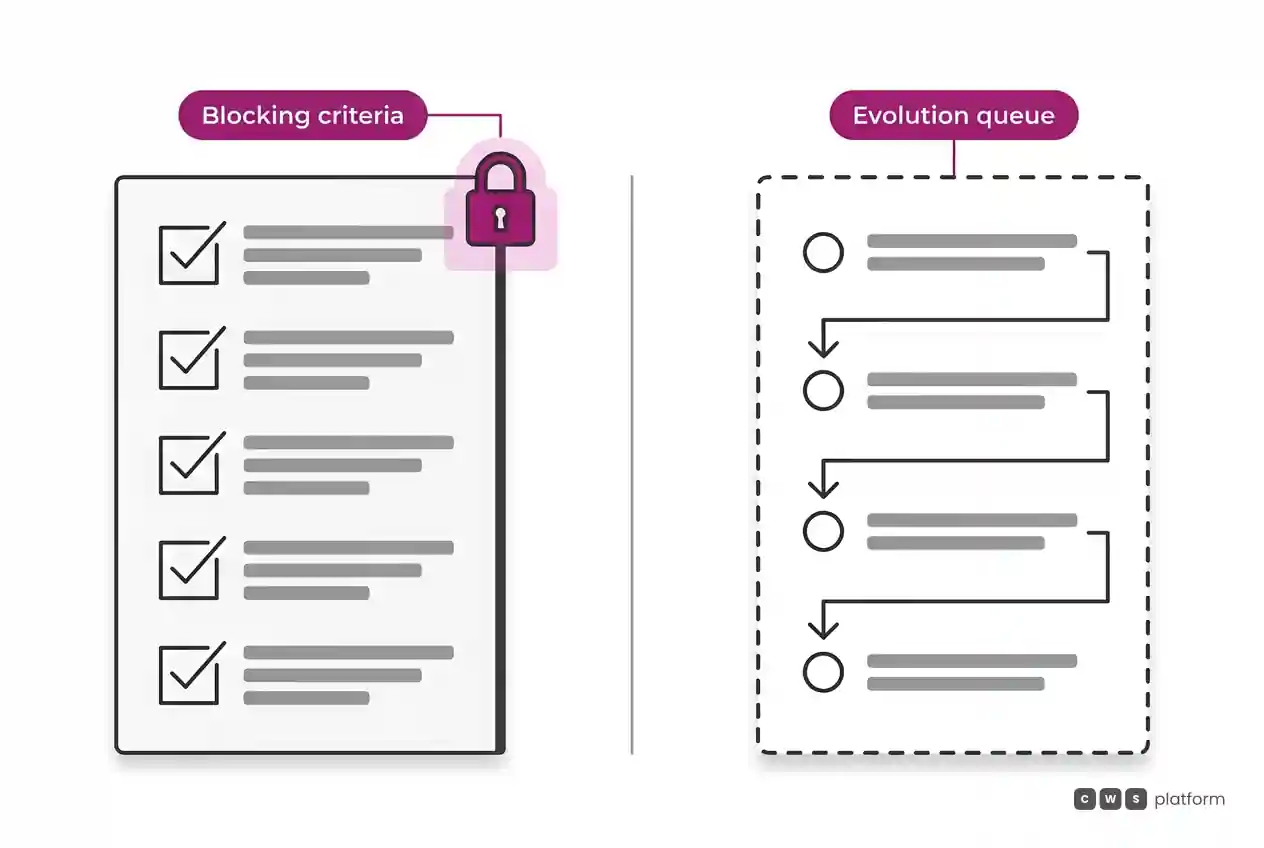
2. Define concrete pass/fail tests for every critical item. "Payments working" is not an acceptance test. "An order from a buyer exceeding their credit limit is blocked with a clear on screen explanation" is.
3. Require formal business and technical sign-off. The business owner and technical lead must verify and sign off, line by line, that each critical test passed in a staging environment mirroring production.
4. Document all late configuration changes. Every environment variable or parameter updated during the final deployment window must be logged alongside its operational justification, ensuring the month one support team knows what changed and why.
In practical B2B deployments, a successful go-live depends on locking down critical transactional flows while aligning sales on the immediate post launch roadmap. For the next step of driving user adoption, see ready B2B portal that no one uses, and explore buyer onboarding best practices in first login to the B2B portal.
Next Step
Audit your current project plan and categorize every open deliverable as either a "blocker" or an "enhancement", attaching verifiable test criteria to each critical entry. For an enterprise portal architecture featuring native trade credit, automated ERP workflows, and payments integrated from day one, explore the B2B digital sales portal by CWS Platform, and review advanced payment workflows in Checkout & Payments.
Frequently Asked Questions
What must be tested before a B2B portal go-live?
End to end payment and credit processing, buyer access and account permissions, contract pricing and multi location stock across complex accounts, touchless ERP order injection, and status synchronization back to the customer portal.
Can I launch a B2B portal without all business rules in place?
Yes, as long as omitted rules cannot generate unfillable orders, a documented manual workaround exists, and each deferred item has an assigned owner and committed delivery date.
What is the difference between an ERP rollout and a B2B portal launch?
The ERP is the internal system of record for accounting, inventory, and operations. The B2B portal is the customer facing digital storefront where accounts and sales reps place orders. While the portal relies on the ERP for master data and inventory, portal launch success is measured by the customer's direct purchasing experience.
Who should approve the go-live decision?
Both the commercial business lead and the technical architect, reviewing each line item together on a checklist where critical failures trigger an automatic postponement.
Read Also
- Low stock on the B2B portal: what to show so buyers do not call
- B2B portal search: helping buyers find parts using their own terminology
About This Publication
Article from the Cost of Sales blog by CWS Platform, focusing on enterprise B2B portal deployment strategies. It does not reference specific client accounts or confidential performance benchmarks.
"responsive, technically engaged, and willing to work through complex commercial rules (negotiated pricing, credit, customer-specific conditions) rather than pushing generic answers"
Does your implementation never end?
Request an assessment of your operation or talk straight to a specialist, whichever you prefer.
I'd rather get the next articles on implementation
A weekly roundup of new articles on implementation, only in weeks when there is one. No spam, and you can leave in one click.