The 4 Types of B2B AI and the Operational Risk of Each
Why confusing internal productivity with transactional agents causes massive B2B budget overruns

TL;DR
- In B2B commerce, "AI" covers at least four different things: internal team productivity, IT agent platforms, customer-facing business knowledge, and customer-facing transactional agents.
- Each carries its own risk, cost, and timeline. The first can be tested in weeks; the fourth touches pricing, credit terms, and orders.
- The most expensive mistake is budgeting the fourth with the cost of the first, simply because both are labeled "AI" on an executive slide.
- Separating these four tiers before greenlighting a project clarifies exactly where the value lies and where the risk begins.
The four types of B2B commerce AI are: internal productivity AI (teams drafting, summarizing, and analyzing faster), IT agent platforms (automating technical tasks and integrations), customer-facing knowledge AI (answering product, fitment, and policy questions from company data), and customer-facing transactional AI (agents building orders, applying custom pricing, and verifying credit). Risk increases across these levels as each step moves closer to revenue and the customer.
Lumping all four into a single buzzword causes teams to size complex transactional systems with the budget of simple productivity tools. Evaluating practical applications of AI for distributors requires separating these tiers early.
1. Internal Productivity AI
What it is. Tools that support internal staff: an outside sales rep summarizing an account's order history before an on-site visit, a pricing analyst drafting a complex quote proposal, or a procurement manager comparing vendor bids.
Risk. Low and contained. Errors are visible to the user, who corrects them before anything leaves the building. The main safeguard is data governance: proprietary quotes, wholesale price sheets, and customer PII must not be fed into unvetted public models.
Cost and timeline. SaaS seat licenses and basic onboarding. Delivers measurable productivity gains in weeks.
2. IT Agent Platforms
What it is. Autonomous agents handling internal technical workloads: monitoring API integrations between ERP and commerce platforms, generating regression tests, cleaning product master data, or flagging stuck EDI order queues.
Risk. Moderate. These agents interact directly with core systems, but they do not face the customer. A malfunction can disrupt an integration or corrupt a database record, though the internal engineering team catches it first. It requires scoped permissions, strict audit logging, and human-in-the-loop oversight.
Cost and timeline. Higher than basic productivity tools because it requires secure system-level connectivity. Deployments take months rather than weeks.
3. Customer-Facing Knowledge AI
What it is. An intelligent assistant that answers buyer inquiries based on proprietary business data: technical part cross-referencing, regional freight lead times, and warranty or return policies. Technically, this typically involves retrieval-augmented generation (RAG) querying structured databases and technical documents before generating a response.
Risk. Moderate to high. Errors now directly reach the buyer. An incorrect part compatibility answer results in costly returns and RMA freight; a misstated return policy causes commercial friction. Quality depends almost entirely on data hygiene: if product catalogs, spec sheets, and terms are outdated, the assistant simply delivers bad information with confident phrasing.
Cost and timeline. The core expense is rarely the underlying language model. It lies in cleansing, structuring, and maintaining the knowledge base the model queries.
4. Customer-Facing Transactional AI
What it is. Autonomous agents acting as transactional sales reps: building a bill of materials, applying customer-specific pricing tiers, offering approved volume discounts, running real-time credit checks, and submitting purchase orders directly into the ERP.
Risk. The highest of all four tiers. Here, mistakes create immediate financial exposure: unauthorized margin erosion, accepted orders for accounts on credit hold, or unapproved delivery terms. These agents must operate within rigid programmatic guardrails, with absolute business limits they cannot bypass, and complete audit trails for every decision. Implementing transactional AI for distributors requires zero tolerance for hallucinated commercial terms.
Cost and timeline. This tier demands a modern commerce platform underneath: customer-specific pricing, credit limits, real-time inventory, and commercial rules consolidated in an engine the agent can query and respect. This transactional layer is where CWS Platform operates through its 6 AI Agents: AI orchestrates the interaction while the commerce platform enforces business logic. How wholesale leaders govern these parameters is explored in depth in when an AI agent negotiates on your behalf, who sets the boundaries?.
Why Separate the Four Before Approving a Project
Because each category has distinct budgets, delivery timelines, and executive sponsors. Approving an "AI initiative" on a Type 1 schedule with Type 4 expectations guarantees budget overruns and missed deadlines. This common operational pitfall is detailed in why B2B AI projects blow through their budgets.
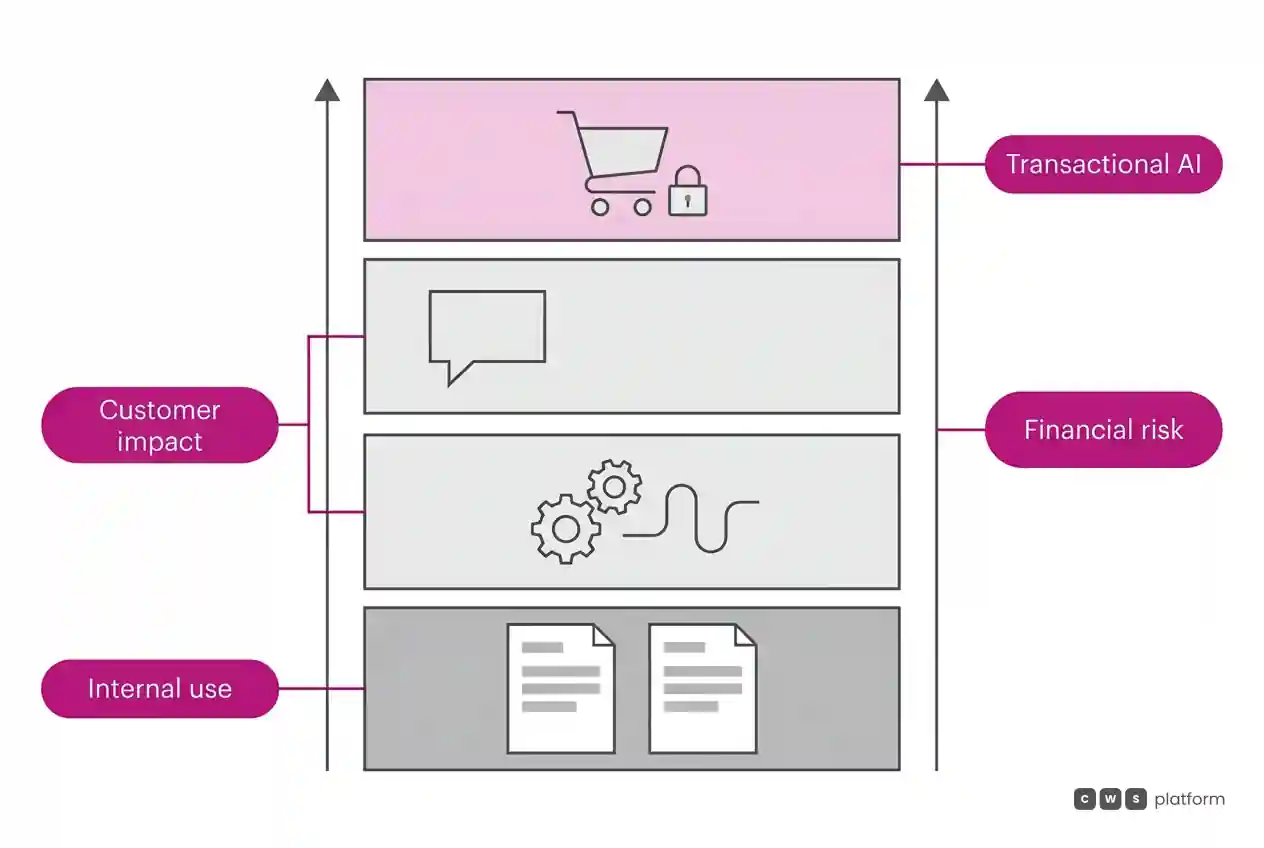
Three operational questions help classify any enterprise AI proposal:
- Who sees the output first? Internal employees (Types 1 and 2) or external buyers (Types 3 and 4)?
- Does the AI only answer, or does it execute? Providing specs is Type 3. Adjusting pricing, drafting contracts, or creating orders is Type 4.
- What data must it access? If it requires contract pricing, real-time inventory, and account credit terms, the project depends on underlying commerce and ERP architecture, not just an AI model.
Where to Begin
Start with the lowest-risk application that solves an immediate operational bottleneck, and use those learnings to structure data for subsequent phases. The data standardization required to clean catalog attributes and business rules for Type 3 knowledge tools lays the groundwork for Type 4 transactional autonomy.
Deploying practical AI for distributors is about removing manual friction, not replacing human relationships: when inside sales reps stop manually keying orders from PDFs, they gain the bandwidth to negotiate larger contracts and prospect key accounts.
Before the next executive steering committee meeting, audit all active enterprise AI initiatives and assign them to these four tiers. That exercise quickly reveals whether two seemingly similar projects carry wildly different financial risks.
Frequently Asked Questions
What are the main types of AI used in B2B commerce?
Internal team productivity, IT agent platforms, customer-facing knowledge assistants, and customer-facing transactional agents that build orders, apply contract pricing, and verify credit lines. Financial risk increases sequentially across these tiers.
Which type of B2B AI carries the highest operational risk?
Transactional AI, because errors directly create financial liability: unauthorized discounts, processed orders for accounts on credit hold, or commitments on unapproved shipping terms. It requires programmatic guardrails that an agent cannot override.
Why do B2B AI implementations often run over budget?
Companies frequently budget initiatives at the cost of generic productivity tools while scoping the requirements of complex transactional systems. The primary development cost stems from catalog clean-up, ERP integration, and business rule enforcement, not the foundation model itself.
Where should a wholesale distributor or industrial manufacturer start with AI?
Begin with the lowest-risk application solving a validated internal bottleneck, such as team productivity tools or product spec lookup assistants. Organizing technical product catalogs and commercial policies during this phase builds the operational foundation needed for transactional AI for distributors down the road.
About This Publication
An article from O Custo da Venda by CWS Platform, covering framework design and risk classification for enterprise B2B AI initiatives.
"responsive, technically engaged, and willing to work through complex commercial rules (negotiated pricing, credit, customer-specific conditions) rather than pushing generic answers"
Does your implementation never end?
Request an assessment of your operation or talk straight to a specialist, whichever you prefer.
I'd rather get the next articles on implementation
A weekly roundup of new articles on implementation, only in weeks when there is one. No spam, and you can leave in one click.