The Amazon Effect and the Invisible B2B Tax
Why wholesale commerce digitized the purchase order but not the market, and how transaction frictions shape enterprise pricing

Between 2008 and 2010, an American multichannel retailer with both brick-and-mortar locations and an online store changed the price of a given product, on average, in roughly 15% of months. Between 2014 and 2017, that frequency had doubled to nearly 30%. For products easily found on Amazon, the pace of change was even faster.
The data comes from Alberto Cavallo, a professor at Harvard Business School, and was presented in August 2018 at the Jackson Hole Economic Symposium, the annual gathering where the Federal Reserve brings together central bankers and economists. Jerome Powell was in the audience. The subject of the paper was a concept that had become a regular talking point across monetary policy desks: the Amazon Effect.
I am opening this column with it for a specific reason. For over a decade, my co-founder Fernando Cymrot and I have built CWS Platform on a core conviction: transaction costs are an invisible tax that every company pays and almost none measures. The Amazon Effect remains the best natural experiment I know of regarding what happens to an economy when that tax drops. B2B commerce between companies is where it remains the highest.
What Was Actually Proven
It is worth separating what the academic research demonstrated from how it was popularized, because the public narrative became far simpler than the underlying evidence.
First finding: online prices rose more slowly. Austan Goolsbee (University of Chicago) and Peter Klenow (Stanford) used transaction data from Adobe Analytics to build a digital price index, comparing it category by category against the official U.S. Consumer Price Index (CPI). Between 2014 and 2017, online inflation ran at least 1 percentage point per year below official inflation for identical product categories. When factoring in the entry of new goods, that gap widened to over 3 percentage points annually. The authors themselves treated this primarily as a measurement issue: transaction data covered a portion of e-commerce, while the official CPI captured very little of that specific channel. It was an insight into what the traditional thermometer missed, rather than definitive proof that Amazon single-handedly suppressed aggregate inflation.
Second finding: pricing mechanics shifted fundamentally. This stems from Cavallo's research, and to me, it represents the most critical insight. Beyond the sheer frequency of price adjustments, he showed that prices became significantly more uniform across geographic territories: Amazon charged identical prices across different U.S. ZIP codes in 91% of cases, while Walmart, Best Buy, and Safeway did so in 78% of cases. Furthermore, prices reacted much faster to nationwide common shocks. For Walmart products easily found on Amazon, exchange-rate pass-through reached 44%, compared to 26% for products facing less direct digital competition. For fuel price shocks, the pass-through was 28% versus 19%.
Third finding: the downward impact on headline inflation exists, but it is modest and model-dependent. In 2017, Goldman Sachs estimated, as reported in financial media at the time, that the Amazon Effect shaved approximately 0.1 percentage points off core PCE, the Fed's preferred inflation gauge. In 2018, the Bank of Japan estimated an impact between 0.1 and 0.2 percentage points on Japanese core inflation, noting data constraints. These are fractions of a percentage point, not the definitive explanation for the low-inflation environment of the prior decade.
What Was Not Proven
This is where the discipline of this column must hold firm.
No one proved that Amazon alone kept American inflation subdued. The 2010s experienced low inflation for multiple concurrent reasons: China's integration into global value chains, well-anchored inflation expectations, and sluggish aggregate demand following the 2008 financial crisis. Disentangling the specific impact of Amazon from broader e-commerce trends, and separating e-commerce from the broader forces of globalization and technology, remains an econometric challenge that no paper fully resolves. The correlations are robust. Macroeconomic causality remains open to debate.
Moreover, there is an outcome that the academic research anticipated and that 2021 and 2022 confirmed. If prices react faster and more uniformly across the board, they move faster in both directions. Cavallo wrote in 2018 that retail prices would experience "faster and larger pass-through" of broad cost shocks. When the pandemic hit, accompanied by supply chain disruptions and surging energy costs, U.S. CPI inflation peaked at 9.1% year-over-year in June 2022. Digital commerce did not stop that surge.
This is why I favor a more precise definition over conventional wisdom: the Amazon Effect is not an effect of direction, it is an effect of velocity. Digital markets do not inherently guarantee permanently lower prices. They compress the friction between information and price formation. When competitive pressures mount, prices drop faster. When input costs surge, prices rise faster.
Why It Works: Transaction Costs
In 1937, Ronald Coase asked why firms exist if markets are so effective at allocating resources. His answer: because using the market carries a cost. Finding a supplier, comparing offerings, negotiating terms, drafting contracts, and enforcing compliance all take resources. Oliver Williamson expanded this into a comprehensive theory, proving that these costs expand alongside uncertainty, asset specificity, and the threat of opportunism. Douglass North scaled this concept to macroeconomic institutions: institutions represent the rules of the game, and poor rules make every transaction more expensive.
I frame these friction points across four structural pillars: search, negotiation, coordination, and execution.
Consumer digital commerce primarily dismantled the first pillar. George Stigler demonstrated back in 1961 that price dispersion across markets is largely an artifact of search costs. The consumer internet demolished those search costs. In 2000, MIT researchers Erik Brynjolfsson and Michael Smith observed online prices for books and CDs that were 9% to 16% lower than in brick-and-mortar stores. Yet they also documented a nuance often overlooked: price dispersion remained elevated. Searching had become cheap, but not frictionless, and sellers adapted by making direct comparisons harder. Glenn and Sara Ellison defined this dynamic as obfuscation.
Keep that nuance in mind. It matters for B2B.
B2B Is Already Digital. Yet It Remains Costly.
When I suggest extending the logic of the Amazon Effect to enterprise trade, a fair objection immediately arises: B2B commerce has been digital for decades. That is true. According to 2019 U.S. Census Bureau data, 67.8% of U.S. manufacturing shipments and 33.3% of wholesale sales flowed through electronic channels, primarily Electronic Data Interchange (EDI), the automated exchange of documents between enterprise systems. By contrast, retail stood at just 10.7%.
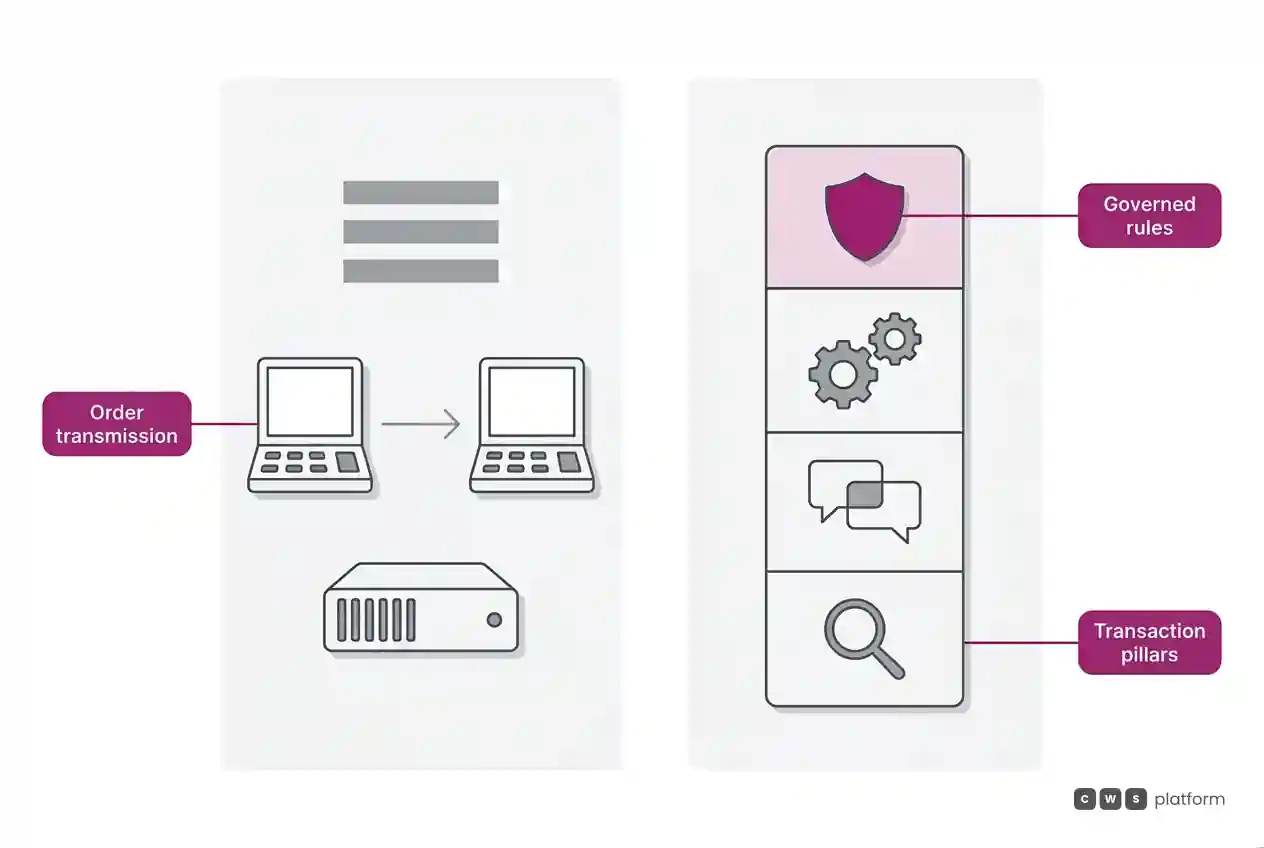
Herein lies the paradox. B2B digitized the purchase order, but it never digitized the market mechanism. EDI reliably pushes a purchase order from one ERP to another. What it fails to do is bring transparency to the complex operational pricing that precedes the order.
In B2B trade, prices rarely sit on an open shelf. A price lives in a customer-specific matrix, a master services agreement, a tiered volume-rebate schedule, an internal approval workflow, negotiated payment terms, and, quite frequently, inside the head of an account executive. In B2B, a quote is not a simple price check. It is an evaluated proposal weighed against multiple overlapping business rules spread across ERPs, CRMs, and offline spreadsheets, which frequently contradict one another.
This structural friction produces inefficiencies familiar to any manufacturing, distribution, or wholesale executive:
- Severe information asymmetry surrounding net pricing and real-time availability;
- Manual, highly fragmented quoting and order workflows;
- Heavy overhead tied to quote negotiation and administrative intermediation;
- Limited liquidity and low transparency between buyers and suppliers;
- Friction in comparing complex proposals or onboarding alternative vendors.
Across all four pillars, B2B continues to pay an exorbitant friction tax: search is challenging due to technical product configurations, negotiation is sluggish because it depends on manual reviews, coordination is brittle across multi-party inventory, credit lines, and freight, and execution is expensive because every operational exception requires human rework.
The Hypothesis
What I propose to explore, and what this column will examine in upcoming articles, is the following:
Commerce digitization is not merely a sales channel migration. When it genuinely drives down transaction costs across all four pillars, it restructures market efficiency. At enterprise scale, it alters how prices form across the broader economy. Because B2B commerce is more fragmented and carries significantly higher transaction costs, it has the potential to unleash this effect with an intensity matching or exceeding retail.
Notice what this hypothesis does not claim. It does not state that B2B digital platforms will permanently depress inflation. It states that if the Amazon Effect was fundamentally an engine of pricing velocity and market mechanics, enterprise commerce retains far more friction to strip away. Consequently, it offers wider latitude for this mechanism to operate: pricing reacting rapidly to cost shocks and competitive pressure, lower unjustified dispersion among comparable commercial accounts, and less margin surrendered to the overhead of selling itself.
In B2B, the initial payoff will rarely surface on the public list price. It surfaces in the cost to serve: what it costs an enterprise to process an order, clear an approval threshold, and remediate an exception. It is the exact operational logic that allows a lower-tier customer with complex operational requirements to become profitable once commercial logic runs autonomously.
Where AI Agents Enter the Equation
If the consumer internet dismantled search costs, autonomous AI agents are positioned to dismantle the remaining three pillars simultaneously.
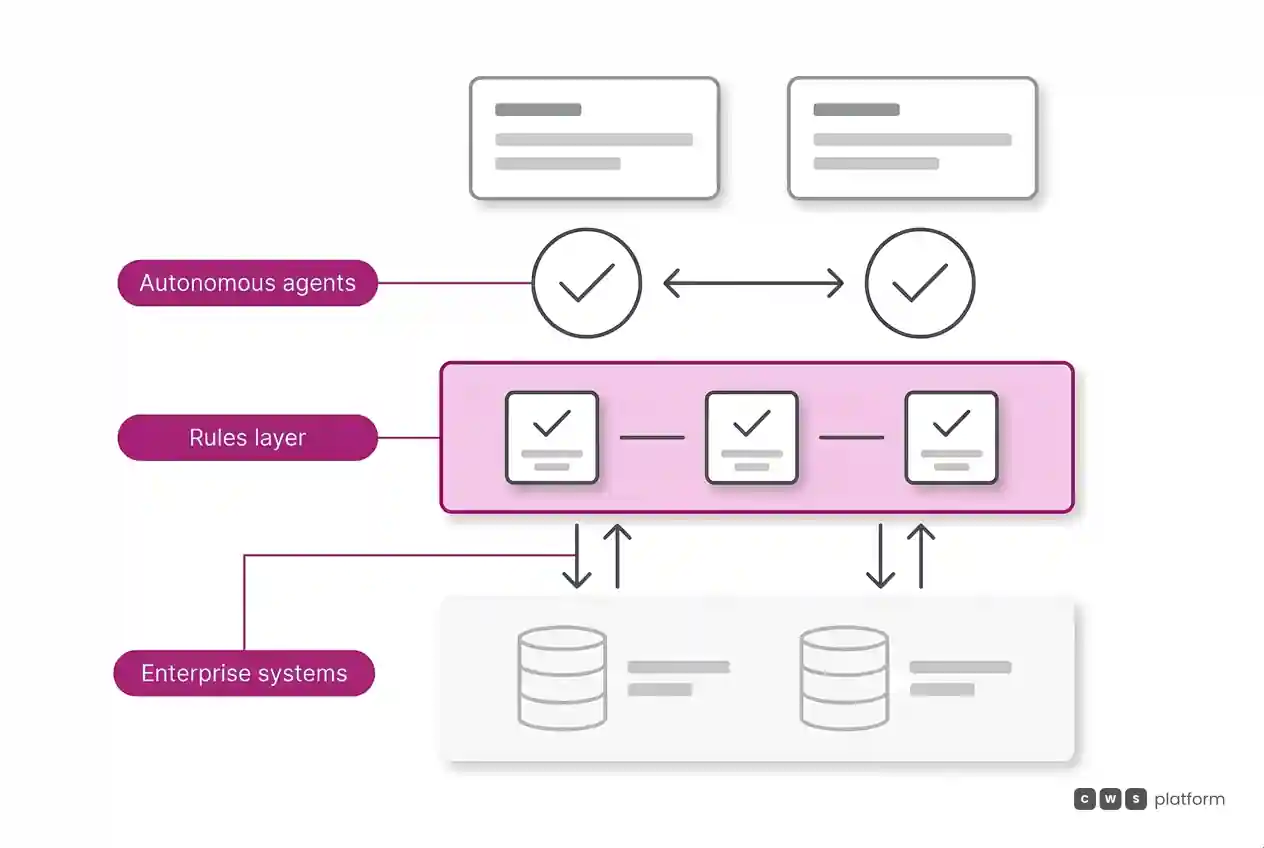
In November 2025, an NBER working paper by Shahidi, Rusak, Manning, Fradkin, and Horton surfaced with an evocative title: The Coasean Singularity? The underlying inquiry is purely Coasean: what happens to markets when autonomous software agents, acting on behalf of individuals and enterprises, can discover, negotiate, and execute transactions at near-zero marginal cost? The authors offer a measured conclusion. While transaction costs could plummet dramatically and unlock novel market structures, new structural frictions emerge: market congestion, when too many agents pursue the same supply, and automated pricing obfuscation, scaling the very dynamics Ellison described years ago. The net welfare effect, they note, remains an empirical question.
Within B2B commerce, I would add an essential operational condition: an autonomous agent can only reduce transaction costs if it executes against explicit, codified business rules. A procurement agent negotiating directly with a vendor agent without an underlying governance layer defining contract limits, payment terms, trade credit, and pricing thresholds does not reduce friction. It merely automates chaos. Enterprise-grade AI in B2B does not invent pricing on the fly. It operates on governed corporate rules, version-controlled, auditable, and directly synced with core enterprise systems.
Countervailing Forces
Any serious thesis must examine its failure modes. I see four primary risks.
Market Concentration. The identical mechanisms that compress friction inherently reward enterprise scale. Digital marketplaces gravitate toward winner-take-all dynamics, and concentration grants pricing power. The Federal Trade Commission has pursued antitrust litigation against Amazon since 2023, alleging pricing distortions: an internal algorithmic initiative, dubbed Project Nessie, reportedly tested price increases that competitors mirrored, allegedly extracting over $1 billion in excess profits, alongside marketplace practices discouraging sellers from offering lower prices on alternative channels. Amazon disputes these claims and maintains the algorithm was discontinued. These allegations remain unresolved, with trial proceedings scheduled for March 2027. Yet the lawsuit illustrates that the Amazon Effect and concentrated platform dominance can push markets in opposing directions.
Algorithmic Coordination. Algorithmic pricing responds instantly to competitors, but it can also learn tacit coordination. This risk escalates when competing enterprises deploy identical commercial optimization models.
Platform Dependency. Any enterprise that outsources its core pricing rules, customer intelligence, and primary sales interfaces to a third-party marketplace ends up paying a toll that did not previously exist. The captured operational efficiency simply shifts into external hands.
Market Volatility. As 2022 demonstrated, high-velocity markets transmit operational shocks far faster. This necessitates tighter internal governance, not looser controls.
What This Means for Decision-Makers
For executives across manufacturing, distribution, and wholesale, I draw five practical takeaways from this shift.
- Digital commerce is not a channel project; it is a transaction cost initiative. Tracking e-commerce adoption strictly as a percentage of top-line revenue tracks an incomplete metric. Track instead the operational cycle time of a complex quote, the percentage of orders requiring human exception handling, and the fully loaded cost to serve mid-market accounts.
- Pricing velocity is a competitive moat. Enterprises that can recalculate and deploy governed, policy-compliant prices in hours capture margin and mitigate volatility far more effectively than those relying on quarterly pricing updates.
- Business rules represent enterprise assets. Pricing logic, credit parameters, tiered approval limits, and customer-specific terms, once documented, versioned, and auditable, allow enterprises to scale automation safely. They are the strict prerequisite for any serious AI deployment.
- Buyers will arrive with autonomous agents. Enterprise procurement will increasingly deploy autonomous software to probe pricing and terms. Sellers without explicitly governed digital business logic will negotiate at a severe structural disadvantage.
- Efficiency without rent extraction. The efficiency unlocked by reducing commercial friction must accrue to your enterprise and your distribution network, rather than an intermediary extracting platform rents.
Why I Am Opening This Column Here
This column will explore enterprise technology, agentic AI, and the evolution of digital B2B commerce, maintaining this exact analytical discipline: separating empirical fact from interpretation, and interpretation from forward-looking bets. I open with the Amazon Effect because it encapsulates the question that has driven my work for years: what happens to an economy when the underlying cost of conducting commerce falls?
Consumer retail provided the initial case study. I believe B2B commerce, powered by autonomous AI agents operating over governed commercial rules, will deliver an even larger economic shift. That remains a working hypothesis, and I will examine it as such: with empirical data, rigorous debate, and an openness to reconsider assumptions as markets evolve.
If you lead an industrial manufacturer, distributor, or wholesale enterprise, or if you analyze market design, I welcome your data and perspectives.
Vinícius Dias is CEO and co-founder of CWS Platform.
In Summary: Fact, Interpretation, and Hypothesis
| Claim | Basis | |
|---|---|---|
| Fact | Online inflation across comparable categories ran below official CPI from 2014 to 2017 | Goolsbee and Klenow (2018), Adobe Analytics data |
| Fact | Retailers competing with Amazon doubled price update frequencies and accelerated cost pass-through for FX and fuel | Cavallo (2018), Jackson Hole |
| Fact | Quantitative models attribute fractions of a percentage point of aggregate inflation dampening to e-commerce | Goldman Sachs (2017, press reports), Bank of Japan (2018) |
| Fact | Most U.S. B2B enterprise transactions already run through electronic channels, primarily EDI | U.S. Census Bureau, E-Stats 2019 |
| Interpretation | The Amazon Effect represents pricing velocity and market mechanics rather than permanent price suppression | Author analysis of Cavallo's findings and 2021-2022 inflation dynamics |
| Interpretation | B2B commerce successfully digitized purchase orders, but failed to digitize price formation | Author analysis |
| Hypothesis | Compressing B2B transaction costs will generate macroeconomic impacts rivaling or exceeding retail digital commerce | Subject to ongoing empirical study |
| Hypothesis | AI agents only lower B2B transaction costs when executing against explicitly governed business rules | Subject to ongoing empirical study |
Read More
- B2B Sales Pricing: From Cost to Customer-Specific Price
- Customer-Specific Pricing in B2B: How to Apply Negotiated Terms Without Spreadsheets
- B2B Margin and Pricing
Sources
- Cavallo, A. (2018). More Amazon Effects: Online Competition and Pricing Behaviors. Jackson Hole Economic Symposium, Federal Reserve Bank of Kansas City. PDF · NBER w25138 · NBER Digest Summary
- Harvard Business School Working Knowledge (2019). The "Amazon Effect" Is Changing Online Price Competition, and the Fed Needs to Pay Attention
- Goolsbee, A. and Klenow, P. (2018). Internet Rising, Prices Falling: Measuring Inflation in a World of E-Commerce. AEA Papers and Proceedings. AEA · NBER w24649 · Chicago Booth Review
- Reuters (2018). "Efeito Amazon pode ter impacto na dinâmica de inflação, diz estudo". UOL
- PYMNTS (2017). Is The Amazon Effect Depressing Inflation? (Goldman Sachs estimate)
- Reuters (2018). BOJ says online shopping pushing down core inflation
- U.S. Census Bureau (2021). E-Stats 2019: Measuring the Electronic Economy
- Shahidi, P., Rusak, G., Manning, B., Fradkin, A. and Horton, J. (2025). The Coasean Singularity? Demand, Supply, and Market Design with AI Agents. NBER w34468.
- NBC News (2023). Amazon used an algorithm to essentially raise prices on other sites, the FTC says
- PYMNTS (2026). Amazon Loses Bid to Delay FTC Antitrust Trial
- Coase, R. (1937). The Nature of the Firm. Economica.
- North, D. (1990). Institutions, Institutional Change and Economic Performance. Cambridge University Press.
- Stigler, G. (1961). The Economics of Information. Journal of Political Economy.
- Brynjolfsson, E. and Smith, M. (2000). Frictionless Commerce? A Comparison of Internet and Conventional Retailers. Management Science.
- Ellison, G. and Ellison, S. F. (2009). Search, Obfuscation, and Price Elasticities on the Internet. Econometrica.
Brands mentioned in this article

Trademarks and logos belong to their respective owners. Mention does not imply partnership or endorsement.
"responsive, technically engaged, and willing to work through complex commercial rules (negotiated pricing, credit, customer-specific conditions) rather than pushing generic answers"
Is selling more not turning into margin?
Request an assessment of your operation or talk straight to a specialist, whichever you prefer.
I'd rather get the next articles on margin and discounts
A weekly roundup of new articles on margin and discounts, only in weeks when there is one. No spam, and you can leave in one click.