B2B Bundles and Frequently Bought Together: Do They Sell?
Why clicks and cart additions mislead commercial leaders and how to calculate the true bottom-line impact on order margin.

TL;DR
- Bundles and "frequently bought together" features drive more revenue when they expand orders from buyers who were already purchasing, without eroding margin or causing returns. Validating this requires a dedicated reporting model, not just a click counter.
- Tracking usage (how often an upsell was displayed or clicked) does not indicate commercial impact.
- The four metrics that truly matter: lines per order, average order value, gross margin per order, and forgotten items that prevent split shipments.
- Always measure against a control group that never saw the recommendation, or the feature will take credit for baseline demand.
To determine whether bundles and "frequently bought together" features actually increase B2B sales, compare orders from buyers exposed to recommendations against those who were not, focusing on lines per order, order value, and margin, rather than raw click-throughs. These tools deliver real value only when they increase basket size without eroding margin or triggering returns, which only becomes visible through reports designed specifically for this purpose.
Why Counting Clicks Falls Short
Across deployments managed by CWS Platform, bundles and product recommendations often show immediate activity: suggestions appear, buyers click, and line items hit the cart. Standard analytics show high adoption, and teams quickly assume the feature is a success.
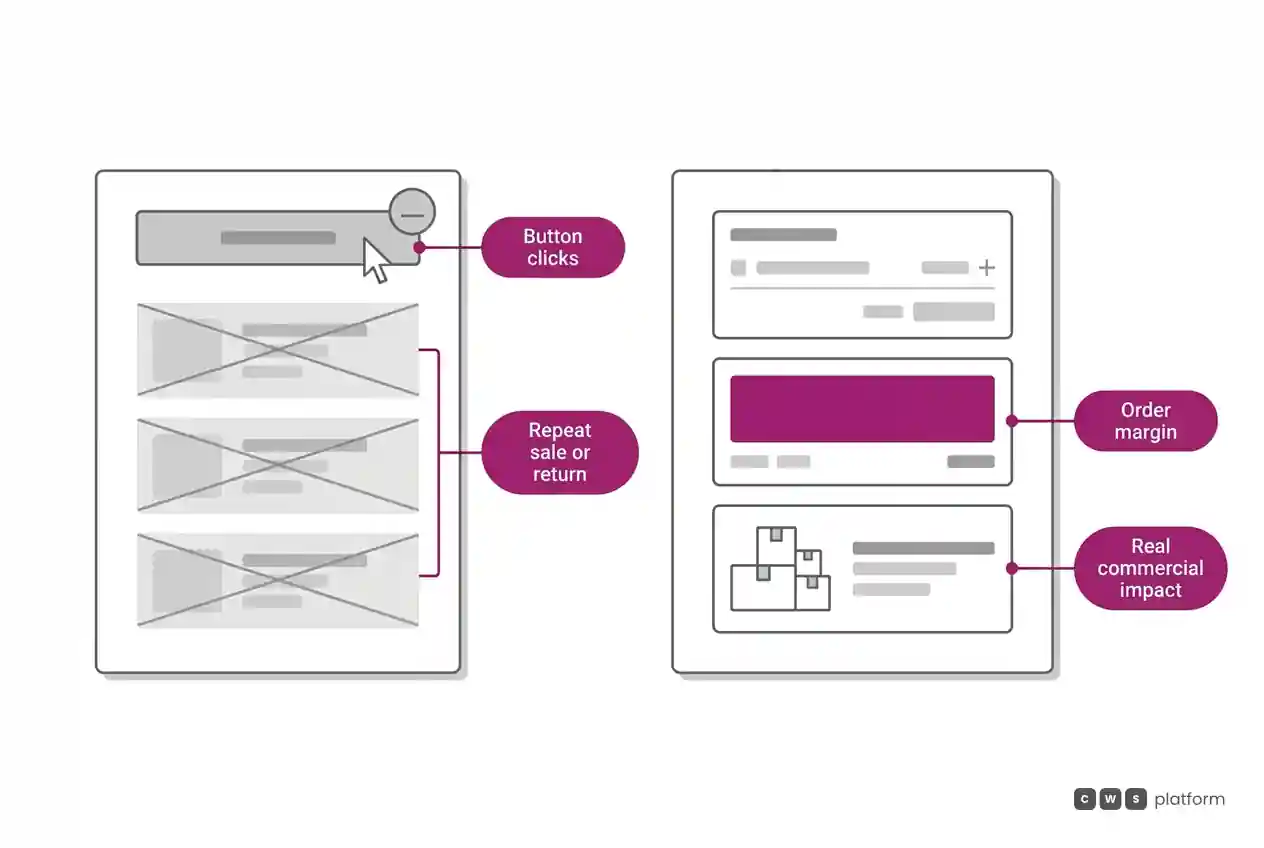
The underlying problem is that adoption does not equal incremental revenue. Three hidden dynamics often occur behind each click:
- Demand that already existed. An auto repair shop or contractor always purchases gaskets alongside a water pump. If the recommendation module suggests the gasket, the buyer clicks it, but that item was already planned for the purchase order.
- Cannibalization of standalone items. A pre-packaged kit replaces loose, higher-margin items the customer previously bought separately at list price. Total units remain flat, but gross margin drops.
- Incompatible parts. A suggested accessory does not match the customer's specific application, resulting in an RMA, two-way freight costs, and warehouse restocking overhead.
None of these issues register on a click tracker. B2B bundling and recommendation engines require specialized reporting that isolates true commercial uplift from surface-level usage.
The Four Metrics That Demonstrate Real Results
1. Lines per order. Do orders with accepted recommendations contain more line items than baseline orders from the same customer segment?
2. Average order value (AOV). Did total order revenue actually increase, or did the cart simply accumulate low-cost convenience items?
3. Margin per order. This is often the most misleading indicator. A discounted bundle can increase top-line order value while reducing absolute dollar margin. Profitability must be tracked at the order level, not by individual SKU.
4. Prevented split shipments. In B2B distribution, an overlooked part turns into a secondary emergency order days later, requiring another pick, pack, and freight charge. When a "frequently bought together" prompt catches an essential consumable early, it lowers the cost to serve even if aggregate revenue stays the same. The operational economics behind order processing are detailed in how much a manual order actually costs.
How to Set Up an Unbiased Comparison
The core requirement is a proper control group. Without it, the merchandising engine takes credit for every downstream transaction.
- Customer-level holdouts. A segment of buyers sees recommendations, while a matching cohort does not see them over a defined testing window.
- Product-level holdouts. Enable cross-sells on half of a product category while keeping the other half unassisted as a benchmark.
- Pre- and post-launch periods. Evaluate the same accounts before and after rollout, adjusting for seasonality. This is the least reliable approach, but it still outperforms unmeasured assumptions.
Define the primary success metric before turning on the feature. Once an upsell widget is active, standard analytics make every number look positive.
Bundles and "Frequently Bought Together" Are Not the Same
A bundle (or kit) is a fixed package sold under a single SKU at a set price: the buyer purchases the entire combination or nothing at all. This fits parts that must be installed together, such as a clutch replacement kit or commercial hardware assembly. The financial risk lies in margin erosion, as bundles typically carry a built-in discount.
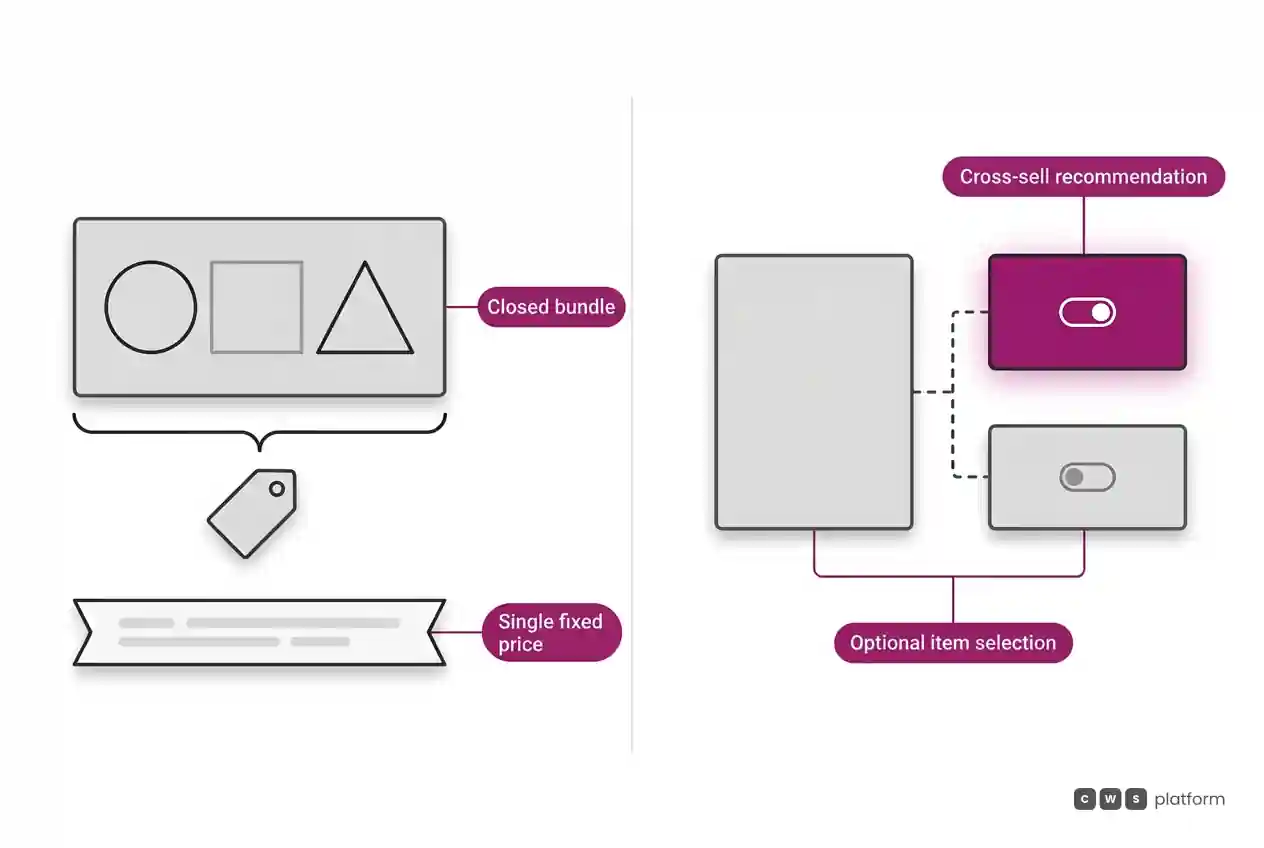
Frequently bought together is an open cross-sell module: the buyer checks off which supplementary items to include. This approach suits field consumables or accessories that depend on the end-user's setup. The primary risk here is bad cross-referencing, which leads to mis-picks and returns.
Both mechanisms rely on clean master data: accurate fitment, compatibility mappings, and clean catalog relationships. Without structured data, kits combine incompatible parts and recommendation widgets suggest items that will not fit. Managing package pricing without leaking margin requires a sound commercial strategy, covered in customer-specific pricing in B2B.
Next Step
Audit your current reporting for bundles and cross-sells: does it isolate lines per order, total order value, dollar margin, and secondary orders against a control group? If your analytics only track clicks and cart additions, demand these four core metrics before expanding the program. To see how buyers manage orders with negotiated pricing and catalog assortments, review the B2B digital sales portal.
Frequently Asked Questions
How do you measure the performance of bundles in B2B e-commerce?
Compare orders containing bundles against non-bundle orders from the same customer segment, tracking total order value and net dollar margin. Discounted bundles can inflate top-line revenue while hurting gross margin, making order-level profitability the essential metric.
What is "frequently bought together" in B2B?
It is the automated recommendation of related items at checkout or on product detail pages, such as mounting hardware for a commercial motor, replacement filters, or tooling consumables. It helps procurement teams catch secondary parts early and eliminates split shipments.
Why is the click-through rate on cross-sells insufficient proof of success?
Because buyers frequently click suggestions for items they were already planning to add to their purchase order. Without a holdout group that never saw the prompt, the software claims credit for baseline customer demand.
Should you use fixed bundles or open recommendations?
Use fixed bundles for components that are always replaced together, priced under a dedicated SKU. Use open recommendations for variable accessories and application-dependent parts. Both tactics require accurate master data and compatibility tables.
Read Also
- Top 9 B2B e-commerce platforms compared
- B2B tax calculation and compliance in enterprise digital commerce
About This Publication
This article outlines implementation patterns identified during B2B portal rollouts by CWS Platform. It does not disclose client identities or confidential business metrics.
"responsive, technically engaged, and willing to work through complex commercial rules (negotiated pricing, credit, customer-specific conditions) rather than pushing generic answers"
Is selling more not turning into margin?
Request an assessment of your operation or talk straight to a specialist, whichever you prefer.
I'd rather get the next articles on margin and discounts
A weekly roundup of new articles on margin and discounts, only in weeks when there is one. No spam, and you can leave in one click.