OroCommerce vs SAP Commerce Cloud: is long-term support in the bill?
Through a CFO lens: a license tied to GMV bands or to blocks of orders, how long a version stays covered, and what the next stack update requires.

Editorial note: CWS Platform competes with both Oro (OroCommerce) and SAP. This comparison uses only each vendor's public documentation, with the address next to each fact and the date of each record cited.
Short answer: OroCommerce fits companies that want quotes, customer-specific price lists, and a choice of where the platform runs. SAP Commerce Cloud fits companies that already run SAP's ERP. Over the long term, Oro records a license tied to GMV bands and extended version coverage that may be purchased case by case; SAP records a cloud ERP edition sold in blocks of orders and manual code review when the stack changes.
Between OroCommerce and SAP Commerce Cloud, the CFO usually gets proposals with the first-year license up front. The line that weighs from year three on is a different one: how long the contracted version stays covered, what it costs to extend that coverage, and what work the next stack update hands back to the budget. The overall map is in the post on the three B2B commerce platform models, the other comparisons are in the comparisons hub, and OroCommerce vs Magento B2B looks at Oro through order operations.
OroCommerce and SAP Commerce Cloud side by side
The table summarizes what each vendor's documentation records; where the source does not cover a point, the cell says so.
| point | OroCommerce | SAP Commerce Cloud |
|---|---|---|
| Platform model | OroCloud (managed SaaS), public cloud, private cloud, or on-premise | Modular platform on public cloud, extended through extensions and AddOns |
| Native B2B or extension | Customers in a tree, buyer roles, and quotes in the platform | Account-based buying, customer-specific catalogs, and multi-step approval |
| Customer and contract pricing | Price lists by website, customer group, and customer | Contract prices in the buyer's account; prices and discounts replicated from SAP's ERP |
| Quotes | Request for quote with target prices; CPQ with approvals by region, brand, value, or segment | Quote converted into an order; complex quotes in SAP CPQ |
| Credit and payment terms | Payment term per customer (prepaid, on delivery, or net days) | Not documented |
| ERP integration | REST API (JSON:API); integrations handled by the internal team or a partner | ERP integration package; cloud ERP edition with SAP-managed connectivity |
| Billing model | License tied to GMV bands | Blocks of 50,000 orders per year or GMV; cloud ERP edition in blocks of 10,000 orders per year |
| Deployment | On OroCloud, a package built from Git by orocloud-cli, with three release modes | Build from Git and a build manifest |
Pricing and commercial rules: what is configuration and what becomes a project
In OroCommerce, the price comes from chains of price lists assigned at the configuration, website, customer group, and customer levels, according to the Combined Price Lists documentation. Automatic price generation uses rules by quantity, unit, and currency, written in Symfony Expression Language (automatic price generation).
In SAP Commerce Cloud, promotions are built in a rules engine that combines conditions and actions, and prices can come from SAP Cloud ERP or from composable engines such as SAP Omnichannel Promotion Pricing, according to the pricing, promotions, and payments page.
Commercial rules are what changes most after go-live. It is worth asking both vendors, in writing, which price changes the sales team can make on its own and which turn into project hours.
Quotes and assisted selling: what comes with the platform and what is a separate product
In OroCommerce, the buyer tracks each request for quote in the storefront, with target prices per line (requests for quote). Oro describes its CPQ with dynamic pricing rules, customer-specific catalogs, and approvals routed by region, brand, opportunity value, or segment (integrated CPQ and RFQ). The Login as Customer User feature lets a back-office user operate the storefront as a specific buyer; it is limited to the Enterprise edition and disabled by default (customer user settings).
In SAP Commerce Cloud, the service agent works in the same storefront interface the customer uses, according to the Assisted Service Module documentation. Complex quotes go through SAP CPQ, connected to Commerce through SAP Cloud Integration, and once accepted they become orders (quote-to-cash integration course).
In the proposal, the difference is scope: at SAP, SAP CPQ is a product of its own, with middleware in between; at Oro, assisted selling depends on the edition. Ask for proposals that separate the license, separate products, and the edition each feature requires.
ERP integration: who builds the bridge
In OroCommerce, the REST API follows the JSON:API standard over platform entities, with separate storefront and back-office endpoints (Oro API). For JD Edwards, the documentation describes two paths: a REST API through the AIS framework, or CSV or XML file exchange (JD Edwards integration).
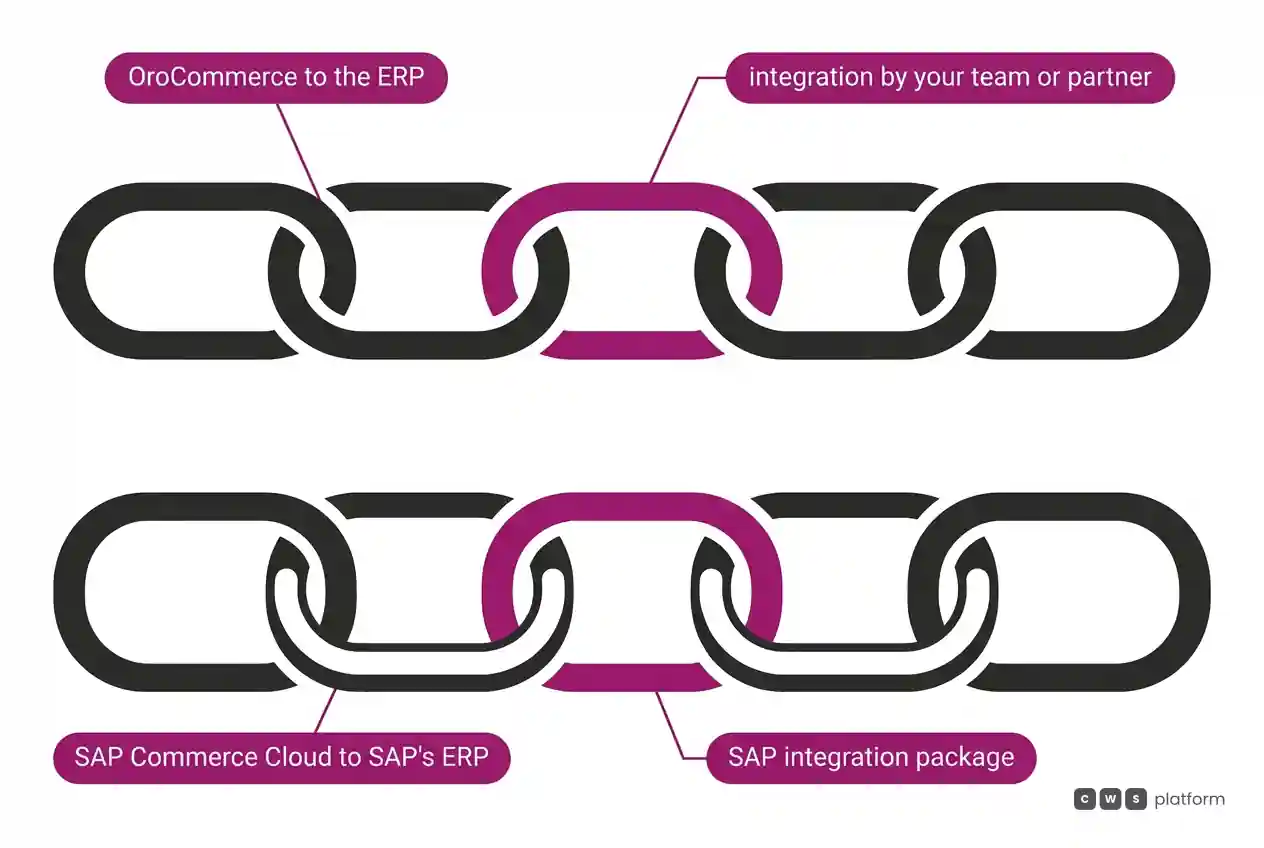
In SAP Commerce Cloud, price and discount replication from SAP S/4HANA or SAP ERP runs on SAP Cloud Integration, with the SAP Commerce Cloud Integration with ERP package and extensions declared in the project (price replication with the ERP).
For the CFO, the line that changes is who pays for the bridge. At SAP, for companies on SAP's ERP, part of it is a vendor package; at Oro, the cost section below shows who handles integrations. Ask both who maintains the integration with each release.
Cost and billing model: the license and what comes with it
Recorded on Oro's pricing page, accessed on October 16, 2026: the license is tied to GMV bands based on the value of goods sold through OroCommerce ("Licenses are aligned to GMV bands based on the value of goods sold through OroCommerce.") and integrations are handled by the customer's internal team or implementation partner ("Integrations are handled through your internal team or implementation partner.", OroCommerce pricing). The same page says Enterprise plans include 25 admin users and carry no separate charge per store, portal, buyer, SKU, or catalog.
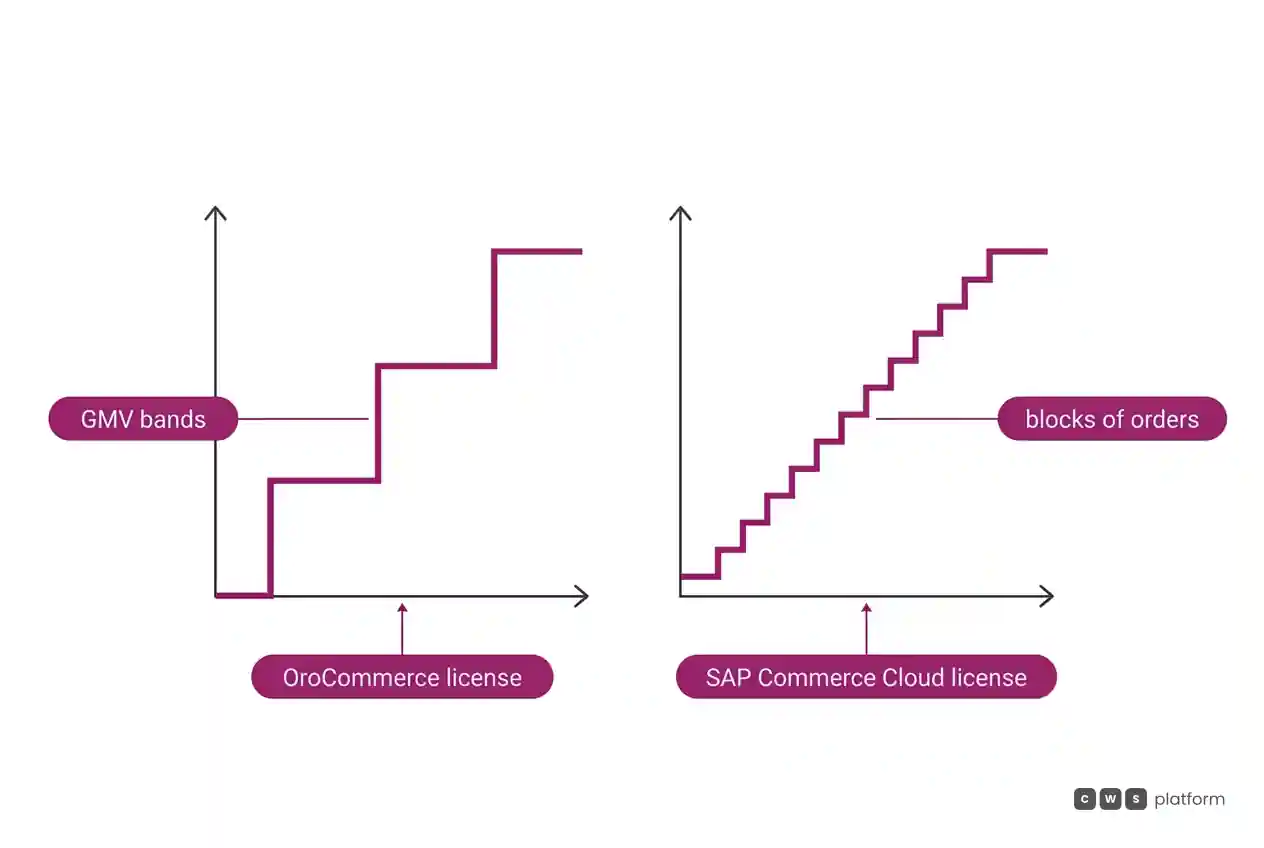
The SAP Commerce Cloud plans and pricing page records billing in blocks of 50,000 orders per year or by GMV. Recorded in SAP's documentation, in a page dated September 15, 2026: the cloud ERP edition is sold in blocks of 10,000 orders per year and has SAP Finance licenses as a prerequisite ("In blocks of 10000 Orders per year", cloud ERP edition page).
The two billing models follow sales along different paths: at Oro, through the GMV band; at SAP, through orders or GMV. Model the year-three license against the volume in your business plan, and ask each proposal what else has to be contracted alongside it, such as prerequisite licenses and partner-built integration.
Deployment and maintenance: how long the version stays covered
On OroCloud, an update is packaged from Git by orocloud-cli and released in maintenance mode, as a rolling upgrade, which is safe only when the database structure does not change, or as a source upgrade (how to run upgrades).
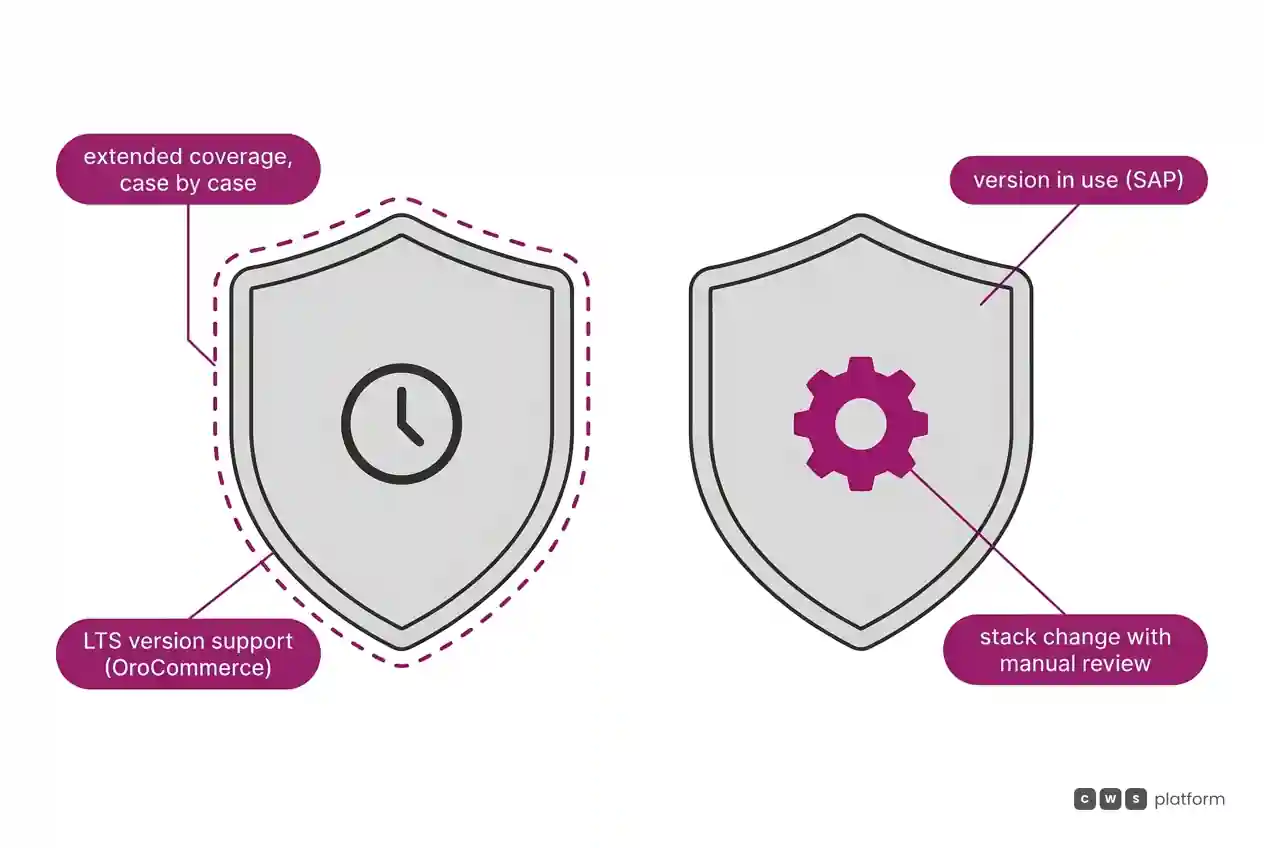
Recorded in Oro's documentation, accessed on October 16, 2026: under the release policy, LTS versions of the Enterprise Edition are supported for 48 months from release ("versions of OroCommerce Enterprise Edition are supported for 48 months from the release date."), extended version coverage "may be available for purchase on a case-by-case basis", and the Community Edition receives patch releases for 12 months after each release (Oro release process).
In SAP Commerce Cloud, the store is built from a Git repository and a build manifest (About SAP Commerce Cloud).
Recorded in SAP's documentation, in a page dated September 25, 2026: the update to JDK 21 and Spring Framework 6.2 requires adjusting custom extensions, with manual code review even when the provided automation is used ("manual code review and updates are necessary", JDK 21 and Spring 6.2 note).
One record says how long a version stays covered and that extending it is negotiated separately; the other says that a stack change requires work on your own code. Ask both vendors for the support calendar, the price of extended coverage where it exists, and the hours the next stack update will take.
When to choose OroCommerce
Freedom to choose where the platform runs. Oro documents four deployment models: OroCloud as managed SaaS, public cloud, private cloud, or on-premise (OroCloud infrastructure).
Quotes with pricing rules and approvals. The CPQ Oro describes uses customer-specific catalogs and approvals routed by region, brand, value, or segment.
Corporate buying in a tree. Customers sit in a tree hierarchy, with buyer roles and permissions by entity, action, and level (Oro access concepts).
When to choose SAP Commerce Cloud
Companies already on SAP's ERP. The cloud ERP edition has SAP-managed connectivity and reads price, stock, and order status from SAP Cloud ERP; SAP announces a standard implementation of about 12 weeks for this edition.
Self-service under contract. Buyers see contract prices, quotes, and invoices, buy against active contracts, and go through multi-step approval, according to the SAP Commerce Cloud for ERP overview.
High-complexity quotes. SAP CPQ governs discounts with eligibility rules and guardrails and handles quotes with more than 10,000 lines.
When neither fits
OroCommerce and SAP Commerce Cloud ask the CFO to read two bills at once: the license and the version that has to stay covered. The post on the three B2B commerce platform models describes a third path, for companies that want commercial policy configured rather than written in code: move the commercial rules into the platform.
That is the CWS Platform model. Billing is a platform license plus an integration license, with no percentage of sales or GMV. All customers run the same version. Price tables, rules, and contracts are configurable in the platform and can come from the ERP or CRM through APIs, and commercial policy is stored as parameters in the Commerce Rules Engine inside CDL Workspace: configuration instead of code. The platform has 11 modules, 6 AI Agents, and 1,029 parameters.
Each vendor is read against that model in OroCommerce or CWS Platform: What Goes Into the Math When the Digital Channel Grows? and in SAP Commerce Cloud vs. CWS Platform: Does Your License Scale with Sales Volume?. If the proposal on the table still leaves the year-three bill open, it is worth talking to a CWS Platform specialist before you sign.
Frequently asked questions
OroCommerce vs SAP Commerce Cloud: which costs less over three years?
The sources used here carry no prices, so the answer depends on the proposals. Oro records a license tied to GMV bands; SAP records blocks of orders or GMV, with SAP Finance licenses as a prerequisite for the cloud ERP edition. By year three, version coverage and update work enter the bill as well.
How does each one bill the license?
At Oro, the pricing page records a license tied to GMV bands, with no charge per store, buyer, SKU, or catalog on Enterprise plans. At SAP, billing is in blocks of 50,000 orders per year or by GMV, and the cloud ERP edition comes in blocks of 10,000 orders per year.
Is long-term support included?
At Oro, the documentation records 48 months of support for LTS versions of the Enterprise Edition and extended coverage that may be purchased case by case. The SAP sources used here do not cover per-version support periods; they record update work, such as manual code review in the move to JDK 21. Ask both vendors for the support calendar in writing.
What weighs on an upgrade?
On OroCloud, an update comes out of orocloud-cli in one of three modes, and a rolling upgrade is safe only when the database structure does not change. At SAP, the move to JDK 21 and Spring 6.2 requires adjusting custom extensions with manual code review. With both, ask for an estimate of hours per update.
Brands mentioned in this article

 Magento
- OroCommerce
- SAP Commerce Cloud
Trademarks and logos belong to their respective owners. Mention does not imply partnership or endorsement.
"responsive, technically engaged, and willing to work through complex commercial rules (negotiated pricing, credit, customer-specific conditions) rather than pushing generic answers"
Is selling more not turning into margin?
Request an assessment of your operation or talk straight to a specialist, whichever you prefer.
I'd rather get the next articles on margin and discounts
A weekly roundup of new articles on margin and discounts, only in weeks when there is one. No spam, and you can leave in one click.