B2B ecommerce platforms: the 9 leading options compared
Three models, nine platforms, and one cut question per model: the work each platform leaves the company after signing.

Editorial note: CWS Platform is one of the nine platforms in this comparison and competes with the other eight: SAP, Salesforce, Adobe, VTEX, commercetools, Spryker, OroCommerce, and Optimizely. Everything said about those eight comes from that vendor's own public documentation, with the address next to each fact and the date of each record cited. About CWS Platform, the text says what CWS itself states about the product.
Short answer: there is no single best B2B ecommerce platform for every company; there is the one that fits the model you choose. To build with your own engineering team, commercetools and Spryker. For out-of-the-box B2B connected to the ERP through an implementation project, OroCommerce and Optimizely Configured Commerce. For companies already in the vendor's ecosystem or starting from retail, SAP Commerce Cloud, Salesforce Commerce Cloud, Adobe Commerce, and VTEX. To bring the commercial policy into the platform, CWS Platform.
The CEO is not going to configure a price table or write a connector. The decision that reaches the CEO's desk is a different one: what work the company takes on after signing. Every B2B platform goes live through a project, and each one leaves part of that project behind for good: code to maintain, connectors to support, versions to keep up with, a license that shifts with scope. When that part stays out of the decision, the implementation never really ends.
This guide covers nine platforms with the same yardstick: who each one is for, its strength, and what to bring to the demo. For the other eight vendors, the strength has a source in their documentation and what to bring is one record from the vendor's own documentation; for CWS Platform, the strength is what CWS states about the product and what to bring is a test to ask for. It is not a ranking. The framing of the models comes from the three B2B commerce platform models, and each pair has its own comparison in the comparisons hub.
The three platform models
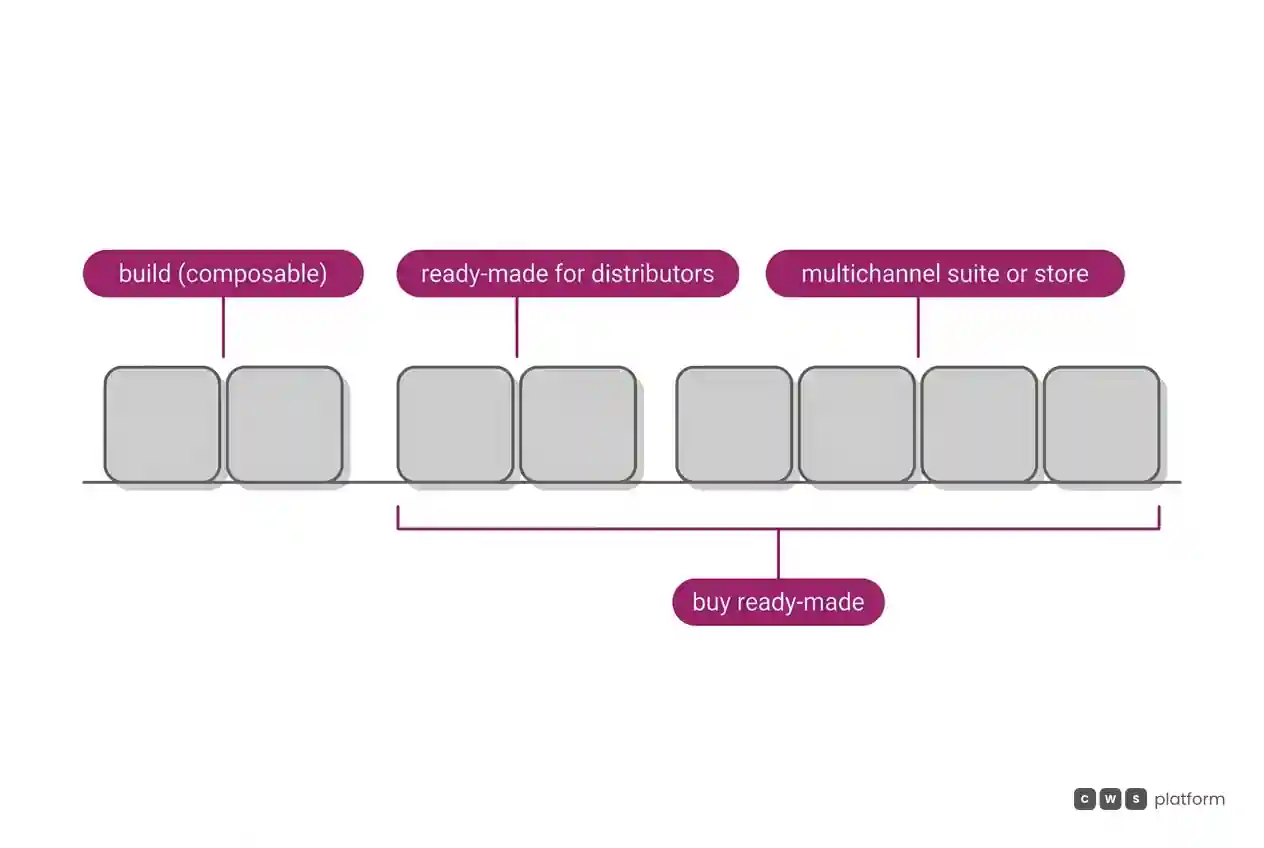
Eight of the nine fit into the first two models; CWS Platform sits in the third, which changes the question.
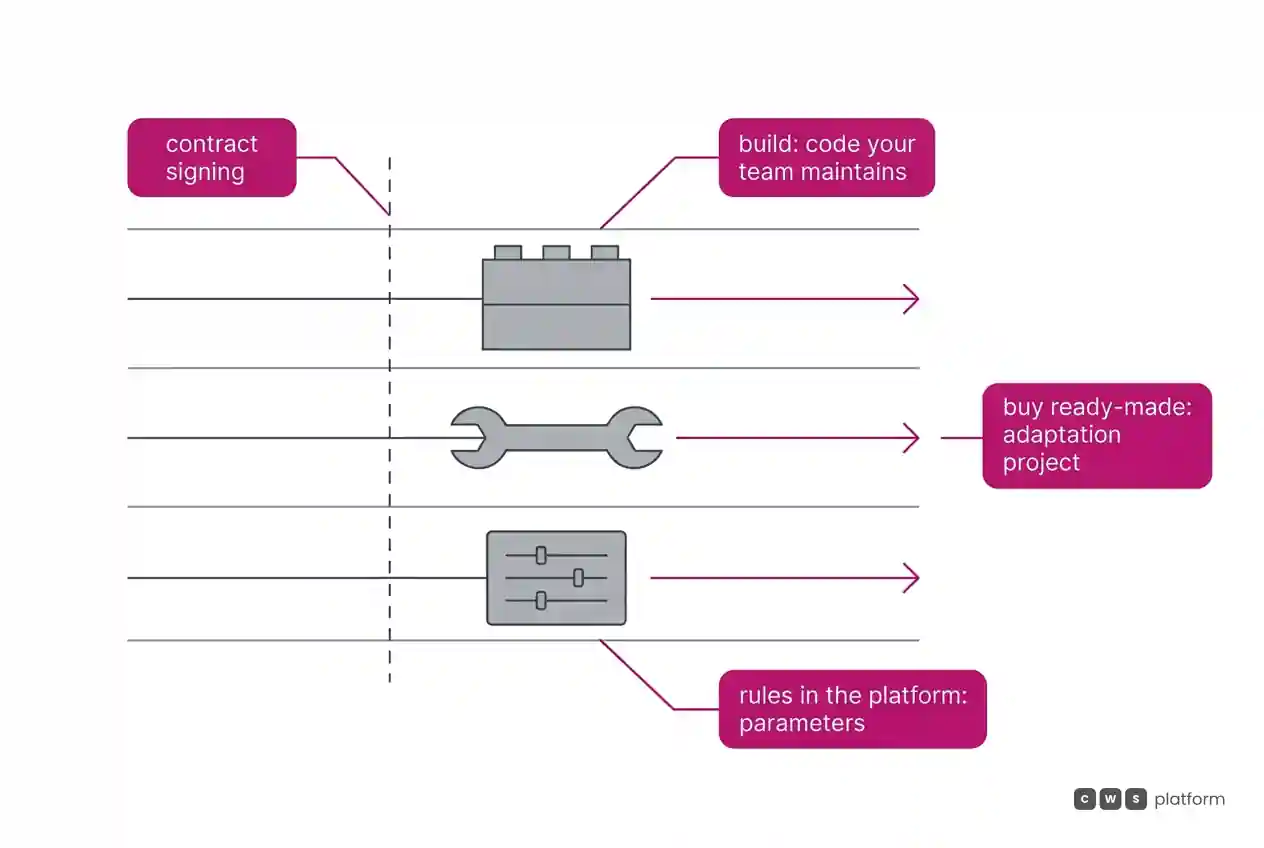
Build (composable). The platform provides APIs or modules, and the customer's team builds the storefront, the integrations, and the commercial rules. commercetools and Spryker sit here. The strength is control over every piece; the commitment is maintaining that code, and the team that writes it, for the life of the channel.
Buy ready-made. The platform ships B2B features out of the box, and an implementation project adapts them to the commercial policy and connects everything to the ERP. There are two families. One was born for the B2B distributor: OroCommerce and Optimizely Configured Commerce. The other is the suite or storefront that serves B2B alongside other channels: SAP Commerce Cloud, Salesforce Commerce Cloud, Adobe Commerce, and VTEX. The strength is starting with the essentials in place; the commitment is the adaptation project and the vendor's roadmap.
Bring the commercial rules into the platform. The commercial policy (customer-specific pricing, contracts, credit, discounts, approvals) lives in the platform as parameters, changed through configuration rather than through a project. CWS Platform sits here. The strength is changing the commercial policy without opening a project; the commitment is describing that policy as parameters, rule by rule. This model answers what the other two leave to the implementation: who changes the commercial policy, and how often.
The nine platforms side by side
The table summarizes what each vendor's documentation records and, in the last row, what CWS states about CWS Platform. A cell with no approved source reads "not documented". The figure groups the eight in the first two models.
| platform | model | native B2B or extension | pricing model | implementation |
|---|---|---|---|---|
| SAP Commerce Cloud | buy ready-made: suite tied to SAP's ERP | native, with B2B self-service and an edition tied to SAP Cloud ERP | in the Cloud ERP edition, 1 to 3 year contracts with automatic renewal | public cloud; about 12 weeks in the Cloud ERP edition |
| Salesforce Commerce Cloud | buy ready-made: B2B store inside the Salesforce org | native (B2B Commerce), in the same org as D2C | percentage of GMV, based on functionality | not documented |
| Adobe Commerce | buy ready-made: store that adds B2B | B2B extension, installed and enabled on the store | not documented | multi-tenant SaaS, dedicated PaaS, or open source |
| VTEX | buy ready-made: omnichannel retail platform | B2B Buyer Portal, available for selected accounts | not documented | multitenant cloud |
| commercetools | build (composable) | B2B Commerce license package | by order volume, not GMV | integrations on Connect, a managed runtime |
| Spryker | build (composable) | native, with Company Account and business units | not documented | not documented |
| OroCommerce | buy ready-made: out-of-the-box B2B | native, with customer hierarchy and roles | GMV tiers and environments, no charge per store, customer, SKU, or catalog | OroCloud, public cloud, private cloud, or on-premise; about six months on average |
| Optimizely Configured Commerce | buy ready-made: out-of-the-box B2B | native, with Price Matrix and quoting | not documented | ERP connected through the Windows Integration Service; for most connectors, by the partner |
| CWS Platform | bring the commercial rules into the platform | native | platform license + integration license, with no percentage of sales or GMV | every customer on the same version |
SAP Commerce Cloud
Built for companies that already run SAP's ERP and want the storefront to read pricing, contracts, and inventory from it. The Cloud ERP edition runs on native connectivity to SAP Cloud ERP, managed by SAP itself, with the ERP as the source of truth for pricing, availability, and order status; buyers get customer-specific catalogs, quote-to-order, and buying against contracts. According to SAP's blog on the edition, the announced standard implementation takes about 12 weeks.
For the demo, bring what is recorded in SAP's documentation on September 9, 2026: SAP explains that it deprecated the Accelerator UI because its tight coupling to the Commerce Cloud code often leads to hard, expensive upgrades ("tight dependencies often result in difficult and costly upgrades", SAP's note on the Accelerator UI). The documented alternative is the composable storefront, built in Angular and talking only through the Commerce REST API. Ask which of the two your store would use.
Further reading: the cost of keeping SAP Commerce Cloud integrated, SAP Commerce Cloud vs Salesforce Commerce Cloud, SAP Commerce Cloud vs Adobe Commerce, and VTEX vs SAP Commerce Cloud.
Salesforce Commerce Cloud
Built for companies that already use Salesforce and want B2B in the same org. Per the B2B Commerce introduction, the store starts from templates, is customized in Experience Builder, and is configured with Lightning features; accounts, products, price books, and entitlements load through CSV. The same Salesforce org can run B2B and D2C channels with shared data and processes.
For the demo, bring what is recorded on Salesforce's B2B Commerce pricing page, accessed on November 5, 2026: the B2B Commerce license is charged as a percentage of GMV, based on the functionality needed ("We take a percentage of Gross Merchandise Value (GMV) based on commerce functionality needed.", B2B Commerce pricing). Ask which functionality falls under the contracted percentage, and what changes in it as the store's scope grows.
Further reading: who governs commercial execution on Salesforce, Salesforce vs Adobe Commerce, SAP vs Salesforce, VTEX vs Salesforce, commercetools vs Salesforce, and Optimizely vs Salesforce B2B Commerce.
Adobe Commerce
Built for companies that want to choose where the store runs and keep B2B and B2C on the same base. Adobe Commerce's pricing page describes three options: Cloud Service, multi-tenant SaaS with automatic updates; Adobe Commerce on Cloud, single-tenant PaaS; and Commerce Optimizer, which attaches storefront, catalog, and merchandising to an existing transaction engine. B2B, per the B2B introduction, is turned on through an extension: company accounts with divisions and roles, shared catalogs with company-specific pricing, and negotiated quotes.
For the demo, bring what is recorded in Adobe's documentation, accessed on November 5, 2026: in Adobe Commerce as a Cloud Service, customizations run as out-of-process App Builder applications, and rebuilding them is "typically the most significant engineering effort" of the migration (migration overview). Ask who rewrites the customizations in the move to SaaS.
Further reading: end of support and architecture on Adobe Commerce, Salesforce vs Adobe Commerce, SAP vs Adobe Commerce, VTEX vs Adobe Commerce, and OroCommerce vs Magento B2B.
VTEX
Built for companies coming from omnichannel retail that want to bring B2B into the same operation. Per the composability guide, VTEX runs as a composable, multitenant cloud commerce platform, with more than 750 API endpoints and more than 900 ready-made integrations with payment providers and marketplaces. The VTEX Commerce Platform page describes ecommerce, physical stores, marketplace, and B2B under order orchestration with connectivity to ERP, WMS, and carriers.
For the demo, bring what is recorded in VTEX's documentation, accessed on November 5, 2026: B2B Buyer Portal is currently available for selected accounts ("B2B Buyer Portal is currently available for selected accounts.", B2B Buyer Portal). Ask whether your account is among the selected ones, and what is available without the portal.
Further reading: what comes ready-made in VTEX B2B, VTEX vs Adobe Commerce, VTEX vs Salesforce, and VTEX vs SAP Commerce Cloud.
commercetools
Built for companies with an engineering team that want to compose B2B piece by piece, on APIs. The B2B Commerce package includes Business Units with account hierarchies, Associate Roles, Approval Rules, Quotes, and pricing per Business Unit, through REST API and GraphQL. The pricing page records pricing driven by order volume, not GMV. Integrations run on Connect, a managed runtime.
For the demo, bring what is recorded in commercetools' documentation, accessed on November 5, 2026: functionalities annotated with a B2B label are subject to additional or different terms and pricing ("Functionalities annotated with a B2B label on the respective pages are subject to additional or different terms and pricing.", order form definitions). Ask, in writing, for the list of labeled functionalities the project will use.
Further reading: the cost of maintaining integrated commercial logic on commercetools, commercetools vs Salesforce, and commercetools vs Spryker.
Spryker
Built for companies that want ready B2B modules to compose inside their own project. Company Account structures the buying company into business units and company users, with roles and permissions. Merchant Custom Prices treats the commercial relationship as a price dimension. A quote starts from the cart and goes through versions between buyer and sales rep until it becomes an order, and the Data Exchange API handles bulk data operations with ERP, PIM, OMS, and BI.
For the demo, bring what is recorded in Spryker's documentation, accessed on November 5, 2026: the App Composition Platform is being sunset and allows no additional activations or changes ("The Spryker App Composition Platform is being sunset. No additional activations or changes are allowed.", App Composition Platform). Ask which of the project's integrations would go through it, and what the documented path is instead.
Further reading: customer pricing and ERP integration on Spryker and commercetools vs Spryker.
OroCommerce
Built for the distributor that wants out-of-the-box B2B and the freedom to choose where the platform runs. The cloud architecture offers four models: OroCloud as managed SaaS, public cloud, private cloud, or on-premise. The pricing page records Enterprise plans priced by GMV tiers and environments, with no extra charge per store, B2B portal, buying customer, SKU, or catalog. The listed ERP integrations cover SAP B1/ECC, Epicor P21, and JD Edwards.
For the demo, bring what is recorded in OroCommerce's documentation, accessed on October 16, 2026: the average implementation time is about six months ("The average implementation time is about six months.", Oro FAQ). Ask how much of the integration with your ERP fits within those six months.
Further reading: order operations after checkout on OroCommerce and OroCommerce vs Magento B2B.
Optimizely Configured Commerce
Built for the distributor with complex pricing policy kept in the ERP. The Price Matrix orders price records from the most specific to the most general and compares the result with the sale price. Pricing and inventory can be queried in the ERP through a direct API call or through the Windows Integration Service, an agent installed behind the customer's firewall that pulls data from the ERP and pushes orders and customers to it.
For the demo, bring what is recorded in Optimizely's documentation, accessed on November 5, 2026: for most connectors, the implementation partner is responsible for evaluating, designing, developing, implementing, and testing ("For most connectors, an implementation partner is responsible for evaluating, designing, developing, implementing, and testing the connector.", connector expectations). Ask who supports the connector after go-live, and under what contract.
Further reading: pricing rules autonomy on Optimizely and Optimizely vs Salesforce B2B Commerce.
CWS Platform
Built for the distributor or manufacturer whose commercial policy changes often and sets the company apart for its customers: customer-specific pricing, contracts, credit, discounts, and sales reps in the same channel. Per what CWS states about the product, price tables, rules, and contracts are configurable in the platform or come from the ERP and CRM through APIs. The Commerce Rules Engine, in the CDL Workspace, holds the commercial policy in parameters, on the principle of configuration over code. Rep discounts go through multi-level approval, each customer's credit limit is kept in the platform, and customer and rep use the same interface, on the same order.
For the demo, ask to see a price or contract change made through configuration, with no project, using your company's real rules, and who can make that change.
It is not the choice for companies without a complex commercial policy. With a single price list, no credit terms, and no sales reps in the channel, a storefront platform does the job with less project work.
Further reading: the three B2B commerce platform models and the comparisons hub.
How to choose
Three cut questions, one per model, narrow the list before the first demo.
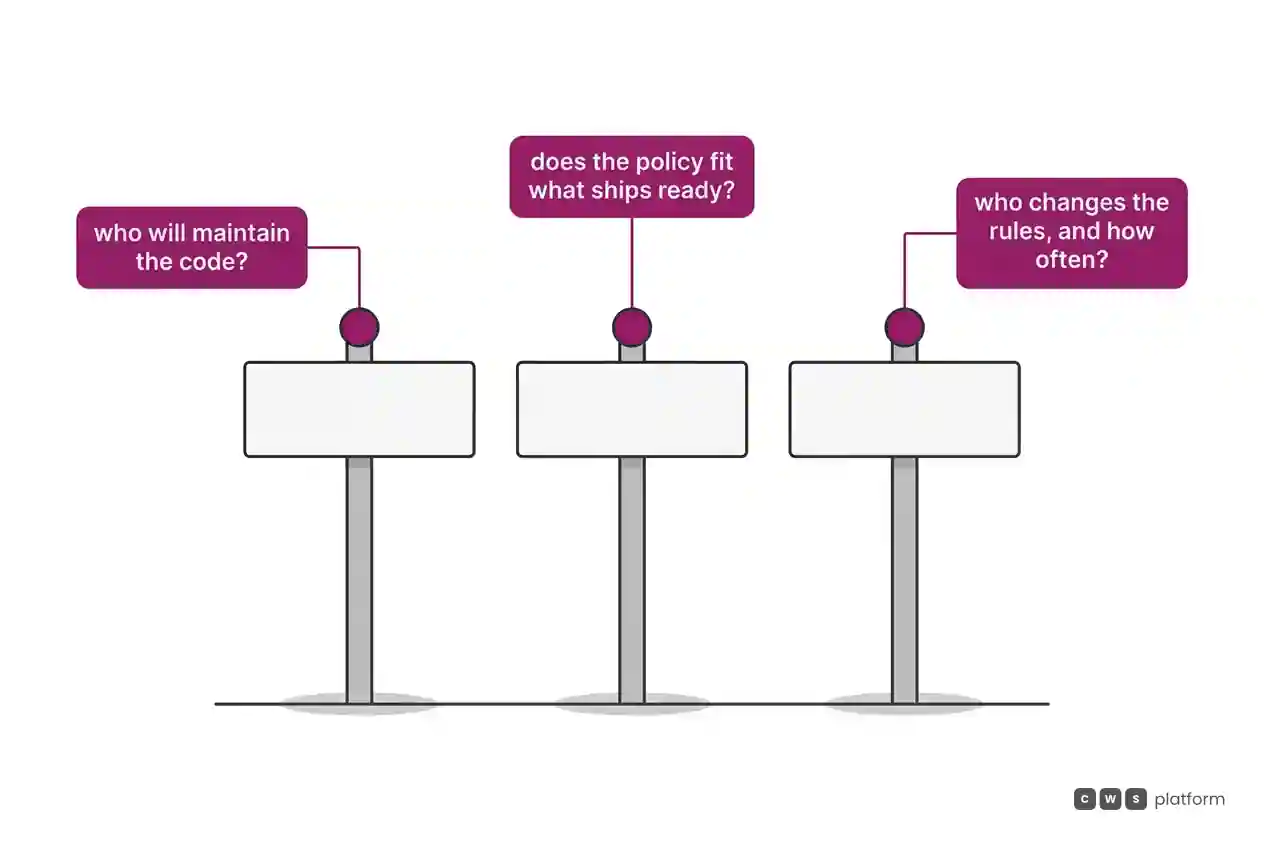
Build: does the company have, and want to keep for years, an engineering team that writes the commercial rules, the storefront, and the integrations as its own code? If yes, commercetools and Spryker make the list. If not, the model turns into a project with no owner.
Buy ready-made: does the commercial policy fit what ships out of the box, and is the ecosystem the platform assumes (SAP's ERP, the Salesforce org, the implementation partner, the retail operation) already the company's own? If yes, the choice is among the six in this model, by the family that matches what already exists.
Bring the rules into the platform: does the commercial policy change often, and is it what sets the company apart for its customers? If yes, CWS Platform makes the list, and the question for any vendor is who makes the next change to pricing, contracts, or credit, and how long it takes.
Frequently asked questions
What is the best B2B ecommerce platform?
None of the nine is best for every B2B company; each one serves a model. commercetools and Spryker serve companies that want to build the architecture with their own engineering team; OroCommerce and Optimizely Configured Commerce, those that want out-of-the-box B2B with an implementation project; SAP Commerce Cloud, Salesforce Commerce Cloud, Adobe Commerce, and VTEX, those already living in the vendor's ecosystem or starting from a retail operation; CWS Platform, those that want to bring the commercial policy into the platform and change it through configuration.
What are the main B2B ecommerce platforms?
This comparison covers nine: SAP Commerce Cloud, Salesforce Commerce Cloud, Adobe Commerce (Magento), VTEX, commercetools, Spryker, OroCommerce, Optimizely Configured Commerce, and CWS Platform. They split between build (composable), buy ready-made, and bringing the commercial rules into the platform, which is CWS Platform's model. Within buy ready-made, there is out-of-the-box B2B and the suite or store that serves B2B alongside other channels.
Which one costs less?
The documentation used here does not support saying which one costs less, because each vendor charges on a different variable. Salesforce records the B2B Commerce license as a percentage of GMV; commercetools, pricing by order volume; OroCommerce, GMV tiers and environments; SAP, in the Cloud ERP edition, 1 to 3 year contracts; CWS Platform, a platform license plus an integration license, with no percentage of sales or GMV. For the others, pricing is not in the sources of this comparison, and the question goes into the proposal.
How do you choose between building (composable), buying ready-made, or bringing the commercial rules into the platform?
By each model's cut question. Building makes sense when there is an engineering team to maintain the rules, the storefront, and the integrations as its own code; buying ready-made, when the commercial policy fits the out-of-the-box features and the ecosystem the platform assumes is already the company's; bringing the rules into the platform, CWS Platform's model, when the policy changes often and is what sets the company apart.
All head-to-head comparisons
Each comparison puts two vendors side by side, without CWS Platform in the middle:
- Salesforce Commerce Cloud vs Adobe Commerce: where does the catalog limit live?
- SAP Commerce Cloud vs Salesforce Commerce Cloud: who talks to the ERP?
- SAP Commerce Cloud vs Adobe Commerce: what drives the three-year cost?
- VTEX vs Adobe Commerce: which one handles the typical B2B order?
- VTEX vs Salesforce Commerce Cloud: can B2B and retail coexist?
- VTEX vs SAP Commerce Cloud: what can a CFO predict before signing?
- commercetools vs Salesforce Commerce Cloud: who decides the rebuild?
- commercetools vs Spryker: what changes in integration and upgrades?
- OroCommerce vs Magento B2B: what weighs on order operations?
- Optimizely Configured Commerce vs Salesforce B2B Commerce: where do reps sell?
- commercetools vs SAP Commerce Cloud: where do orders meet the ERP?
- commercetools vs Adobe Commerce: what changes in B2B order operations?
- Spryker vs SAP Commerce Cloud: what does the contract guarantee?
- Spryker vs Adobe Commerce: which price reaches the B2B order?
- Spryker vs Salesforce Commerce Cloud: who handles the large B2B order?
- Optimizely vs Adobe Commerce: what changes with each new version?
- Optimizely vs SAP Commerce Cloud: how much of the store depends on the ERP?
- OroCommerce vs Salesforce Commerce Cloud: which price applies in B2B?
- VTEX vs. commercetools: Packaged B2B Suite or Composable APIs?
- OroCommerce vs SAP Commerce Cloud: is long-term support in the bill?
- OroCommerce vs Spryker: how does each connect ERP and procurement?
- OroCommerce vs Optimizely: how does each organize the B2B catalog?
- Optimizely vs commercetools: what must the proposal include?
- Optimizely vs Spryker: who maintains the ERP integration layer?
- VTEX vs Spryker: which fits a B2B marketplace with sellers?
- VTEX vs Optimizely: what goes on the B2B bill?
- VTEX vs OroCommerce: what can change after an order is invoiced?
Read next
Brands mentioned in this article

 VTEX


 Magento
- Salesforce
- OroCommerce
- Optimizely
- SAP Commerce Cloud
- Adobe Commerce
Trademarks and logos belong to their respective owners. Mention does not imply partnership or endorsement.
"responsive, technically engaged, and willing to work through complex commercial rules (negotiated pricing, credit, customer-specific conditions) rather than pushing generic answers"
Does your implementation never end?
Request an assessment of your operation or talk straight to a specialist, whichever you prefer.
I'd rather get the next articles on implementation
A weekly roundup of new articles on implementation, only in weeks when there is one. No spam, and you can leave in one click.