VTEX vs Optimizely: what goes on the B2B bill?
Through a CFO's lens: a transaction-based fee and separately billed services on one side, licenses per domain and support tied to the LTS version on the other.

Editorial note: CWS Platform competes with VTEX and with Optimizely. This comparison uses only each vendor's public documentation and the annual report VTEX filed with the SEC, with the address next to each fact and the date of each record cited.
Short answer: VTEX fits the company that accepts a transaction-based fee that, per its 20-F, is primarily structured as a percentage of the value of orders processed, and services such as VTEX Shield with possible additional fees. Optimizely fits the company that prefers licenses associated per domain, with pricing, quoting, and ERP integration inside Configured Commerce, accepting that support only escalates to engineering on the current LTS version or newer.
A CFO comparing VTEX and Optimizely Configured Commerce is not just picking a B2B storefront. The real choice is what each line of the bill is tied to: order value, a separately contracted service, the store's domain, or the version the company runs. Each tie changes what happens to cost as the digital channel grows, and what happens to support when the company postpones an upgrade.
The map of platform models is in the three B2B commerce platform models, and the other comparisons are in the comparisons hub, including VTEX vs SAP Commerce Cloud and Optimizely Configured Commerce vs Salesforce B2B Commerce.
VTEX and Optimizely side by side
The table sums up what each source records; where the source does not cover a point, the cell says so.
| criterion | VTEX | Optimizely Configured Commerce |
|---|---|---|
| Platform model | Composable, multitenant cloud platform, with more than 750 API endpoints | Storefront and Admin REST APIs; on .NET Core, separate Admin, Storefront, and Integration applications |
| B2B native or by extension | B2B Suite apps, such as B2B Organizations, installed through VTEX IO | Configured Commerce features: Price Matrix, Request for Quote, Job Quotes, Quick Order, and PunchOut |
| Customer and contract pricing | Price tables per buyer organization | Price Matrix in a flat table, from the most specific record to the most general |
| Quoting | B2B Quotes & Carts app, with statuses and price adjustment | Request for Quote and Job Quotes, with a quantity consumed across several orders until the expiration date |
| Credit and net terms | Customer credit among the payment gateway's methods | Invoice history in My Account, with terms, due date, and balance columns |
| ERP integration | REST APIs by module; connectivity to ERP, WMS, and carriers | Windows Integration Service, with Refresh and Submit tasks |
| Billing model | Transaction-based fee primarily structured as a percentage of order value, per the 20-F; possible additional fees for VTEX Shield | Licenses associated per domain; price not covered by the sources used here |
| Implementation | Built-in components, already installed, and Plug-and-play components that require installation | Support escalation to engineering only on the current LTS version or newer |
Pricing and commercial rules: where pricing policy is calculated
On VTEX, the buyer's pricing rule lives in the organization. B2B Organizations groups a company's users into an organization with its own price tables, payment methods, and product collections, and splits the organization into cost centers with their own addresses.
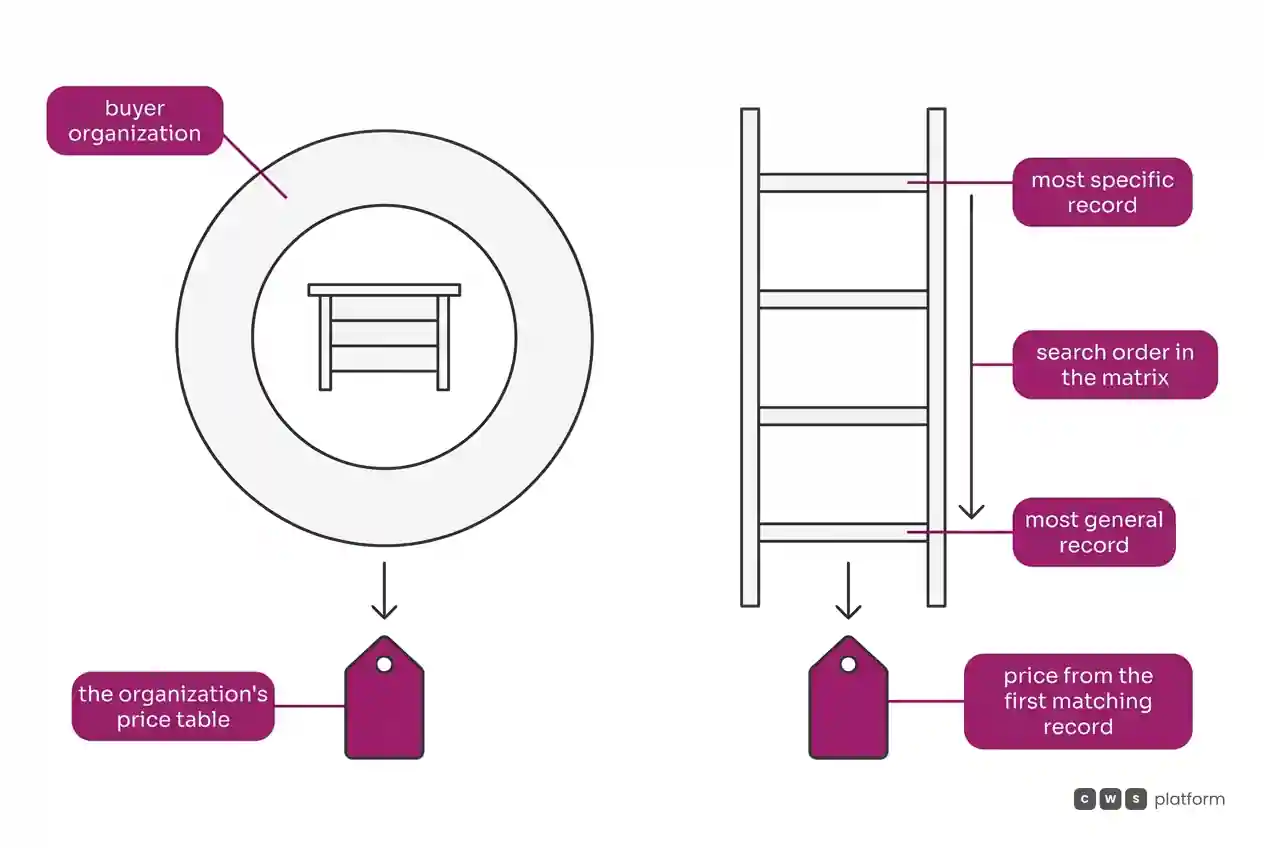
On Optimizely, customer pricing comes from a matrix. Per the technical overview of the price matrix, pricing schemes sit in a flat, denormalized table designed to calculate without a direct connection to the ERP, and since version 3.7.1 the calculation runs as a service in code. Teams that prefer to query the ERP have the pricing and inventory service, which calls the ERP through an API or the Windows Integration Service, with a default 60-minute cache for pricing.
For the CFO, the point is who maintains pricing policy and what it costs to change it. In the demo, ask how many people, and from which team, change a price table or a pricing rule on each platform.
Quoting and assisted selling: the volume commitment
On VTEX, per the B2B Quotes GraphQL API, a quote stores the cart's items, quantities, and prices, moves through statuses such as PENDING, REVISED, and PLACED, accepts price adjustments, and can go back to the cart.
On Optimizely, Request for Quote starts from the buyer's cart or is created by the sales rep, and the rep and the sales manager are notified at their next login. Job Quotes set a total quantity to be consumed across several orders until an expiration date, which brings the quote close to a volume commitment.
With both, ask the proposal to state whether quoting and saved carts are part of the base contract.
ERP integration: who builds the bridge
On VTEX, integration starts from the platform's APIs. The REST API guide separates modules such as Catalog, Checkout, and Logistics, and the VTEX Commerce Platform page describes connectivity to ERP, WMS, and carriers.
On Optimizely, the bridge has its own agent. Per the Windows Integration Service guide, WIS runs inside the customer's firewall, polls the commerce site to run integration jobs, and splits the work into Refresh tasks, which pull products, inventory, and customers from the ERP, and Submit tasks, which push orders and customers created in the store to the ERP.
With both, ask who writes and who maintains the ERP bridge, and whether that work is in the proposal.
Cost and billing model: what each line of the bill is tied to
On the VTEX side, the public record is about how VTEX builds its subscription revenues. It is recorded in the 20-F annual report VTEX filed with the SEC on February 26, 2026, for fiscal year 2025, that "The transaction-based fee accounts for most of our subscription revenues and is primarily structured as a take rate or percentage of the total value of the orders processed through our platform" (VTEX 20-F annual report). On top of it, there are separately contracted services. It is recorded by VTEX, in an announcement dated June 25, 2025, that VTEX Shield may carry extra charges: "Additional fees may apply." (VTEX Shield announcement).
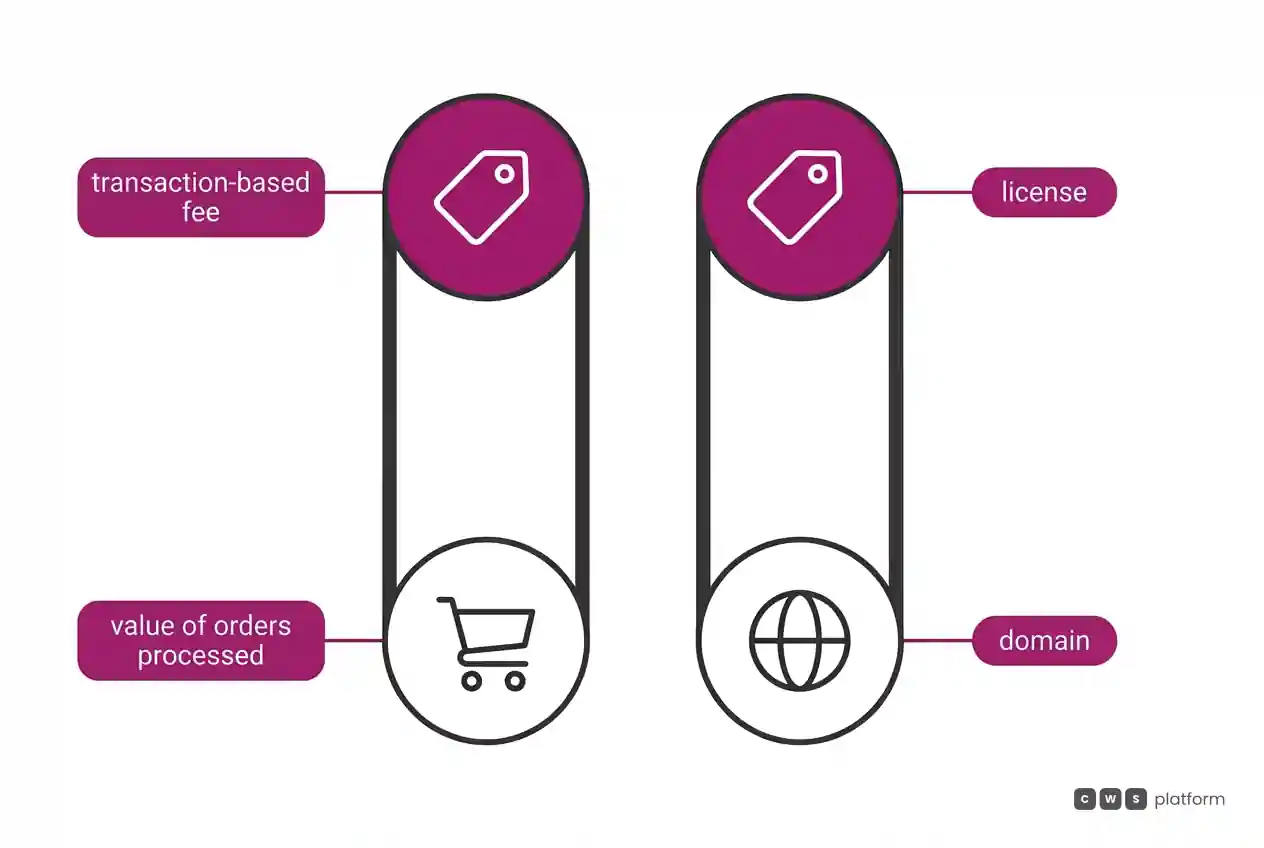
On the Optimizely side, the license is tied to the domain. It is recorded in Optimizely's documentation, accessed on October 16, 2026, about Configured Commerce licenses, that "These are associated per domain and are configured in the Admin Console" (license activation guide). The sources used here do not cover the license price.
For the CFO, the question differs on each side. On VTEX, model the transaction line under three growth scenarios for the B2B channel and ask in writing which services, such as Shield, sit outside it. On Optimizely, ask how many domains the operation will need over three years, with separate brands, countries, or channels, and what each domain adds to the contract.
Implementation and support: what support requires
On VTEX, implementation work depends on the component type. Per the composable components guide, there are Built-in components, already installed, and Plug-and-play components, which require installation and, in some cases, configuration; anything outside those categories requires development.
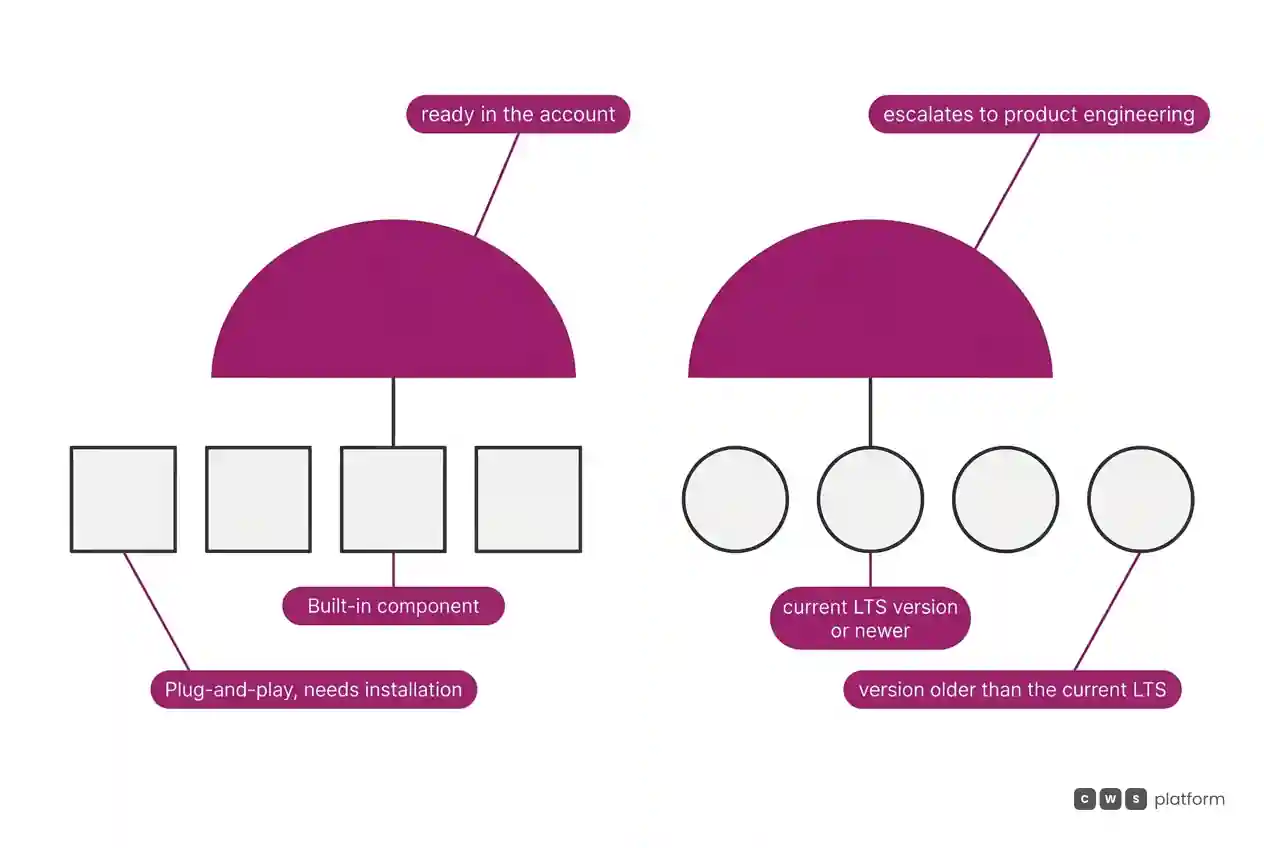
On Optimizely, support depends on the version. It is recorded in Optimizely's documentation, accessed on October 16, 2026, that "support cases will no longer be escalated to product engineering unless the current Long-Term Support (LTS) version or newer is in use." (support policy update notice). For the budget, ask how often the company will need to upgrade to stay on the current LTS and what each upgrade costs.
With both, ask for the three-year support plan, separating what belongs to the platform from what stays with your team.
When to choose VTEX
Customer credit at checkout. The payments overview lists customer credit among the methods the gateway accepts, alongside cards, digital wallets, and gift cards.
A broad integration ecosystem. The composability guide describes more than 750 API endpoints and more than 900 ready-made integrations with payment providers and marketplaces.
Commercial rules per organization. B2B Organizations arranges buyers into organizations and cost centers, with their own price tables and payment methods.
Retail and B2B in the same operation. The VTEX Commerce Platform page describes ecommerce, physical stores, marketplace, and B2B under the same order orchestration.
When to choose Optimizely
Pricing calculated without relying on the ERP connection. The Price Matrix stores pricing schemes in a flat table, designed to calculate without a direct connection to the ERP.
Quotes tied to volume. Job Quotes set a total quantity consumed across several orders until an expiration date.
ERP integration through an agent. The Windows Integration Service runs Refresh and Submit jobs between the store and the ERP.
Purchasing from the customer's own system. PunchOut over cXML returns the cart to the customer's procurement system as a requisition, which comes back to the platform as a purchase order.
When neither fits
In some companies commercial policy changes often, and each change should not depend on new code. For them there is a third model, described in the post on the three B2B commerce platform models: moving commercial rules into the platform.
That is the CWS Platform model. Billing is a platform license plus an integration license, with no percentage of sales or GMV, and all customers run on the same version. Commercial policy is stored as parameters in CDL Workspace, configuration instead of code, and price tables, rules, and contracts are configurable in the platform or come from the ERP and CRM through APIs. The customer's credit limit is kept in the platform, and a sales rep's discount goes through tiered approval. The platform has 11 modules, 6 AI Agents, and 1,029 parameters.
To read each vendor against that model, there are two comparisons: VTEX vs CWS Platform: B2B total cost over three years and Optimizely Configured Commerce vs CWS Platform: total cost over three years.
Before you lock in the budget, it is also worth talking to a CWS Platform specialist.
Frequently asked questions
VTEX or Optimizely: which costs less over three years?
The sources used here publish no price for either, so the answer depends on the growth plan. On VTEX, the 20-F records that the transaction-based fee accounts for most of VTEX's subscription revenues and is primarily structured as a percentage of the value of orders processed; on Optimizely, licenses are associated per domain. Model both under three scenarios of volume and number of domains.
How does each one charge?
VTEX states in its 20-F that the transaction-based fee accounts for most of its subscription revenues and is primarily structured as a percentage of the value of orders processed. Optimizely records that Configured Commerce licenses are associated per domain and configured in the Admin Console, and the sources used here do not cover their price.
What goes on the bill besides the license?
On VTEX, the documentation records that VTEX Shield may carry additional fees. On Optimizely, the sources used here do not cover billing items beyond the license; ask the proposal to price the ERP integration and version upgrades.
Does support cover any version?
On Optimizely, no: the documentation records that support cases are only escalated to product engineering on the current LTS version or newer. The VTEX sources used here do not cover a support policy by version, so ask for it in writing in the proposal.
Brands mentioned in this article
 VTEX

- Optimizely
- SAP Commerce Cloud
- Salesforce
Trademarks and logos belong to their respective owners. Mention does not imply partnership or endorsement.
"responsive, technically engaged, and willing to work through complex commercial rules (negotiated pricing, credit, customer-specific conditions) rather than pushing generic answers"
Is selling more not turning into margin?
Request an assessment of your operation or talk straight to a specialist, whichever you prefer.
I'd rather get the next articles on margin and discounts
A weekly roundup of new articles on margin and discounts, only in weeks when there is one. No spam, and you can leave in one click.