Optimizely vs commercetools: what must the proposal include?
A plan packaged case by case or an order-based license: through a CFO's lens, what each proposal needs to put in writing on billing, environments, and beta features.

Editorial note: CWS Platform competes with Optimizely and with commercetools. This comparison uses only each vendor's public documentation, with the address next to each fact and the date of each record cited.
Short answer: Optimizely Configured Commerce fits companies that want a B2B portal backed by the ERP, with customer pricing in a matrix, rep-led quoting, and a plan packaged case by case, accepting that development and test environments sit with the partner. commercetools fits companies that want to compose B2B on APIs, with an order-based license rather than a GMV-based one, accepting that public beta features fall outside the SLA.
A CFO comparing Optimizely Configured Commerce and commercetools will get two proposals built in different ways: one with a plan designed for the company, the other with a license tied to order count. The finance decision is what each proposal has to put in writing so that the three-year math does not rest on assumptions: what is billed, what stays with the partner, and what comes in without a service level agreement.
The map of platform models is in the three B2B commerce platform models, and the other comparisons are in the comparisons hub, including Optimizely Configured Commerce vs Salesforce B2B Commerce and commercetools vs Spryker.
Optimizely Configured Commerce and commercetools side by side
The table summarizes what each vendor's documentation records; where the source does not cover a point, the cell says so.
| criterion | Optimizely Configured Commerce | commercetools |
|---|---|---|
| Platform model | Storefront and Admin REST APIs; on .NET Core, separate Admin, Storefront, and Integration applications | B2B Commerce package on the commercetools Platform, with Merchant Center and REST and GraphQL APIs |
| Native B2B or by extension | Price Matrix, Request for Quote, Job Quotes, Quick Order, and PunchOut documented in the product | Business Units, Associate Roles, Approval Rules, and Quotes in the B2B Commerce package |
| Customer and contract pricing | Price Matrix from the most specific record to the most general; price can also be queried from the ERP | Standalone Prices and Business Unit prices, with quantity tiers |
| Quoting | RFQ from the cart or from the rep; Job Quotes | Quote Request, Staged Quote, and binding Quote, with renegotiation |
| Credit and payment terms | Invoice history in the portal, with terms, due date, and balance | Not documented |
| ERP integration | Windows Integration Service with Refresh and Submit jobs | Connect (managed integration runtime) and asynchronous Import API |
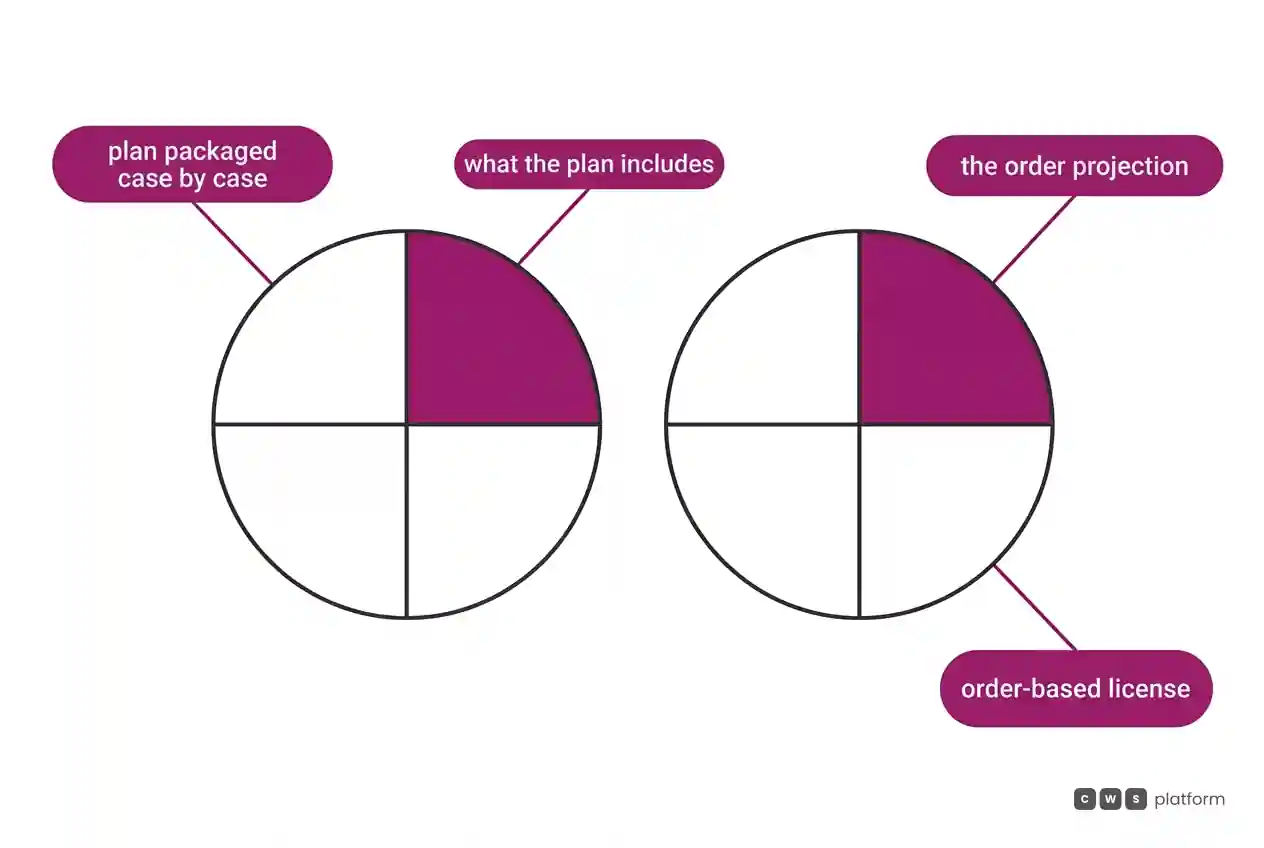
| Billing model | Each plan individually packaged | Order-based license, not GMV-based |
| Implementation | Development and test environments hosted by the partner or implementation team | commercetools Frontend as SaaS or a Store Launchpad copied into the project; public beta features outside the SLA |
Pricing and commercial rules: where the customer price comes from
In Optimizely Configured Commerce, customer pricing comes from the Price Matrix. Per the pricing guide, the calculation orders records from the most specific to the most general, applies the first match, compares the result with the sale price, and returns the lower one. The technical overview of the matrix explains that the table is flat to speed up the calculation without a direct ERP connection. When the price has to come from the ERP, the pricing and inventory service queries the ERP through an API or through the Windows Integration Service, with a 60-minute price cache.
On commercetools, a price is an API resource. Standalone Prices live outside the product document, tied to the variant by SKU, scoped by currency, country, Customer Group, or channel, with quantity tiers and validity dates. The B2B Commerce package adds Business Unit prices and cart and product discount rules with conditional predicates.
For finance, the shared question is who maintains the price table after go-live, and whether that work is inside the proposal's scope.
Quoting and assisted selling: where the discount limit lives
In Optimizely, quoting runs through the rep. Per the Request for Quote guide, a request starts in the buyer's cart or is created directly by the rep. The RFQ configuration caps the maximum discount against list price, calculates minimum margin on unit cost per warehouse, and sets how many days a quote stays valid.
On commercetools, negotiation is a cycle of API resources. Per the Quotes overview, the buyer creates a Quote Request from the cart, the seller builds a Staged Quote with items, quantities, validity, and discounts, and the Quote sent is a binding offer the buyer accepts, declines, or asks to renegotiate. Approval Rules set criteria by currency, country, or order value, with requester and approver roles.
For the CFO, the difference is where the commercial limit gets written down: in Optimizely, in the quote configuration; on commercetools, in the order approval rules. It is worth bringing a real negotiation to the demo and seeing where it stops.
ERP integration: what runs inside and outside the platform
In Optimizely, the Windows Integration Service runs as an agent inside the customer's corporate firewall and executes Refresh jobs, which pull products, inventory, and customers from the ERP, and Submit jobs, which push orders and customers to the ERP. For cloud ERPs, the internal WIS setup runs the jobs inside Configured Commerce.
On commercetools, integration is project code running in a vendor-managed environment. Connect runs small integration applications in JavaScript, TypeScript, or Java. The Import API takes batch loads asynchronously, and the best practices guide recommends up to 300 API calls per second per project.
It is worth asking, in both proposals, who writes, hosts, and maintains each ERP integration.
Cost and billing model: what the proposal has to include
At Optimizely, the proposal is the pricing document. It is recorded on Optimizely's plans page, accessed on October 16, 2026: "Every Optimizely plan is individually packaged." (Optimizely plans page). It is worth asking the proposal to state, line by line, what the plan includes and what changes in the price if sites, users, or orders grow.
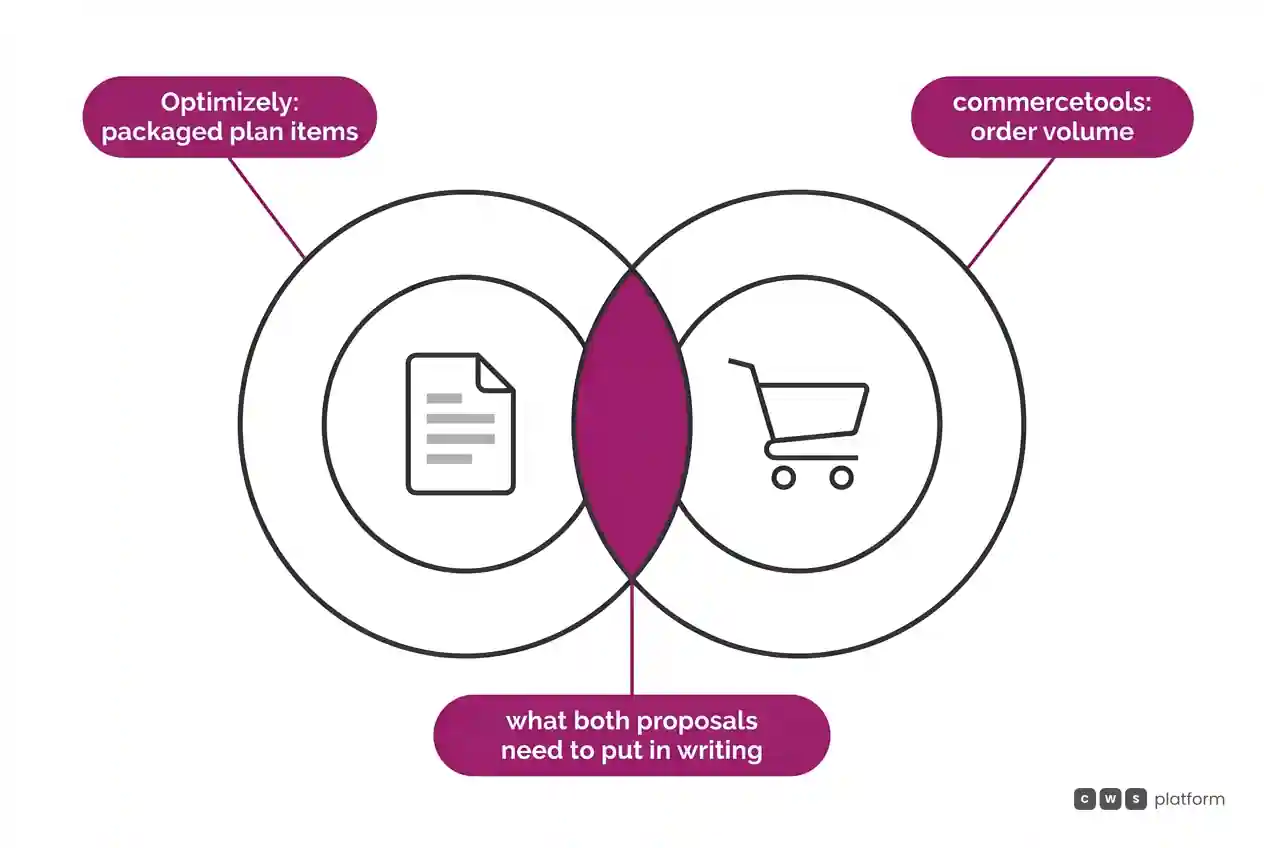
At commercetools, the billing model is stated. It is recorded on commercetools' pricing page, accessed on October 16, 2026, that the license is order-based, not GMV-based: "Unlike GMV-based models, our order-based approach ensures no hidden fees or penalties for scaling." (commercetools pricing page). The same page provides for channels, catalogs, and storefronts with no explicit quantity limits in the license. Order count becomes the variable in the math: it is worth bringing the three-year order projection to the negotiation and asking how the license tracks that projection.
In both cases, it is worth having in writing what is in the base price and what becomes a separate line item.
Implementation and support: environments, partner, and beta features
In Optimizely, implementation runs through the partner. It is recorded in Optimizely's documentation, accessed on October 16, 2026: "Your partner/implementation team is responsible for hosting all development and test environments." (Optimizely guide to sandbox and production environments). It is worth asking the partner's proposal to include the cost of hosting and maintaining those environments for the full contract term, not only during implementation.
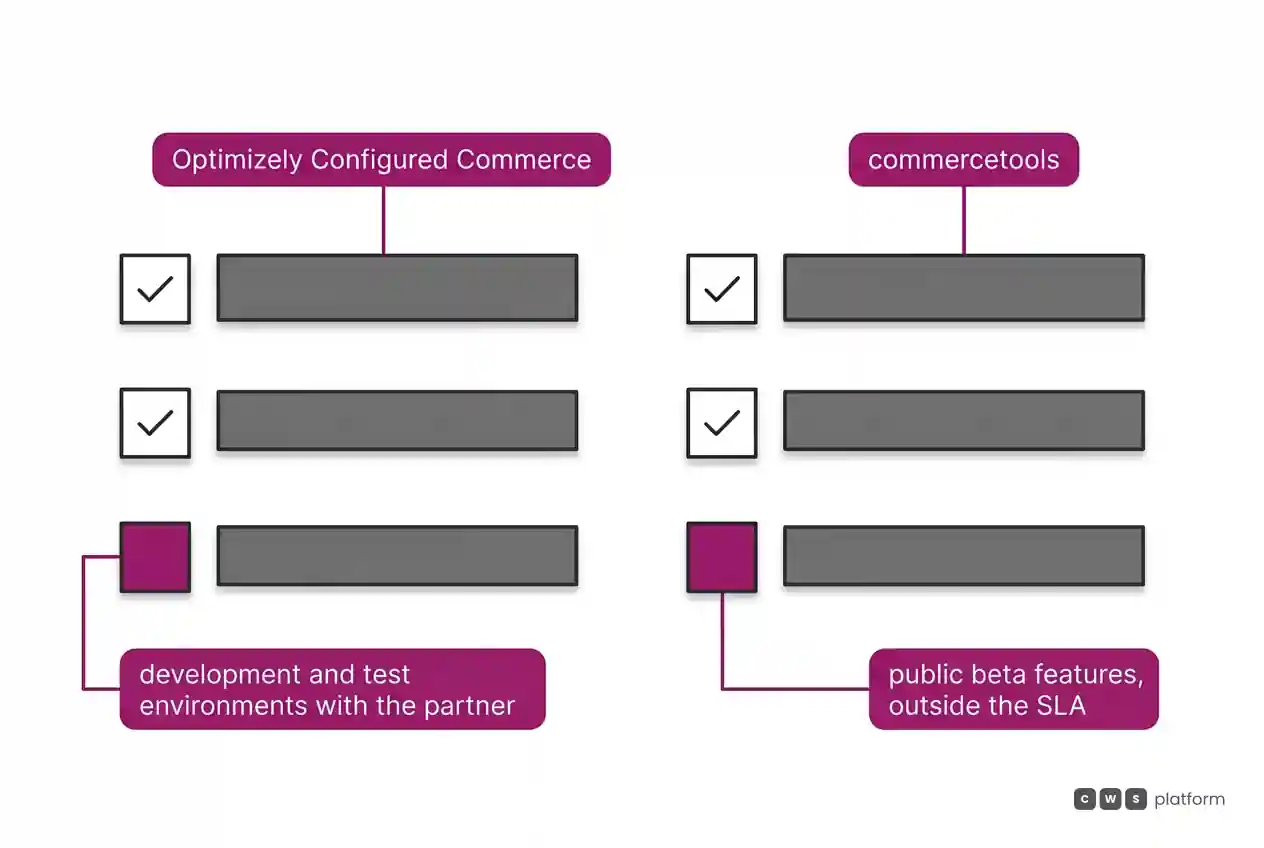
On commercetools, per the Store Launchpads overview, commercetools Frontend is SaaS and updated automatically, while the Store Launchpad for B2B Manufacturing is a template copied into the project and maintained by the developer. Each feature's release stage also matters for the contract. It is recorded in commercetools' documentation, accessed on October 16, 2026, that public beta features get support and bug fixes but fall outside service level agreements: "They receive Customer Support and bug fixes like general availability features but are not covered by Service Level Agreements or remedies." (commercetools compatibility page). It is worth asking the proposal to list which in-scope features are in public beta on the signing date.
When to choose Optimizely Configured Commerce
Customer pricing that already lives in the ERP. The Price Matrix resolves price from the most specific record to the most general, and the pricing and inventory service queries the ERP when the price has to come from there.
Reps who quote within discount and margin limits. The RFQ configuration ties the maximum discount to list price and the minimum margin to unit cost.
Invoices in front of the buyer. The invoice history lets the buyer look up invoices on the site and generate a PDF or send them by email.
Buying from the customer's procurement system. PunchOut brings the catalog and negotiated prices into the customer's procurement system over cXML.
When to choose commercetools
A license that does not track GMV. As recorded on commercetools' pricing page, accessed on October 16, 2026, the license is order-based and provides for channels, catalogs, and storefronts with no explicit quantity limits (commercetools pricing page).
A buyer hierarchy modeled by your team. Business Units organize company and divisions, with inheritance of Stores, associates, and approval rules.
Formal negotiation. The Quotes cycle covers quote requests, binding offers, renegotiation, and conversion into orders.
Reps inside the customer's cart. Assisted Selling lets the rep take over the cart in Merchant Center, lock it during the session, and hand it back to the buyer to place the order.
When neither fits
For some companies, the proposal question is not which pricing line to pick, but where commercial rules will live and how much code each change takes. For them there is a third model, described in the post on the three B2B commerce platform models: move commercial rules into the platform.
That is the CWS Platform model. Billing is a platform license plus an integration license, with no percentage of sales or GMV, and every customer runs the same version. Commercial policy is stored as parameters in CDL Workspace, configuration instead of code, and price tables, rules, and contracts are configurable in the platform or come from the ERP and CRM through APIs. The customer's credit limit is kept in the platform, and payment on terms supports split, scheduled, and multi-address delivery. It comes to 11 modules, 6 AI Agents, and 1,029 parameters.
To read each vendor against that model, there are two comparisons: Optimizely Configured Commerce vs CWS Platform: what is the total cost over three years? and commercetools vs CWS Platform: what goes into the three-year total cost of ownership?.
If neither proposal answers the questions your finance team needs to ask, it is worth talking to a CWS Platform specialist before signing.
Frequently asked questions
Optimizely vs commercetools: which costs less over three years?
Public sources do not settle it. Optimizely records that every plan is individually packaged, so the number exists only in the proposal. commercetools records an order-based license, not a GMV-based one, so the number depends on the order projection. A fair comparison needs both proposals priced on the same order volume and the same scope.
How does each one charge?
At Optimizely, each plan is individually packaged, and the price comes from the proposal built for the company. At commercetools, the B2B Commerce package license is driven by order volume, not GMV.
What does the proposal need to include?
From Optimizely, what the packaged plan includes and who hosts and maintains the development and test environments, which the documentation assigns to the partner or implementation team. From commercetools, the order projection the license is based on and the list of in-scope features that are in public beta. From both, who writes and maintains the ERP integration.
Are test environments and beta features covered by the contract?
At Optimizely, the documentation records that the partner or implementation team hosts all development and test environments, so it is worth finding that cost in the partner's proposal. At commercetools, public beta features get support and bug fixes but are not covered by service level agreements or remedies, so it is worth knowing which of them your operation will use.
Read next
Brands mentioned in this article


- Optimizely
- Salesforce
Trademarks and logos belong to their respective owners. Mention does not imply partnership or endorsement.
"responsive, technically engaged, and willing to work through complex commercial rules (negotiated pricing, credit, customer-specific conditions) rather than pushing generic answers"
Is selling more not turning into margin?
Request an assessment of your operation or talk straight to a specialist, whichever you prefer.
I'd rather get the next articles on margin and discounts
A weekly roundup of new articles on margin and discounts, only in weeks when there is one. No spam, and you can leave in one click.