B2B Systems Integration: What to Connect First and How
Why B2B integration is about business rule governance and data ownership, not just data pipelines.

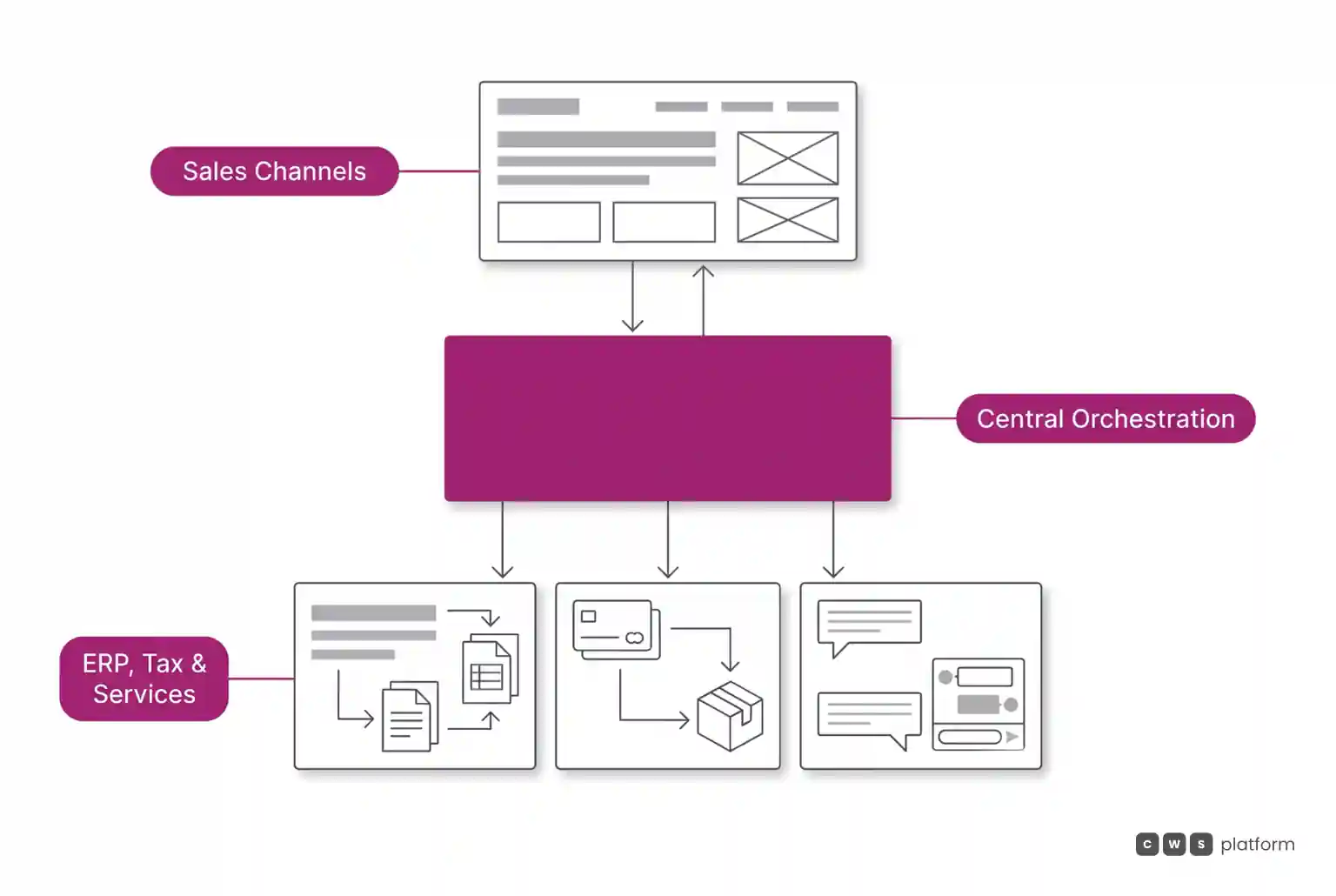
Systems integration means enabling different software applications to exchange data automatically, without anyone having to manually copy information from one screen to another. In B2B sales, it connects your sales channels (buyer portals, sales reps, marketplaces) to your ERP, tax engines, payment gateways, freight carriers, and CRM, ensuring an order originates with accurate data and moves straight to fulfillment and invoicing without manual re-entry.
A well-architected integration is invisible. A poorly executed integration shows up every single day, disguised as a spreadsheet.
What gets integrated in B2B sales
- ERP. Customer master records, product catalogs, inventory levels, custom pricing, credit limits, sales orders, and invoicing.
- Tax. Automated sales tax calculation and exemption certificate management.
- Payments. ACH transfers, credit cards, wire transfers, net payment terms, and automated reconciliation.
- Logistics. Real-time freight rating (LTL/parcel), transit times, and tracking updates.
- CRM. Account interaction history, sales pipeline, and rep account assignments.
- Communications. Transactional email, SMS, and purchase workflow notifications.
Common approaches to systems integration
APIs. One system queries or posts data to another on demand. This is the most versatile and widely adopted standard today.
Webhooks. One system immediately notifies another whenever an event occurs, such as an inventory balance change or an updated order status. Ideal for real-time synchronization.
Flat files and batch processing. Scheduled transfers of CSV or data files at predefined intervals. Best suited for high-volume payloads that do not require instant updates, such as nightly catalog syncs.
Middleware. An integration layer or iPaaS sitting in the middle to translate, map, and orchestrate communications across multiple platforms.
Why systems integration becomes complex
Why does data drift between systems? Because every platform maintains its own isolated record of the account, the SKU, and the contracted price.
Why does each platform maintain its own record? Because no one clearly established which system serves as the single source of truth for each specific data point.
Why does this stall the sales pipeline? Because an order is captured using stale pricing or inaccurate inventory counts, triggering order exceptions that kick it out of the ERP billing flow.
Why does the breakdown keep happening? Because the integration was built only for initial transaction volumes, and sync frequency failed to keep up as business scaled.
The fundamental root cause: integration is not merely connecting software endpoints. It is defining data governance and governing the speed at which that data travels.
How to plan systems integration for B2B commerce
1. Establish the single source of truth for every data domain. Customer profiles, SKUs, inventory counts, pricing tables, credit limits, and orders: designate clearly which application owns which domain.
2. Map the sync frequency for each pipeline. Available inventory and order statuses demand real-time or near-real-time synchronization. Broad catalog updates and base customer records can run on batch schedules.
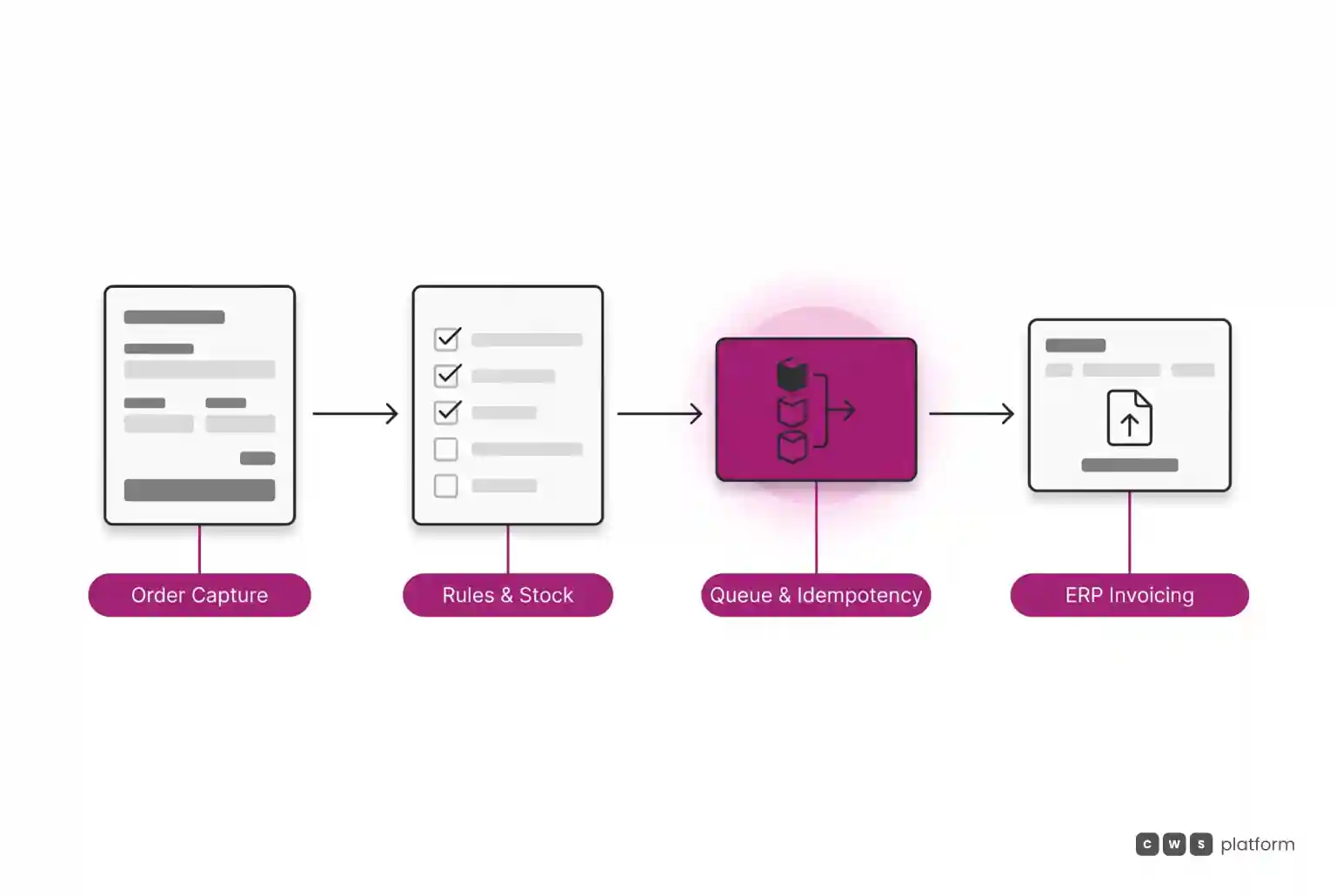
3. Focus on order intake first. The most critical integration workflow is delivering clean, fully validated orders into the ERP. This single pipeline eliminates manual order entry and duplicate handling.
4. Plan for inevitable network and API errors. Every integration encounters temporary failures. Implementing message queuing, exponential backoff retries, and idempotent keys is what prevents temporary network drops from generating duplicate customer orders.
5. Do not rip and replace your ERP to achieve modern integration. A modern digital commerce layer can orchestrate workflows on top of your existing core backend. We explore this approach in how to modernize B2B sales without an ERP migration.
We outline the specific data contracts and handshakes in what data needs to flow between your ERP and B2B platform.
Systems integration with CWS Platform
CWS Platform integrates via open APIs and modern webhooks without forcing an ERP replacement: real-time inventory feeds via webhook or API with idempotent keys, high-volume batch loads via scheduled files and background queues, and custom price schedules, business rules, and customer contracts maintained natively or synced from your ERP, CRM, or external databases. The integration ecosystem also seamlessly connects with CRM platforms and communication channels. Review the full architecture on our APIs and integrations page.
Next steps
Create a simple matrix with six rows (customer, product, inventory, price, credit, and order) and two columns: which system is the single source of truth, and how frequently that record must update in the digital sales channel. Any row left blank marks the exact spot where your integration is poised to break first.
Frequently asked questions
What is systems integration?
It is the process of linking separate software applications to exchange data automatically without human intervention. In B2B commerce, it ties your sales channels to your ERP, tax software, payment gateways, shipping carriers, and CRM.
What are the main types of systems integration?
The most prevalent methods include RESTful APIs (real-time requests and responses), webhooks (event-driven alerts), scheduled batch file exchanges, and middleware or iPaaS layers that translate and route data across multiple endpoints.
What should a B2B business integrate first?
The sales order workflow. Delivering clean, pre-validated orders directly into the ERP ready for fulfillment eliminates manual data re-entry, billing errors, and operational drag. Real-time inventory balances and customer-specific pricing logic follow right behind.
Do you need to replace your ERP to integrate a modern B2B platform?
No. An enterprise B2B sales platform can connect directly to your existing ERP via modern APIs and webhooks, leaving the ERP intact as the core financial and operational source of truth.
Read also
- Essential B2B E-Commerce Integrations: ERP, Tax, Payments, Shipping, and CRM
- B2B e-commerce and ERP integration: why the ERP was never the problem (and the real cost that hits in year two)
About this publication
A publication by CWS Platform. Visit us at cws-platform.com.
"responsive, technically engaged, and willing to work through complex commercial rules (negotiated pricing, credit, customer-specific conditions) rather than pushing generic answers"
Want to see this in your operation?
Real B2B operations already run on it.