B2B Portals and Sales Reps: How the Rep's Role Shifts When Buyers Order Directly
E-commerce doesn't eliminate sales reps: it scales digital self-service so reps can focus on high-friction orders.

TL;DR
- When customers start placing orders independently through a B2B portal, sales reps stop keying in routine reorders and start handling what self-service cannot resolve: custom pricing, new product lines, and lapsed accounts.
- Self-service is not all-or-nothing. It is measured account by account: how much of each customer's volume happens touch-free, and where orders still get stuck.
- Sales reps will only champion the portal if they keep earning commissions on their accounts, regardless of the channel.
- The practical yardstick is the self-service rate per book of business, analyzed alongside the reason why any order required rep intervention.
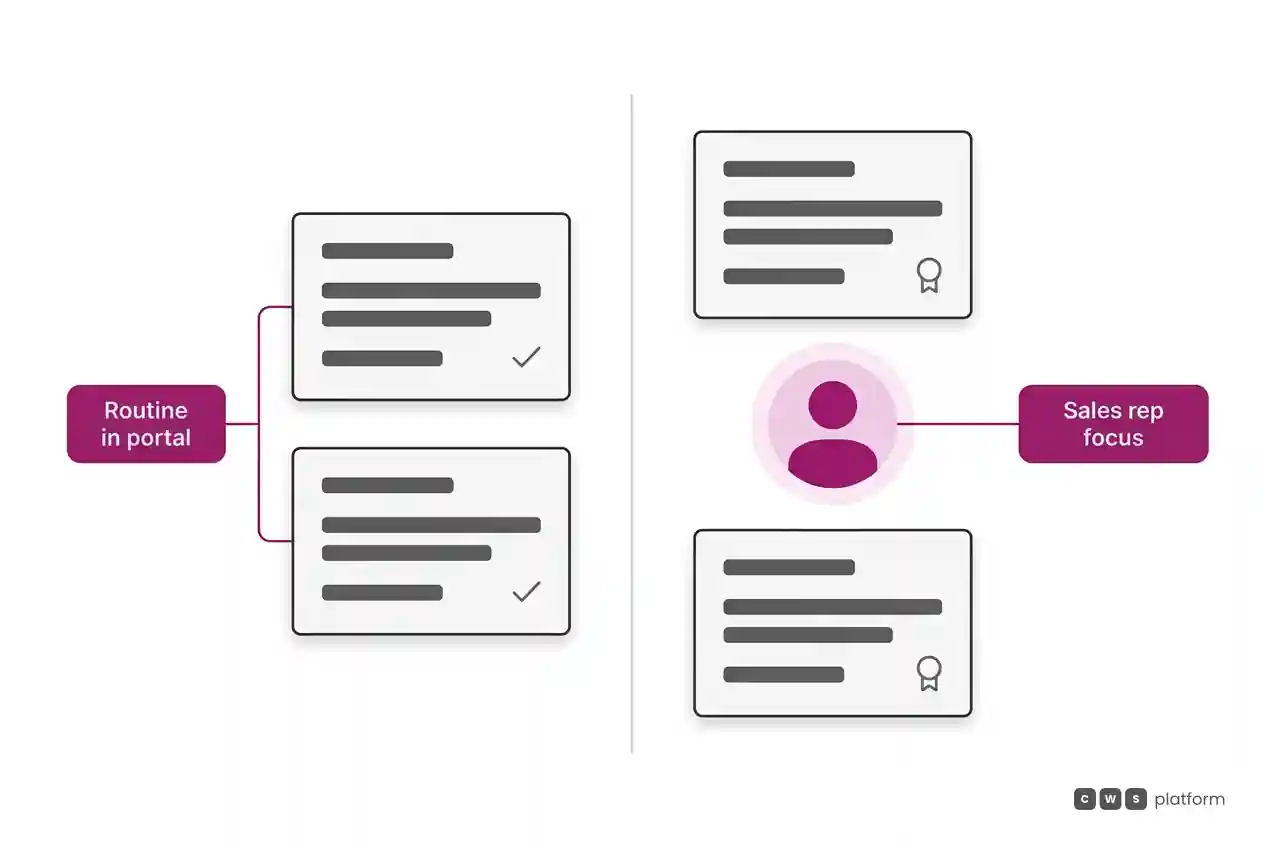
When customers place orders independently through a B2B portal, the sales representative's role shifts from order entry to deal unblocking. They step away from routine replenishment to focus on high-friction points: off-matrix pricing, credit exceptions, unfamiliar SKUs, and lapsed accounts. The rep does not disappear. What disappears is the portion of their workday that never required human judgment in the first place.
Every VP of Sales asks the exact same question: "If customers buy through the portal, why do I need a sales force?" The short answer is that portals excel at routine reorders and fail at purchases requiring real conversation. Your sales team keeps the second group.
What Sales Reps Do Today That a Portal Can Handle
Look at the calendar of an outside sales rep at a typical wholesale distributor. A massive share of visits, calls, and emails ends in an order the buyer already knew by heart: the same items as last month, the same quantities, under the same payment terms. The rep writes it down, checks price tiers, keys it into the ERP, or passes it to an inside sales coordinator to enter.
This is the exact workload a B2B portal absorbs first:
- Routine replenishment. Buyers reorder past shipments or build carts from saved item lists.
- Price and inventory inquiries. Procurement teams look up contract pricing and warehouse availability without picking up the phone.
- Invoices, tracking, and order history. Copies of invoices, account statements, and freight updates live on the portal, not in the rep's text messages.
During implementation, distributors quickly realize that these three tasks consumed far more sales capacity than leadership ever estimated, largely because they were fragmented into small interruptions throughout the day.
What Remains the Sales Rep's Job
A self-service portal hits a wall the moment a B2B transaction stops being routine. That friction point is where field reps deliver real value:
Off-matrix pricing and custom terms. The buyer wants volume tier discounting, special project credit terms, or introductory pricing on a new category. That is a negotiation, and negotiations require commercial authority.
Unfamiliar product categories. In an assisted sales portal, product discovery, application context, and personalized assortments work in tandem. Even so, a procurement manager switching vendors or adopting a complex product line wants to talk to a technical expert.
At-risk and lapsed accounts. The portal flags that an account stopped ordering. The person who picks up the phone, uncovers the underlying issue, and saves the relationship is the sales rep.
Exception handling. Credit limit holds, out-of-stock items, or non-standard freight configurations. Every order that drops out of the portal workflow becomes a direct action item for the rep.
How to Measure Self-Service Account by Account
The most common operational mistake is treating a B2B portal as an isolated channel with separate quotas, directly competing with the sales team. The model that works treats self-service as an adoption maturity scale, tracked customer by customer:
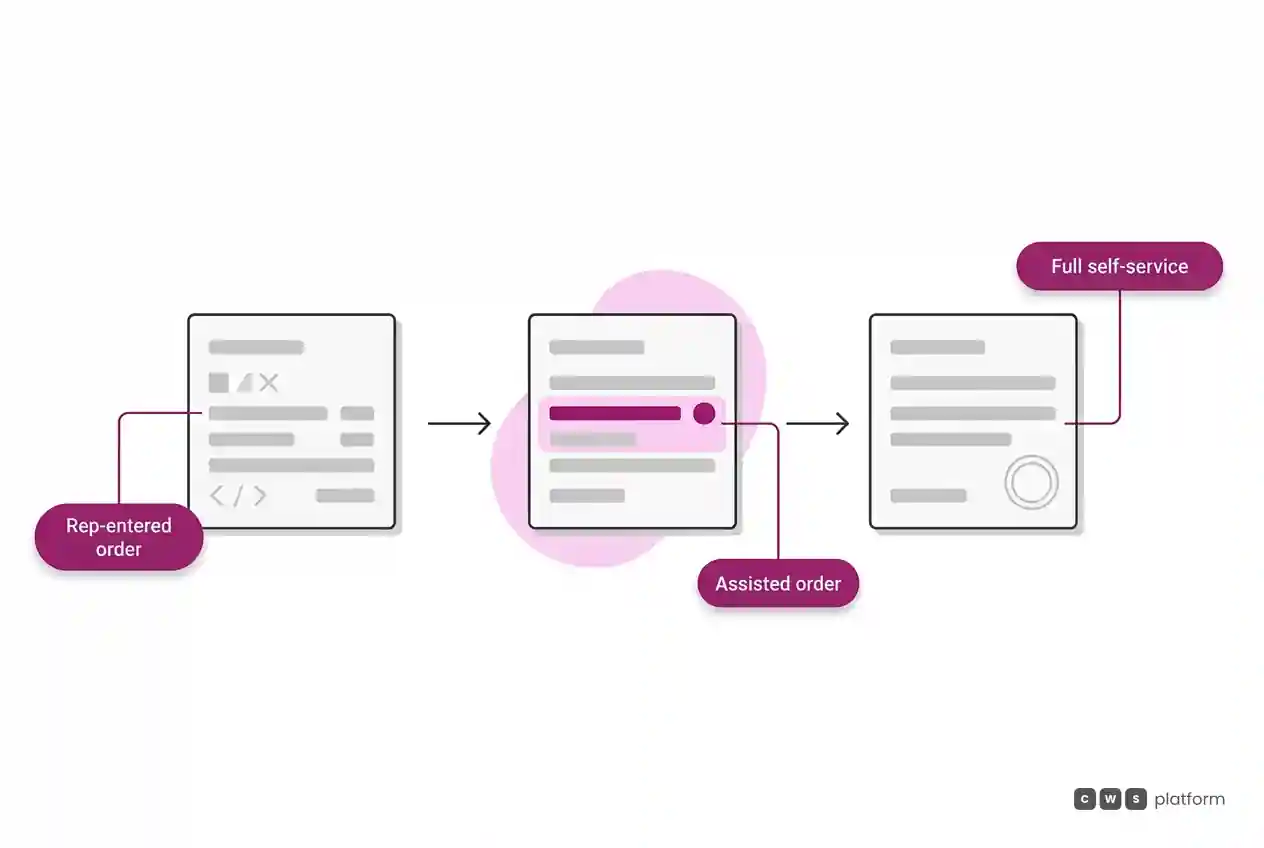
- 100% self-service orders. Built, approved, and submitted on the portal with zero internal touches.
- Assisted sales orders. The buyer starts the cart online, and the rep steps in to adjust margins, substitute items, or grant payment terms within that shared order.
- Rep-entered orders. Built and submitted directly by the rep on behalf of the customer, using the exact same catalog, pricing rules, and business logic.
Aggregated across an entire territory or book of business, these three metrics show exactly where accounts sit today and where they can go. An account that relies entirely on a rep is not a portal failure. It is a customer that has not yet found a reason to switch workflows, and the account manager knows why.
The second critical metric is the root cause behind every assisted order. If half the orders kicked to sales reps stall due to credit holds, the issue is not digital adoption, it is credit limit policy. A platform that systematically tracks these exception types turns the vague complaint "the portal is broken" into concrete operational fixes. That shared workflow is what the Sales Hub from CWS Platform manages: reps and buyers working inside the same order, using unified contract pricing, with every intervention documented.
Why Commission Structures Make or Break Portal Adoption
No portal strategy survives a comp plan that cuts rep commissions when accounts buy online. If reps lose money, they will actively protect their income by telling buyers to send purchase orders directly to them.
Across enterprise projects deployed by CWS Platform, the principle that unlocks adoption is straightforward: account reps earn full commission on all orders from their assigned territory, regardless of order origin. Once that rule is in place, reps become internal change agents who train customers on the portal. Every reorder the buyer submits independently frees up selling time to pursue larger, higher-margin opportunities.
Best-in-class operations manage two distinct targets: overall revenue quotas, which reps already have, and digital self-service adoption rates, which reveal whether they are successfully migrating transactional volume to lower-cost digital channels.
Equipping Sales Reps With the Customer Portal
The most overlooked operational requirement is putting the portal directly into the sales rep's hands. When reps sell through the exact same platform their accounts use, three critical advantages emerge: the pricing they quote matches what the buyer sees online, quotes can be turned into digital carts for buyer approval, and account history lives in a single audit trail instead of disconnected spreadsheets.
For a detailed breakdown of how reps and buyers collaborate on shared orders, read our guide on sales reps and buyers sharing the same B2B portal. To explore how sales-built orders get handed over for customer sign-off, see our framework on assisted sales.
Next Steps
Select the accounts of three sales reps and audit their purchase orders from the past 30 days across three categories: transactions the buyer could have completed independently, deals that required real negotiation, and orders that required manual intervention due to operational exceptions (credit holds, inventory shortages, freight rules). The first category is what your portal must absorb immediately. The second is high-value selling that reps need more time to pursue. The third is the technical punch list of business rules your platform must solve before launch.
Frequently Asked Questions
Does a B2B portal replace outside sales reps?
No. A portal takes over routine replenishment, pricing lookups, and order status tracking. Sales reps retain deal negotiations, new product rollouts, business development, and lapsed account recovery.
How should reps be compensated when accounts order through the portal?
The model that drives digital adoption pays reps their full commission on assigned accounts across every channel. Without channel-neutral compensation, reps will actively steer buyers away from the portal.
What is a hybrid B2B sales model?
A hybrid model runs sales reps and buyers on the same unified commerce engine. Buyers manage routine reorders through self-service, while reps configure, discount, or review complex orders within the same system under identical business logic.
How do you measure if self-service ordering is working?
Track the self-service adoption rate across each book of business (fully touchless orders, assisted orders, and rep-entered orders), paired with an audit of the exception reasons behind every manual touchpoint.
Recommended Reading
- Low Inventory Visibility in B2B Portals: What to Display So Buyers Stop Calling
- B2B Portals and Self-Service Ordering
About This Publication
Published by O Custo da Venda, a CWS Platform blog focused on the strategic role of commercial teams in digital B2B commerce. This article does not disclose client names or proprietary benchmark metrics.
"responsive, technically engaged, and willing to work through complex commercial rules (negotiated pricing, credit, customer-specific conditions) rather than pushing generic answers"
Are your channels competing for the same customer?
Request an assessment of your operation or talk straight to a specialist, whichever you prefer.
I'd rather get the next articles on channel conflict
A weekly roundup of new articles on channel conflict, only in weeks when there is one. No spam, and you can leave in one click.