B2B Channel Conflict: When Your Portal and Sales Reps Offer Different Prices
How the lack of unified pricing governance erodes margins when buyers find discrepancies between digital and direct sales
TL;DR
- B2B channel conflict happens when the same customer finds different terms for the exact same item depending on whether they buy through the portal, a sales rep, or an outside agent.
- The defect does not look like a system bug. It shows up as artificial portal adoption, leaked margin, and a growth thesis that falls apart.
- Testing each channel in isolation will not catch the problem: the portal passes the test, the sales rep passes the test, and together they quote two different prices.
- The solution is a single commercial policy enforced by the platform across all channels, with any channel difference written as a transparent business rule, not an ad hoc exception.
When the customer portal and the sales rep offer different prices to the same account, the company needs to replace two separate policies with one: a single price schedule per customer, enforced by the same system across both self-service and direct sales, with any channel difference codified as an explicit rule (such as a systematic digital order discount) rather than negotiated case by case. Channel conflict is not resolved by picking a winning channel. It is resolved by removing the rep's ability to offer an offline workaround that the portal knows nothing about.
How Channel Conflict Emerges
Leadership rarely decides to run two conflicting prices. The split happens gradually:
- The portal goes live using the official price list.
- The sales rep, used to negotiating freely, keeps offering off-system discounts over the phone or via email and text.
- The buyer realizes that calling the rep yields a better deal. They start browsing inventory on the portal and finalizing the order through the rep.
From the standpoint of each individual channel, everything works. The portal displays the correct list price. The rep books the deal. The issue only surfaces when looking at the account level: the buyer sees two prices, and they will always take the lower one.
Why Testing Channels in Silos Misses the Issue
You can validate each channel independently, even using AI to accelerate QA testing, and still deploy an operation where reps quietly undercut the digital storefront. Portal testing checks whether the displayed price matches the ERP table. Sales order testing checks whether the rep can submit a quote into the system. Neither test checks whether the same buyer, on the exact same day, is offered two conflicting price points.
For executive leadership, the defect appears under several disguises:
- Artificial adoption. The portal records strong login traffic but few checkout completions, or high order volume exclusively for non-negotiated commodity items.
- Leaked margin. Average discount rates creep upward without any deliberate executive decision.
- A broken scaling thesis. The digital strategy assumed self-service would lower the cost to serve. Because final transactions keep flowing back through sales reps, operational costs remain high, and the business now pays to maintain two redundant workflows.
The Business Rules That Resolve Conflict
1. One price schedule per customer across all channels. The customer price is a single source of truth queried by both the portal and the rep. This model is outlined in customer specific pricing.
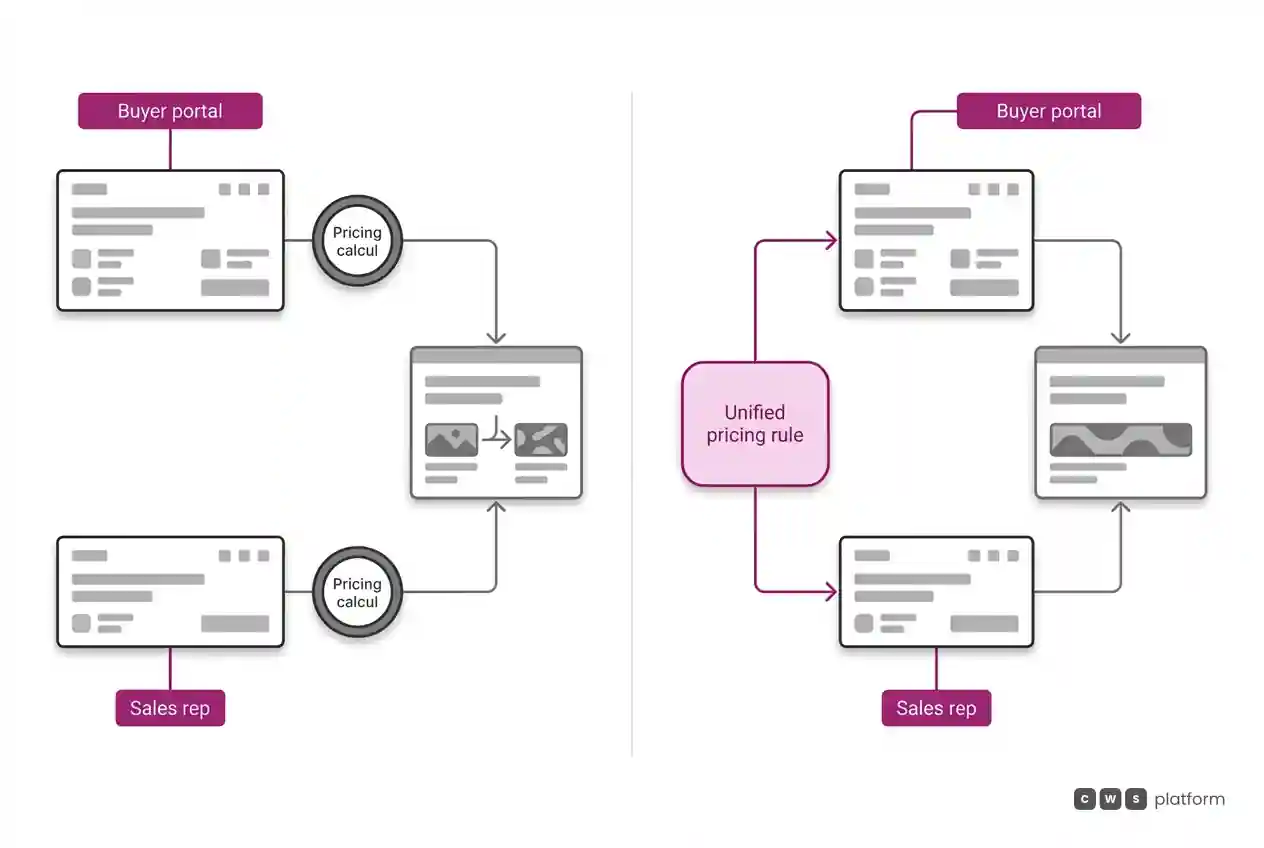
2. Rep discounts bounded by automated approval thresholds. Reps can negotiate, but only within strict policy bands. Anything beyond the assigned band triggers an approval workflow with a clear audit trail. The mechanics are detailed in discount authorization levels.
3. Channel differences must be systematic rules, not ad hoc exceptions. If the business wants to drive digital adoption, a web-order incentive should be a published system rule. If full-service rep support carries a premium, that difference should also be programmatic. What cannot happen is price divergence caused simply because one channel has zero visibility into the other.
4. Reps must see what the portal displays. When speaking with a client, the rep must see the exact pricing and promotions the customer sees online. It is hard to invent an off-book rate when the platform clearly surfaces the standard entitlement.
5. Compensate on the account, not the transaction medium. If sales reps are only credited for orders they manually enter into the ERP, the compensation plan directly incentivizes channel conflict.
How to Audit for Channel Conflict
- Average price paid per item by channel, benchmarked across identical buyer segments.
- Accounts that view products on the portal and purchase via a sales rep within 24 hours.
- Out-of-policy discount frequency by rep, highlighting where off-system workarounds thrive.
Next Steps
Select your top twenty revenue-generating SKUs and compare the average realized price between web orders and rep orders over the last quarter, segmented by account tier. If an uncodified gap exists, that delta measures the hard cost of your channel conflict. The infrastructure to enforce unified pricing logic across every touchpoint is the Pricing Engine by CWS Platform.
Frequently Asked Questions
What is channel conflict in B2B?
It occurs when the same business buyer sees different pricing, payment terms, or availability for identical items depending on whether they order via the web portal, an inside sales rep, or an independent broker. Buyers naturally exploit the lowest price, degrading margins and corporate governance.
How do you fix pricing discrepancies between B2B e-commerce and direct sales?
Implement a unified customer-specific price matrix across all channels, govern rep discounting through automated approval levels, codify channel incentives as formal rules, and align rep commissions with total account revenue regardless of checkout channel.
Can a B2B portal offer different pricing than a sales rep?
Yes, provided the discrepancy is an intentional, policy-driven rule, such as an automatic discount for unassisted digital orders. The problem arises when discrepancies stem from siloed data and disconnected workflows.
How can I identify channel conflict inside my organization?
Compare the average net price paid per SKU across channels for comparable account profiles, and audit how many accounts regularly log into the portal but route their purchase orders through a rep on the same day.
Related Articles
- B2B Sales Pricing: From Cost to Customer-Specific Price
- Customer-Specific Pricing in B2B: Managing Negotiated Rates Without Spreadsheets
About This Publication
An article from the blog The Cost of Selling, published by CWS Platform, covering commercial governance across B2B sales channels. It does not reference specific clients or actual company financial records.
"responsive, technically engaged, and willing to work through complex commercial rules (negotiated pricing, credit, customer-specific conditions) rather than pushing generic answers"
Are your channels competing for the same customer?
Request an assessment of your operation or talk straight to a specialist, whichever you prefer.
I'd rather get the next articles on channel conflict
A weekly roundup of new articles on channel conflict, only in weeks when there is one. No spam, and you can leave in one click.