Reps and Buyers in the Same B2B Portal: Unifying Experience Without Shadow Channels
Why splitting sales reps and buyers across disconnected tools creates channel conflict, and how shared carts solve it.

TL;DR
- When the customer buys through the portal and the sales rep works in a separate system, the business ends up with two channels and two conflicting realities: different pricing, order history, and carts depending on who handles the account.
- Unification means putting both sides in the exact same workspace: the buyer orders independently, while the rep accesses the same account, views the same cart, and applies the same business rules.
- Commercial digitization is only complete when buyer and seller rely on the same technology. Digitizing only one side leaves the other buried in paper forms, phone calls, and spreadsheets.
- The practical result is a single source of truth for order history, uniform commercial policies, and sales reps who guide buyers through the portal instead of competing against it.
To unify the rep and customer experience in a B2B portal, place both users inside the exact same environment with shared accounts, identical carts, uniform pricing, and consolidated history. The customer purchases self-service when reordering or buying standard products. The sales rep steps directly into the customer account whenever negotiations are needed, configuring or adjusting the cart within corporate rules, while the order travels along the exact same workflow. Without this alignment, the online portal and the field sales force become competing parallel channels, each operating with its own disconnected view of the buyer.
The Two-System Problem
The most common operational challenge looks like this: the company rolls out a customer-facing portal while keeping sales reps in legacy software, whether that is the core ERP, a mobile sales tool, or disconnected spreadsheets. Both tools work, but each functions in an isolated silo.
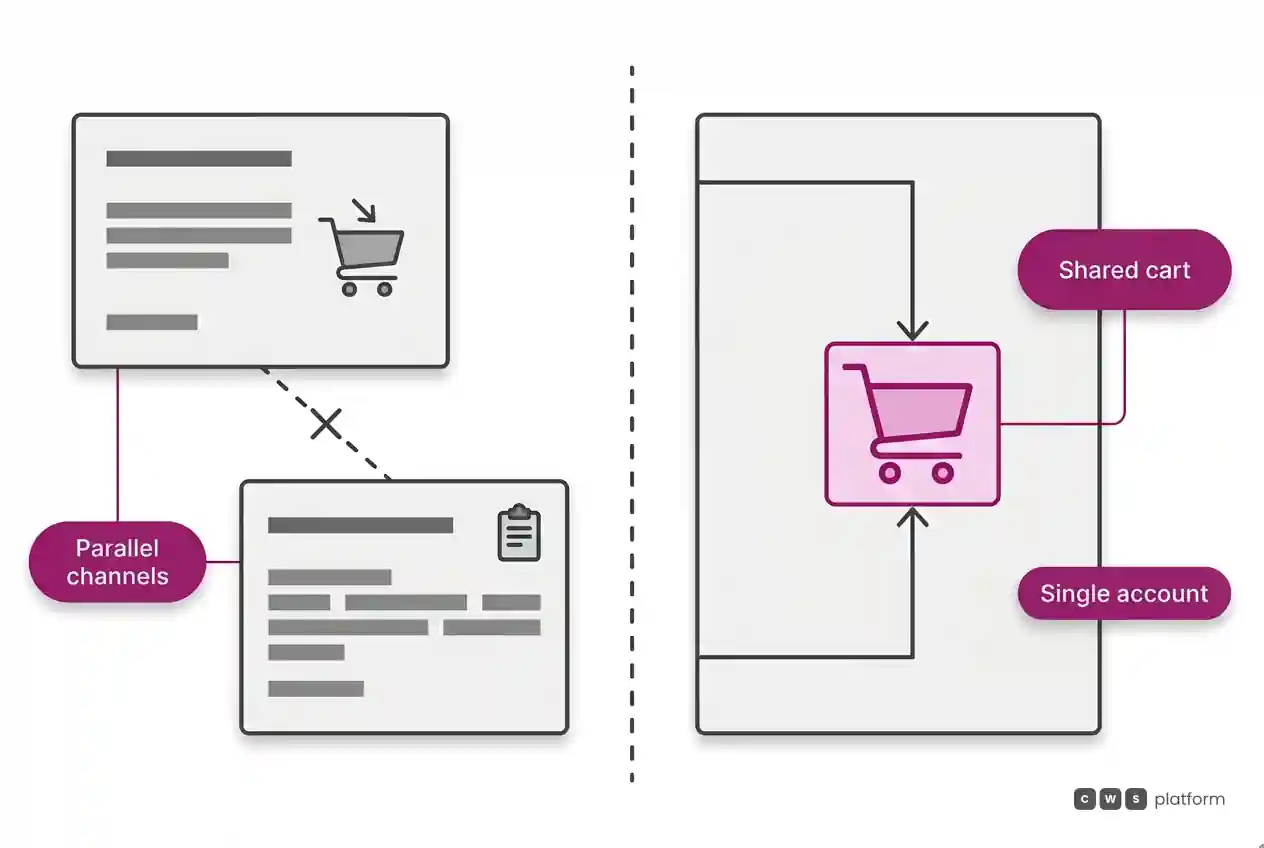
A buyer builds a cart in the portal and calls their sales rep to clarify product specs or payment terms. The rep cannot see the live cart. They ask the buyer to read out SKU numbers line by line, re-enter every item into their internal software, and occasionally quote terms that clash with the portal. The order gets keyed twice, quotes display contradictory pricing, or the online cart ends up abandoned.
From the buyer perspective, the enterprise feels disjointed and inconsistent. Internally, customer data splits down the middle, with half recorded in the portal database and half buried inside legacy sales logs.
Why Digitization Requires Both Sides
True digital sales transformation requires aligning customer and sales team on identical tech rails. Digitizing solely the customer journey isolates reps outside the channel, turning the portal into an internal rival. Digitizing only internal sales teams leaves the buyer completely dependent on manual rep touches for every routine reorder.
A unified platform bridges three areas that often operate in isolation:
- Commercial strategy, defining custom price sheets, product catalogs, and credit terms per account.
- The sales team, managing customer relationships, negotiations, and technical consulting.
- Operational execution, ensuring orders flow cleanly into the ERP without manual entry errors.
When these three pillars share the same platform, corporate pricing rules match what the sales rep offers and align with what the portal displays online.
How a Unified Experience Works
Buyers handle routine orders independently. For standard replenishable inventory, familiar catalog items, or pre-negotiated contracts, buyers log in, repeat previous orders, review terms, and check out.
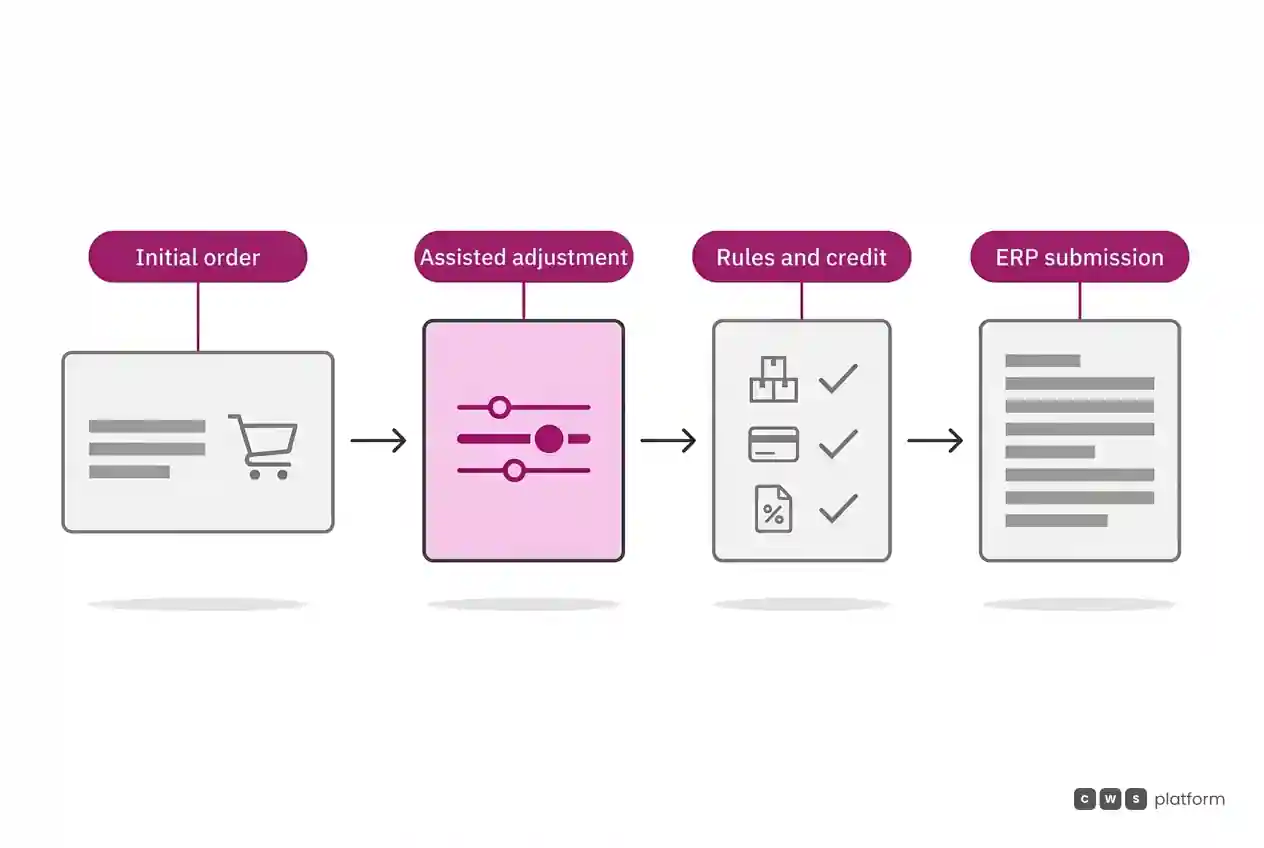
Sales reps step directly into the customer account for negotiations. Operating with explicit user permissions, the rep reviews the customer active cart, order history, and remaining credit line. They adjust unit volumes, cross-sell related SKUs, and apply custom discounts within pre-authorized margins. If discounts exceed standard thresholds, the workflow automatically routes the quote for documented managerial review.
Orders follow a single pipeline. Whether submitted directly by the procurement officer or configured by the account executive, the transaction passes identical inventory verification, credit clearance, and sales tax rules before landing in the ERP in a standard data format.
Account history remains unified. Every draft quote, submitted purchase order, and conversation record lives inside the client account, accessible to any authorized representative. If accounts transition to a new territory rep, the relationship history remains completely intact.
This framework defines assisted sales, supported through dedicated rep environments like the Sales Hub inside CWS Platform.
What Changes for the Sales Representative
A frequent concern is that launching a digital storefront will sideline the sales team. Within an integrated model, the opposite occurs. Reps offload manual order transcription, winning back valuable time for high-impact activities such as contract negotiations, outbound prospecting, and solving complex account requirements. For an expanded analysis, review when the customer already knows what they want, a rep in the middle is just overhead.
Making this shift work operationally requires two core foundations:
- Channel-neutral commission structures. If reps only earn incentives on transactions they manually submit, they will actively fight customer self-service.
- Superior workflow tools. Account reps must find it noticeably faster to build quotes inside the shared portal than relying on legacy spreadsheets. If the digital portal adds friction, teams will quietly revert to manual offline workarounds.
Signs Your Business Operates Parallel Channels
- Account reps manually typing orders into internal software for clients who hold active portal logins.
- Spike in abandoned online shopping carts followed by offline purchase orders submitted by sales reps that same afternoon.
- Conflicting quotes or unit pricing across the portal and field reps for identical buyers and SKUs.
- Sales reps unable to confirm whether their assigned accounts placed orders through the website this week.
Next Steps
Ask three of your account executives if they can view the active digital cart built by one of their enterprise buyers right now. If the answer is no, your business runs two disconnected sales channels rather than a unified digital engine. To discover how sales teams and procurement buyers collaborate inside a single account workspace, visit our dedicated guide to the B2B digital sales portal.
Frequently Asked Questions
How do you integrate sales reps into a B2B commerce portal?
By embedding reps into the customer operating environment, providing direct visibility into live carts, order logs, and credit limits, along with configurable discounting thresholds. All purchase orders flow through the exact same automated pipeline, regardless of who submits the final checkout.
Does a B2B ecommerce portal replace account representatives?
No. It automates repetitive replenishment orders that buyers prefer to place self-service, freeing sales professionals to manage key account expansion, contract pricing, and complex product consultation. In an integrated architecture, the sales team works directly inside the portal interface.
What is a parallel channel conflict in B2B sales?
It happens when an online ecommerce portal and a direct sales team operate on disconnected software stacks, creating inconsistent pricing tiers, fractured order histories, and out-of-sync carts. The buyer encounters contradictory brand experiences and routinely works around the portal to find lower pricing.
How do you get sales reps to champion the portal instead of competing with it?
Align compensation plans so sales reps receive full commission credit regardless of whether the buyer checks out online or requests phone assistance, and equip reps with fast quote-building features directly inside the shared portal workspace.
Recommended Reading
- B2B ecommerce platforms: the top 9 options compared
- ICMS, ST, and NF-e: how Brazilian tax logic lives in B2B ecommerce
About This Publication
Published by The Cost of the Sale, a CWS Platform blog focused on B2B sales force architecture. This article contains no client names or proprietary financial benchmarks.
"responsive, technically engaged, and willing to work through complex commercial rules (negotiated pricing, credit, customer-specific conditions) rather than pushing generic answers"
Are your channels competing for the same customer?
Request an assessment of your operation or talk straight to a specialist, whichever you prefer.
I'd rather get the next articles on channel conflict
A weekly roundup of new articles on channel conflict, only in weeks when there is one. No spam, and you can leave in one click.