Phased B2B Channel Programs: Partner Tiers and Ideal Customer Profile
How to scale channel sales, eliminate margin erosion, and prevent partner conflict through 90-day execution milestones and tier governance.

TL;DR
- A B2B channel program works best in short, sequential phases (foundation, activation, and scale), each lasting about 90 days with clear criteria to move to the next.
- Misaligned partners are the historical pitfall of channel programs. You prevent this through three combined pillars: margin economics that make sense for both sides, transparent partner tiers with objective rules, and validating the ideal customer profile (ICP) that each partner actually serves.
- The partnership hypothesis must be tested before executing a formal contract: a short trial run with real customers proves whether the arrangement creates mutual value.
- The core metric is joint value creation, not the number of signed partner agreements.
To structure a B2B channel program, break it into 90 day phases (foundation, activation, and scale) and govern partner entry and progression through three criteria: channel margin unit economics, transparent partner tiers with known rules, and clear validation that each partner reaches your ideal customer profile. Before executing a new contract, validate the partnership hypothesis through a short cycle with real accounts.
Why So Many Channel Programs Fail to Launch
The familiar playbook goes like this: an enterprise decides to sell through partners, signs dozens of agreements, hosts a launch event, and waits for deal volume. Six months in, only a handful of partners have sold anything, several are directly competing with the internal sales team, and the program turns into a graveyard of idle contracts.
Three root causes are usually responsible:
- Broken margin economics. The partner does not earn enough margin to prioritize your offering, or their cut comes at an expense your own unit economics cannot sustain.
- Partner and customer mismatch. The partner sells to an audience that falls outside your ideal customer profile. The few deals they close generate disproportionate support tickets and negligible repeat purchases.
- Executing everything at once. Recruiting, enablement, collateral, and quotas roll out simultaneously without learning from the initial cohort.
The Three Phases
Foundation (First 90 Days). Define your ideal customer profile (ICP), identify the partner profile that has verified access to that audience, and model the financial incentives. Map the ecosystem: who already serves these accounts, what solutions do they provide, and where does a partnership create distinct value that neither entity can generate alone? Recruit a select few partners for the initial validation run.
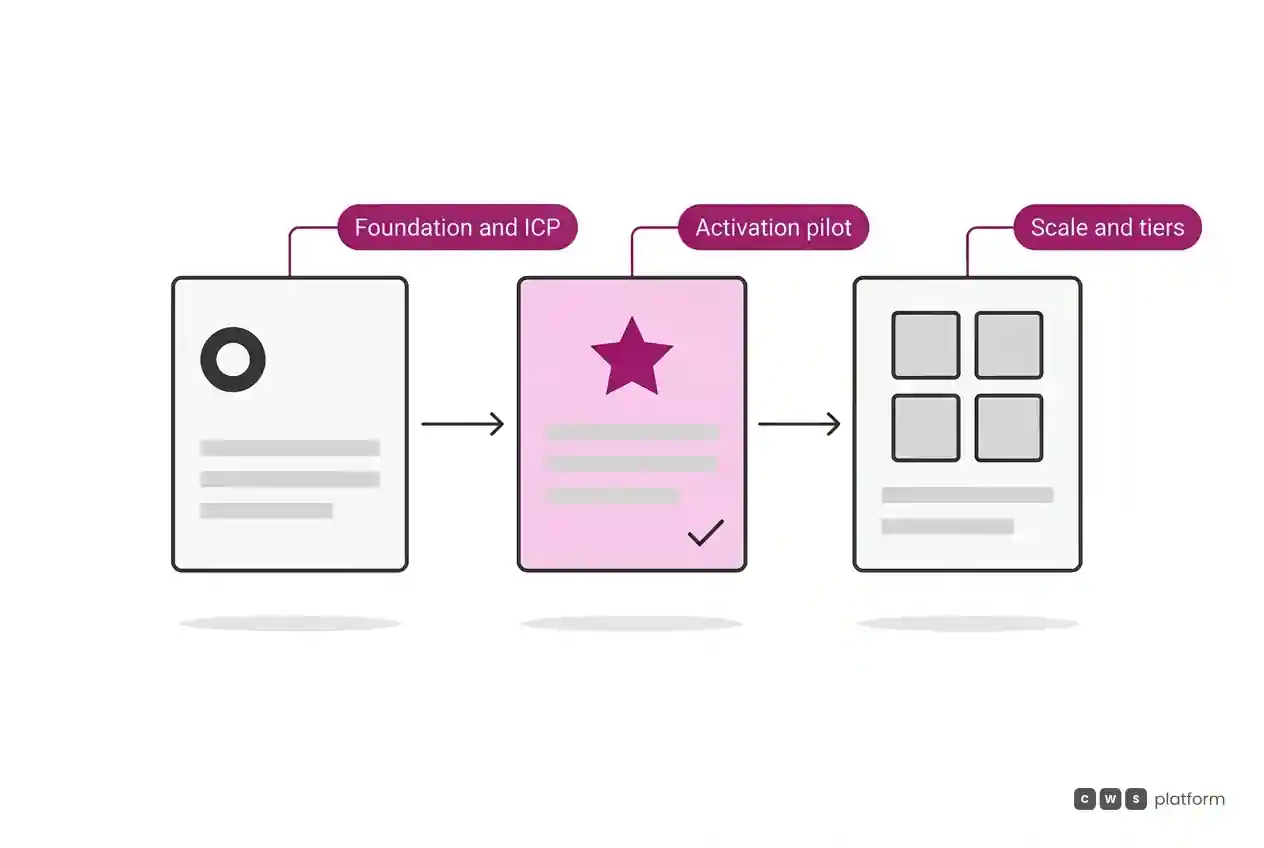
Activation (Next 90 Days). Get your initial partners closing real deals with live customers. Provide field enablement, co-sell through early pipeline opportunities, and refine your enablement assets and deal registration guidelines. Track the joint value created, not merely top-line partner revenue.
Scale (Day 180 and Beyond). With a validated model in hand, expand recruitment targeting the partner profile that delivered results, formalize tier thresholds, and automate administrative tasks that were handled manually during activation.
Structuring channel rollout into sequential phases with a compact timeline neutralizes an old, systemic industry pitfall: onboarding unvetted, misaligned partners before confirming that the economic model actually works.
Partner Tiers: Transparent Rules for Everyone
Tiers align partner commitments with program benefits. A standard framework includes three levels:
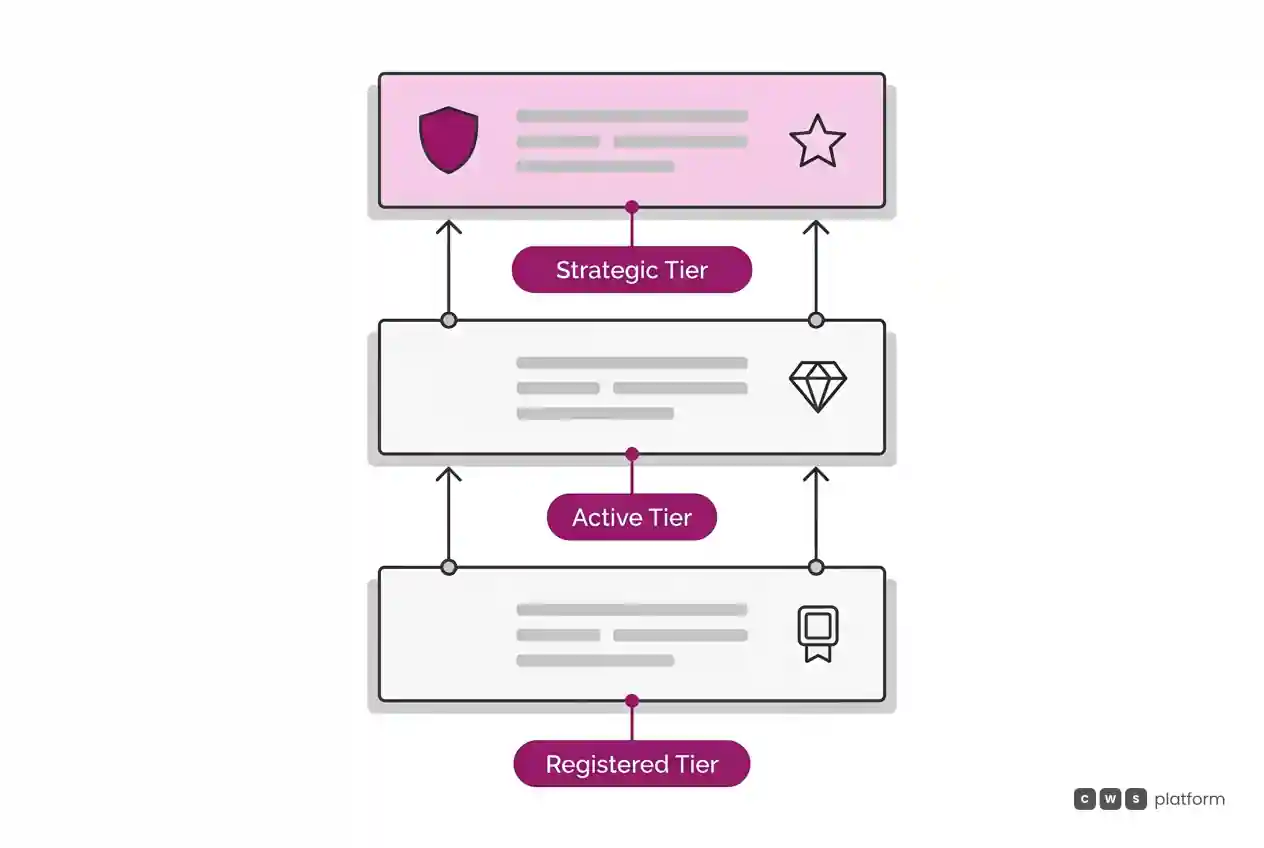
- Registered. Base access to sales materials, wholesale rate cards, and standard partner support.
- Active. Requires baseline sales volume and active accounts matching the ICP. Unlocks better margin discounts and dedicated co-selling support.
- Strategic. High sales volume, verified technical certifications, and a joint business plan. Includes priority deal registration, executive sponsorship, and access to enterprise pursuits.
The total number of tiers is secondary. What matters is that progression and demotion rules are objective, tracked within your commercial platform, and applied equally across the board. Negotiating tier perks on a one-off basis inevitably breeds channel conflict.
Validating the Ideal Customer Profile (ICP)
Every channel partner must serve buyers that match your ICP: the industry, business size, and operational pain points where your solution delivers clear value and recurring revenue. Confirming this fit before signing agreements keeps you from onboarding partners who push product to the wrong accounts.
Evaluate three diagnostic questions:
- Does the partner's existing book of business match your target ICP?
- Does the partner's core offering complement your solution, or does it substitute for it?
- Are the early accounts closed by the partner successfully onboarding, utilizing the solution, and repurchasing?
Test Before You Sign
Validate the partnership hypothesis before formalizing long-term contractual commitments. Running a short trial with two or three active prospects quickly reveals if margins hold, if the customer fits, and if the partner can reliably execute. Walking away from a 60 day trial run costs far less than unwinding an underperforming master services agreement. The partners page on CWS Platform illustrates the operational structure of an aligned partner program.
Key Metrics to Track
- Joint value creation: net revenue and active customers that exist exclusively because of the partner channel.
- ICP account volume: percentage of partner-sourced deals that meet target customer criteria.
- Partner customer retention and repurchase rate: channel cohort retention compared directly to your direct sales baseline.
- Time to first deal: elapsed days between partner onboarding and their first closed-won transaction.
Next Steps
Audit the partners onboarded over the past twelve months. Flag every partner that sourced at least one ICP-compliant customer who placed a repeat order. That ratio will tell you whether your channel strategy is ready to scale or whether your team needs to step back and re-anchor in the activation phase. To see how distribution networks optimize their operational architecture, review our solutions for distributors.
Frequently Asked Questions
How do you structure a B2B channel program?
Structure the rollout into roughly 90 day sequential phases (foundation, activation, and scale). Define your ideal customer profile, establish viable margin economics, publish objective tiering criteria, and test commercial viability before executing formal contracts.
What are partner tiers in a channel program?
Partner tiers are performance categories (such as Registered, Active, and Strategic) that establish specific margins, resources, and obligations based on deal volume, active account health, and technical competencies. Progression rules must be transparent, measurable, and applied uniformly.
What does ICP mean in a partner program?
ICP stands for Ideal Customer Profile. It defines the specific industry vertical, company size, and operational requirements where your product generates high lifetime value and consistent repurchases. Validating that your partner actively sells into this profile prevents low-margin deals with high churn risks.
How do you determine if a channel partner is worth pursuing?
Run a short pilot sprint involving real pipeline opportunities before executing an agreement. Then measure performance against joint value creation, ICP compliance, and customer repurchase rates over time.
Read More
- B2B Sales Process: Stages, Execution, and Commercial Policy Alignment
- How to Turn Commercial Policy into Automated Execution Rules
- Commercial Governance and Enforceable Policy
About This Publication
Published by CWS Platform on O Custo da Venda, focusing on operational architecture for B2B channel programs. This article contains no client names, partner disclosures, or confidential financial metrics.
"responsive, technically engaged, and willing to work through complex commercial rules (negotiated pricing, credit, customer-specific conditions) rather than pushing generic answers"
Are your channels competing for the same customer?
Request an assessment of your operation or talk straight to a specialist, whichever you prefer.
I'd rather get the next articles on channel conflict
A weekly roundup of new articles on channel conflict, only in weeks when there is one. No spam, and you can leave in one click.