commercetools vs Salesforce Commerce Cloud: who decides the rebuild?
A store composed on APIs or a store built from a template: through the CTO lens, who sets the date when the B2B storefront has to be rebuilt.

Editorial note: CWS Platform competes with commercetools and with Salesforce. This comparison uses only each vendor's public documentation, with the address next to each fact and the date of each record cited.
Short answer: in the commercetools vs Salesforce decision, commercetools fits the engineering team that wants to assemble the B2B portal on APIs and decide when to rewrite each layer, accepting that the vendor also changes what a new project can activate. Salesforce Commerce Cloud fits the team that wants the B2B store to start from a template, configured in Experience Builder, in the same Salesforce org that can run B2B and D2C, accepting that framework changes arrive on Salesforce's calendar.
Almost every B2B storefront gets rewritten at some point. The question a CTO has to answer before signing is not whether that will happen, but who sets the date. When the company composes the store from APIs, the rewrite tends to be the team's own call, one layer at a time. When the store starts from a vendor template, the rewrite tends to arrive with the vendor's framework change. Both models have public records on this, and this comparison follows them.
The overall map of models is in the post on the three B2B commerce platform models, and the other comparisons are in the comparisons hub.
commercetools and Salesforce Commerce Cloud side by side
The table sums up what each vendor's documentation records; where the source does not cover a point, the cell says so.
| criterion | commercetools | Salesforce Commerce Cloud |
|---|---|---|
| Platform model | B2B Commerce package on the commercetools Platform, with Merchant Center and REST and GraphQL APIs | B2B store created from templates, customized in Experience Builder and configured with Lightning features |
| Native B2B or by extension | Native in the package: Business Units, Associate Roles, Approval Rules, Approval Flows, and Quotes | Native in B2B Commerce: buyers tied to accounts and groups, access through profiles and permission sets |
| Customer and contract pricing | Standalone Prices by currency, country, Customer Group, or channel, prices per Business Unit, and quantity tiers | Price books and entitlements, loaded by CSV |
| Quoting | Quote Request, Staged Quote, and Quote, with renegotiation | Not documented |
| Credit and payment terms | Not documented | Not documented |
| ERP integration | Connect (managed runtime for integration apps) and an asynchronous Import API | Not documented; accounts, products, and prices load by CSV, with Data Loader for large loads |
| Billing model | By order volume, not GMV | Not documented |
| Implementation | SaaS Frontend or the Store Launchpad template copied into the project | Store template; B2B checkout is always custom |
Pricing and commercial rules: where the rules live
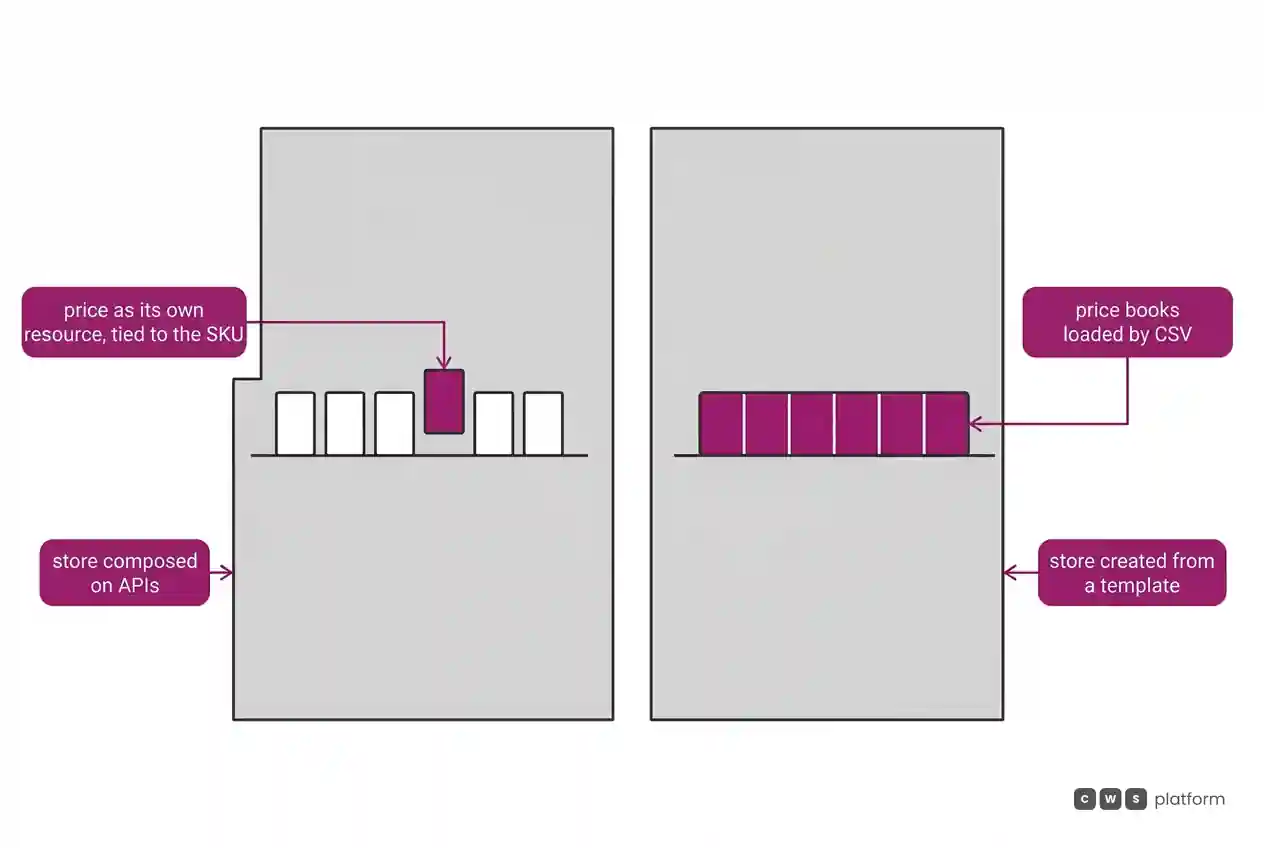
On commercetools, B2B pricing is a resource of its own. Per the Standalone Prices reference, a price sits outside the product document, tied to the variant by SKU, scoped by currency, country, Customer Group, or channel, with quantity tiers and start and end dates. The B2B Commerce package adds prices per Business Unit and discount rules with conditional predicates. Pricing becomes data queried through APIs, and the team decides how the storefront presents it.
That choice has a dependency on search. The types of prices guide records that to filter, facet, or sort in Product Projection Search, Standalone Prices are not supported and Embedded Prices are the path. And it is recorded in commercetools' documentation, in a release note dated August 31, 2026, that new projects can no longer turn that search on: "Any Project that was created after 31-08-2026 and does not already have it activated can no longer activate it." (commercetools release note). For a team starting now, it is worth asking in the demo which search API the project will use and how it handles the pricing model chosen.
On Salesforce Commerce Cloud, the B2B Commerce overview records that accounts, products, price books, and entitlements load by CSV, in an asynchronous import of up to 10,000 products per session, and that the recommendation for large loads is Data Loader. The same Salesforce org can run B2B and D2C channels with shared data and processes.
Quoting and assisted selling
commercetools documents a full quoting cycle. Per the Quotes overview, the buyer creates a Quote Request from the cart, the seller builds a Staged Quote with items, quantities, an expiration date, and discounts, and the Quote that goes out is a binding offer the buyer accepts, declines, or asks to renegotiate. Assisted Selling lets a sales rep take over the customer's cart in the Merchant Center, lock it during the session, and hand it back for the buyer to place the order.
In the Salesforce Commerce Cloud sources used here, quoting is not covered. What the documentation records is access control: buyers associated with accounts and groups, self-registration, and guest browsing, with profiles and permission sets. If quoting is a requirement, it is worth asking in the demo for the end-to-end flow and which Salesforce product it lives in.
ERP integration: who writes the connector
On commercetools, the ERP connector is project code running in a vendor environment. Connect is a managed runtime for small integration apps in JavaScript, TypeScript, or Java, with the code in a GitHub repository and app types such as Service, Event, and Job. The Import API takes batch loads asynchronously and does not support deletion. The team writes and versions the integration; commercetools hosts it.
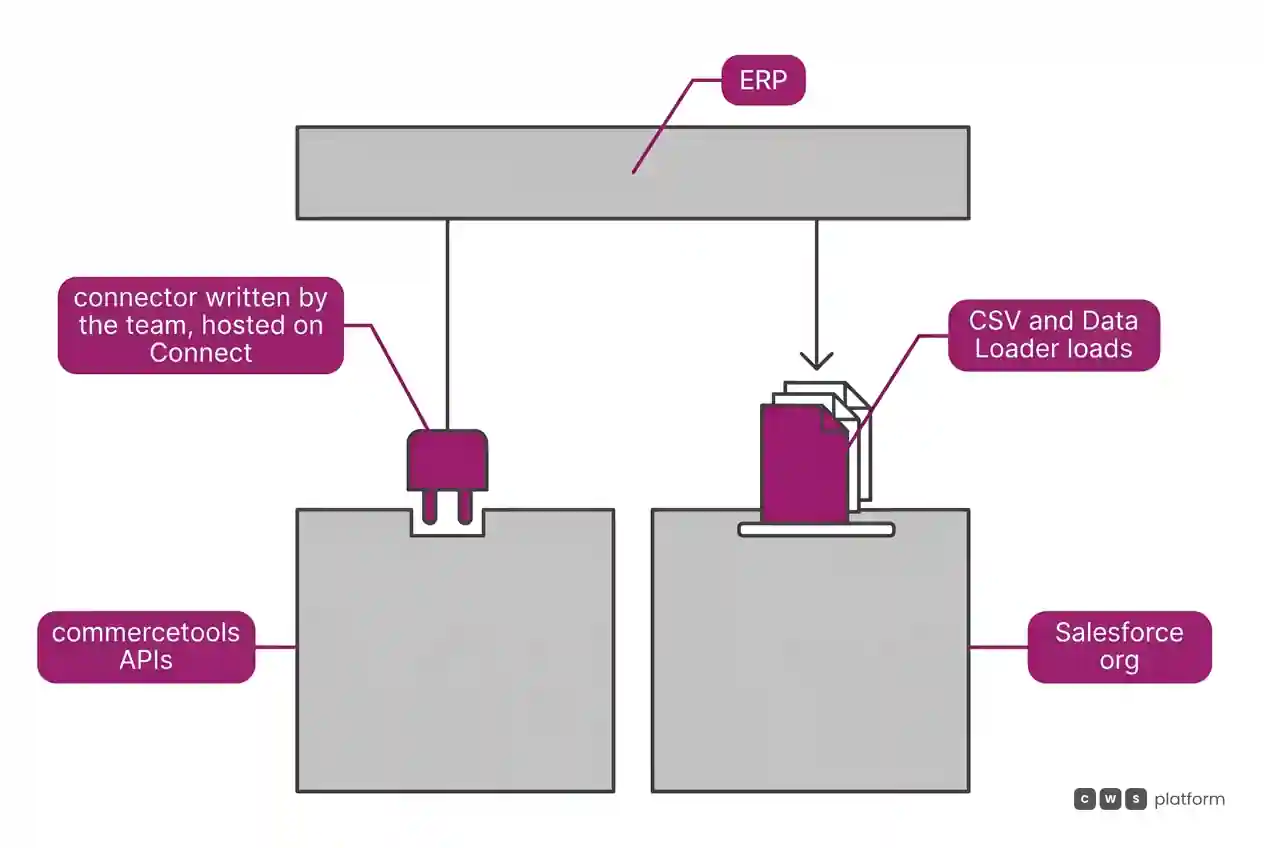
On Salesforce Commerce Cloud, ERP integration is not covered by the sources in this comparison. What is recorded is the CSV and Data Loader path and the checkout: B2B stores use only custom checkout, with services from third-party providers. For the CTO, the question is which part of the integration stays with the team, which goes to a partner, and in what language each one is maintained.
Cost and billing model
The commercetools pricing page records that the B2B Commerce package is priced by order volume, not GMV, and the package describes capabilities delivered as separate Add-Ons, such as HIPAA support and load testing. The presentation layer is part of that math. It is recorded in commercetools' documentation, accessed on October 16, 2026, that commercetools Frontend requires an add-on of its own: "This requires the Frontend Add-On." (commercetools Frontend documentation). It is worth asking in the proposal whether the storefront comes as a managed add-on or as a template the team maintains, because the cost line moves.
In the Salesforce Commerce Cloud sources used here, the B2B Commerce billing model is not covered. The question for the proposal is the same on both sides: what is in the base contract and what becomes a line of its own, in writing.
Implementation and upkeep: who sets the rebuild date
On commercetools, the team picks between two storefront paths. Per the Store Launchpads overview, commercetools Frontend is SaaS that updates automatically, while the Store Launchpad for B2B Manufacturing is an open source Next.js template copied into the project and maintained by the developer. On the second path, the team decides when to update the storefront.
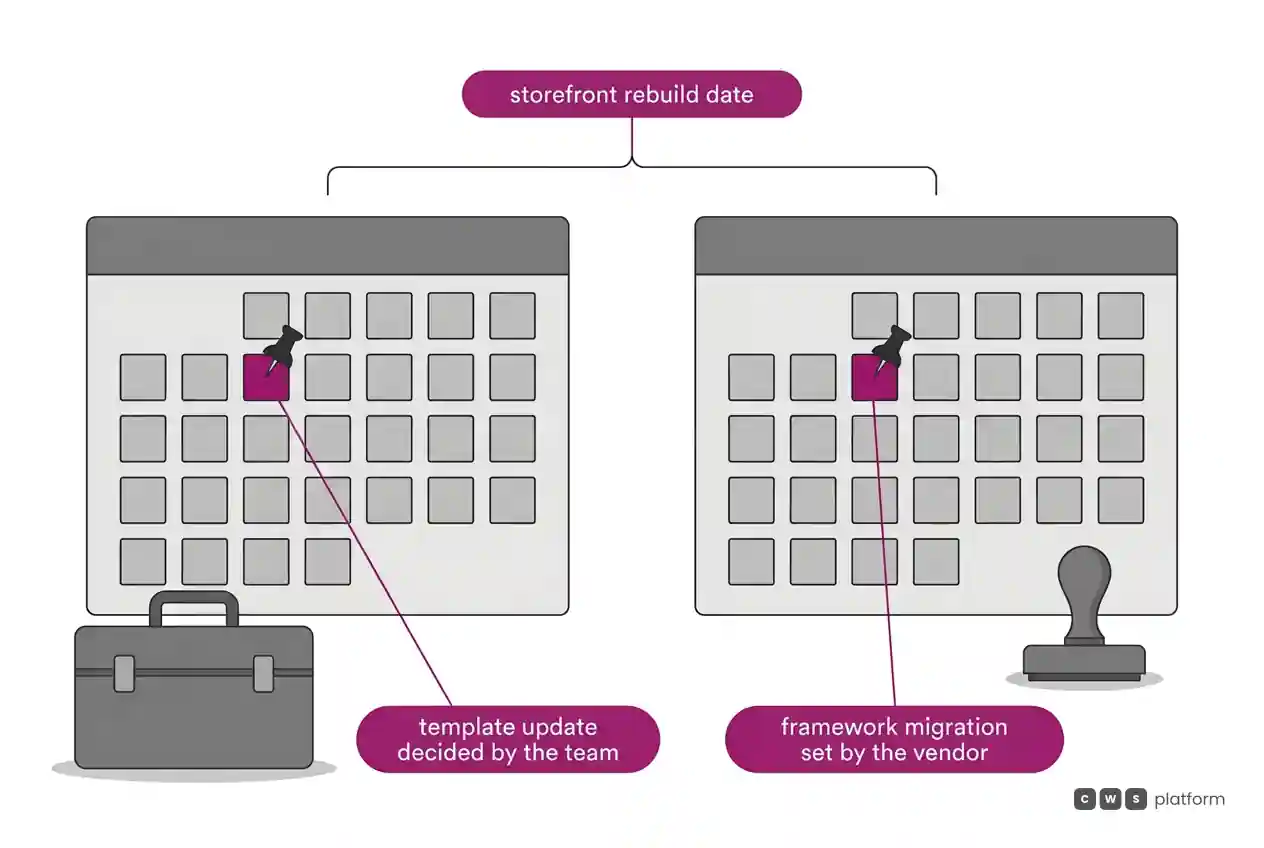
On Salesforce Commerce Cloud, the store starts from a vendor template, and so does its framework. It is recorded in Salesforce's documentation, accessed on October 9, 2026, that migrating an Aura store to LWR means replacing its components: "all Aura components must be replaced eventually" (LWR migration preparation guide). And it is recorded in Salesforce's release notes, accessed on October 9, 2026, that since Summer '25 the earlier line receives patches only: "maintains only patch notes for B2B Commerce for Visualforce" (B2B Commerce release notes).
For the CTO, both sides lead to the same evaluation question: how much of what the team builds now depends on a layer the vendor can change, and with how much notice. It is worth asking in the demo for the history of framework changes and deprecated APIs over the last few years.
When to choose commercetools
An engineering team that wants to compose. The B2B Commerce package delivers commerce as REST and GraphQL APIs plus the Merchant Center, and the storefront can be a template the team maintains.
A buying structure with many units. Business Units model a company and its divisions as a hierarchy, inheriting Stores, roles, and approval rules from the units above.
Formal negotiation through quotes. The Quotes cycle covers the quote request, a binding offer, renegotiation, and conversion into an order.
Billing that does not track GMV. The pricing page describes the B2B package priced by order volume, not GMV.
When to choose Salesforce Commerce Cloud
A B2B store from a template. The B2B Commerce overview describes a store created from a template, customized in Experience Builder, with search, cart, checkout, and payment configured with Lightning features.
B2B and D2C in one org. The same Salesforce org can run B2B and D2C channels with shared data and processes, per the B2B Commerce documentation.
Access governed by profiles. Per the same documentation, buyers are associated with accounts and groups, with self-registration and guests, and profiles and permission sets control access.
Several storefronts in B2C. In B2C Commerce, Business Manager administers products, customers, orders, and promotions, and one site exposes several storefronts by brand, locale, or channel.
When neither fits
There is a third model, described in the post on the three B2B commerce platform models: moving commercial rules into the platform instead of composing them in code or inheriting them from a template.
That is the CWS Platform model. Commercial policy is stored as parameters, configuration instead of code, and price tables, rules, and contracts are configurable in the platform or arrive from the ERP and CRM through APIs. The architecture is API-first and headless, with REST APIs and webhooks, and all customers run the same version of the platform. It comes to 11 modules, 6 AI Agents, and 1,029 parameters.
To read each vendor against that model, there are two comparisons: commercetools vs. CWS Platform: what goes into the three-year total cost of ownership and Salesforce vs. CWS Platform: who rebuilds the storefront when frameworks change.
If the decision is between composing and inheriting and neither fits what your team can sustain, it is worth talking to a CWS Platform specialist before you lock in the architecture.
Frequently asked questions
commercetools vs Salesforce Commerce Cloud: which is better for B2B?
It depends on who will sustain the store. commercetools fits the team that wants to build B2B on APIs, with Business Units, approvals, and quoting native to the B2B Commerce package. Salesforce Commerce Cloud fits the team that wants the store from a template, configured in Experience Builder, with B2B and D2C in the same Salesforce org.
Which one gives the technical team more control?
commercetools delivers commerce as REST and GraphQL APIs and allows a Next.js storefront copied into the project and maintained by the team itself. On Salesforce Commerce Cloud, the store starts from a vendor template and is customized in Experience Builder, and B2B checkout is always custom. More control comes with more code to maintain.
What happens when the platform changes frameworks?
At Salesforce, the documentation records that migrating an Aura store to LWR means replacing all Aura components, and the release notes record that B2B Commerce for Visualforce receives patches only since Summer '25. At commercetools, the documentation records that projects created after August 31, 2026 can no longer activate Product Projection Search. In both cases, it is worth asking for the change history and the notice period.
Which one needs more custom integration work?
On commercetools, the ERP connector is project code running on Connect, and batch loads go through the Import API. In the Salesforce Commerce Cloud sources used here, ERP integration is not covered; accounts, products, and prices load by CSV and Data Loader. In both, the answer depends on which part the team writes and which part goes to a partner.
Further Reading
Brands mentioned in this article

- Salesforce
Trademarks and logos belong to their respective owners. Mention does not imply partnership or endorsement.
"responsive, technically engaged, and willing to work through complex commercial rules (negotiated pricing, credit, customer-specific conditions) rather than pushing generic answers"
Does your implementation never end?
Request an assessment of your operation or talk straight to a specialist, whichever you prefer.
I'd rather get the next articles on implementation
A weekly roundup of new articles on implementation, only in weeks when there is one. No spam, and you can leave in one click.