commercetools vs Spryker: what changes in integration and upgrades?
API SaaS or a PaaS framework with the code in your project: through the CTO lens, what each model does to the ERP integration and to upgrades.

Editorial note: CWS Platform competes with commercetools and with Spryker. This comparison uses only each vendor's public documentation, with the address next to each fact and the date of each record cited.
Short answer: commercetools fits the team that wants to consume B2B commerce as vendor APIs and write only the integrations, running in an environment it manages. Spryker fits the team that wants the commerce code inside its own project, with the order process, endpoints, and contract pricing adjustable in code, and accepts updating that code through packages. The difference shows up in ERP integration and in upgrades.
The two often show up together for anyone looking at a composable B2B platform, so they get treated as equivalents. For a CTO, they are not. On commercetools, the project talks to the APIs of the licensed package, and the team's own code sits at the edges: storefront and integrations. On Spryker, the commerce code lives in the project repository, and the vendor ships updates as packages the team applies. The decision is where your team wants the hardest code to maintain to live, and who answers when the version changes.
The overall map of models is in the post on the three B2B commerce platform models, and the other comparisons are in the comparisons hub.
commercetools and Spryker side by side
The table sums up what each vendor's documentation records, through a B2B lens; where the source does not cover a point, the cell says so.
| criterion | commercetools | Spryker |
|---|---|---|
| Platform model | B2B Commerce package on the commercetools Platform, with Merchant Center and REST and GraphQL APIs | Commerce code in the project, updated through Composer; order process in XML and endpoints declared in YAML |
| Native B2B or by extension | Native in the package: Business Units, Associate Roles, Approval Rules, Approval Flows, and Quotes | Native: Company Account with business units, roles and permissions, Approval Process, and Request for Quote |
| Customer and contract pricing | Standalone Prices by currency, country, Customer Group, or channel, prices per Business Unit, and quantity tiers | Merchant Custom Prices: a price per business relationship, applied to the assigned business units |
| Quoting | Quote Request, Staged Quote, and Quote, with renegotiation | Request for Quote with versions, editing by the sales rep, and an expiration date |
| Credit and payment terms | Not documented | Not documented |
| ERP integration | Connect (managed runtime for integration apps) and an asynchronous Import API | Data Exchange API for ERP, PIM, OMS, and BI, Async Event API, and PunchOut Gateway |
| Billing model | By order volume, not GMV | Not documented |
| Implementation | Integrations written by the team and hosted on Connect | Code Upgrader with a CI pipeline per project, under the PaaS+ model |
Pricing and commercial rules: data in the API or code in the project
On commercetools, pricing rules are data the project writes and reads through APIs. Per the Standalone Prices reference, a price sits outside the product, tied to the variant by SKU, scoped by currency, country, Customer Group, or channel, with quantity tiers. Business Units model a company and its divisions, inheriting Stores, roles, and approval rules. The structure has operating ceilings. It is recorded in commercetools' documentation, accessed on October 16, 2026, on the API limits page: "The hierarchy of Business Units is limited to 5 levels." and "The maximum number of 50 000 StandalonePrices can be specified per ProductVariant" (commercetools API limits). The Business Units reference treats the 5 levels as a limit that can be adjusted per project after a technical assessment. It is worth bringing the real depth of your customer tree and the number of price records per SKU to the demo.
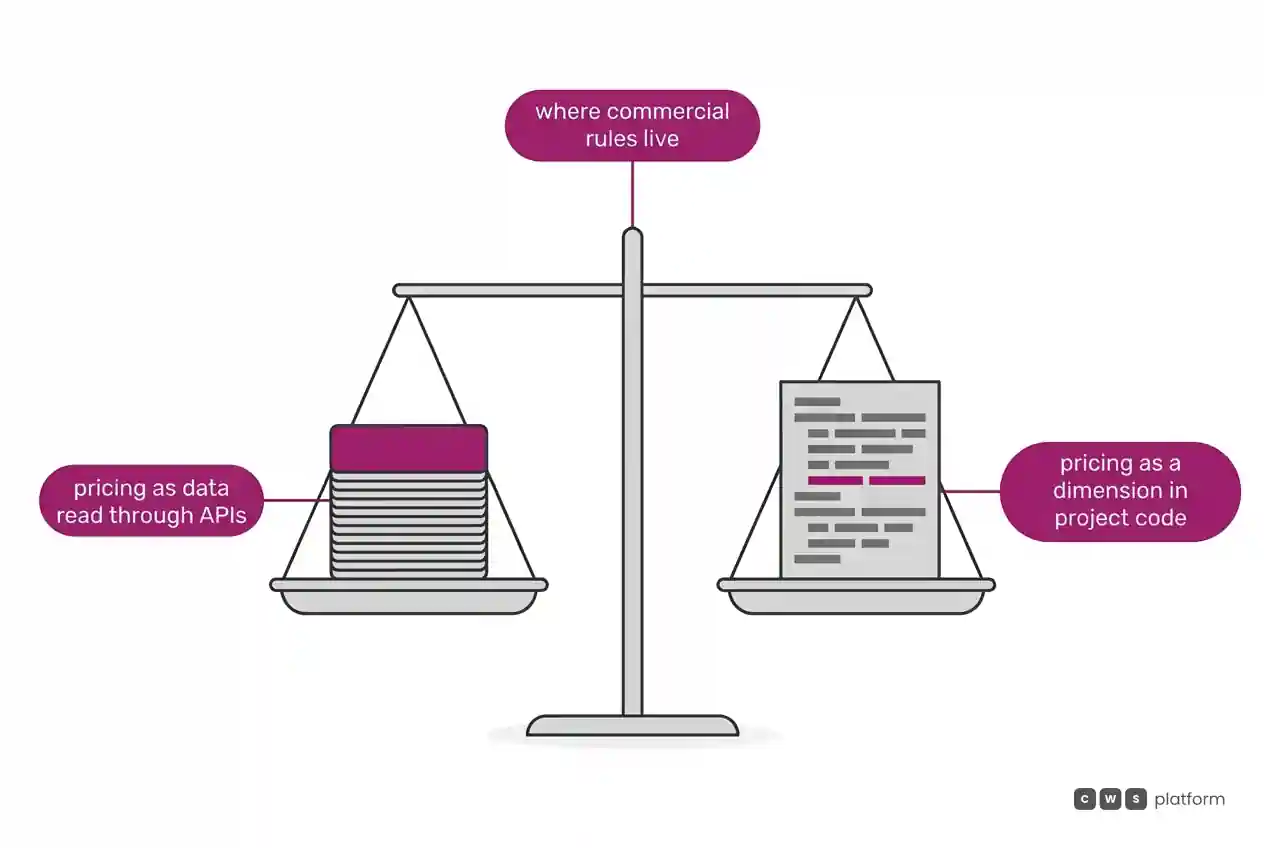
On Spryker, contract pricing is a dimension of the pricing engine that runs in the project. Per the Merchant Custom Prices overview, the business relationship is a price dimension alongside mode, volume, store, and currency, the price applies to the assigned business units, and when several relationships carry different prices the lowest one wins. Bulk loads go through CSV with a console command.
Quoting and assisted selling
On commercetools, quoting is a cycle of API resources. Per the Quotes overview, the buyer creates a Quote Request from the cart, the seller builds a Staged Quote and sends a binding Quote, which can be renegotiated. Assisted Selling lets the sales rep take over and lock the customer's cart in the Merchant Center.
On Spryker, Request for Quote moves through draft, waiting, editing by the sales rep, and ready states, creates a new version each time it goes back to the buyer, and closes on its own when it expires. Agent Assist lets an agent act as the customer in the storefront.
ERP integration: the message delivery contract
This is where the two models split most visibly. On commercetools, the integration is a project app running on Connect, a managed runtime with Service, Event, and Job app types, and batch loads use the asynchronous Import API. The team runs no servers, but it has to write the connector for the platform's delivery contract. It is recorded in commercetools' documentation, accessed on October 16, 2026: "The delivery promise is at-least-once delivery with no ordering guarantees." (Connect deployment behavior). For anyone syncing orders and prices with the ERP, it is worth asking in the demo how the connector handles a repeated event and an out-of-order event.
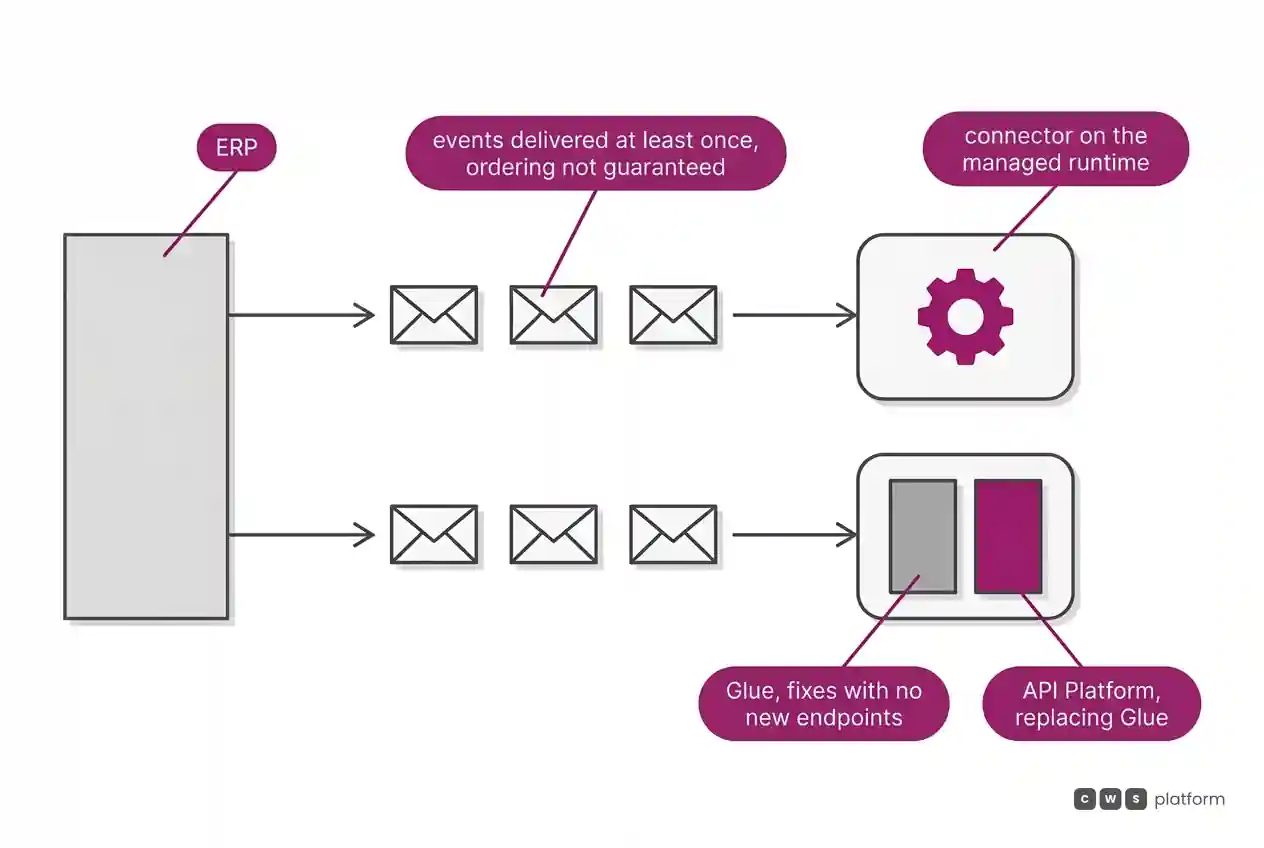
On Spryker, the integration APIs are split by actor: Storefront API, Back Office API, Merchant API, Data Exchange API for bulk operations with ERP, PIM, OMS, and BI, and Async Event API for event notifications. The Data Exchange API lets you create endpoints from the Back Office, with no code. The older API layer is in a recorded transition. It is recorded in Spryker's API roadmap, on a page dated July 30, 2026: "Glue gets bugfixes, security, and compatibility, no new endpoints" (Spryker API roadmap). The same page records that the Symfony-based API Platform replaces Glue and runs alongside it. It is worth asking in the demo which of the two a new integration should be built on.
Cost and billing model
The commercetools pricing page records that the B2B Commerce package is priced by order volume, not GMV, and the package describes capabilities delivered as separate Add-Ons, such as HIPAA support and load testing. It is worth asking whether Connect usage is in the base contract or a line of its own, and adding the cost of the integration the team will write.
In the Spryker sources used here, the billing model is not covered; the Code Upgrader is described as part of the PaaS+ model. The question for the proposal is the same on both sides: what is in the base contract, what becomes an add-on, and how much project code the team will maintain.
Implementation and upkeep: who applies the upgrade
On commercetools, the code the team maintains sits at the edges: connectors and, if it picks the template, the storefront. Connect publishes each connector from a Git tag, with a preview build and code validation before deployment. The upgrade that falls to the team is the upgrade of that code.
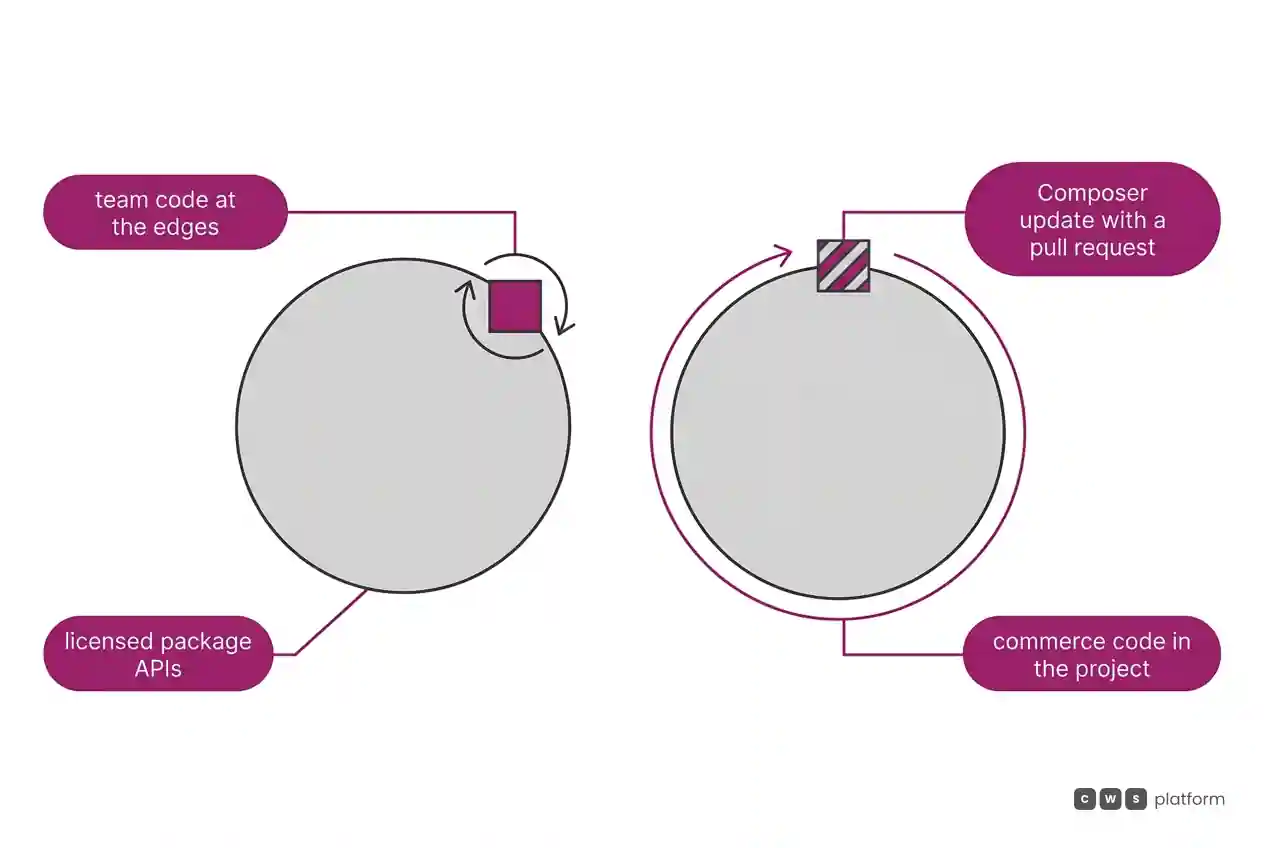
On Spryker, the upgrade is to the project's code. Per the Code Upgrader documentation, the tool compares composer.json and composer.lock with the latest released code, applies security releases first, and opens a pull request with the updates; major versions are not applied automatically. And there is an environment condition. It is recorded in Spryker's documentation, accessed on October 16, 2026: "The Upgrader supports only projects that run in cloud environments. If you are running Spryker on premises, migrate to cloud" (preparing a project for the Code Upgrader). For anyone planning to run on their own infrastructure, it is worth asking how upgrades work outside the cloud.
When to choose commercetools
A team that wants to consume commerce as APIs. The B2B Commerce package delivers Business Units, Associate Roles, approvals, and Quotes as REST and GraphQL APIs, with the Merchant Center for the operator.
Integration without your own servers. Connect hosts the integration apps, with types for synchronous calls, events, and scheduled jobs.
Multi-tier approvals. Approval Rules set criteria by amount, currency, and country, with requesters and approvers by role, inherited by child units.
Billing that does not track GMV. The pricing page describes the B2B package priced by order volume.
When to choose Spryker
A custom order process. The Spryker OMS models the order lifecycle as an XML state machine, with PHP conditions and commands that wire in business rules and integrations.
Buyers who purchase through their own procurement system. The PunchOut Gateway implements OCI and cXML flows to connect the store to eProcurement systems.
Contract pricing across several relationships. Merchant Custom Prices treats the business relationship as a price dimension, with a documented tie-break rule.
Upgrades assisted by pull request. The Code Upgrader runs in a CI pipeline dedicated to the project, on a configurable schedule.
When neither fits
There is a third model, described in the post on the three B2B commerce platform models: neither consuming APIs and writing the rules at the edges, nor bringing the commerce code into the project, but moving commercial rules into the platform.
That is the CWS Platform model. Commercial policy is stored as parameters, configuration instead of code. Price tables, rules, and contracts are configurable in the platform or arrive from the ERP and CRM through APIs, and tax calculation can be delegated to the tax engine the customer already uses. The architecture is API-first and headless, with REST APIs and webhooks, and all customers run the same version. It comes to 11 modules, 6 AI Agents, and 1,029 parameters.
To read each vendor against that model, there are two comparisons: commercetools vs. CWS Platform: what it costs to keep commercial rules integrated and Spryker vs. CWS Platform: where customer pricing travels in the ERP integration.
If neither way of splitting the code fits the team you have, it is worth talking to a CWS Platform specialist before you lock in the architecture.
Frequently asked questions
commercetools vs Spryker: which is better for B2B?
It depends on where the team wants the code. commercetools fits a team that wants to consume Business Units, approvals, and quoting as APIs and write only the integrations. Spryker fits a team that wants the order process, contract pricing, and endpoints inside the project code, with PunchOut for buyers who use eProcurement.
SaaS or PaaS: what is the practical difference?
On commercetools, the project calls the APIs of the licensed package and hosts its integrations on Connect, a managed runtime. On Spryker, the commerce code sits in the project repository, and the Code Upgrader, delivered under the PaaS+ model, opens pull requests with updates. In practice, what changes is who applies the new version and where the custom code lives.
Which one integrates better with the ERP?
Both have a documented path. commercetools offers Connect and the Import API, and records that Connect events are delivered at least once, with no ordering guarantee. Spryker offers the Data Exchange API and the Async Event API, and records that Glue gets no new endpoints while the API Platform replaces it.
How do upgrades work on each?
On commercetools, the team updates the code it wrote at the edges, connectors and storefront, and publishes each connector from a Git tag. On Spryker, the Code Upgrader applies updates through Composer and opens a pull request, but major versions are not automatic and the tool supports only projects in the cloud, as the documentation records.
Read Also
Brands mentioned in this article


Trademarks and logos belong to their respective owners. Mention does not imply partnership or endorsement.
"responsive, technically engaged, and willing to work through complex commercial rules (negotiated pricing, credit, customer-specific conditions) rather than pushing generic answers"
Is integration holding your operation back?
Request an assessment of your operation or talk straight to a specialist, whichever you prefer.
I'd rather get the next articles on ERP integration
A weekly roundup of new articles on ERP integration, only in weeks when there is one. No spam, and you can leave in one click.