Redesigning B2B Checkout: What to Review Before Buyers Revert to Offline Reps
Why B2B checkout updates require end-to-end API and ERP governance rather than cosmetic UI tweaks to prevent buyer friction.

TL;DR
- Changing a B2B checkout is not a simple UI redesign. It affects the API payloads exchanged with the ERP, integrations for credit checks, freight, and sales tax, as well as the audit trails required for every order.
- Treat the update as an end to end operational change: review the entire flow, from cart to invoiced order, before going live.
- The opposite mistake is equally expensive: adding manual hurdles and extra confirmation screens to mitigate risk creates a secure but empty checkout, driving buyers back to phone orders.
- Frictionless security lives within automated transaction rules (purchasing limits, net terms, pricing policies) enforced by software, not by adding more clicks for the procurement team.
Before redesigning a B2B checkout, review the entire buyer journey rather than just the interface: inspect the payloads exchanged between checkout, ERP, credit scoring, freight carriers, and sales tax engines, verify the audit trail captured for each order, and evaluate how every extra step affects completion rates. Modifying a checkout is an architectural change. It can break an integration that nobody associated with the front end, or introduce friction that causes a buyer to abandon their cart and call a sales rep instead.
Why the B2B checkout is more than just a screen
In consumer retail, checkout is almost entirely about processing payment. In B2B, it is the exact point where an order must satisfy every operational, legal, and commercial rule simultaneously:
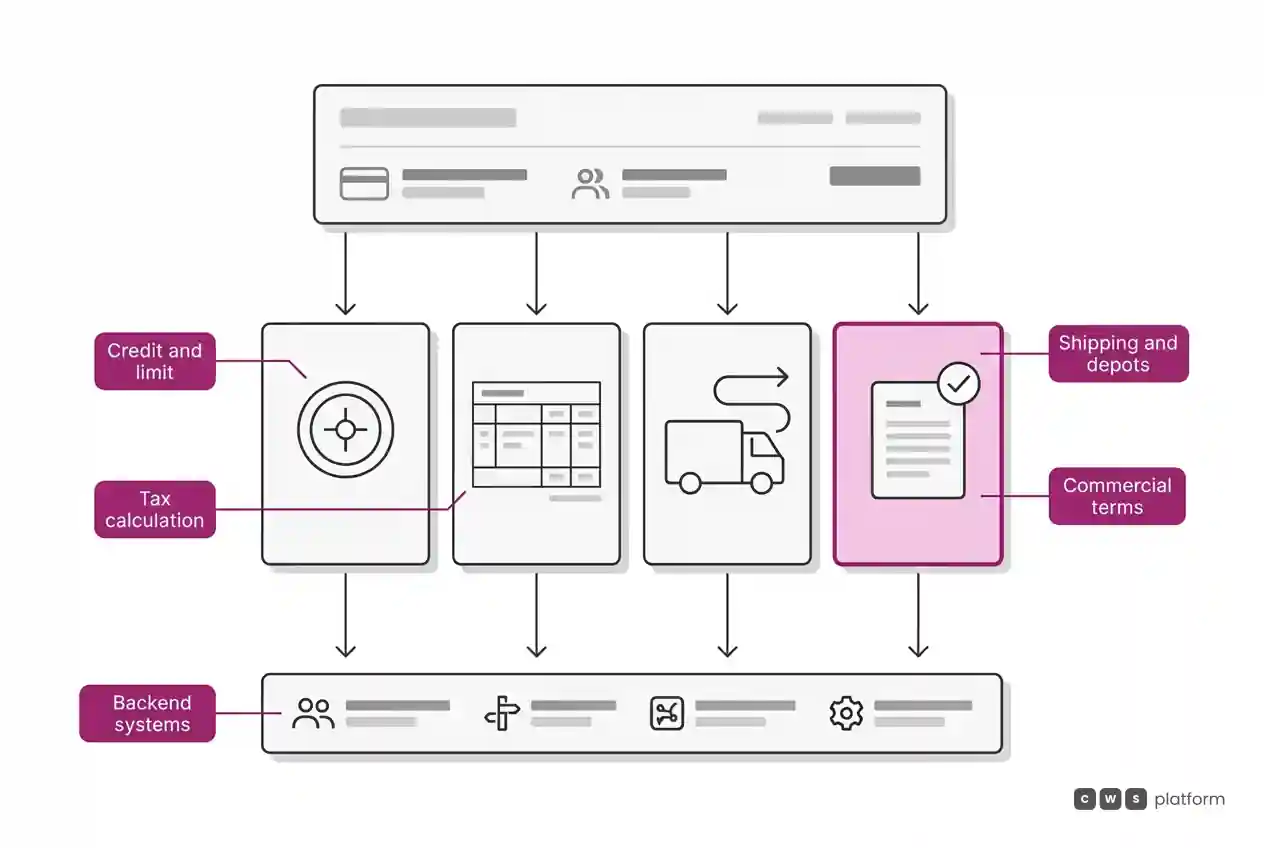
- Credit. Available credit limits are validated in real time, determining whether an order clears automatically, gets placed on hold, or routes to manual review.
- Taxes. Sales tax, nexus rules, state exemptions, and resale certificates must be calculated accurately before generating the invoice. This operational layer is detailed in Sales Tax, Exemption Certificates, and Invoicing in B2B E-Commerce.
- Freight and delivery terms. Shipping origin, multi-warehouse routing, preferred freight carriers, and minimum order requirements.
- Payment terms. Trade credit (Net 30, Net 60), customer-specific credit lines, purchasing cards, and corporate ACH.
- Audit trails. A verifiable record of who approved the purchase, when it occurred, the agreed pricing tiers, and the applied terms.
Each of these steps communicates with other systems through API payloads. Changing the sequence of steps, combining screens, or modifying an input field can alter the data transmitted to the ERP. Consequently, orders that previously processed cleanly can start failing or drop out of the sync queue altogether.
What to audit before making changes
During deployment, following a concise checklist prevents costly surprises.
1. API payloads. For every altered step, which data payloads change format, sequence, or timing? Are the ERP, credit reporting tools, and shipping engines still receiving the expected schema?
2. Downstream integrations. Which systems consume the order downstream (invoicing, fulfillment, accounting)? Does any core process depend on a field that was modified or removed?
3. Audit trails. Does the finalized order capture explicit buyer acceptance, contracted pricing, payment terms, and user identity? In B2B, this transaction record is what resolves invoice disputes months later.
4. Edge cases. A customer exceeding their credit line, out-of-stock items at a regional warehouse, or an order exceeding an individual procurement agent's spending threshold. The updated flow must be stress-tested against these edge cases, not just happy-path orders.
5. Alert routing. If the update triggers a new operational hold, who receives the notification, and what is the target resolution time?
Updating checkout patterns must be treated as a cross-functional systems project requiring comprehensive end to end testing, not as a visual cosmetic tweak.
The opposite mistake: friction that pushes buyers back to offline channels
When a checkout redesign introduces operational issues, the standard reaction is to add controls: extra confirmations, mandatory fields, or manual manager sign-offs. This mitigates immediate risk, but it ruins the purchasing experience.
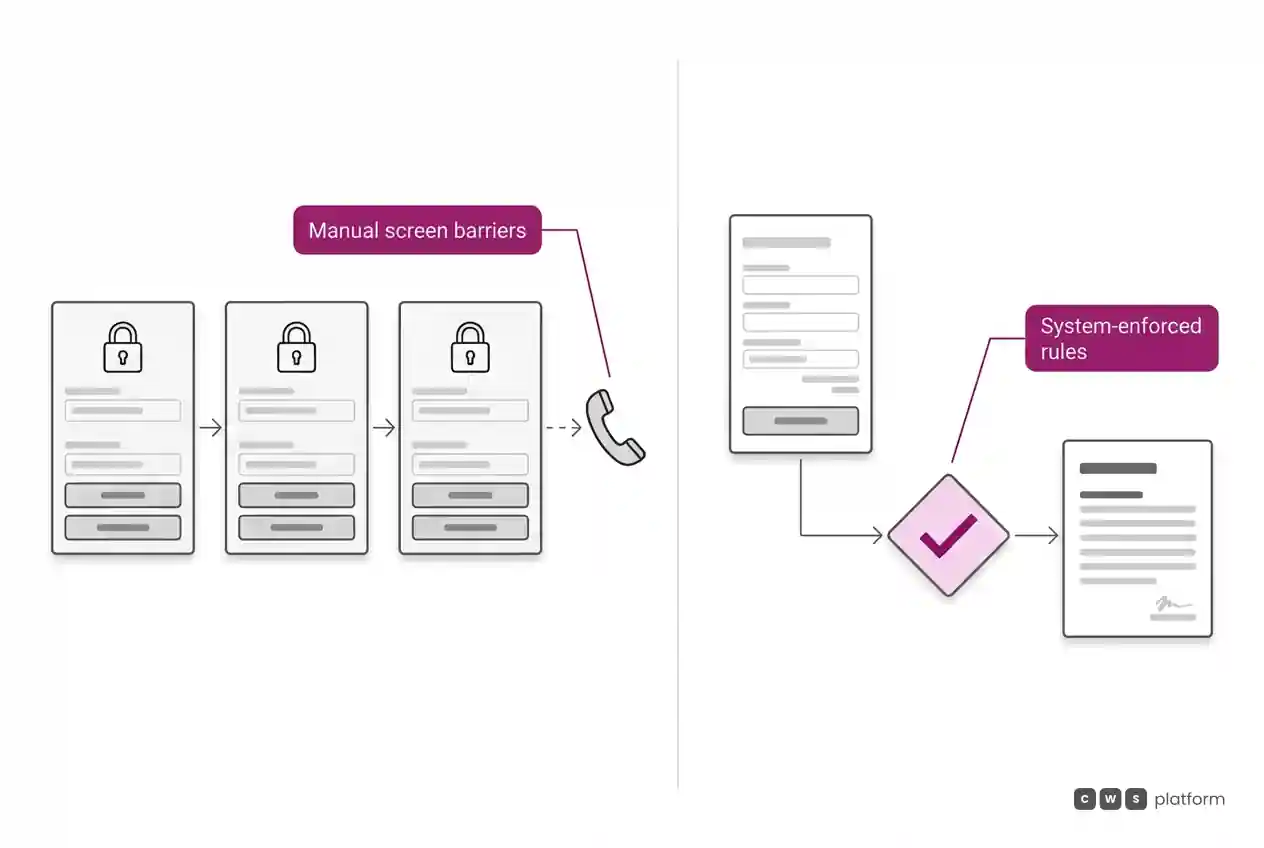
A corporate buyer confronted with three extra confirmation dialogues just to reorder recurring inventory will find it faster to pick up the phone. A client who was expensive to onboard into your digital channel reverts to manual order entry and stops using the self-service portal.
The solution is shifting risk management into transactional rules enforced in the background rather than adding user friction on the screen:
- User and order spending limits, enforced programmatically. Orders within pre-approved thresholds clear instantly; exceptions route to an approver without slowing down compliant purchases.
- Real-time credit checks, displaying clear, actionable messaging whenever an order requires review.
- Configured pricing policies, ensuring contract pricing and volume discounts calculate accurately without human intervention.
The buyer does not need to see the underlying complexity. They just experience a fast checkout that works reliably. Structuring checkouts to handle commercial credit lines, customized terms, and invoice billing is covered in Checkout & Payments, and invoicing trade credit is discussed in B2B Invoiced Payment Terms.
How to measure whether the update succeeded
- Checkout completion rates, tracked before and after the update across distinct customer tiers.
- Orders ingested into the ERP with sync errors during the first week post-launch.
- Offline orders from active portal accounts received via phone or email shortly after rollout. This pattern is the clearest indicator that new friction is driving buyers away.
Next steps
Before making the next checkout update, map the lifecycle of a real transaction from cart entry to final invoice, identifying every enterprise system it touches. Next, check which of those touchpoints the proposed redesign affects. If the changes involve more than two integrations, manage the rollout as an integration project with end to end regression testing. Identifying initial architectural priorities is explored in System Integration in B2B Sales.
Frequently asked questions
What should be reviewed before changing a B2B e-commerce checkout?
API payloads shared with the ERP, credit evaluation services, shipping engines, and sales tax calculation tools. Additionally, evaluate downstream data consumers, transaction audit trails, edge case behavior, and alert routing when orders are placed on hold.
Why does a B2B checkout differ from a consumer retail checkout?
Because it must handle credit line validation, sales tax exemptions, freight rules, custom payment terms, and legally binding audit trails simultaneously. Each checkpoint integrates with separate backend systems, and altering the checkout interface can disrupt what those systems receive.
How can businesses secure the B2B checkout without adding buyer friction?
By embedding security into transactional business rules (buyer spending thresholds, automated real-time credit checks, programmatically enforced commercial terms) executed by the platform, rather than forcing users through manual approval steps and repetitive confirmations.
How can a company tell if a checkout change hurt sales?
Compare conversion rates before and after launch, monitor ERP sync errors, and track whether onboarded portal accounts start sending orders via phone or email again.
Read also
About this publication
This article outlines implementation patterns observed during B2B portal deployments by CWS Platform. It does not name specific clients or provide proprietary metrics.
"responsive, technically engaged, and willing to work through complex commercial rules (negotiated pricing, credit, customer-specific conditions) rather than pushing generic answers"
Is integration holding your operation back?
Request an assessment of your operation or talk straight to a specialist, whichever you prefer.
I'd rather get the next articles on ERP integration
A weekly roundup of new articles on ERP integration, only in weeks when there is one. No spam, and you can leave in one click.