OroCommerce vs Spryker: how does each connect ERP and procurement?
Through a CTO lens: the ERP connector, PunchOut with the customer's procurement system, and the order invoice, on both sides.

Editorial note: CWS Platform competes with both Oro (OroCommerce) and Spryker. This comparison uses only each vendor's public documentation, with the address next to each fact and the date of each record cited.
Short answer: OroCommerce fits companies that want quotes, customer-specific price lists, and documented integrations with ERPs such as Epicor Prophet 21. Spryker fits companies that want the commerce code in their own project, with PunchOut over OCI and cXML. Check the bridge on both: Oro records its SAP connector and PunchOut as extensions outside the license; Spryker records that only listed cXML elements are parsed and that the invoice email is not a structured e-invoice.
Between OroCommerce and Spryker, the CIO usually compares architecture: a B2B platform that runs wherever the company chooses on one side, and the commerce code inside the project on the other. The question that decides the integration is narrower: how an order leaves the customer's procurement system, passes through the store, reaches the ERP, and comes back as an invoice. The overall map is in the post on the three B2B commerce platform models, the other comparisons are in the comparisons hub, and the commercetools vs Spryker comparison looks at Spryker through integration and upgrades between composable platforms.
OroCommerce and Spryker side by side
The table summarizes what each vendor's documentation records; where the source does not cover a point, the cell says so.
| point | OroCommerce | Spryker |
|---|---|---|
| Platform model | OroCloud (managed SaaS), public cloud, private cloud, or on-premise | Commerce code inside the project, with the order process modeled as a state machine |
| Native B2B or extension | Customers in a tree, buyer roles, and quotes in the platform | Company Account with business units, roles, and permissions, plus request for quote |
| Customer and contract pricing | Price lists by website, customer group, and customer | Price per merchant relationship, applied to the assigned business units |
| Quotes | Request for quote with target prices; CPQ with approvals by region, brand, value, or segment | Request for quote with versions, sales rep edits, and an expiry date |
| Credit and payment terms | Payment term per customer (prepaid, on delivery, or net days) | Not documented |
| ERP integration | REST API (JSON:API); listed ERP integrations are custom extensions, outside the core | Data Exchange API, with data endpoints created in the Back Office |
| Billing model | Not covered in the sources used here | Not covered in the sources used here |
| Deployment | On OroCloud, a package built from Git by orocloud-cli, with three release modes | With Code Upgrader, package updates opened as pull requests |
Pricing and commercial rules: where customer pricing comes from
In OroCommerce, the price comes from chains of price lists assigned at the configuration, website, customer group, and customer levels (Combined Price Lists). In the documented Epicor Prophet 21 integration, product-specific prices, promotions, and tax rates flow from the ERP into the store (Epicor P21 integration).
In Spryker, the Merchant Custom Prices feature treats the merchant relationship as a price dimension, alongside mode, volume, store, and currency, and applies the price to the assigned business units; bulk loading is done by CSV file through a console command (Merchant Custom Prices).
For the CTO, the question is which system owns the rule and which one only receives it. Ask both vendors, in the demo, to walk a price change from the ERP to the cart, with who executes each step.
Quotes, assisted selling, and PunchOut: the order that starts in the procurement system
In OroCommerce, the buyer tracks each request for quote in the storefront, with target prices per line (requests for quote), and the Login as Customer User feature lets a back-office user operate the storefront as a specific buyer, on the Enterprise edition (customer user settings).
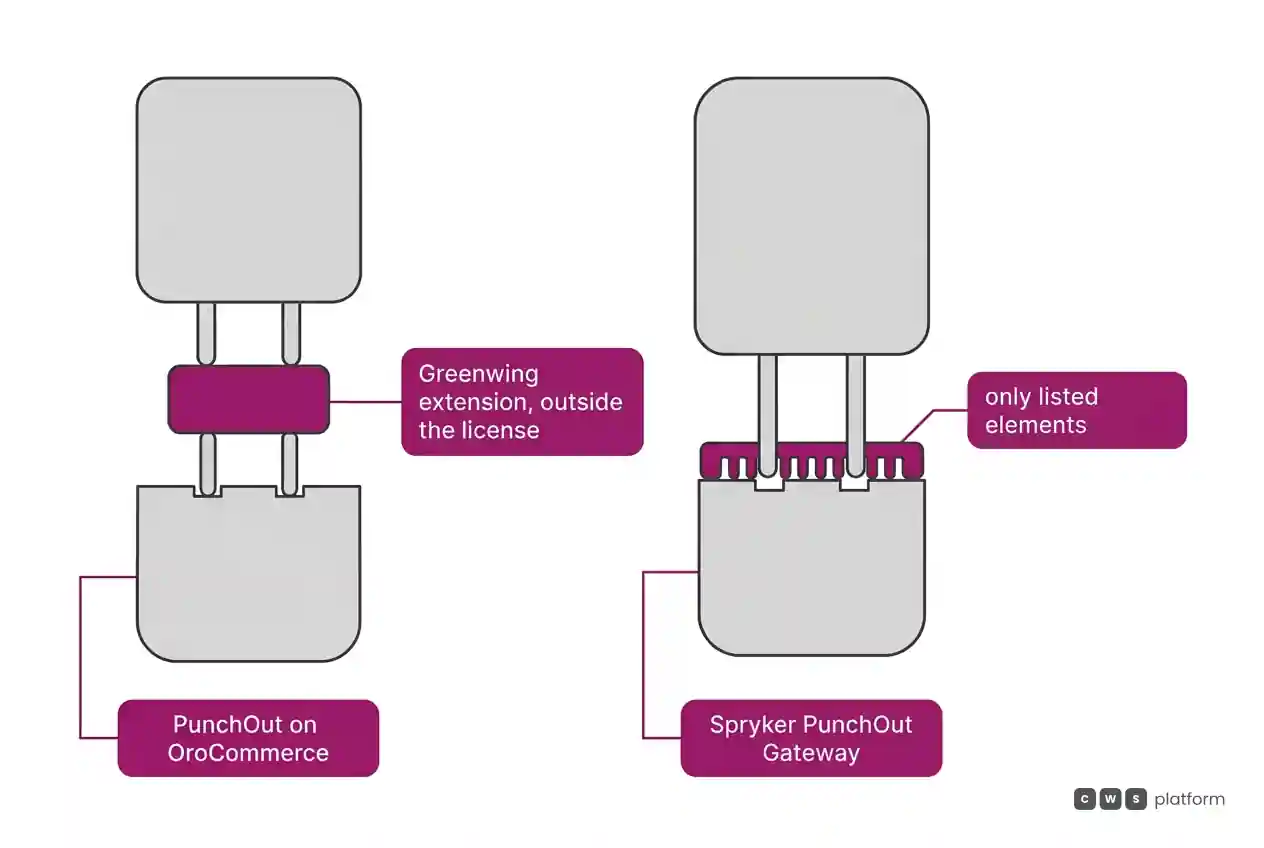
Recorded in Oro's documentation, accessed on October 16, 2026: the Greenwing PunchOut integration is a custom extension and is not covered by the Oro User License Agreement ("This is a custom extension, not a core feature of OroCommerce, and is not covered by the Oro User License Agreement.", Greenwing PunchOut).
In Spryker, the sales rep edits prices, quantities, and shipping on the quote and returns a new version with an expiry date (Request for Quote), and the email of the agent who assisted can be stored on the order (Agent Assist installation). The PunchOut Gateway implements OCI and cXML flows to connect the store to eProcurement systems, with one cart per BuyerCookie in cXML.
Recorded in Spryker's documentation, in a page dated June 22, 2026: in the cXML flow, the connection is identified and authenticated by the sender's credentials, and the cart goes back to the procurement system in a PunchOutOrderMessage; cXML elements not on the coverage list are not parsed by the default flow ("Elements that are not listed are not parsed by the default flow.", PunchOut protocol coverage).
Ask both vendors, in the demo, for a test against a real customer's procurement system, and ask who maintains that bridge.
ERP integration: the connector and the invoice
At Oro, the Epicor P21 integration runs in two phases, an initial migration and ongoing sync, scheduled or real-time; the store sends customers, addresses, new orders, and paid invoices, and receives quotes, prices, stock, and unshipped items (Epicor P21 integration). Invoices can be imported from external systems, with a custom numbering prefix (invoice settings).
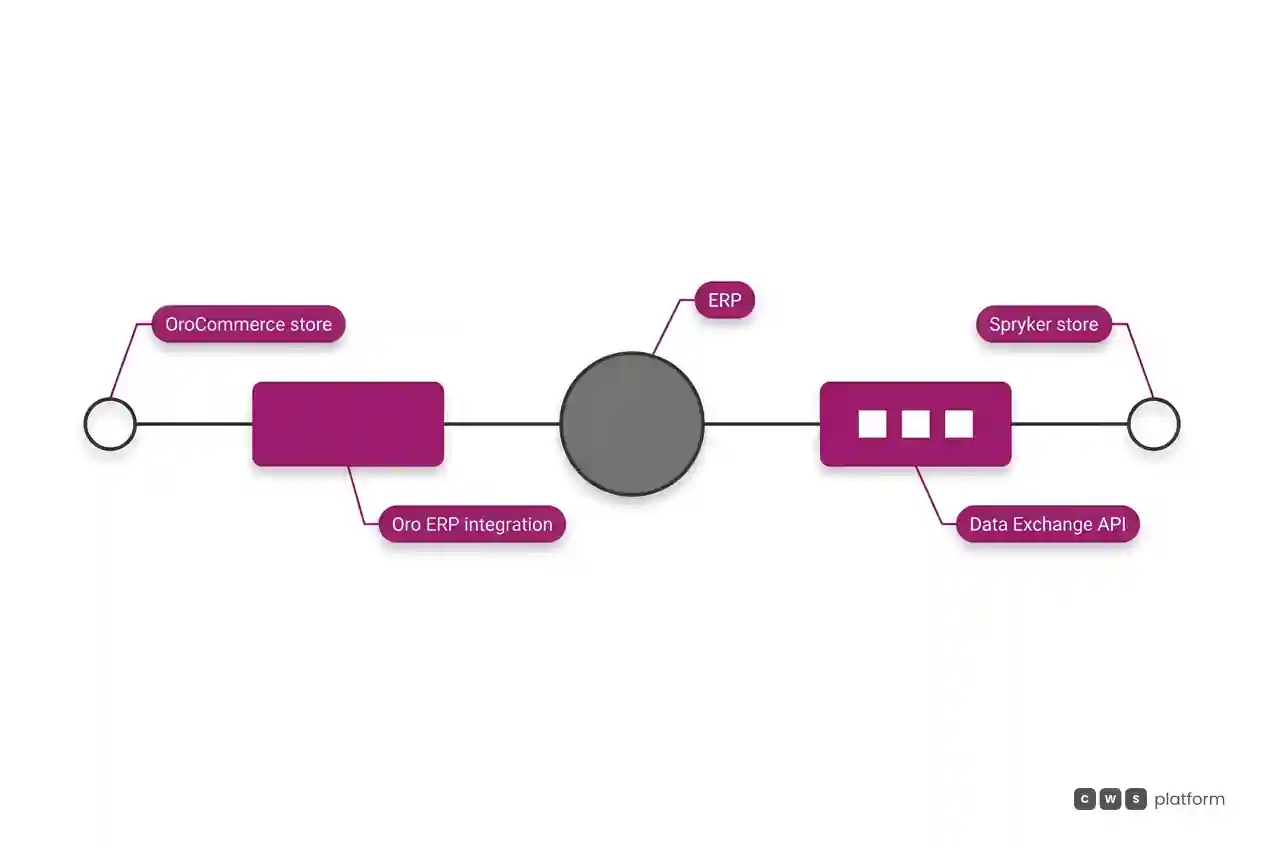
Recorded in Oro's documentation, accessed on October 16, 2026: the SAP integration is a custom extension, not a core feature, and is not covered by the Oro User License Agreement ("This is a custom extension, not a core feature of OroCommerce, and is not covered by the Oro User License Agreement.", SAP integration).
In Spryker, the Data Exchange API is built on the Dynamic Entity API, which creates endpoints, validations, and mappings in the Back Office without code, and it accepts OAuth 2.0, Back Office credentials, or an API key. In the Spryker OMS, order events can be triggered by an API call, and PHP commands run routines such as payment authorization.
Recorded in Spryker's documentation, in a page dated October 6, 2026: the order confirmation and invoice email is not a structured e-invoice ("It is not a structured e-invoice.", Order Management overview).
For the CTO, the question is which end owns each document. Ask both vendors which system issues the invoice the buyer receives, in what format, and who maintains the ERP connector with each release.
Cost and billing model: what the license covers and what becomes a project
In the sources used here, neither vendor details platform billing: the proposal has to bring it. What the sources do show is where the integration work lands.
At Oro, the listed ERP integrations, such as Epicor Prophet 21 and Oracle JD Edwards, are treated as custom extensions, outside the product core and the standard license agreement (ERP integrations). In Spryker, order business rules and integrations come in as PHP plugins registered in the project: conditions check whether a transition can happen, and commands run the routines (Spryker OMS).
Ask for both proposals to separate the platform license, extensions, and integration project hours, including maintenance of each bridge over the contract term.
Deployment and maintenance: who tests the bridge with each release
On OroCloud, an update is packaged from Git by orocloud-cli and released in maintenance mode, as a rolling upgrade, which is safe only when the database structure does not change, or as a source upgrade (how to run upgrades).
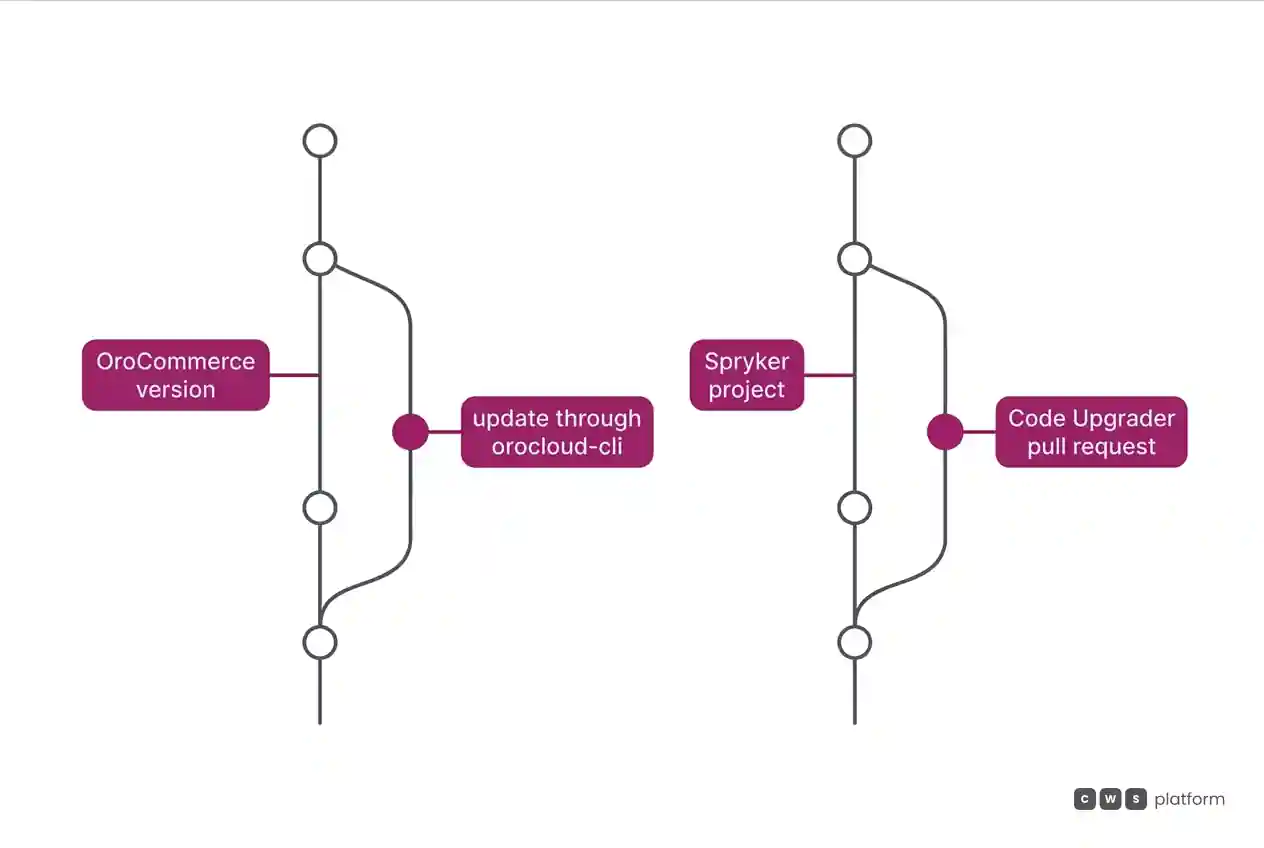
With Spryker Code Upgrader, the tool compares the project's composer.json and composer.lock with the latest released code, applies security releases first, and opens a pull request; major versions stay with the team, with instructions in the pull request (how Code Upgrader works).
An extension outside the core and a plugin in the project lead to the same question: who tests the ERP connector and the PunchOut flow when the platform moves to a new version, and on what timeline.
When to choose OroCommerce
An ERP with a documented integration map. For Epicor P21, an integration delivered as an extension, Oro describes what the store sends to and receives from the ERP, with scheduled or real-time sync (Epicor P21 integration).
Invoices paid in the portal. Buyers pay invoices in the storefront, through an external link, or as guests, and each payment status change fires a webhook (InvoicePaymentBundle).
Freedom to choose where the platform runs. OroCloud, public cloud, private cloud, or on-premise (OroCloud infrastructure).
When to choose Spryker
Buyers who purchase through their own procurement system. The PunchOut Gateway implements OCI and cXML to connect the store to eProcurement systems.
An order process designed by the company. The Spryker OMS models the order lifecycle as a state machine, with automatic, manual, API-triggered, or time-based events.
Data endpoints without code. The Data Exchange API creates endpoints, validations, and mappings in the Back Office.
When neither fits
At Oro and at Spryker, part of the conversation with the ERP and with the customer's procurement system depends on an extension or on project code. The post on the three B2B commerce platform models describes a third path: move the commercial rules into the platform.
That is the CWS Platform model. The platform is API-first and headless, with REST APIs and webhooks. Price tables, rules, and contracts are configurable in the platform and can come from the ERP or CRM through APIs, and tax calculation can be delegated to the tax engine the customer already uses: the tax comes from the ERP. Billing is a platform license plus an integration license, and all customers run the same version. CDL Workspace is a single system for the whole ecosystem. The platform has 11 modules, 6 AI Agents, and 1,029 parameters.
Each vendor is read against that model in OroCommerce vs. CWS Platform: what happens to order operations after checkout? and in Spryker or CWS Platform: Where Does Customer Pricing Travel in the ERP Integration?. If the integration design still leaves open questions, it is worth talking to a CWS Platform specialist before you lock the architecture.
Frequently asked questions
OroCommerce vs Spryker: which integrates better with the ERP?
It depends on the ERP and on who will maintain the bridge. Oro documents integrations with ERPs such as Epicor Prophet 21 and JD Edwards and records its SAP connector as a custom extension, outside the license agreement. Spryker offers the Data Exchange API, with endpoints created in the Back Office, and order rules come in as plugins in the project.
Which one supports PunchOut with the customer's procurement system?
Both document PunchOut. At Oro, the Greenwing integration is recorded as a custom extension, outside the license agreement. At Spryker, the PunchOut Gateway implements OCI and cXML, and the default flow does not parse elements outside the coverage list. Test it against the buyer's own procurement system.
Is the ERP connector included in the license?
At Oro, the documentation records the SAP connector and the listed ERP integrations as custom extensions, outside the core and the license agreement. The Spryker sources used here do not cover a ready-made ERP connector; they describe integration through the APIs, such as the Data Exchange API.
How is the order invoice handled?
At Oro, invoices can be imported from external systems and paid in the storefront, through a link, or as a guest, with a webhook on each payment status change. At Spryker, the documentation records that the order confirmation and invoice email is not a structured e-invoice. Ask both vendors which system issues the invoice the buyer receives.
Read next
Brands mentioned in this article




- OroCommerce
Trademarks and logos belong to their respective owners. Mention does not imply partnership or endorsement.
"responsive, technically engaged, and willing to work through complex commercial rules (negotiated pricing, credit, customer-specific conditions) rather than pushing generic answers"
Is integration holding your operation back?
Request an assessment of your operation or talk straight to a specialist, whichever you prefer.
I'd rather get the next articles on ERP integration
A weekly roundup of new articles on ERP integration, only in weeks when there is one. No spam, and you can leave in one click.