Optimizely vs Adobe Commerce: what changes with each new version?
A front end and search the vendor replaces, or the PHP version and the PaaS upgrade: the work the next version hands back to your tech team.

Editorial note: CWS Platform competes with both Optimizely and Adobe. This comparison uses only each vendor's public documentation, with the address next to each fact and the date of each record cited.
Short answer: Optimizely Configured Commerce fits teams that want customer pricing calculated in its own price matrix, quotes with the sales rep, and ERP integration run by an agent installed on the customer's network. Adobe Commerce fits teams that want to choose between SaaS and dedicated PaaS, with a headless GraphQL storefront, serverless extensions, and B2B as an extension of the same store.
For a CTO, the question is not only what the platform does on go-live day, but how much work the next version hands back to the team. At Optimizely, the records of that kind sit in the front end and in search; at Adobe, in the PHP version and in the PaaS upgrade. The overall map is in the three B2B commerce platform models, and other reads, such as Optimizely Configured Commerce vs Salesforce B2B Commerce and Salesforce Commerce Cloud vs Adobe Commerce, are in the comparisons hub.
Optimizely Configured Commerce and Adobe Commerce side by side
The table summarizes each vendor's documentation; where there is no source, the cell says "not documented".
| criterion | Optimizely Configured Commerce | Adobe Commerce |
|---|---|---|
| Platform model | Storefront and Admin REST APIs; on .NET Core, separate Admin, Storefront, and Integration applications | Multi-tenant SaaS, dedicated PaaS, or Commerce Optimizer; open source in Magento Open Source |
| Native B2B or extension | Quotes, customer pricing, PunchOut, and quick order described in the product | B2B extension installed and enabled in the store, which also runs B2C |
| Customer and contract pricing | Price Matrix, from the most specific record to the most general | Shared catalogs with product prices for companies or groups |
| Quotes | Request for quote from the cart or by the sales rep; Job Quotes | Quotes from the cart or by the seller in the Admin, with discount negotiation |
| Credit and payment terms | Invoice history supplied by the ERP, shown on the site | Company credit tracked in self service |
| ERP integration | Windows Integration Service, with Refresh and Submit jobs | REST APIs for third parties, App Builder, API Mesh, webhooks, and events |
| Billing model | Not documented | Not documented for the license; Managed Services contracted through a Base Package |
| Implementation | .NET applications and an integration agent installed behind the customer's firewall | SaaS with automatic updates, dedicated PaaS, or a service managed by Adobe |
Pricing and commercial rules: where the calculation runs
In Optimizely Configured Commerce, customer pricing comes from the PriceMatrix table, flat and denormalized so the calculation does not depend on a direct ERP connection; since version 3.7.1, the calculation moved from stored procedures to a service in code, the PriceCalculator Generic, per the Price Matrix technical overview. When the price has to come from the ERP, the pricing service queries the ERP by API or through the Windows Integration Service, with a 60 minute cache and batches of 20 items, and an active Price Matrix overrides the queried price, per the pricing and inventory service.
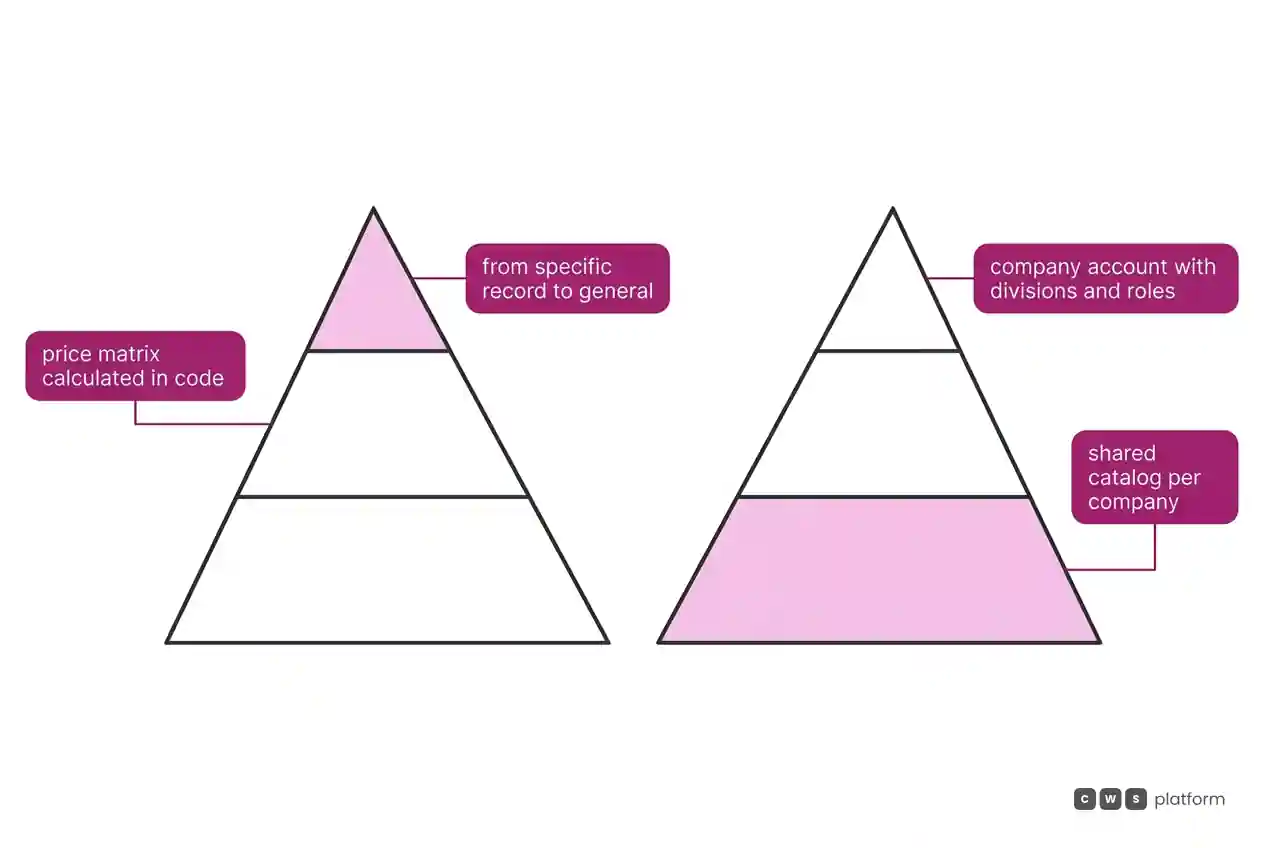
In Adobe Commerce, B2B commercial rules come from the B2B extension: the company account groups buyers into divisions and roles, the store admin sets payment methods, price levels, quote negotiation, and requisition lists, and shared catalogs apply product prices to companies or groups, across one or more sites, per the B2B introduction. In the open source code, any native or third party service becomes a web API declared in XML, with GraphQL, REST, and SOAP, per the web API guide.
On both sides, it is worth asking how much of your pricing logic will live in project code, and who reviews that code when the version changes.
Quotes and assisted selling: what comes ready
In Optimizely, a request for quote starts in the buyer's cart or is created by the rep, and the rep and the sales manager are notified at their next login, per the Request for Quote guide. A Job Quote sets a total quantity consumed across several orders until an expiration date, per Job Quotes setup, and Quick Order accepts product search and order file uploads, per the Quick Order guide.
In Adobe Commerce, authorized buyers start quotes from the cart and sellers from the Admin; both change items and quantities, request and apply discounts, and exchange messages until they agree, and purchase orders can go through approval rules, per the B2B introduction. In self service, the customer tracks shipments, checks quotes and orders, accesses invoices, and monitors company credit, per Adobe's B2B page.
ERP integration: who maintains the bridge
In Optimizely, the Windows Integration Service is an agent installed behind the customer's firewall that polls the site and runs integration jobs: Refresh pulls products, inventory, and customers from the ERP, and Submit pushes orders and customers created in the store to the ERP, through direct database calls or web services, per the WIS documentation. For a cloud ERP such as Acumatica, WIS can run as an internal connection, with customizations loaded through Extensions.dll, per the internal WIS guide.
In Adobe Commerce, GraphQL moves data to and from the storefront, and REST APIs integrate third party software, per the developer documentation. App Builder creates microservices without the merchant's own infrastructure and API Mesh combines several sources into one GraphQL endpoint, per the composable commerce guide, and there are starter kits for back office, payment, tax, and shipping integrations, per Adobe's pricing page. It is worth asking both vendors who maintains the code of the bridge to your ERP.
Cost and billing model: the work that lands in the budget
The sources in this comparison do not document the license price of either vendor. What they do record is work that lands in the budget. It is recorded in Optimizely's documentation, accessed on October 16, 2026, that all cloud clients on Search v1 had to implement a new search solution by June 30, 2026 ("All Configured Commerce Cloud clients using Commerce Search v1 must implement a new search solution by June 30, 2026.", Search v1 end of life notice). It is worth asking how much of the search replacement project stayed with the customer and how much with the vendor.
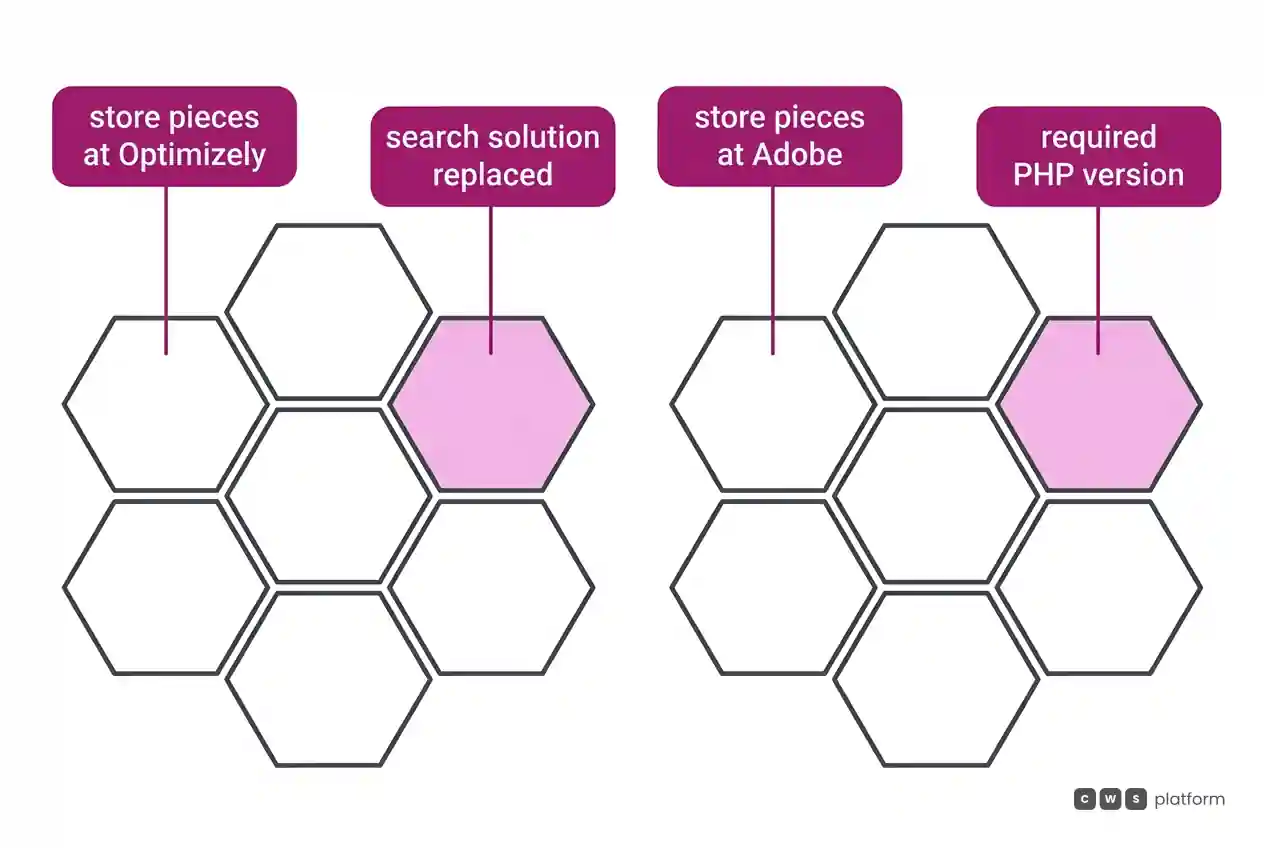
At Adobe, Managed Services are contracted through a Base Package, with assigned engineers and consumption quotas in the sales order, per the Managed Services product description. It is also recorded in Adobe's release notes, on a page dated August 12, 2026, that starting with 2.4.9, PHP 8.2 and 8.3 are no longer supported ("PHP 8.2 and PHP 8.3 are no longer supported.", 2.4.9 release notes). It is worth asking who pays for the stack update when a new version raises the requirement.
Implementation and maintenance: the front end and the upgrade
In Optimizely, on .NET Core the APIs live in three separate applications, Admin, Storefront, and Integration, behind a reverse proxy, per the API reference. The front end change is recorded in Optimizely's documentation, accessed on October 16, 2026: moving a Classic site to Spire requires rewriting the front end ("the project(s) will require a front-end rewrite as the underlying technologies are fundamentally different (i.e., Angular to React).", notice on Classic and cloud versions). It is worth asking which front end your store starts on and which one comes next.
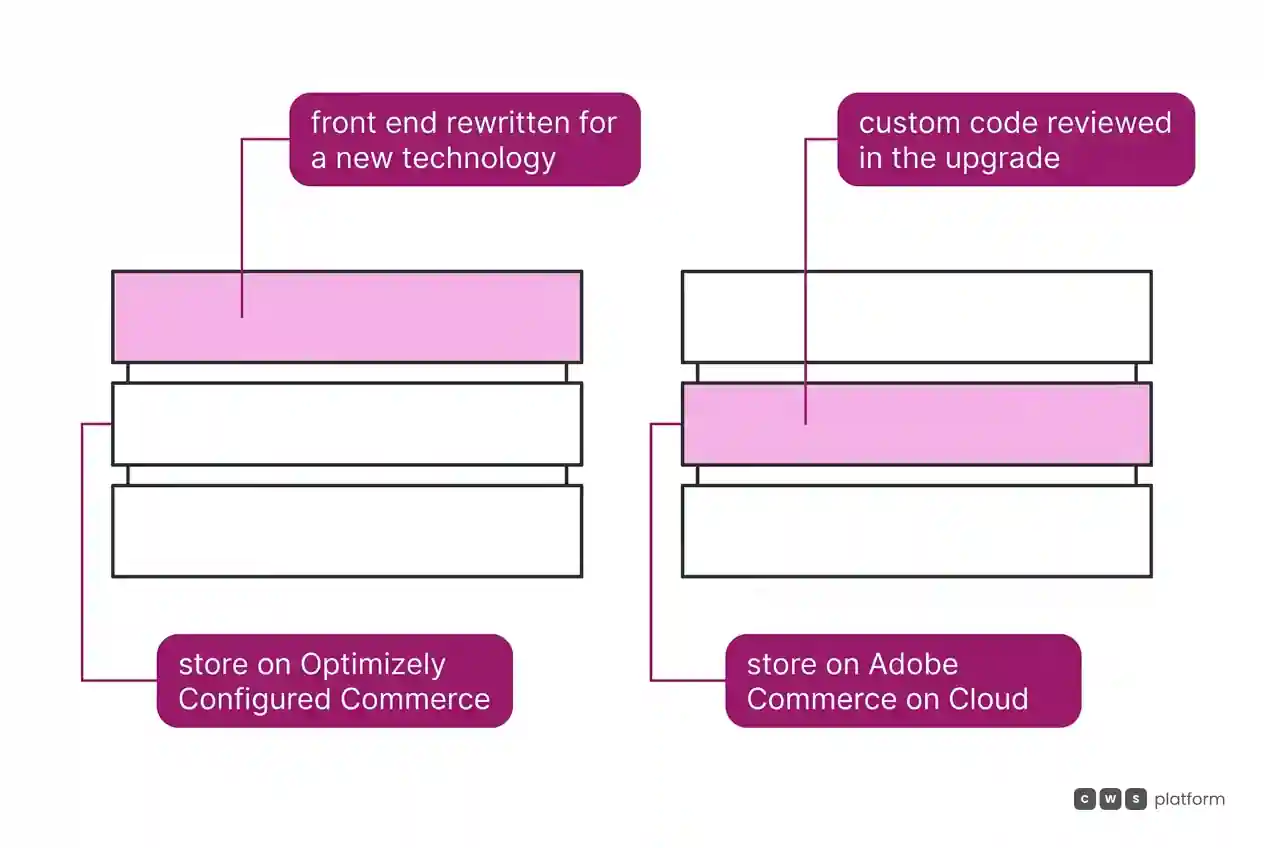
At Adobe, under Managed Services Adobe owns the instance, network, CDN, operating system, scaling, and backups, and the customer owns custom code, per the Managed Services guide. The upgrade is recorded in Adobe's documentation, on a page dated October 8, 2026: on Commerce on Cloud it involves backups, instance cloning, compatibility tools, and fixing code conflicts ("running compatibility tools, and fixing code conflicts"), and Adobe Commerce as a Cloud Service does not support Luma storefronts ("does not support Luma storefronts", Cloud Service overview). It is worth asking how much custom code goes into each upgrade and which storefront the store will run on.
When to choose Optimizely Configured Commerce
An ERP behind the firewall. Choose Optimizely when the ERP sits on the company network and integration should run through an agent that executes jobs both ways, per the WIS documentation.
Pricing without querying the ERP on every page. Choose Optimizely when your customer pricing rules fit a flat matrix calculated by a service in code, per the Price Matrix technical overview.
Quantity contracts with a deadline. Choose Optimizely when customers negotiate a total quantity consumed across several orders, per Job Quotes setup.
Buying from the customer's procurement system. Choose Optimizely when large customers buy through PunchOut, see their catalog and negotiated prices, and send the cart back to their procurement system in cXML, per the PunchOut overview.
When to choose Adobe Commerce
A choice of hosting model. Choose Adobe when the team wants to decide between multi-tenant SaaS with automatic updates, dedicated PaaS, or only storefront and catalog on top of another engine, per Adobe's pricing page.
A decoupled front end. Choose Adobe when the storefront should be headless, with API Mesh, App Builder, and gradual migration between front ends, per the composable commerce guide.
Open source. Choose Adobe when the team wants the code on GitHub, with the community contributing to the core, per the Magento Open Source page.
Infrastructure run by the vendor. Choose Adobe when the company wants Adobe to run the infrastructure, with infrastructure and application SLAs, per the Managed Services guide.
When neither fits
The two hand work back to the team along different paths: at Optimizely, the front end and search the vendor replaces; at Adobe, the PHP version and the upgrade of custom code. There is a third model, described in the post on the three B2B commerce platform models: bringing the commercial rules into the platform.
That is the CWS Platform model. All customers run on the same version. The platform is API-first and headless, with REST APIs and webhooks, and the Commerce Rules Engine (CDL Workspace) keeps commercial policy in parameters: configuration instead of code. Price lists, rules, and contracts are configurable in the platform and can come from the ERP or CRM by API, and tax calculation can be delegated to the tax engine the customer already uses. The platform brings together 11 modules, 6 AI Agents, and 1,029 parameters.
Each vendor is read against this model in Optimizely Configured Commerce vs CWS Platform: ERP integration maintenance and in Adobe Commerce vs CWS Platform: end of life and architecture. If neither version path fits your team, it is worth talking to a CWS Platform specialist.
Frequently asked questions
Optimizely or Magento: which is better for B2B?
It depends on the work your team is willing to take on. Optimizely fits teams that want pricing in its own matrix, quotes with the rep, and ERP integration through an agent on the customer's network. Adobe Commerce fits teams that want to choose between SaaS and dedicated PaaS, with a headless storefront and B2B as an extension of the store.
Which one takes more work with each new version?
Both record version work, in different places. At Optimizely, cloud clients on Search v1 had to implement a new search by June 30, 2026, and moving from Classic to Spire requires rewriting the front end. At Adobe, 2.4.9 drops support for PHP 8.2 and 8.3, and the PaaS upgrade involves compatibility tools and fixing code conflicts.
What happens to the store when the platform changes?
At Optimizely, moving from Classic to Spire changes the front end technology, from Angular to React, and calls for a rewrite. At Adobe, the Cloud Service does not support Luma storefronts, and the headless GraphQL storefront can be developed separately from the core.
Which one needs more in-house technical staff?
It depends on the model you contract. At Optimizely, the integration agent runs behind the customer's firewall, and WIS customizations are loaded through Extensions.dll. At Adobe, Managed Services leave the instance, network, and backups with the vendor, and custom code stays with the customer.
Brands mentioned in this article
 Magento
- Optimizely
- Adobe Commerce
- Salesforce
Trademarks and logos belong to their respective owners. Mention does not imply partnership or endorsement.
"responsive, technically engaged, and willing to work through complex commercial rules (negotiated pricing, credit, customer-specific conditions) rather than pushing generic answers"
Does your implementation never end?
Request an assessment of your operation or talk straight to a specialist, whichever you prefer.
I'd rather get the next articles on implementation
A weekly roundup of new articles on implementation, only in weeks when there is one. No spam, and you can leave in one click.