Salesforce Commerce Cloud vs Adobe Commerce: where does the catalog limit live?
Search, attributes, indexers, and API limits: what each vendor's documentation records for a large B2B assortment, through the CTO lens.

Editorial note: CWS Platform competes with both Salesforce and Adobe. This comparison uses only each vendor's public documentation, with the address next to each fact and the date of each record cited.
Short answer: Salesforce Commerce Cloud fits teams that want the B2B store inside a Salesforce org, built from templates, with B2B and D2C sharing data, for a catalog that fits within the search limits Salesforce publishes. Adobe Commerce (Magento) fits teams that want quotes, shared catalogs, and purchase orders in the B2B extension and prefer to choose between SaaS, dedicated cloud, or open source code, taking on the upkeep each option requires.
For a CTO choosing between Salesforce Commerce Cloud and Adobe Commerce, the real question is where the limit lives: how many products search covers, how many attributes filters accept, how many items fit in one API call, and who responds when a background process stalls. For a distributor, the assortment tends to be large and pricing tends to arrive from the ERP several times a day.
On Salesforce, the store lives in a Salesforce org, and the catalog and search limits are published by the vendor. On Adobe, there is SaaS, a dedicated cloud, and Magento Open Source, with code on GitHub: the closer you get to the code, the more the limit becomes your team's problem. The broader map is in the three B2B commerce platform models, and the other vendor reads are in the comparisons hub.
Salesforce Commerce Cloud and Adobe Commerce side by side
Where the source does not address a point, the cell says "not documented."
| criterion | Salesforce Commerce Cloud | Adobe Commerce (Magento) |
|---|---|---|
| Platform model | Store built from templates in a Salesforce org, customized in Experience Builder | Cloud Service (multi-tenant SaaS), Adobe Commerce on Cloud (dedicated PaaS), and Commerce Optimizer; Magento Open Source with code on GitHub |
| Native B2B or by extension | B2B Commerce; B2B and D2C in the same org, with shared data | B2B extension installed and enabled on the store, which keeps serving B2C |
| Customer and contract pricing | Price lists and entitlements, loaded by CSV along with accounts and products | Shared catalogs with per-product pricing for companies and customer groups |
| Quotes | Not documented | Buyer starts from the cart, seller from the Admin, negotiating items, quantities, and discounts |
| Credit and net terms | Not documented | Buyer tracks company credit in self-service; purchase orders with approval rules |
| ERP integration | Not documented as a connector; loads by CSV or Data Loader; customized B2B checkout with third-party services | REST, GraphQL, and SOAP APIs; App Builder, API Mesh, webhooks, events, and back-office kits |
| Pricing model | Not documented | Under managed services: base package with consumption entitlements in the sales order (vCPU-days, storage, CDN, store views); other options not documented |
| Implementation | Templates, Experience Builder, and Lightning features | SaaS, dedicated PaaS, or a service managed by Adobe; for Open Source, install with Composer |
Catalog, pricing, and commercial rules
On Salesforce, commercial rules come in through the store's data structure. According to the B2B Commerce introduction, accounts, products, price lists, and entitlements are imported by CSV, in an asynchronous import of up to 10,000 products per session; for large loads, the stated recommendation is Data Loader.
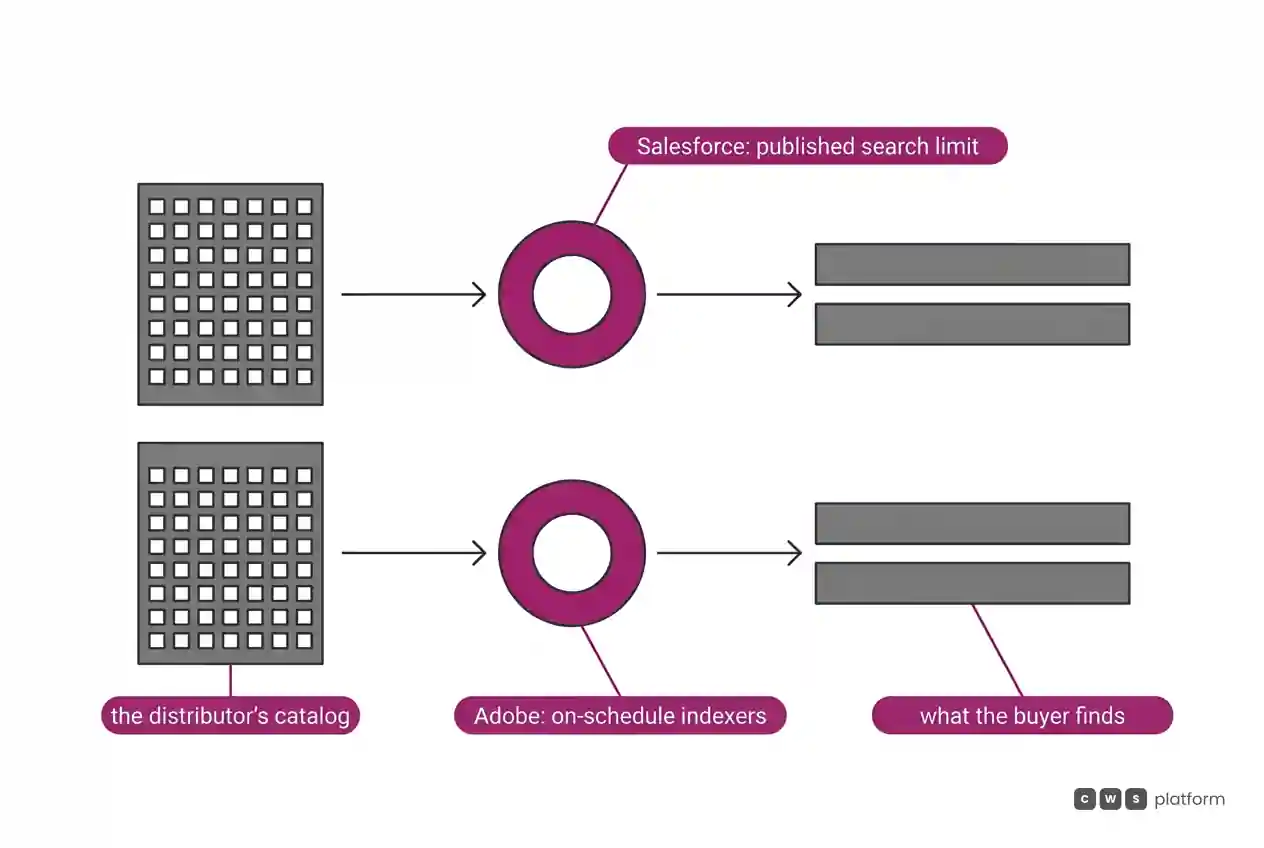
The limit that matters for a long catalog sits in search. It is recorded in Salesforce's documentation, accessed on October 9, 2026, that a store accepts 4 million products, but search supports only up to 1 million ("only up to 1 million products are supported for search.", data model product limits). It is worth asking in the demo how a buyer finds what falls outside search.
On Adobe, customer pricing lives in the shared catalog. Per the Adobe Commerce B2B introduction, shared catalogs set per-product pricing for different companies or customer groups, on one or more sites, and require the store to support company accounts.
Adobe's record sits in catalog maintenance. Recorded in Adobe's public issue tracker (the magento/magento2 repository), still open as of November 5, 2026, issue #36724 describes on-schedule indexers stuck in working status ("On-schedule indexers stuck in "working" status", issue #36724); it was opened in January 2023 and is labeled "Progress: dev in progress." For teams running their own instance, it is worth asking how operations detect a stalled indexer and what buyers see in the catalog and in pricing meanwhile.
Quotes and assisted selling
In the Commerce Cloud pages used here, Salesforce does not describe quotes or a sales rep working inside the store; both are marked "not documented" and become questions for the demo. The B2B Commerce introduction records that B2B stores use only a customized checkout, with services from third-party providers and a customizable interface, and that buyers can self-register or browse as guests.
On Adobe, quotes ship in the B2B extension. According to the B2B introduction, authorized buyers start quotes from the cart and sellers from the Admin; both sides change items and quantities, request and apply discounts, and exchange messages until they agree. With purchase orders enabled, every order can go through multiple approval rules. Per the B2B optimization page, buyers track shipments, invoices, and company credit in self-service.
ERP integration and API limits
On Salesforce, the Commerce Cloud sources used here do not describe an ERP connector. The design of the ERP integration is a project decision, and it is worth asking the proposal for the load architecture for pricing, inventory, and orders.
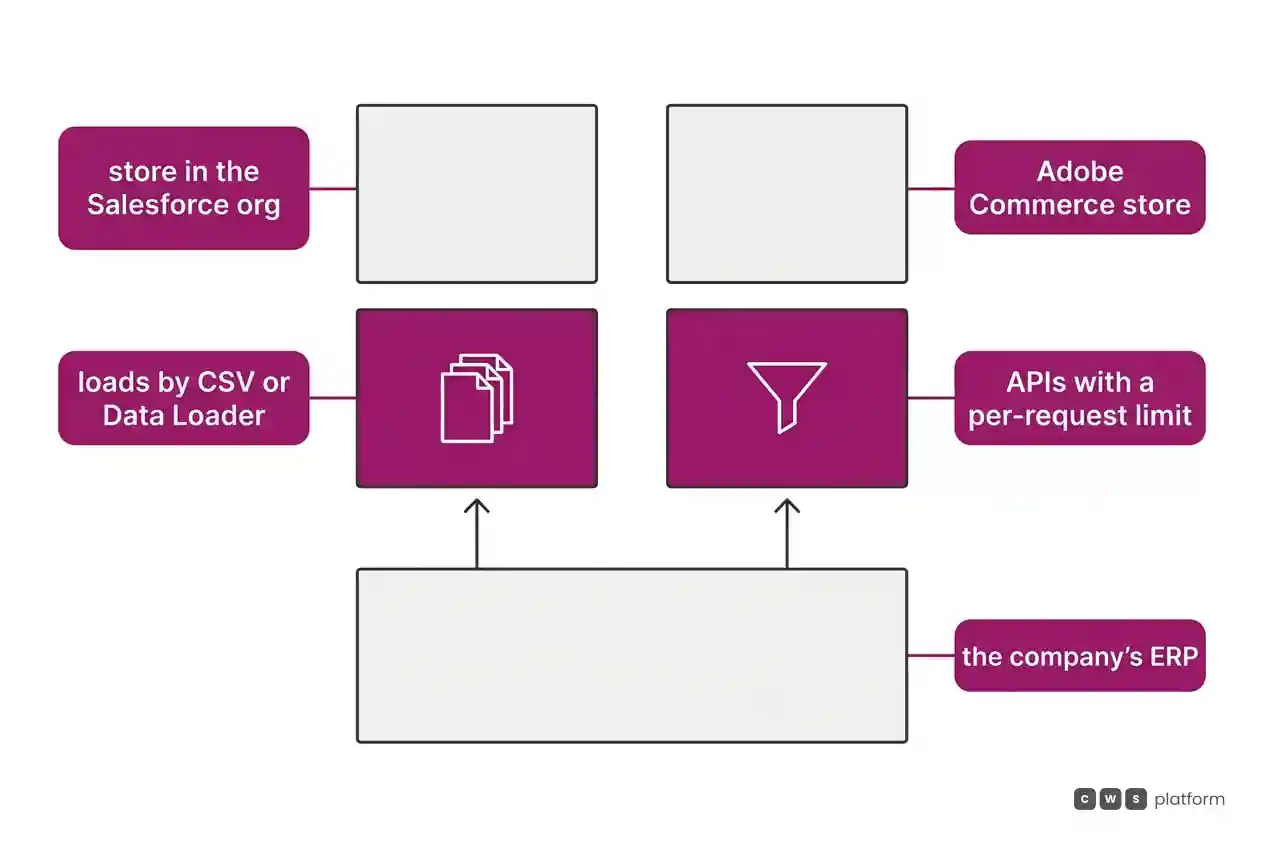
On Adobe, integration runs through the APIs. The web API guide, which applies to Magento Open Source and Adobe Commerce, describes GraphQL, REST, and SOAP; the model is CRUD and search, with no webhook support in that framework, and an integration-style call runs several services in a single request. On the pricing page, Adobe describes App Builder, API Mesh, webhooks, and events, with starter kits for back office, payments, tax, and shipping.
The API limit is also recorded in Adobe's documentation, on a page last updated June 4, 2026: with input limiting enabled, the default is 20 items per synchronous request and 5,000 per asynchronous one ("20 for synchronous requests and 5,000 for asynchronous", web API security). For a daily pricing and inventory load from the ERP, it is worth asking how it splits between synchronous and asynchronous calls and who sets the limiter value.
Cost and pricing model
The Commerce Cloud documentation consulted does not include Salesforce's pricing model. The cell stays "not documented," and the question goes to the proposal: what the billing base is and what counts toward it.
On Adobe, the managed services product description details a base package with two designated experts. Consumption entitlements are listed in the sales order: production and staging vCPU-days, storage, CDN, and store views. Add-ons are sold per unit, and New Relic observability has an allowance tied to the GMV band.
In both cases, the bill includes the team: whoever customizes checkout and integrations on Salesforce, and whoever runs indexes, APIs, and versions on Adobe.
Implementation and ongoing operations
On Salesforce, the store starts from templates, is customized in Experience Builder, and is configured with Lightning features, per the B2B Commerce introduction. One decision that matters is attribute design. It is recorded in Salesforce's documentation, accessed on October 9, 2026, that searchable attributes, filterable attributes, and sort rules add up to at most 70 per store ("can't exceed 70", data model search limits). It is worth bringing to the demo the list of attributes buyers use to find a part.
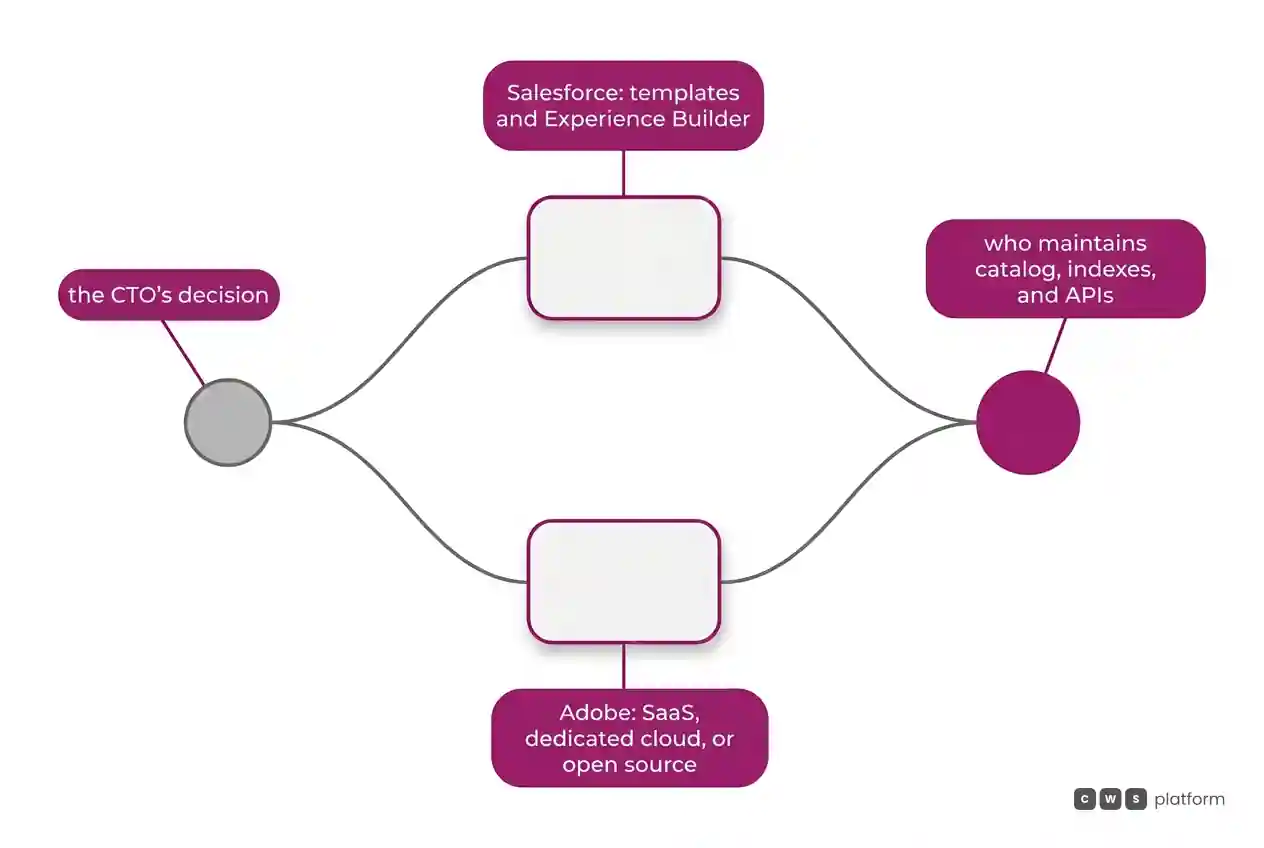
On Adobe, the first decision is the deployment option. The pricing page describes Cloud Service as multi-tenant SaaS with automatic updates, Adobe Commerce on Cloud as dedicated infrastructure, and Commerce Optimizer, which can sit on top of another transaction engine. Under managed services, Adobe states a 99.99% infrastructure SLA and a 99.9% application SLA and owns the instance, network, CDN, scaling, and backup; the customer owns custom code, PCI for the custom application, and SSO. With Magento Open Source, the code comes from GitHub, per the Magento Open Source page, and is installed with Composer, with versions pinned in composer.lock, per the package reference.
When to choose Salesforce Commerce Cloud
B2B and D2C in the same org. When the company wants to run both channels with shared data and processes in one Salesforce org, as the B2B Commerce introduction describes.
A store built from templates. When the team prefers to start from templates and customize in Experience Builder, with buyers organized into accounts and groups.
Multiple consumer storefronts. When the consumer business needs several storefronts by brand, locale, or channel, managed in Business Manager, per the Get Started with B2C Commerce guide.
File-based catalog loads. When the data team prefers to load accounts, products, and price lists by CSV, in asynchronous imports, with Data Loader for large loads.
When to choose Adobe Commerce (Magento)
B2B ready in the extension. When company accounts with divisions, negotiated quotes, shared catalogs, and purchase orders with approvals are day-one requirements, as the B2B introduction records.
Choice of deployment. When the CTO wants to choose between SaaS with automatic updates, a dedicated cloud, or only the storefront and catalog layer, per the pricing page.
Control of the code. When the team wants open source code on GitHub and owns the instance's evolution, per the Magento Open Source page.
Operations with a vendor SLA. When the company prefers Adobe to run the infrastructure with an application SLA, under managed services.
When neither fits
There is a third model, beyond buying the store ready-made in a suite or running the code yourself: moving commercial rules into the platform. That is the CWS Platform model. On it, price tables, rules, and contracts are configurable in the platform and can come from the ERP or CRM through APIs, with customizable decimal places. The Commerce Rules Engine, in CDL Workspace, holds commercial policy as parameters: configuration instead of code. The architecture is API-first and headless, with REST APIs and webhooks, and all customers run the same version. CWS brings together 11 modules, 6 AI Agents, and 1,029 parameters.
To read each vendor against that model, the comparisons Salesforce vs. CWS Platform: who rebuilds the storefront when frameworks change and Adobe Commerce vs CWS Platform: who upgrades when versions hit end of life go one by one, and the post on the three B2B commerce platform models shows when each model fits. If the question is which one fits your operation, it is worth talking to a CWS Platform specialist with your catalog and your rules on the table.
Frequently asked questions
Salesforce Commerce Cloud or Adobe Commerce: which is better for B2B?
It depends on what your B2B business needs. Salesforce Commerce Cloud fits teams that want B2B and D2C in the same Salesforce org, with the store built from templates. Adobe Commerce fits teams that need quotes, shared catalogs, and purchase orders with approvals in the B2B extension, and want to choose how it is operated.
Which one handles a large B2B catalog?
They record limits in different places. Salesforce documents search of up to 1 million products in a 4-million-product store, and at most 70 searchable attributes, filterable attributes, and sort rules per store. On Adobe, the records sit in operations: on-schedule indexers stuck in working status, in an open issue, and 20 items per synchronous API request with input limiting enabled.
Which one needs more in-house technical staff?
It depends on the deployment option. With Magento Open Source, upkeep belongs to whoever runs the instance; under managed services, Adobe owns the infrastructure and the customer owns custom code. On Salesforce, the store starts from templates, but the B2B checkout is always customized, with services from third-party providers.
Magento or Salesforce: which costs more to maintain?
The public sources used here do not allow a price comparison. Adobe describes managed services as a base package with consumption entitlements; the Commerce Cloud documentation consulted does not include Salesforce's pricing. It is worth requesting both proposals with the same catalog and volume, and adding the team that handles checkout, indexes, and integrations.
Brands mentioned in this article
 Magento
- Salesforce
- Adobe Commerce
Trademarks and logos belong to their respective owners. Mention does not imply partnership or endorsement.
"responsive, technically engaged, and willing to work through complex commercial rules (negotiated pricing, credit, customer-specific conditions) rather than pushing generic answers"
Is your catalog getting in the way of the sale?
Request an assessment of your operation or talk straight to a specialist, whichever you prefer.
I'd rather get the next articles on catalog management
A weekly roundup of new articles on catalog management, only in weeks when there is one. No spam, and you can leave in one click.