Optimizely vs Spryker: who maintains the ERP integration layer?
ERP connectors and LTS branches or actor-based APIs in a generational shift: through a CTO's lens, what each vendor maintains in the layer that talks to the ERP.

Editorial note: CWS Platform competes with Optimizely and with Spryker. This comparison uses only each vendor's public documentation, with the address next to each fact and the date of each record cited.
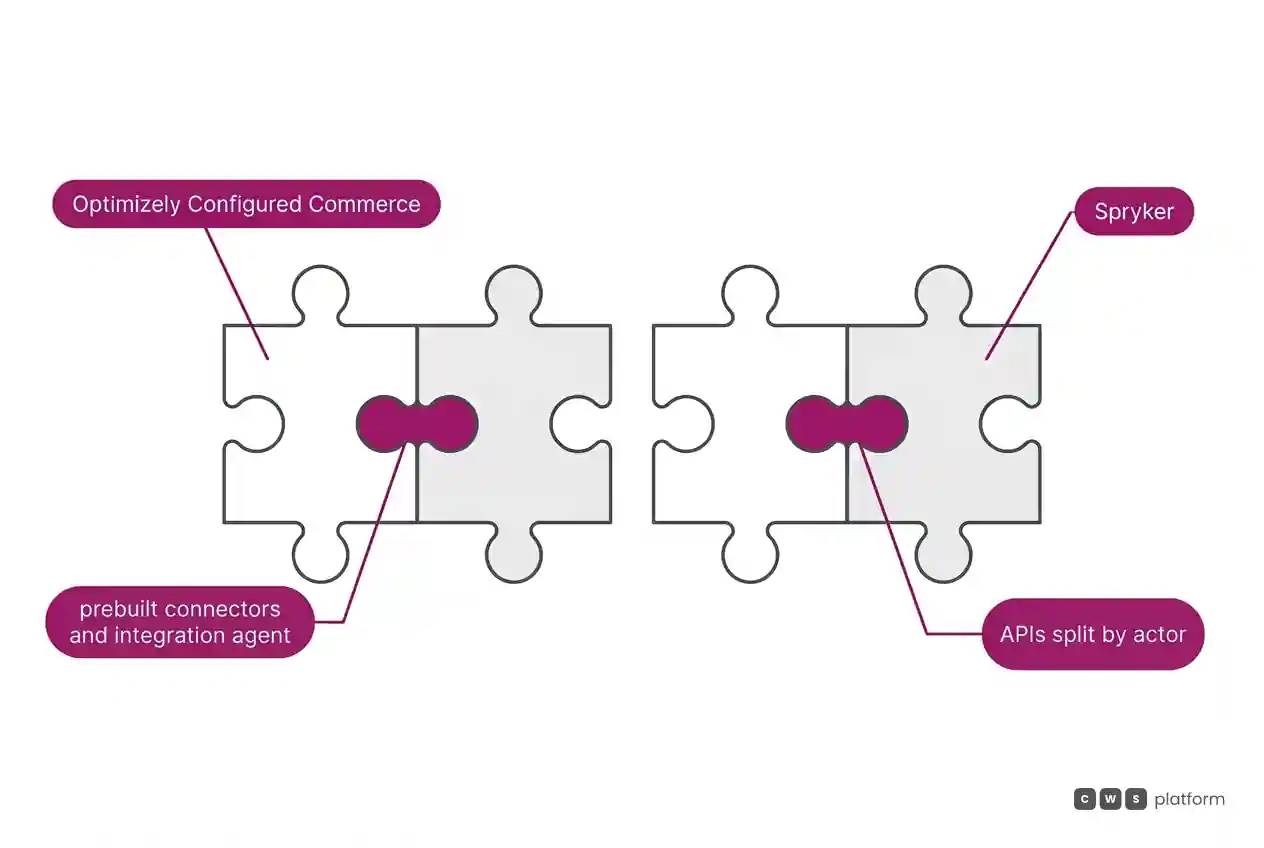
Short answer: Optimizely Configured Commerce fits companies that run one of the ERPs with a prebuilt connector and want integration jobs generated by the platform, accepting that those connectors are offered in their current state and do not support .NET 8. Spryker fits companies that want to integrate through APIs split by actor, with endpoints created without code in the Data Exchange API, accepting that Glue gets fixes but no new endpoints.
A CTO comparing Optimizely Configured Commerce and Spryker is choosing who maintains the layer that talks to the ERP after go-live: prebuilt connectors and an agent that runs close to the ERP, or APIs split by actor, with a new generation arriving to replace the old one. The question is what the vendor maintains, for how long, and what comes back to your team with each version.
The map of platform models is in the three B2B commerce platform models, and the other comparisons are in the comparisons hub, including Optimizely Configured Commerce vs Salesforce B2B Commerce and commercetools vs Spryker.
Optimizely Configured Commerce and Spryker side by side
The table summarizes what each vendor's documentation records; where the source does not cover a point, the cell says so.
| criterion | Optimizely Configured Commerce | Spryker |
|---|---|---|
| Platform model | Storefront and Admin REST APIs; on .NET Core, separate Admin, Storefront, and Integration applications | APIs by actor (Storefront, Back Office, Merchant, Data Exchange, Async Event); Symfony-based API Platform replacing Glue |
| Native B2B or by extension | Price Matrix, Request for Quote, Job Quotes, Quick Order, and PunchOut documented in the product | Company Account with Business Units, Approval Process, Quotation Process, and Agent Assist |
| Customer and contract pricing | Price Matrix from the most specific record to the most general; price can also be queried from the ERP | Merchant Custom Prices by business relationship, with bulk CSV loads |
| Quoting | RFQ from the cart or from the rep; Job Quotes | RFQ from the cart, with versions and a validity date set by the sales rep |
| Credit and payment terms | Invoices with terms, due date, and balance shown from ERP data | Not documented |
| ERP integration | Windows Integration Service and prebuilt connectors for SX.e, Prophet 21, Infor A+, Acumatica, and FACTS | Data Exchange API for bulk operations with ERP, PIM, OMS, and BI; Async Event API for events |
| Billing model | Not documented | Not documented |
| Implementation | LTS branches with hotfixes for four months | Order process in XML state machines, with commands and conditions in PHP in the project |
Pricing and commercial rules: where ERP pricing lands
In Optimizely Configured Commerce, customer pricing sits in a table designed around the ERP. Per the Price Matrix technical overview, the table is flat and denormalized to speed up the calculation without a direct ERP connection. When the price has to come from the ERP, the pricing and inventory service queries the ERP through an API or through the Windows Integration Service, with caching and batched requests.
In Spryker, customer pricing is a dimension of price. Merchant Custom Prices sets prices for the business units of B2B customers from the Merchant Portal or the Back Office. Per the base shop feature overview, the business relationship sits alongside mode, volume, store, and currency, and bulk loads run from CSV through the merchant relationship price import command.
For the CTO, the shared question is who writes the load for prices that come out of the ERP, and who maintains it when the ERP format changes.
Quoting and assisted selling: what the integration has to carry
In Optimizely, per the Request for Quote guide, a quote starts in the buyer's cart or is created directly by the rep. The RFQ configuration caps the discount against list price and calculates minimum margin on unit cost per warehouse.
In Spryker, per the Quotation Process, the buyer creates a quote from the cart, the sales rep edits prices, quantities, and shipping and sets the validity date, and each return to the buyer creates a new version. Agent Assist can record on the order the email of the agent who served the customer.
It is worth listing which of these data points, from margin to quote version, the integration needs to carry to the ERP.
ERP integration: prebuilt connector or API by actor
In Optimizely, the Windows Integration Service runs as an agent inside the customer's corporate firewall and executes Refresh jobs, which pull products, inventory, and customers from the ERP, and Submit jobs, which push orders and customers to the ERP. It is recorded in Optimizely's documentation, accessed on October 16, 2026, that the connectors for SX.e, Prophet 21, Infor A+, Acumatica, and FACTS generate the jobs when activated in the Admin Console, and that "Optimizely offers existing ERP connectors in their current state", with the limit "Optimizely's ERP connectors do not support .NET 8." (ERP connector implementation guide). Per the same page, adapting them in that case is manual work on the open code provided to partners. It is worth asking in the demo which .NET version the project will run on and who takes on adapting the connector.
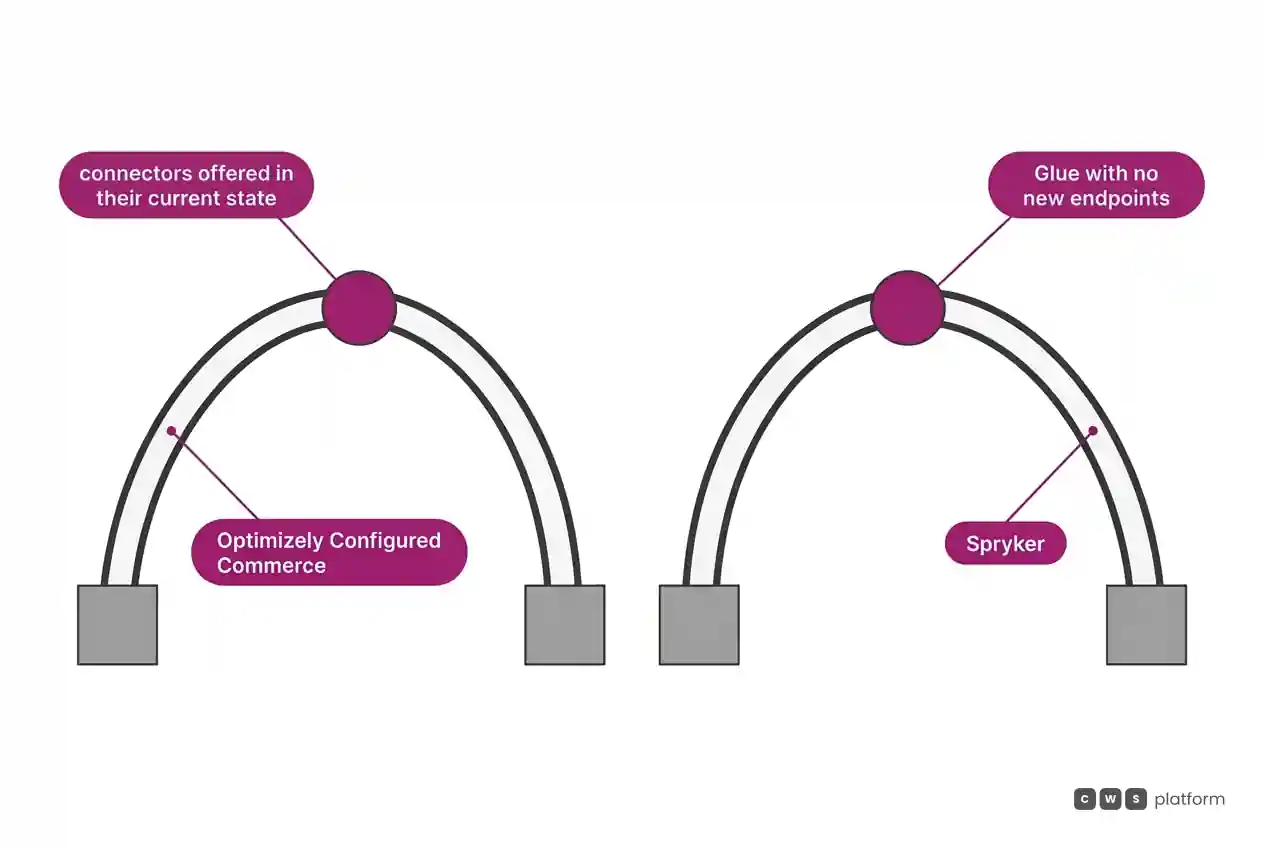
In Spryker, integration starts from APIs split by actor: Storefront, Back Office, Merchant, Data Exchange, for bulk operations with ERP, PIM, OMS, and BI, and Async Event, per the getting started with APIs guide. The Data Exchange API lets you create endpoints, validations, and mappings from the Back Office, with no code. It is recorded in Spryker's API roadmap, on a page dated July 30, 2026: "Glue gets bugfixes, security, and compatibility, no new endpoints" (Spryker API roadmap). The same page records that each API type has its own credentials and that the Symfony-based API Platform, with endpoints declared in YAML, replaces Glue and runs alongside it. It is worth asking for the plan for integrations that use Glue today.
Cost and billing model: what does not show up in the license
None of the sources in this comparison documents the platform's billing model. For the CTO, the cost that matters sits outside the license: in Optimizely, the connector adaptation a .NET version may call for; in Spryker, the work on integrations that use Glue today, which gets no new endpoints. It is worth asking the proposal to state who does and who pays for each of these tasks.
Implementation and support: what the vendor maintains afterward
In Optimizely, the Storefront and Admin APIs change shape with the .NET version: on .NET Core, Admin, Storefront, and Integration become separate applications behind a reverse proxy. It is recorded in Optimizely's documentation, accessed on October 16, 2026: "LTS branches do receive hotfixes for their four-month life, and the hotfixes end the week before a new LTS branch release." (Optimizely guide to LTS and STS branches). It is worth asking how often your team will switch branches and how much integration testing each switch takes.
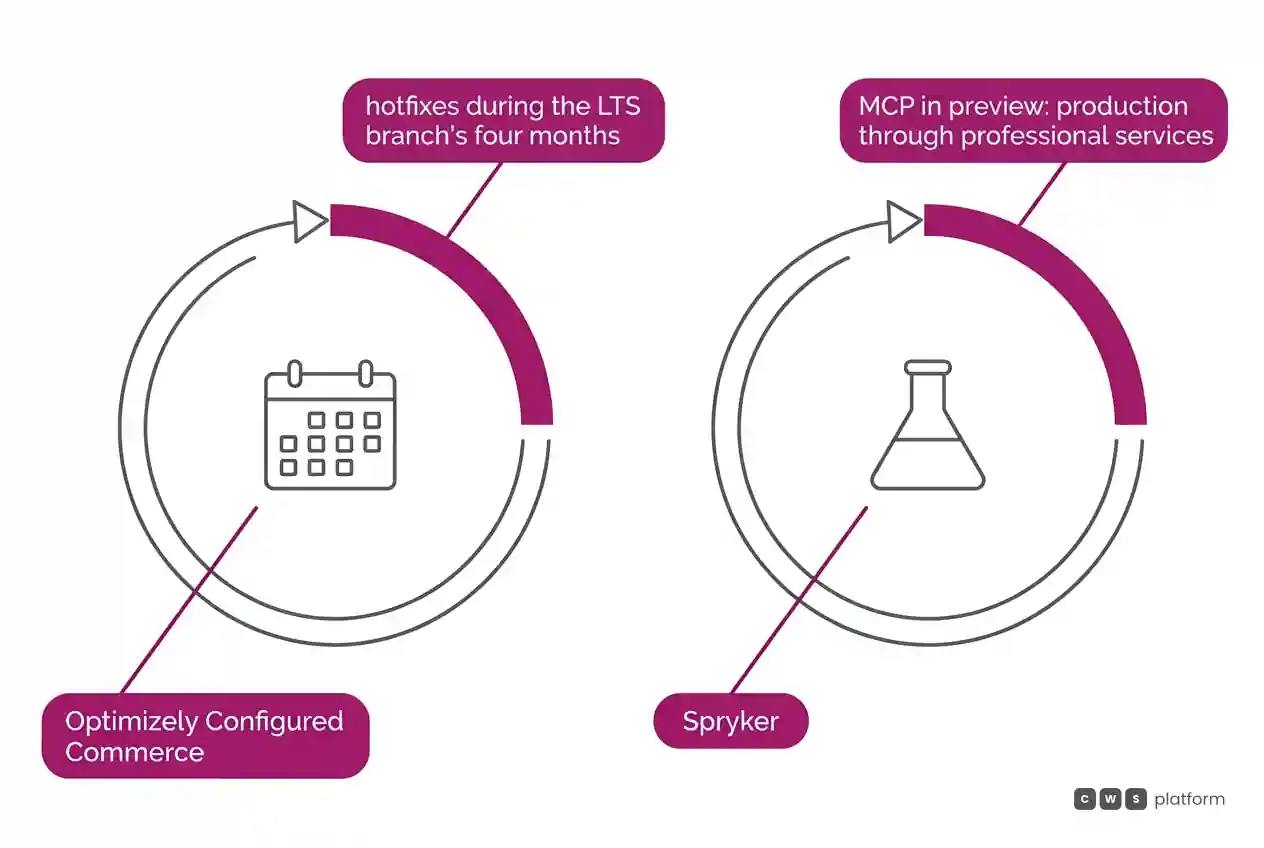
In Spryker, the order process is project code. Per the Order Management System guide, states, transitions, and events live in XML state machines, and commands and conditions are PHP plugins, which is where business rules and integrations connect. It is recorded in Spryker's documentation, on a page dated June 22, 2026, about the Commerce MCP Server: "It is intended for demonstration, evaluation, and prototyping. For a production rollout, engage Spryker professional services." (Commerce MCP Server page). It is worth asking whether MCP is in scope and who takes it to production.
When to choose Optimizely Configured Commerce
An ERP on the prebuilt connector list. As recorded in Optimizely's documentation, accessed on October 16, 2026, the connectors for SX.e, Prophet 21, Infor A+, Acumatica, and FACTS generate integration jobs when activated in the Admin Console (ERP connector implementation guide).
Integration that runs close to the ERP. The Windows Integration Service runs jobs inside the customer's network, and for cloud ERPs there is the internal WIS, which runs inside Configured Commerce.
Pricing and inventory that live in the ERP. The pricing and inventory service queries the ERP with caching and batched requests, and can return inventory in the same call as pricing.
Buying from the customer's procurement system. With PunchOut, the buyer leaves the procurement system for a Configured Commerce session, sees the catalog and negotiated prices, and the cart returns over cXML.
When to choose Spryker
One API per usage profile. The getting started with APIs guide splits Storefront, Back Office, Merchant, Data Exchange, and Async Event by actor and data consumption pattern.
Data endpoints with no code. The Data Exchange API creates endpoints, validations, and mappings from the Back Office, for bulk operations with ERP, PIM, OMS, and BI.
An order process your team designs. The Order Management System models states, transitions, and events, triggered automatically, manually, through an API, or by a timeout.
Pricing by business relationship. Merchant Custom Prices sets prices for each B2B customer's business units, from the Merchant Portal or the Back Office.
When neither fits
In some companies, commercial rules change faster than the team can rewrite integrations. For them there is a third model, described in the post on the three B2B commerce platform models: move commercial rules into the platform.
That is the CWS Platform model. The platform is API-first and headless, with REST APIs and webhooks, and tax calculation can be delegated to the tax engine the customer already uses. Price tables, rules, and contracts are configurable in the platform and can come from the ERP or CRM through APIs, and commercial policy is stored as parameters in CDL Workspace, configuration instead of code. The customer's credit limit is kept in the platform, granted in CDL Workspace or through the API, and every customer runs the same version. It comes to 11 modules, 6 AI Agents, and 1,029 parameters.
To read each vendor against that model, there are two comparisons: Optimizely Configured Commerce vs CWS Platform: who maintains the ERP integration? and Spryker or CWS Platform: where does customer pricing travel in the ERP integration?.
If the integration design still does not close with either one, it is worth talking to a CWS Platform specialist before choosing the architecture.
Frequently asked questions
Optimizely vs Spryker: which integrates better with the ERP?
It depends on the ERP and on who will maintain the bridge. Optimizely fits companies that run SX.e, Prophet 21, Infor A+, Acumatica, or FACTS, with a prebuilt connector and jobs generated by the platform, and records that those connectors are offered in their current state and do not support .NET 8. Spryker fits companies that want to integrate through APIs split by actor, such as the Data Exchange API, and records that Glue gets no new endpoints.
Who maintains the connectors?
In Optimizely Configured Commerce, Optimizely offers its existing connectors in their current state, and without .NET 8 support, adapting them is manual work on the open code provided to partners. In Spryker, the sources in this comparison do not document a prebuilt ERP connector: integration starts from the platform's APIs, and who writes and maintains the bridge to the ERP is a point to get in writing in the proposal.
How does the API work in each one?
In Optimizely, the Storefront and Admin APIs change shape with the .NET version: on .NET Core, Admin, Storefront, and Integration become separate applications behind a reverse proxy. In Spryker, the APIs are split by actor, each with its own credentials, and the Symfony-based API Platform replaces Glue, which gets fixes but no new endpoints.
Which one requires more version upgrades?
The sources do not allow measuring that. In Optimizely, each LTS branch gets hotfixes for four months, and switching branches goes on your team's calendar. In Spryker, Glue gets fixes but no new endpoints while the API Platform replaces it, and the Commerce MCP Server is intended for demonstration and prototyping, with production rollouts directed to professional services.
Brands mentioned in this article


- Optimizely
- Salesforce
Trademarks and logos belong to their respective owners. Mention does not imply partnership or endorsement.
"responsive, technically engaged, and willing to work through complex commercial rules (negotiated pricing, credit, customer-specific conditions) rather than pushing generic answers"
Is integration holding your operation back?
Request an assessment of your operation or talk straight to a specialist, whichever you prefer.
I'd rather get the next articles on ERP integration
A weekly roundup of new articles on ERP integration, only in weeks when there is one. No spam, and you can leave in one click.