SAP Commerce Cloud vs Adobe Commerce: what drives the three-year cost?
Through a CFO lens: what goes into the license measurement and what it costs to stay on a supported version, on both sides.

Editorial note: CWS Platform competes with both SAP and Adobe. This comparison uses only each vendor's public documentation, with the address next to each fact and the date of each record cited.
Short answer: SAP Commerce Cloud (Hybris) fits companies that already run SAP's ERP and want contracts, quotes, and pricing tied to it, billed in blocks of orders per year or by GMV. Adobe Commerce (Magento) fits companies that want to choose between SaaS, PaaS, and open source and add B2B as an extension. In both, the three-year cost depends on the measured volume and on the cost of staying on a supported version.
For a CFO choosing between SAP Commerce Cloud and Adobe Commerce, the decision is rarely about features: both handle B2B with company accounts, quotes, and approvals. What moves the three-year model are two lines worth opening up in the proposal: what counts as volume when the license is measured, and what it costs to keep the store on a version the vendor still accepts. The broader map is in our post on the three B2B commerce platform models, and the other comparisons are in the comparisons hub.
SAP Commerce Cloud and Adobe Commerce side by side
The table summarizes what each vendor's documentation records on the eight points that matter in B2B.
| point | SAP Commerce Cloud | Adobe Commerce |
|---|---|---|
| Platform model | Modular platform on public cloud (version 2211), extended through extensions and AddOns | Three options: multi-tenant SaaS, single-tenant PaaS, and Commerce Optimizer; Magento Open Source is open source |
| Native B2B or extension | Account-based buying, customer-specific catalogs, and multi-step approval | B2B extension installed and enabled in the store, which keeps serving B2C |
| Customer and contract pricing | Contract prices in the buyer's account; prices and discounts replicated from SAP S/4HANA or SAP ERP | Shared catalogs with per-product pricing for each company or customer group |
| Quotes | Quotes converted to orders by the buyer; RFQ through SAP CPQ via SAP Cloud Integration | Quote opened by the buyer from the cart or by the seller in the Admin |
| Credit and payment terms | Not documented in the sources for this comparison | Credit access set by role in the company account; buyers track company credit in the portal |
| ERP integration | SAP Commerce Cloud Integration with ERP package; cloud ERP edition with connectivity managed by SAP | REST and GraphQL APIs, App Builder, and back-office integration starter kits |
| Billing model | Blocks of 50,000 orders per year or GMV | Pricing page with three options; under managed services, consumption quotas in the Sales Order |
| Deployment | Builds from a Git repository and a build manifest in the Cloud Portal | SaaS with automatic updates, dedicated PaaS, or a service managed by Adobe |
Pricing and commercial rules: where the rule lives and who maintains it
In SAP Commerce Cloud, promotions run on a rule engine that combines extensible conditions and actions, according to the payments and promotions page. Catalog prices can be replicated from SAP ERP or SAP CRM, without calling the back end on every page; to do that, the documentation on activating catalog pricing requires turning off the "Synchronous Pricing for Catalog" setting and running delta uploads after every change.
In Adobe Commerce, the store administrator decides what each buying company can use (payment methods, price levels, quote negotiation, and requisition lists), according to Adobe Commerce's B2B introduction. Shared catalogs apply per-product pricing to companies or customer groups, as long as the store is set up for company accounts.
For the CFO, the question is not which engine is more complete, but who maintains the rule after go-live and which line of the model carries that work: internal team, systems integrator, or an additional license. Ask for the answer in writing, with estimated hours per month.
Quotes and assisted selling
In SAP Commerce Cloud, the service agent works in the same storefront interface customers use, according to the Assisted Service Module documentation. Complex quoting involves three pieces: the buyer opens an RFQ, the cart is locked and sent through SAP Cloud Integration to SAP CPQ, and the quote edited by the sales rep returns to Commerce and, once accepted, becomes an order that goes to SAP S/4HANA, as the quote-to-cash integration course describes.
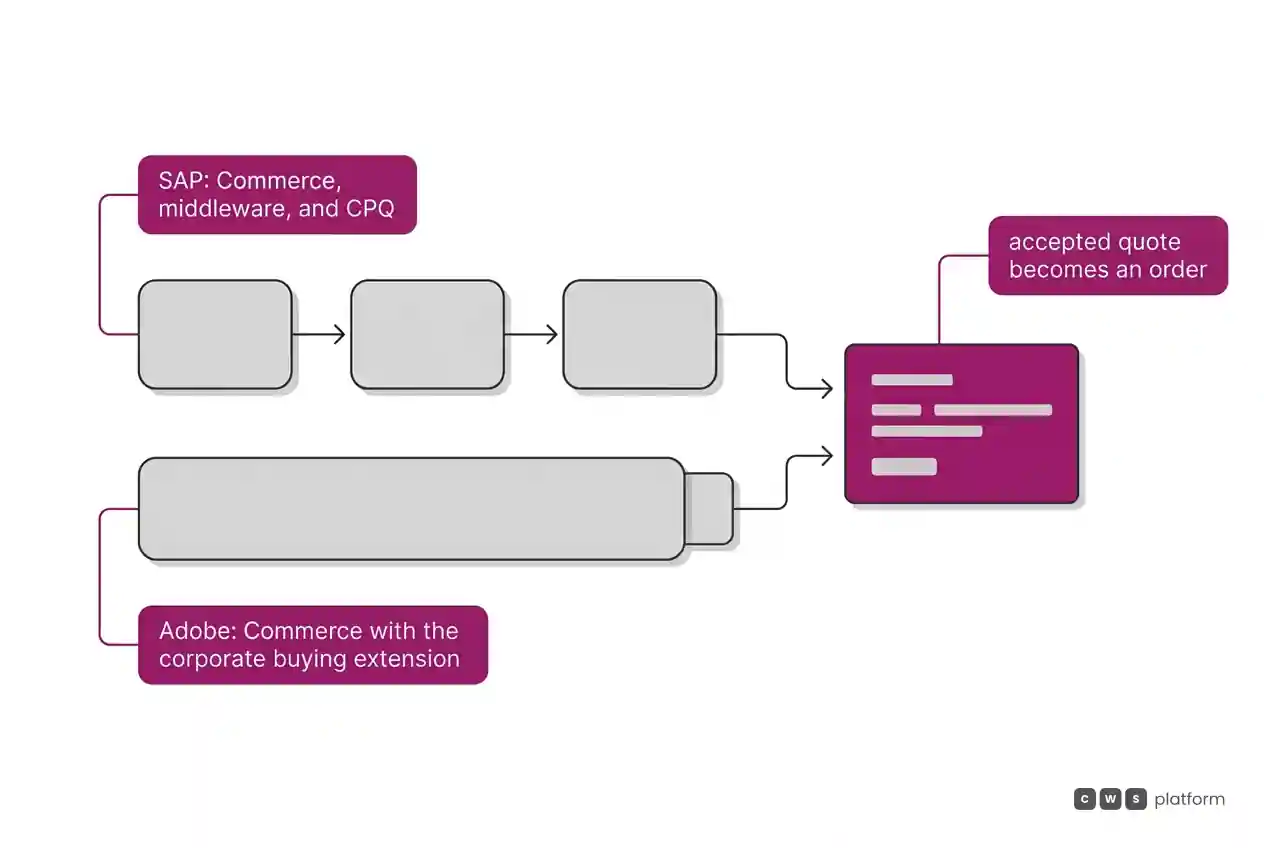
In Adobe Commerce, authorized buyers start a quote from the cart and sellers from the Admin; both sides change items, request discounts, and exchange messages until they agree, according to the B2B introduction. With purchase orders enabled, every company order becomes a PO and can go through several approval rules.
For the CFO, the difference is the number of pieces: at SAP, Commerce, middleware, and CPQ; at Adobe, Commerce with the B2B extension. Ask which pieces are in the proposal and which are contracted separately.
ERP integration
At SAP, price and discount replication from SAP S/4HANA or SAP ERP runs on SAP Cloud Integration, with the "SAP Commerce Cloud Integration with ERP" package, according to the price replication documentation. In the cloud ERP edition, connectivity is managed by SAP itself, and prices, inventory, and order status are read from SAP Cloud ERP as the source of truth.
At Adobe, the storefront talks over GraphQL and REST APIs integrate third-party software, according to the developer documentation. Extensions and integrations can use App Builder, API Mesh, webhooks, and events, with starter kits for checkout, back office, payments, tax, and shipping, as the Adobe Commerce pricing page records.
In the model, integration shows up in different places: for companies already on SAP's ERP, part of it comes as a product; at Adobe, it is built on APIs and kits, inside the project. Ask both vendors who maintains the connector with each new version.
Cost and billing model: what goes into the measurement
The SAP Commerce Cloud plans and pricing page records billing in blocks of 50,000 orders per year or by GMV. Recorded in SAP's documentation, in the SAP Commerce Cloud supplement dated March 2026: returns, refunds, and cancellations do not reduce the GMV counted toward the license ("will not reduce the GMV amount", SAP Commerce Cloud contract supplement).
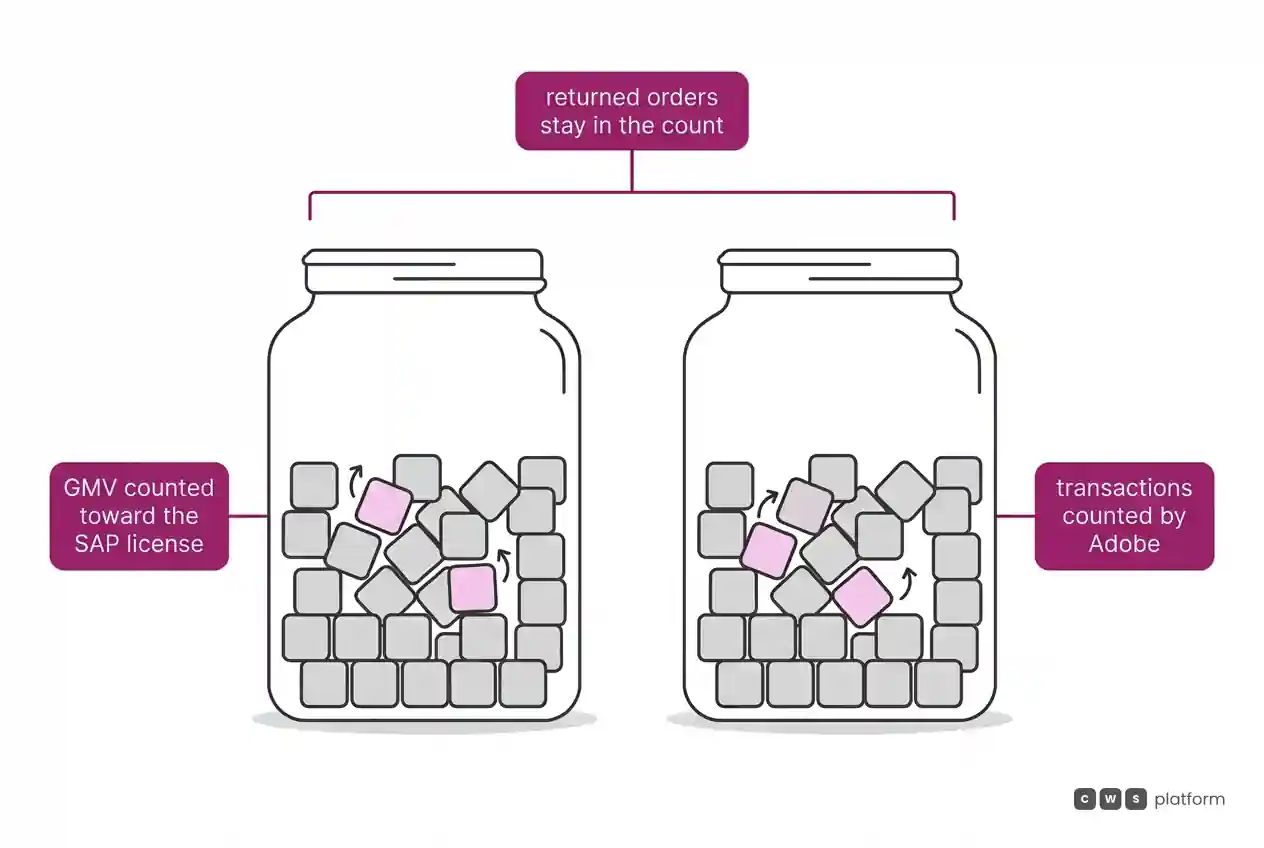
At Adobe, the pricing page separates three options. Under managed services, consumption quotas (vCPU days, storage, CDN transfer, and store views) are set in the Sales Order, and the observability quota changes by GMV tier, according to the managed services description. Recorded in Adobe's documentation, in a page dated April 30, 2026: the Adobe Commerce on Cloud product description states that every accepted order counts as a transaction, even if it is later refunded, returned, or charged back ("even if such order is later subject to a refund, return, chargeback", Adobe Commerce on Cloud product description).
Both records lead to the same question: the measurement looks at the accepted order, not the order that stayed. In B2B, with lot returns, item exchanges, and orders canceled for declined credit, the gap between accepted volume and net volume can matter. Build volume scenarios with your historical return rate and ask both vendors, in writing, which metric the contract uses and what happens when volume exceeds the contracted tier.
Deployment and maintenance: the price of staying on a supported version
SAP Commerce Cloud builds the store from a Git repository and a build manifest with extensions, properties, and tests, according to the About SAP Commerce Cloud page. Recorded in SAP's documentation, in a page dated September 9, 2026: the Cloud Portal does not allow builds against an update release that is no longer listed as current ("The Cloud Portal will not allow builds against an update release no longer listed", SAP Commerce Cloud update release notes).
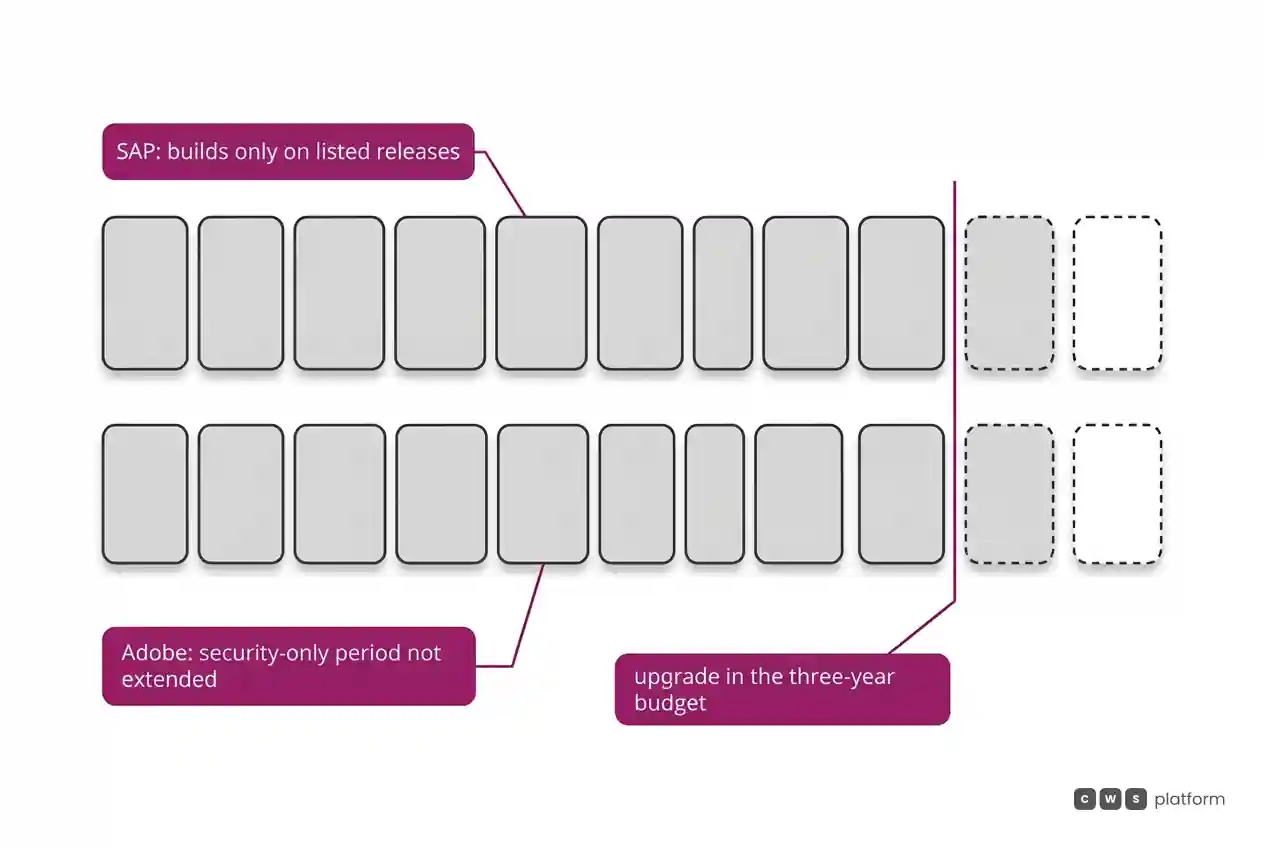
At Adobe, Adobe Commerce as a Cloud Service is SaaS with automatic feature and security updates, and Adobe Commerce on Cloud runs on dedicated PaaS infrastructure, according to the pricing page. Recorded in Adobe's documentation, in a page dated September 18, 2026: the lifecycle policy states that the security-only transitional period for versions 2.4.4, 2.4.5, and 2.4.6 is a one-time exception and will not be extended beyond the published dates ("The security-only transitional period is a one-time exception.", Adobe Commerce lifecycle policy).
In both cases, standing still has a deadline, and the upgrade becomes a line in the three-year budget, with hours, an owner, and a window. In each demo, ask how many mandatory updates fall within the contract term and who performs each one.
When to choose SAP Commerce Cloud
Companies already on SAP's ERP. The cloud ERP edition has connectivity managed by SAP and reads price, inventory, and order status from SAP Cloud ERP.
Contract-based corporate buying. The same page records customer-specific catalogs, quote-to-order, direct buying against contracts, bulk uploads, and approvals.
High-complexity quoting. SAP CPQ controls discounts with guardrails and handles quotes with more than 10,000 lines.
When to choose Adobe Commerce
Choice of deployment. The pricing page offers multi-tenant SaaS, dedicated PaaS, or Commerce Optimizer attached to another transaction engine.
B2B and B2C on one platform. The B2B extension runs alongside B2C, with company accounts, quotes, and purchase orders with approvals, according to the B2B introduction.
Operations handed to the vendor. Under managed services, Adobe owns instance provisioning, network, CDN, backup, and scaling, with a 99.99% infrastructure SLA and a 99.9% application SLA.
When neither fits
SAP Commerce Cloud and Adobe Commerce are storefront platforms that take on B2B: one tied to SAP's ERP, the other extended through an extension. Our post on the three B2B commerce platform models describes a third path: moving commercial rules into the platform.
That is the CWS Platform model. Pricing is a platform license plus an integration license, with no percentage of sales or GMV. All customers run the same version. Price tables, rules, and contracts are configurable in the platform and can come from the ERP or CRM through APIs, and commercial policy is stored as parameters in the CDL Workspace, configuration instead of code. The platform includes 11 modules, 6 AI Agents, and 1,029 parameters.
How each vendor compares with that model is covered in SAP Commerce Cloud vs. CWS Platform: Does Your License Scale with Sales Volume? and Adobe Commerce vs CWS Platform: Do Returned Orders Count Toward Licensing?. If the three-year model still does not close, talk to a CWS Platform specialist and build it with your real volume and returns.
Frequently asked questions
SAP Commerce Cloud or Adobe Commerce: which costs less over three years?
It depends on two variables the proposals need to disclose: the volume that goes into the measurement and the cost of upgrades during the term. SAP Commerce Cloud is billed in blocks of orders per year or by GMV, and Adobe's pricing page separates three deployment options. The sources for this comparison do not include prices, so the comparison only closes with both proposals in the same model.
How does each one bill for the license?
SAP's pricing page records blocks of 50,000 orders per year or GMV. At Adobe, the pricing page separates SaaS, PaaS, and Commerce Optimizer, and managed services list vCPU, storage, CDN, and store view quotas in the Sales Order.
Do returns and cancellations count?
According to both records, yes. SAP's supplement states that returns, refunds, and cancellations do not reduce the GMV counted toward the license, and Adobe's product description states that every accepted order counts as a transaction, even if it is later returned, refunded, or charged back.
What happens when a version goes out of support?
At SAP, the Cloud Portal does not allow builds against an update release that is no longer listed as current. At Adobe, the security-only period for versions 2.4.4, 2.4.5, and 2.4.6 is a one-time exception and will not be extended. In both, the upgrade needs to be in the budget.
Brands mentioned in this article

 Magento
- SAP Commerce Cloud
- Adobe Commerce
Trademarks and logos belong to their respective owners. Mention does not imply partnership or endorsement.
"responsive, technically engaged, and willing to work through complex commercial rules (negotiated pricing, credit, customer-specific conditions) rather than pushing generic answers"
Is selling more not turning into margin?
Request an assessment of your operation or talk straight to a specialist, whichever you prefer.
I'd rather get the next articles on margin and discounts
A weekly roundup of new articles on margin and discounts, only in weeks when there is one. No spam, and you can leave in one click.