commercetools vs SAP Commerce Cloud: where do orders meet the ERP?
The API your team integrates or the suite that already speaks SAP: through the CIO lens, where B2B orders and prices meet the ERP in each.

Editor's note: CWS Platform competes with both commercetools and SAP. This comparison uses only each vendor's public documentation, with the source address next to each fact and the date of each record cited.
Short answer: commercetools fits the team that wants B2B commerce delivered as APIs and prefers to write its own bridge to the ERP, in applications the platform hosts. SAP Commerce Cloud fits companies already running SAP S/4HANA or SAP Cloud ERP that want to use SAP's integration flows, with pricing, quoting and orders passing through SAP components. The difference shows up where B2B orders and prices meet the ERP.
For the CIO, this choice starts with who writes and who maintains the bridge between the B2B order and the ERP. On commercetools, your team writes the applications that move orders, prices and master data back and forth. On SAP Commerce Cloud, the bridge is a set of SAP packages, and your team configures and extends what already exists. The decision is where to spend the effort.
The broader map is in our post on the three B2B commerce platform models, and the other head-to-heads are in the comparisons hub.
commercetools and SAP Commerce Cloud side by side
The table summarizes what each vendor's documentation records; where the source does not cover a point, the cell says so.
| criterion | commercetools | SAP Commerce Cloud |
|---|---|---|
| Platform model | B2B Commerce package, with Merchant Center and REST and GraphQL APIs | Modular platform on public cloud (version 2211), with extensions, AddOns and OCC APIs |
| Native B2B or extension | Native in the package: Business Units, Associate Roles, Approval Rules and Quotes | Self-service with account-based buying, customer-specific catalogs and multi-step approval |
| Customer and contract pricing | Standalone Prices by currency, country, Customer Group or channel, with quantity tiers | Prices and discounts replicated from SAP S/4HANA or SAP ERP, using the ERP's condition types |
| Quoting | Quote Request, Staged Quote and Quote, with renegotiation | Request for Quote from the storefront, handled in SAP CPQ through SAP Cloud Integration |
| Credit and payment terms | Not documented | Not documented |
| ERP integration | Project applications on Connect, a managed runtime, plus the asynchronous Import API | SAP Commerce Cloud Integration with ERP package; cloud ERP edition with SAP-managed connectivity |
| Billing model | B2B Commerce license package; billing basis outside this comparison | SAP Commerce Cloud license; billing basis outside this comparison |
| Implementation | Integrations written by your team and published to Connect from a Git repository | Build from a Git repository and build manifest; decoupled Angular storefront |
Pricing and commercial rules: where B2B prices are calculated
On commercetools, price is data written and read through APIs. According to commercetools' pricing documentation, a Standalone Price lives outside the product, tied to the variant by SKU, scoped by currency, country, Customer Group or channel, with quantity tiers. If contract pricing originates in the ERP, the project's integration application translates it into that model.
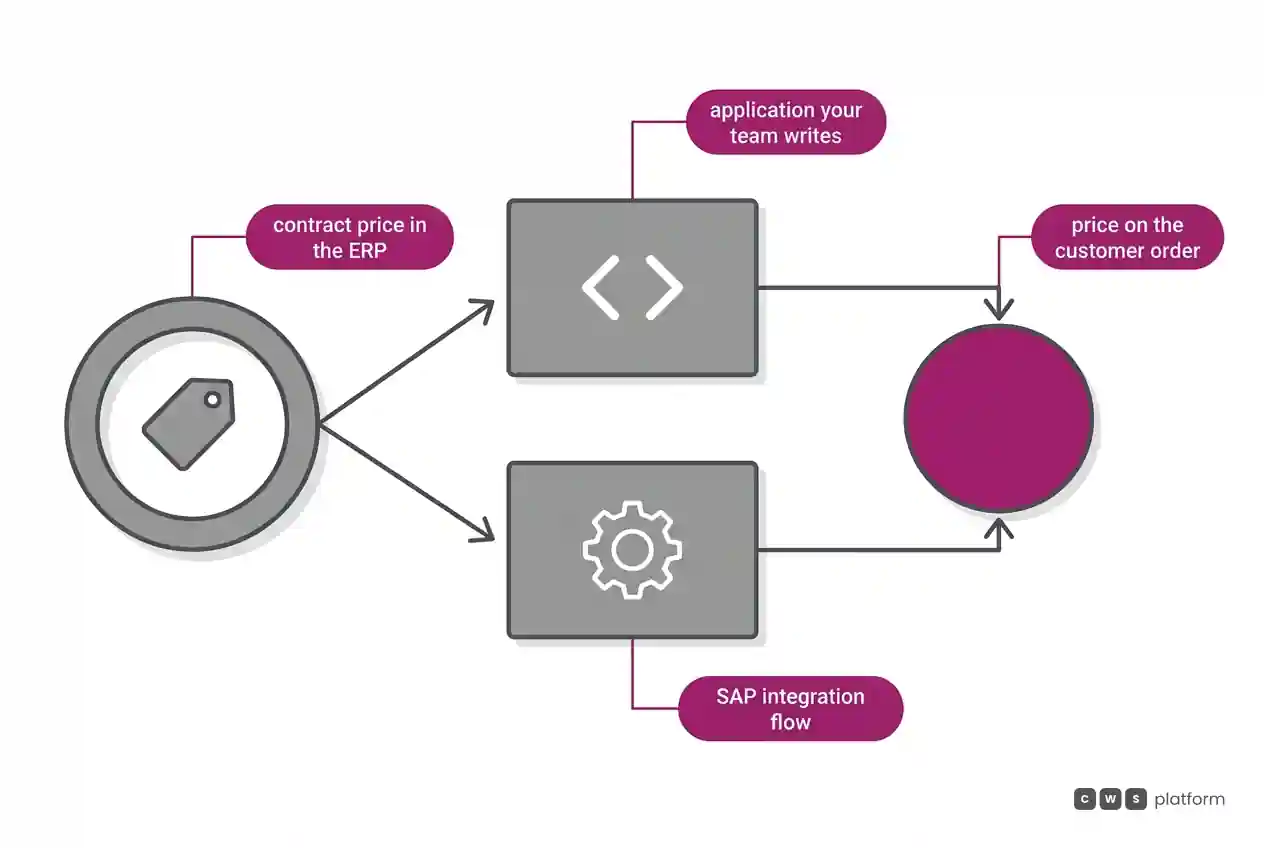
On SAP Commerce Cloud, the standard path is to bring prices over from the ERP. According to the price and discount integration documentation, replication from SAP S/4HANA or SAP ERP runs in SAP Cloud Integration flows and maps the ERP's own price and discount condition types. Recorded in SAP's documentation, on a page dated June 23, 2026, about the Calculation SPI, the interface that hands pricing and tax to external services: "This includes any scenarios outside the standard B2C cart and checkout flow unless additional custom implementation is provided." (SAP Commerce Cloud Calculation SPI). Per the same page, the interface covers the B2C cart without customization, and the B2B flow requires development. It is worth asking in the demo how much of that work is in the project scope.
Quoting and assisted selling
On commercetools, according to the Quotes overview, the buyer creates a Quote Request from the cart; the seller builds a Staged Quote, adjusts items, discounts and validity, and sends a binding Quote, which the buyer accepts, rejects or asks to renegotiate. Assisted Selling lets the sales rep take over and lock the customer's cart in the Merchant Center.
On SAP Commerce Cloud, complex quoting runs through SAP CPQ: according to the integration overview, the buyer's Request for Quote locks the cart and travels through SAP Cloud Integration to CPQ, carrying the customer's ERP code; once edited by the seller, the quote returns to Commerce and, if accepted, becomes an order that flows to S/4HANA. The Assisted Service Module puts the agent in the same storefront interface the customer uses.
ERP integration: where the order travels
On commercetools, the integration is a project application running on Connect, a managed runtime with application types for synchronous calls, events and scheduled jobs. Recorded in commercetools' documentation, accessed on October 16, 2026: "The source code of Connect applications must be saved in a GitHub repository and have a Git tag that refers to a specific release." (Connect overview). It is worth asking in the demo how that fits your team's repository and release policy.
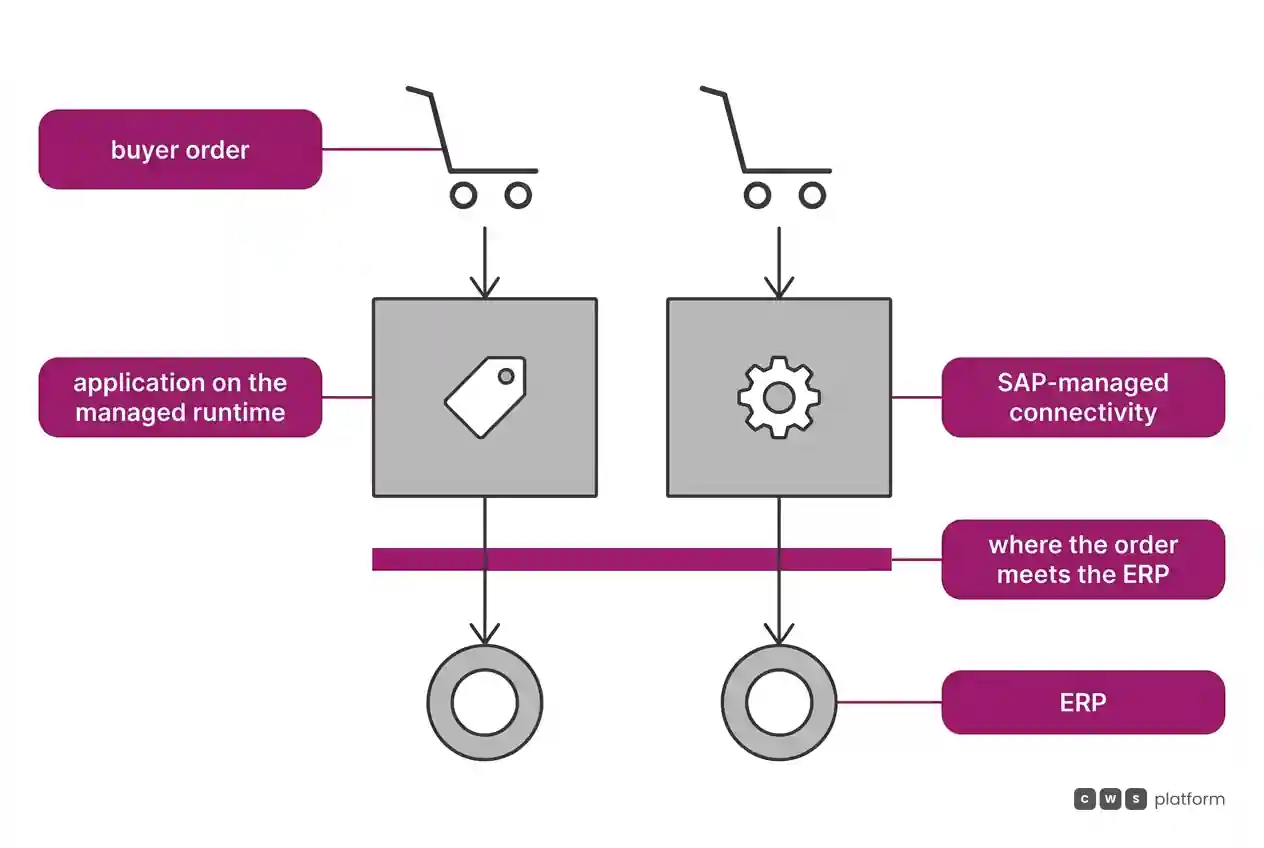
On SAP Commerce Cloud, the cloud ERP edition runs on connectivity managed by SAP and reads prices, stock availability and order status from SAP Cloud ERP as the source of truth. For orders created synchronously in S/4HANA, it is recorded in SAP's documentation, on a page dated September 9, 2026: "Multiple B2B cost centers aren't supported.", "Account payment type is the only supported payment type." and "Orders created synchronously have no persistency in the SAP Commerce system." (synchronous order creation with SAP S/4HANA). It is worth asking in the demo whether your flow uses more than one cost center per buyer and where an order created that way can be looked up.
Cost and billing model: what the bridge consumes
On commercetools, integration applications run on Connect, with no customer-owned servers; the cost that stays with your team is writing and maintaining each application, with testing every time the ERP changes.
On SAP Commerce Cloud, price replication and the hand-off of quotes to SAP CPQ run through SAP Cloud Integration, and the ERP integration package provides extension points before and after processing; the cost that stays with your team is configuring, extending and testing those flows when commercial rules depart from the standard.
The billing basis of each license is outside this comparison. In the proposal, one question applies to both: are the integration runtime, the middleware and quoting part of the base contract or separate line items?
Implementation and maintenance: who maintains the bridge code
On commercetools, batch loads coming from the ERP use the Import API, which is asynchronous and accepts up to 20 resources per call. Recorded in commercetools' documentation, accessed on October 16, 2026: "the resource-specific import endpoints remain in public beta" (Import API overview). It is worth asking in the demo which endpoints the project will use and what stage each one is in.
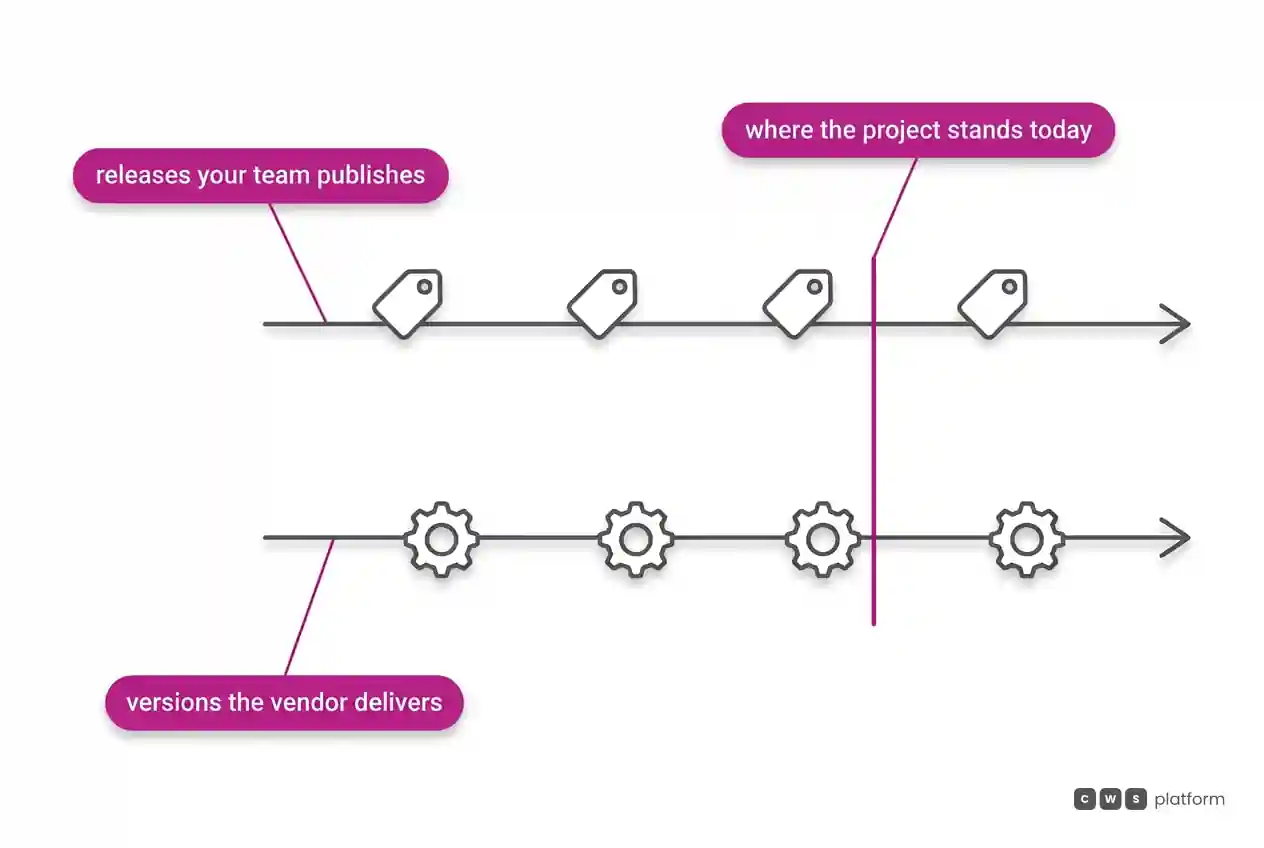
The commercetools B2B storefront template, if adopted, is copied into the customer's repository and maintained by the developer, according to the launchpads overview.
On SAP Commerce Cloud, the platform runs on public cloud at version 2211, and the build reads a Git repository with a build manifest, according to the SAP Commerce Cloud architecture documentation. The Composable Storefront, built in Angular, talks to the back end through OCC APIs and can be hosted outside SAP. The cloud ERP edition follows the clean core model, and SAP announces a standard implementation of about 12 weeks in its post on SAP Commerce Cloud for ERP.
When to choose commercetools
A team that wants to integrate through APIs and pick its own architecture. The B2B Commerce package delivers Business Units, Associate Roles, approvals and Quotes as REST and GraphQL APIs.
Contract pricing treated as data. The Standalone Prices reference describes price as a resource of its own, with quantity tiers.
Integration applications without your own servers. Connect publishes each application privately to the project or, once certified, on the Connect marketplace.
Quotes that work as offers. Per the Quotes overview, a sent Quote is a binding offer that cannot change after sending, and renegotiation produces a new Quote.
When to choose SAP Commerce Cloud
Companies already running SAP S/4HANA or SAP Cloud ERP. The cloud ERP edition connects commerce to the ERP with SAP-managed connectivity, with master data, contract pricing and invoices synchronized, according to SAP's post on the edition.
Pricing that follows the ERP's conditions. The ERP integration package replicates prices and discounts using the ERP's own condition types.
Quotes with many lines and discount rules. SAP CPQ applies eligibility rules and discount guardrails to quotes of more than 10,000 lines.
Corporate buyers in self-service. The same SAP post describes account-based buying, customer-specific catalogs, multi-step approval, bulk upload and quick reorder.
When neither fits
There is a third model, described in our post on the three B2B commerce platform models: neither writing the whole bridge to the ERP yourself nor adopting the bridge designed by the ERP vendor, but moving the commercial rules into the platform, connected to the ERP through APIs.
That is the CWS Platform model. Commercial policy is stored as parameters in the CDL Workspace: configuration instead of code. Price lists, rules and contracts are configurable in the platform or arrive from the ERP and CRM through APIs. The architecture is API-first and headless, with REST APIs and webhooks, and every customer runs the same version. It has 11 modules, 6 AI Agents and 1,029 parameters.
To read each vendor against that model, there are two comparisons: commercetools vs CWS Platform: the cost of maintaining integrated commercial logic and SAP Commerce Cloud vs CWS Platform: integration cost and API architecture.
If neither way of connecting orders and prices to the ERP fits the team you have, it is worth talking to a CWS Platform specialist before you settle the architecture.
Frequently asked questions
commercetools vs SAP Commerce Cloud: which is better for B2B?
It depends on where you want the bridge to the ERP: commercetools fits companies that want B2B commerce as APIs and have a team to write the applications on Connect. SAP Commerce Cloud fits companies already running S/4HANA or SAP Cloud ERP that want the integration, CPQ and self-service that SAP connects to the ERP.
Which integrates better with SAP S/4HANA?
SAP Commerce Cloud has the vendor's own path: the integration package on SAP Cloud Integration and the cloud ERP edition; for synchronous orders, the documentation records that multiple B2B cost centers are not supported and that only the Account payment type is accepted. On commercetools, the S/4HANA integration is an application your team writes and publishes to Connect, whose code, the documentation records, must sit in a GitHub repository with a release tag.
Who builds the ERP integration in each?
On commercetools, the project team writes the integration applications and publishes them to Connect, which hosts them. On SAP Commerce Cloud, SAP delivers the flows on SAP Cloud Integration and the connectivity of the cloud ERP edition, and the team configures and extends them through the extension points provided.
Which requires more development for B2B pricing and orders?
Both record project work, in different places. On SAP Commerce Cloud, the documentation records that the Calculation SPI, which hands pricing and tax to external services, needs custom implementation outside the standard B2C flow. On commercetools, contract pricing coming from the ERP depends on the application your team writes, and the resource-specific import endpoints remain in public beta, as the documentation records.
Read next
Brands mentioned in this article


- SAP Commerce Cloud
Trademarks and logos belong to their respective owners. Mention does not imply partnership or endorsement.
"responsive, technically engaged, and willing to work through complex commercial rules (negotiated pricing, credit, customer-specific conditions) rather than pushing generic answers"
Is integration holding your operation back?
Request an assessment of your operation or talk straight to a specialist, whichever you prefer.
I'd rather get the next articles on ERP integration
A weekly roundup of new articles on ERP integration, only in weeks when there is one. No spam, and you can leave in one click.