Integration Maintenance Costs: SAP Commerce Cloud vs CWS Platform in API Architecture
An architectural comparison for engineering leaders on structuring data contracts, business rules, and ERP integrations.

Editorial note: architectural comparison between SAP Commerce Cloud and CWS Platform, written for technology leaders and CTOs. Every fact regarding SAP Commerce Cloud comes from its public documentation, referenced alongside.
For engineering leadership, evaluating an enterprise commerce platform goes far beyond the digital storefront or the public product catalog: the real cost lies in technical coupling, integration contract design, and the technical debt accumulated with every business rule change. When analyzing SAP Commerce Cloud from a systems architecture perspective, the central challenge is the engineering effort required to synchronize transactional data across the ERP, business rules engine, and sales channels without turning the enterprise landscape into a rigid monolith.
When the core system of record is forced to act as a real-time customer experience engine, latency bottlenecks and heavy dependencies on complex integration pipelines inevitably arise. The common enterprise complaint, "Every minor change requires six months of IT backlog," captures this structural friction. It explains why many organizations choose to decouple commercial governance from the system of record rather than routing every pricing or policy update through the ERP development queue.
In this context of technical scalability and governance, Gartner, 2020 highlights that poor data quality costs organizations an average of at least $12.9 million annually. Understanding how each architecture handles data contracts, service calls, and business logic validations is critical to assessing total cost of ownership and the long-term sustainability of integrations across operational lifecycles.
What SAP Commerce Cloud Solves Well
SAP Commerce Cloud provides a mature enterprise infrastructure built for environments requiring native alignment with SAP ecosystem instances. Operating in the public cloud on release 2211, the platform relies on extensions and AddOns that encapsulate business logic and data types. Deployment orchestration is centralized via Cloud Portal, which connects Git repositories and processes build manifests containing properties, aspects, and pre-defined extensions to compile enterprise environments.
Transactional data exposure and consumption occur primarily through the Omni Commerce Connect (OCC) layer, exposing commerce services and data via REST. This architecture decouples the presentation layer from backend data infrastructure, supporting headless front-end applications such as composable storefront built on Angular. Furthermore, enterprises with structured editorial approval workflows benefit from Product Content Management (PCM), which enforces strict isolation between Staged and Online catalog versions, supporting formal publishing governance through the Backoffice Cockpit.
For distributed inventory and order orchestration, the platform integrates with SAP Order Management for Sourcing and Availability to manage reservations and stock visibility. In enterprise implementations, ingesting master data and inventory positions from the ERP requires dedicated integration layers, such as Data Ingestion for Industry Cloud Solutions, structuring consolidated operational data flows.
Where the Architectures Diverge
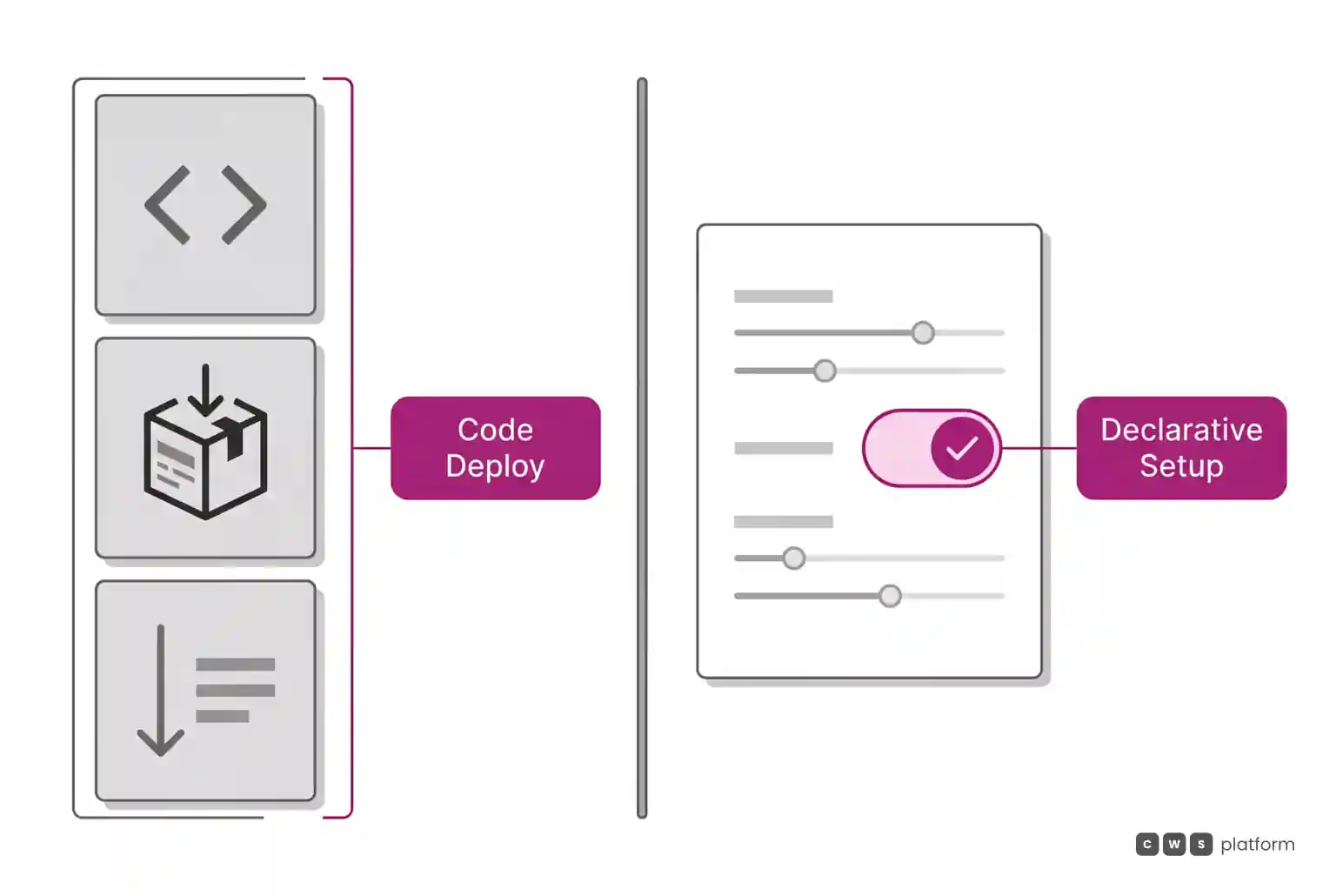
The fundamental architectural divergence lies in code dependency and build pipeline requirements when executing commercial changes. In SAP Commerce Cloud, select commercial policies are configurable: rule-based promotions combining visual conditions and actions, coupon management, and a payment framework featuring low-code/no-code tooling. Logic falling outside these core modules, such as custom business logic and new data types, must be packaged as an extension, version-controlled in Git, and deployed via build manifests in Cloud Portal. Conversely, CWS Platform leverages a deterministic layer built on the Commerce Rules Engine (CDL Workspace), allowing teams to configure and adjust business rules, approval thresholds, and trade policies directly within an administrative console without triggering a software deployment.
For inventory, when SAP Commerce Cloud pairs with SAP Order Management for Sourcing and Availability, ERP master data and stock ingestion run through Data Ingestion for Industry Cloud Solutions. On the product detail page, stock availability defaults to the cached Product OCC API; real-time lookups via the ProductAvailabilities API require enabling specific storefront properties (SAP Help). In CWS Platform, Distributed Inventory (Inventory Hub) ingests ERP stock levels via API, applying immediate updates by warehouse location and Stock ID, and broadcasts inventory via API and webhooks; bulk ERP loads are handled via scheduled queues.
Regarding price calculation, SAP Commerce Cloud documents three primary paths: synchronous backend lookups, price and discount table replication from SAP ERP or SAP CRM via delta uploads, or composable pricing engines like SAP Omnichannel Promotion Pricing. In CWS Platform, Contextual Pricing (Pricing Engine) resolves net pricing natively using a contract > rule > price list hierarchy, evaluating account profiles, operating subsidiaries, order volume, shipping jurisdictions, and active customer agreements; line-item taxes can be resolved directly via real-time ERP tax calculation APIs prior to order submission.
SAP's own documentation records two limits that weigh on this cost:
- limitation recorded in the vendor's documentation on June 23, 2026: the Calculation SPI, which delegates price and tax to external services, covers only the B2C cart without customization, and the B2B flow requires development ("This includes any scenarios outside the standard B2C cart and checkout flow unless additional custom implementation is provided.", https://help.sap.com/docs/SAP_COMMERCE_CLOUD_PUBLIC_CLOUD/e1391e5265574bfbb56ca4c0573ba1dc/20c9ed7bbf6d427a9ab006602be3b637.html?locale=en-US&state=PRODUCTION&version=v2211).
- limitation recorded in the vendor's documentation on September 9, 2026: in synchronous order creation with S/4HANA there are no multiple B2B cost centers, only the Account payment type is accepted, and the order is not stored in Commerce ("Multiple B2B cost centers aren't supported.", "Account payment type is the only supported payment type.", "Orders created synchronously have no persistency in the SAP Commerce system.", https://help.sap.com/docs/SAP_COMMERCE_INTEGRATIONS/47ad58c1a27447949aad8addbee46fca/dd3c227d5863456c9e6d242c06adbf52.html?locale=en-US&state=PRODUCTION&version=2211).
| Architectural Decision | SAP Commerce Cloud (Documented Mechanism) | CWS Platform |
|---|---|---|
| Where trade policy and business logic are executed | Promotions and coupons via UI configuration; business logic outside these modules requires custom extensions deployed via Cloud Portal build manifests | Declarative parameters in CDL Workspace, updated via admin console without software deployments |
| How distributed inventory is ingested and synchronized | Via SAP Order Management for Sourcing and Availability, ingesting ERP data through Data Ingestion; storefront reads from cached Product OCC API or, if enabled, real-time ProductAvailabilities API | Receives stock balances via API (instant discrete updates, scheduled queue for bulk batches) and distributes via Stock ID using API and webhooks |
| How contextual pricing is calculated for transactions | Synchronous backend query, delta-upload table replication from ERP, or composable engines (SAP Omnichannel Promotion Pricing) | Resolves pricing dynamically per transaction via contract > rule > price list hierarchy, evaluated by shipping origin and location; tax calculations query the ERP API |
| How buyers and sales reps collaborate on orders | The Assisted Service Module allows representatives to navigate the customer storefront session on their behalf, including SSO launch from SAP CRM Interaction Center | Sales reps and buyers collaborate within the same shared cart, refreshed on page reload, with integrated quote negotiation and discount approval thresholds |
| Pricing structure and commercial licensing model | Billed in blocks of 50,000 orders/year or based on GMV | Platform licensing and infrastructure consumption, with no percentage-of-transaction fees in the standard tier |
The engineering decision is not about labeling one platform superior to the other, but choosing where to place system coupling: within a pipeline-dependent extensible framework or inside an API-driven deterministic rules engine.
What Changes in Operations, Through a CTO Lens
From an engineering operations standpoint, running an enterprise commerce stack requires monitoring the downstream cost of data discrepancies and unconstrained compute calls. The common operational complaint, "The portal shows inventory we do not actually have," stems from batch replication delays between the ERP and digital sales channels. Falling back on spreadsheets and manual checks to resolve these integration gaps exposes the business to severe operational risk: University of Hawaii research (R. Panko) / arXiv, 2000 shows that spreadsheet audits consistently identify material errors in at least 86% of analyzed operational workbooks, underscoring the fragility of non-automated workflows.
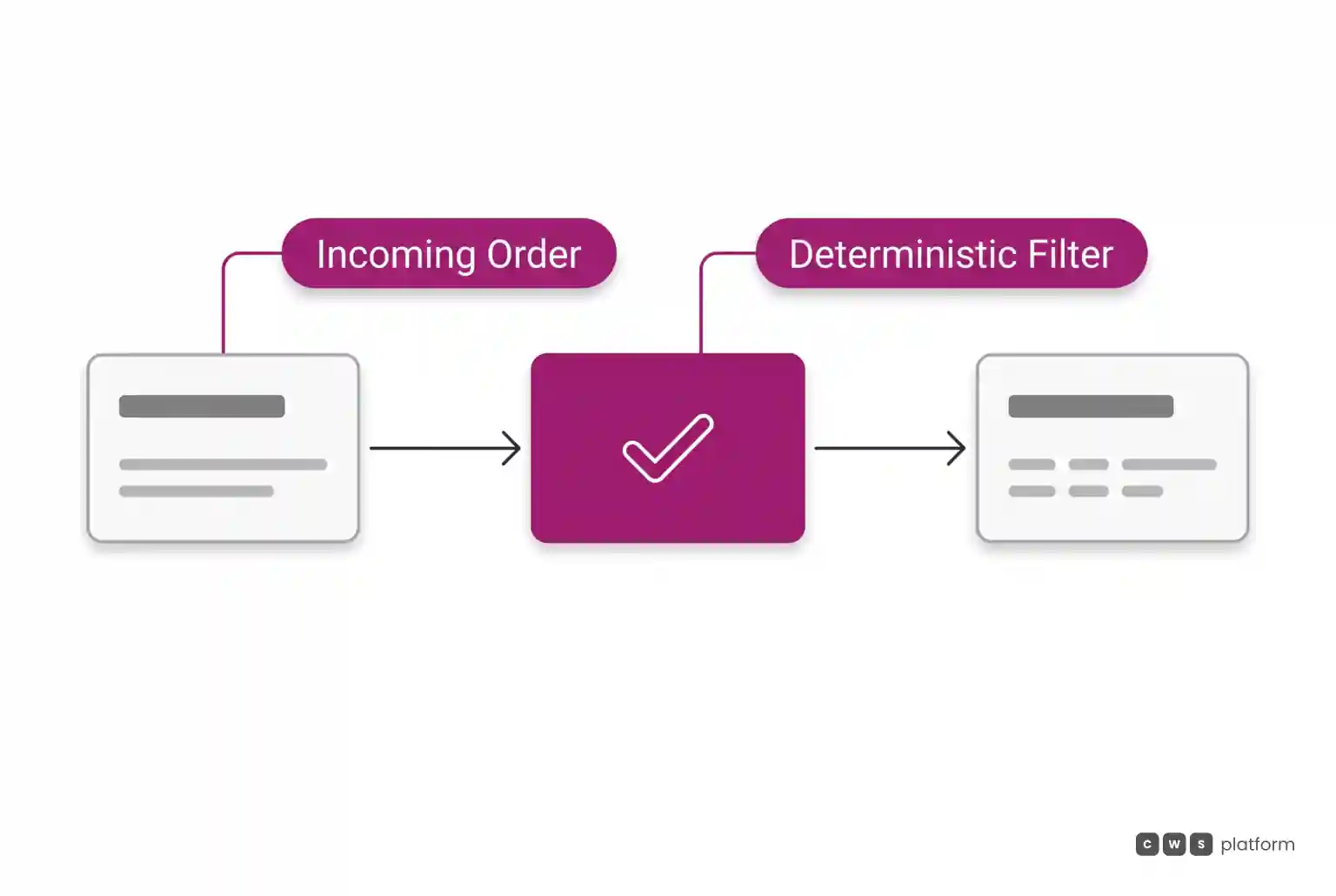
Another critical architectural challenge is the tendency to offload complex commercial business logic to generic AI models. The field observation, "The pilot worked fine, but rolling this out to three hundred field reps completely blows up our unit economics," highlights the danger of architectures that delegate commercial decisions to LLMs without underlying guardrails. Gartner, 2024 reports that over 90% of CIOs find cost management a primary barrier to capturing measurable value from enterprise AI initiatives.
For this reason, CWS Platform encapsulates commercial logic inside deterministic engines such as the Commerce Rules Engine (CDL Workspace) and Credit-First B2B Checkout (Checkout & Payments). By enforcing commercial contracts, discount authority matrices, and credit line limits before invoking automation layers or digital sales interfaces, the architecture protects operations against runaway API consumption and costly token inference.
How core operational pain points map to architectural solutions:
| Pain Point | Root Cause | Architectural Solution |
|---|---|---|
| "Every minor change requires six months of IT backlog" | Occurs when the backend ERP is pressured to handle real-time digital customer interactions, requiring slow custom development and release cycles for policy tweaks. | The platform positions a deterministic rules engine at the commerce layer while delegating fiscal math to ERP APIs, eliminating continuous core ERP code modifications. |
| "The customer portal displays pricing and stock that do not match the ERP" | Caused by delayed batch sync jobs and intermediate cache layers lagging behind physical warehouse balances. | The inventory engine manages multi-warehouse stock allocations per SKU-facility pair, updating storefront views and triggering transactional balance events. |
| "Custom negotiated contract pricing cannot be reflected accurately online" | Traditional platforms rely on static flat tables instead of evaluating multi-variable corporate deal terms at runtime. | The pricing engine resolves dynamic transaction totals during cart assembly, orchestrating jurisdiction rules, subsidiary contracts, and payment terms simultaneously. |
| "Scaling AI across the entire sales workflow drives unsustainable compute costs" | Generative AI models make costly, unconstrained inference calls to evaluate basic catalog entitlements, discount tiers, and credit terms without prior filters. | The system enforces deterministic validation gates that clear trade terms and authorization levels before handing structured data off to computational models. |
When to Choose SAP Commerce Cloud
SAP Commerce Cloud is the appropriate architectural choice when enterprise roadmaps require deep alignment with its underlying cloud ecosystem and custom Java extension framework:
Organizations fully standardized on SAP Cloud ERP. Select this architecture when your back office runs on SAP Cloud ERP and requires native vendor-managed connectivity: the cloud ERP edition syncs pricing, inventory, and order status with the ERP in real time, featuring an advertised target deployment timeframe of approximately 12 weeks.
Contact centers already operating on SAP CRM. Choose this architecture when customer service workflows originate in the SAP CRM Interaction Center: the Assisted Service Module launches authenticated storefront sessions via SSO and retrieves customer context by account or cart ID. In parallel, SAP Order Management for Sourcing and Availability works alongside Data Ingestion for Industry Cloud Solutions to unify global backend data schemas.
Strict requirements for multi-stage editorial publishing pipelines. Select this architecture when catalog enrichment requires formal, multi-tier enterprise governance workflows before changes reach production. Product Content Management (PCM) provides physical catalog partitioning between Staged and Online versions with granular synchronization controls, meeting strict corporate audit and compliance criteria.
Decoupled storefront development built on Angular. Choose this architecture when in-house engineering teams possess the capacity to maintain a decoupled front-end powered by composable storefront. The framework relies on specialized libraries integrating directly via the Commerce REST API and OCC, giving internal engineering full control over UI behavior and styling.
When CWS Platform Is the Right Architectural Choice
CWS Platform is the recommended choice when enterprise operations require updating commercial policies without software build cycles and calculating dynamic pricing based on customer context.
Decentralized regional fulfillment and multi-entity operations. Select this architecture when multiple branch locations, distribution centers, or legal entities require location-specific commercial logic while maintaining central administrative oversight. In CWS, child entities inherit master catalog SKUs while configuring local overrides (internal cross-references, localized pricing, and regional warehouse stock). Negotiated pricing agreements can be scoped per operating entity, and customer credit limits can apply to specific branches or roll up to parent accounts, isolating balances for clear accounting reconciliation.
Complex B2B order settlement and split-payment terms. Choose this architecture when transactions require combining multiple payment methods or financing terms within a single order. In CWS, a commercial order can split balances across trade credit limits, corporate purchasing cards, and net-term invoicing. For counter or depot sales, transaction balances can be distributed across payment rails, applying distinct interest rules or line-level cash discounts. Account trade limits can be configured and updated via the console or automated via API.
Enterprises maintaining tax and fiscal calculation in the ERP. Choose this architecture when complex enterprise tax calculation rules reside in the ERP or a specialized tax engine and should not be duplicated in the commerce layer. CWS synchronizes orders, inventory positions, credit lines, and customer price schedules via API and webhooks, delegating real-time tax resolution directly to backend corporate fiscal engines without code deployments for rate updates.
Collaborative assisted sales workflows within a unified order interface. Select this architecture when sales representatives need to collaborate in real time on customer transactions. In CWS, the field rep and corporate buyer access the same shared cart, synchronized on refresh, supported by built-in communication channels and discount threshold controls. Representatives can configure drafted orders, dispatch quote links for customer review, or finalize checkout on customer authorization with clear rep attribution.
Maintaining SAP as the foundational ERP system of record. This architecture does not require replacing SAP S/4HANA or SAP Cloud ERP. CWS Platform acts as the dynamic B2B engagement and sales execution layer: it consumes stock levels, master data, corporate contracts, and validation rules mapped via external IDs, dispatches submitted orders back via webhooks, and preserves the ERP as the definitive system of record for accounting and fulfillment. For technical leadership, the architectural question shifts from "SAP or CWS" to identifying where rapidly evolving commercial rules should live.
Where to Go Next
If your primary focus is defining the right architectural fit for your organization rather than selecting a software vendor, review The Seven Questions That Separate B2B Commerce Architectures.
If your current bottleneck involves core data alignment or legacy ERP constraints, the guides When the Product Catalog Turns to Chaos and When System Integration Blocks Growth explore these root challenges in detail, independent of platform vendors.
Recommended Reading
Brands mentioned in this article

- SAP Commerce Cloud
- Gartner
Trademarks and logos belong to their respective owners. Mention does not imply partnership or endorsement.
"responsive, technically engaged, and willing to work through complex commercial rules (negotiated pricing, credit, customer-specific conditions) rather than pushing generic answers"
Want to see this in your operation?
Real B2B operations already run on it.