Competitive Pricing Strategy: How to Build a Reliable Benchmark Basket
How to filter marketplace noise, compute category price indexes, and defend B2B margins

TL;DR
- Comparing your price to competitor pricing only helps if the comparison is built on a basket of equivalent items, cleansed of errors and outlier offers.
- Three rules make the basket reliable: truly identical items (part number, UPC, or mapped cross reference), the lowest price per seller, and discarding prices far above or below the median.
- The outcome is not a price to blindly copy. It is an index by product category that highlights where you are expensive, where you are cheap, and where the difference is strategic.
- The practical benchmark is the basket price index by category, evaluated alongside each category's gross margin.
To leverage competitor pricing in your pricing strategy, build a basket of comparable items, collect the lowest price from each seller per item, discard outliers far from the median (for instance, below half or above double), and compare your price against this clean benchmark, category by category. Without this cleansing process, the comparison mixes wrong parts, dead listings, and flash sales, forcing your sales team to react to ghost prices that do not reflect reality.
Every commercial VP has heard reps claim that "the competition is selling for less." Sometimes they are. Often, the rep simply spotted a listing for a vaguely similar product, excluding freight, from a distributor with zero inventory.
Why Price Comparisons Are Usually Misleading
Gathering competitor prices, whether manually or through web scraping, introduces three types of noise:
- Non-equivalent items. Matching descriptions with different packaging or specs. A 10 pack compared against a 12 pack.
- Outlier pricing. Data entry errors, stale listings, closeout inventory liquidations, or list prices that nobody actually pays.
- Seller duplication. On B2B marketplaces, the exact same part number surfaces dozens of times from the same distributor or small resellers.
A simple average of these scraped figures does not describe the market. It describes the messiness of your data collection.
How to Build a Comparative Basket
1. Select items by revenue impact, not convenience. The basket must include your highest volume SKUs and your key value items (KVIs), which are the products customers actively use to benchmark vendors. Long tail SKUs rarely make or break a deal.
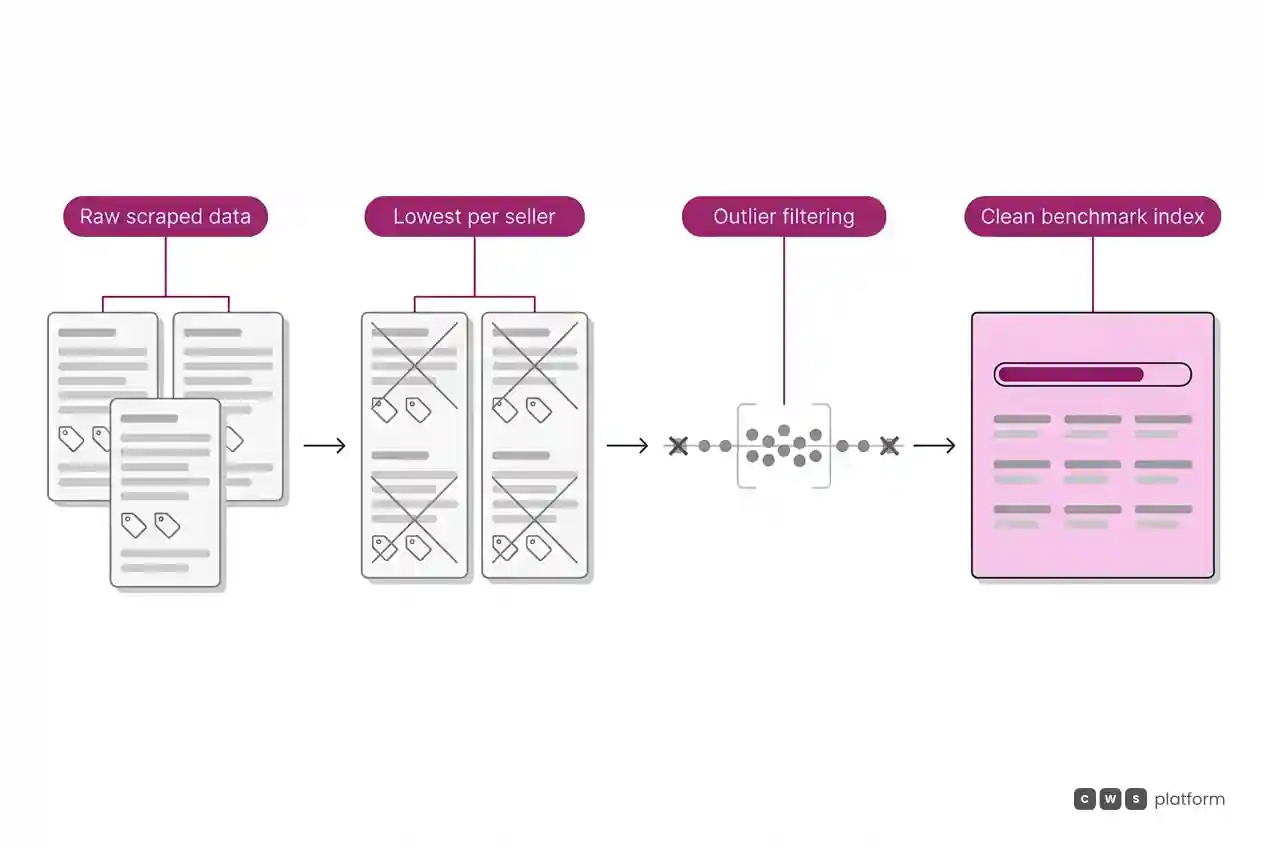
2. Ensure true product equivalence. Match by manufacturer part number (MPN), UPC, or an internal cross reference table maintained within your product catalog. Without strict mapping, you are comparing apples to oranges.
3. Retain only the lowest price per seller. A seller with twenty duplicate listings for the same part number counts exactly once, based on their lowest listed price.
4. Trim outliers using the median. Calculate the median price for each item and discard anything falling outside a predetermined band, such as 0.5x to 2x the median. The median resists extreme data anomalies; the simple average collapses under them.
5. Index your pricing. For each item, divide your price by the cleansed benchmark. An index of 1.05 means you are 5% above the market on that SKU. A weighted average of these item indices across a product line provides your category price index.
How to Interpret the Results
A category matrix, often represented as a heatmap, reveals three distinct scenarios:
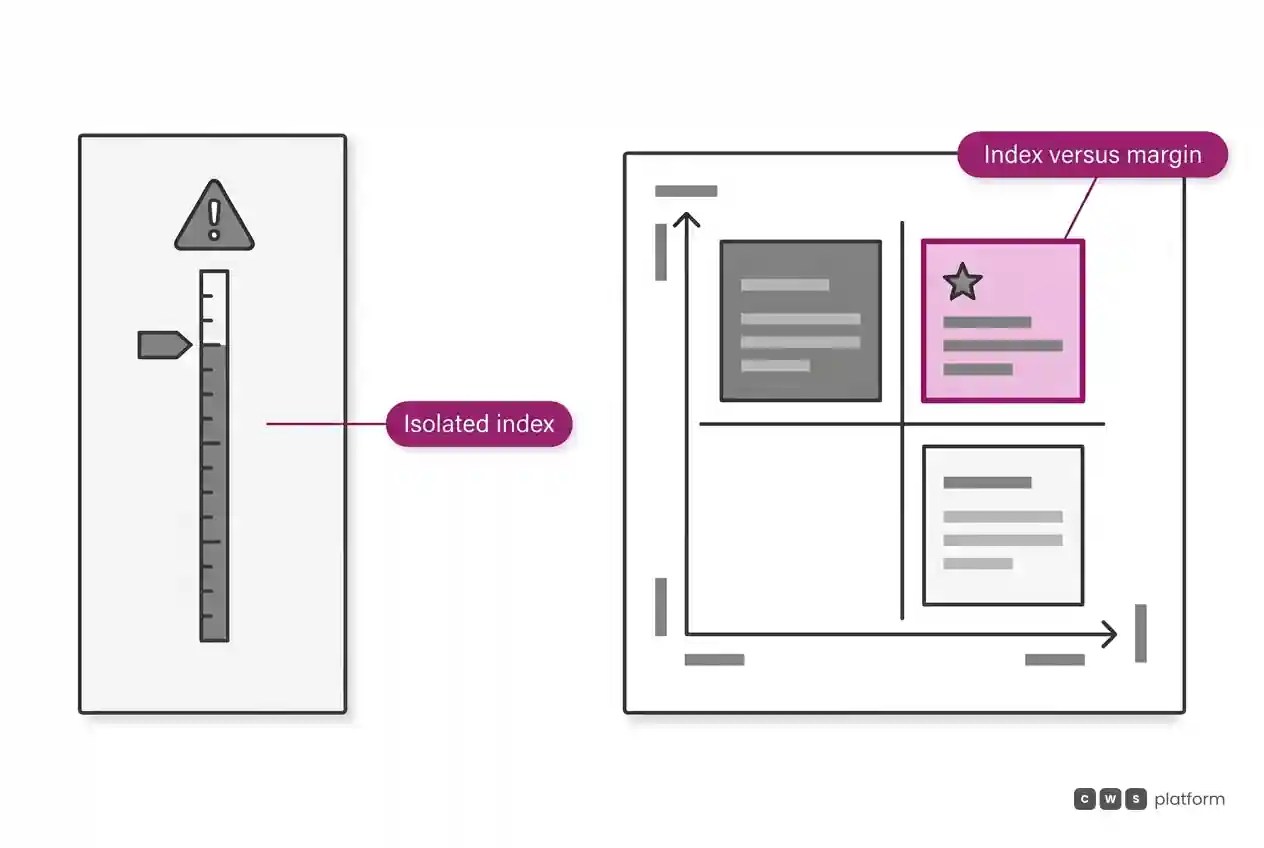
- Unjustifiably expensive. A high index in a category where buyers price shop aggressively and your company offers zero value add. This is where you lose purchase orders.
- Unjustifiably cheap. A low index in a category where buyers rarely benchmark. This is margin left on the table.
- Strategic price premium. A high index where you provide immediate stock availability, faster lead times, field engineering, or flexible net terms that competitors cannot match. Here, a higher price point is entirely defensible, and your sales reps need the talk tracks to defend it.
Never evaluate the price index in isolation. Map it directly against category gross margin so the team avoids slashing prices where margins are already razor thin. The underlying math between markup and margin, which dictates your true pricing floor, is detailed in B2B Sales Discounts: How to Protect Gross Margin.
From an Index to Executable Pricing Rules
Market benchmarking becomes an actual pricing strategy only when integrated into order execution rules rather than static slide decks:
- Positioning corridors by category. For example, targeting between 0.95 and 1.05 of the market benchmark on high sensitivity SKUs while maintaining wider discretion across low visibility lines.
- Scheduled cadence. Refresh the basket on a predictable schedule using the exact same normalization rules, ensuring measured price movements reflect genuine market shifts rather than methodology tweaks.
- Sales enablement data. Where your index is intentionally high, arm reps with value drivers rather than a discount approval matrix.
Executing dynamic rules on live orders across categories, customer tiers, and sales channels is the core job of the Pricing Engine within CWS Platform. Meanwhile, maintaining part number cross references, the foundation of every reliable comparative basket, lives inside the product master, covered in the Catalog Engine.
Next Step
Identify one product line that drives frequent price objections from your sales reps. Build a test basket containing its top 30 revenue generating SKUs, run them through the five cleansing steps above, and compute the category index. If the resulting data contradicts field feedback, you have your first objective baseline to replace ad hoc discounting with structured positioning corridors.
Frequently Asked Questions
What is competitor-based pricing strategy in B2B?
It is the practice of establishing your price points against competitor prices on equivalent items, adjusted for your company's specific service differentiators, payment terms, and category margin floors.
How do you accurately benchmark competitor pricing?
By enforcing strict part number equivalence, filtering for each vendor's single lowest price point, and eliminating statistical outliers from the median before calculating baseline indices.
Should you always match competitor pricing?
No. Match prices where buyers compare options closely and your offering lacks meaningful differentiation. Where you provide superior inventory availability, specialized logistics, or engineering support, maintaining a price premium is often the right strategic move.
How often should competitor price benchmarks be updated?
Match the update frequency to the pricing velocity of your industry. Crucially, keep the basket items and data normalization rules identical across runs so you track authentic market trends instead of collection noise.
Read Also
- B2B Price Formation: From Cost Structure to Customer-Specific Pricing
- Customer-Specific Pricing in B2B: Managing Contract Rates Without Spreadsheets
About This Publication
An article from the The Cost of Selling blog by CWS Platform, covering B2B pricing strategy. It references no specific client names or proprietary financial figures.
"responsive, technically engaged, and willing to work through complex commercial rules (negotiated pricing, credit, customer-specific conditions) rather than pushing generic answers"
Is selling more not turning into margin?
Request an assessment of your operation or talk straight to a specialist, whichever you prefer.
I'd rather get the next articles on margin and discounts
A weekly roundup of new articles on margin and discounts, only in weeks when there is one. No spam, and you can leave in one click.