Essential B2B E-Commerce Integrations: ERP, Tax, Payments, Shipping, and CRM
Why vendor claims of 'universal integration' fail and the exact questions to ask before signing.

"The platform integrates with everything." Every B2B software proposal includes this phrase, and almost none of them explain what it actually means. Integrating with an ERP can mean exchanging a flat file once a night, or it can mean line-item communication in real time. Integrating with payments might just mean credit cards, or it might include trade credit, net terms, and vendor split payouts. The difference only shows up after the contract is signed.
A B2B platform only needs a few core integrations, but it needs them done right. It pays to know what they are and what questions to ask about each one.
Why the Integration Checklist Is Misleading
Why does every vendor claim to integrate with everything? Because, given enough time and budget, any system can talk to any other system.
Why does this claim fail to help buyers make a decision? Because the question that matters is not whether it integrates, but how: at what frequency, in which direction, and with how much effort from your internal team.
Why is this effort usually hidden? Because integration work is typically billed separately as professional services, and the true scope is only calculated after the contract is signed.
Why do problems surface in year two? Because every change in business logic or core systems requires touching the integration again. This is the exact cost we analyzed in ERP and B2B e-commerce integration: why the ERP was never the problem.
The root cause: integration was evaluated as a checklist item rather than as an architectural component of the operation.
The Core Integrations Every B2B Platform Needs
1. ERP. The most critical integration. Master customer records, base pricing, inventory, and credit terms live in the ERP; the validated order returns there for billing and fulfillment. Ask: at what frequency does each data point sync, is inventory updated item by item, and what happens if duplicate updates arrive at the same time?
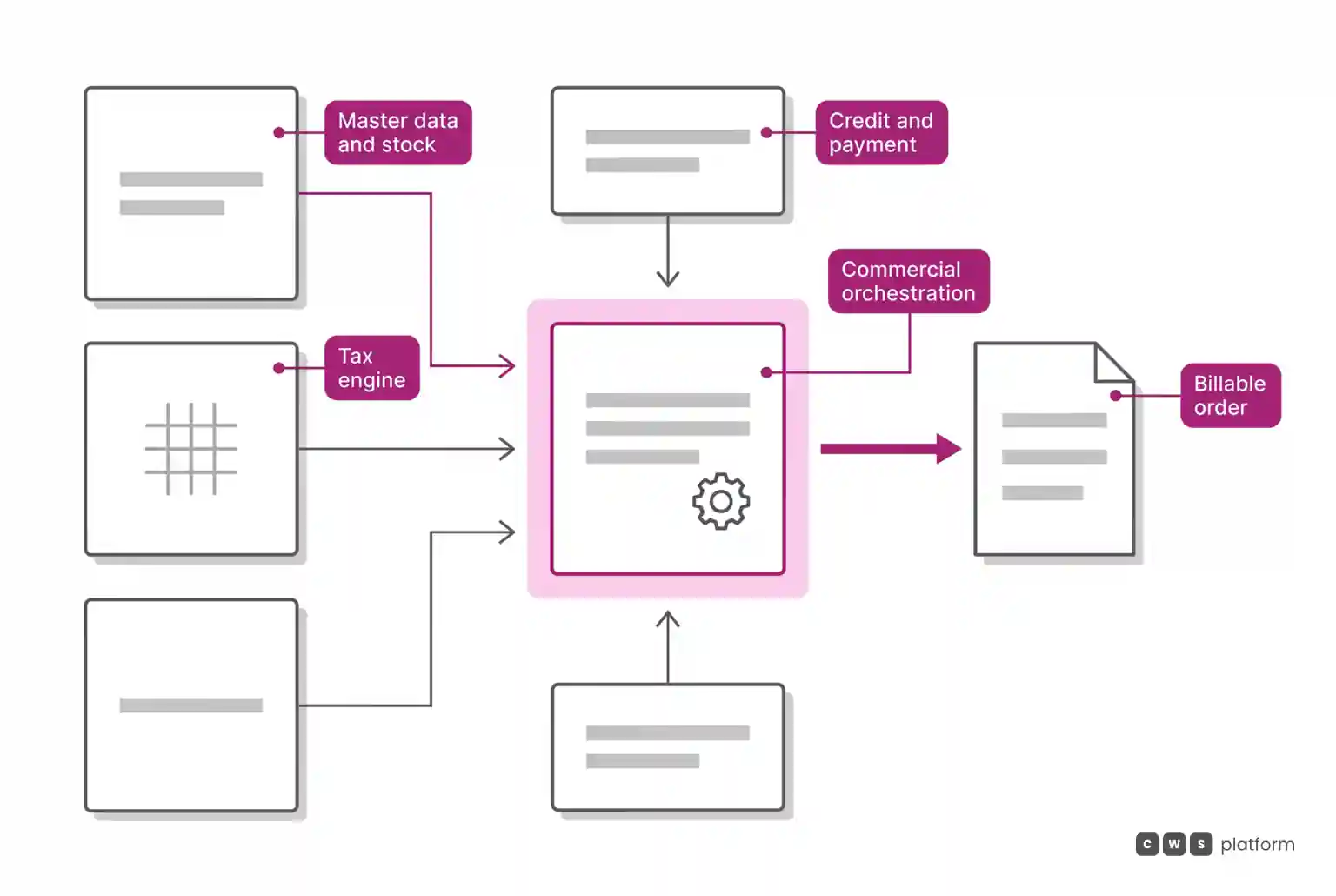
2. Tax Engine. In US B2B commerce, sales tax calculations depend on origin sourcing, destination sourcing, state nexus, and customer exemption certificates. Ask: is sales tax calculated inside the order at the line-item level, based on the fulfillment warehouse location, before checkout is finalized?
3. Payments and Terms. Credit cards and ACH transfers are the straightforward part. B2B commerce requires net terms invoicing within an approved credit limit, as well as split payouts across vendors in a marketplace setup. Ask: does approved trade credit function as a native payment method? What happens when an order exceeds the customer credit limit?
4. Freight and Tracking. Real-time LTL and parcel freight rating by warehouse, shipping terms, and order tracking. Ask: is accurate freight calculated and included in the order total before checkout? Is tracking visibility shared directly with the buyer?
5. CRM. The CRM manages relationships; the platform manages commercial transactions. Ask: do full order histories and negotiation logs sync back to the CRM so sales reps have a complete view of the account?
6. AI Agents. Increasingly, the entity querying price and availability is an automated agent rather than a human. Ask: do AI agents access the platform through the same business logic as a sales rep, or do they bypass governance through an open backdoor?
How to Evaluate Integrations Without Relying on Vendor Claims
- Request the detailed ERP integration architecture before signing. Identify which data flows, in which direction, and at what frequency.
- Clarify ownership for each milestone. Define what is standard configuration, what requires custom code, and who covers the bill for development.
- Run a real-world test order. Use a complex order with line items sourced from multiple distribution centers, paid via net 30 terms. We detailed this framework in how to choose a distribution system: five tests using a real order.
- Ask what happens during an outage. The answer reveals whether the integration was built for enterprise operations or merely assembled for a sales demo.
How CWS Platform Handles Integrations
CWS Platform orchestrates commercial logic on top of existing ERP systems using open APIs and webhooks, without requiring companies to rewrite ERP core code. Inventory updates in real time on a line-item basis; taxes are calculated directly at checkout based on origin and nexus rules; trade credit operates as a native payment method with configurable workflows for orders exceeding credit limits (hard stop, approval queue, or bypass). AI agents interact with the catalog under the exact same commercial guardrails as internal reps. Review the technical architecture on our APIs and integrations page.
Next Step
Turn the checklist above into six written questions and send them to the vendors currently on your shortlist. The technical precision of their answers, and how fast they deliver them, will tell you far more than any slide deck.
Frequently Asked Questions
What integrations does a B2B platform need?
An ERP for master records, price books, real-time inventory, credit terms, and order booking; an automated tax engine at checkout; B2B payment methods with net terms support; freight rating and tracking carriers; CRM for customer account visibility; and governed API access for AI agents.
How do you integrate B2B self-service portals with a CRM?
By syncing order history, order status, and quoting data back to the CRM so sales reps maintain complete visibility into account purchasing. The CRM manages the customer relationship, while the B2B platform executes transactions and enforces commercial policy.
How do you compare B2B order portals with integrated payments?
By checking whether the portal supports net terms as a native checkout method, validates real-time credit limits at checkout, provides clear escalation workflows for over-limit orders, and handles split settlements between multiple vendors in marketplace scenarios.
How should you evaluate a B2B platform ERP integration?
By requesting the data flow architecture prior to signing: mapping which fields sync, in which direction, and on what schedule; clarifying what is out-of-the-box versus custom development; and reviewing how the architecture handles duplicate requests and connection drops.
Read More
- When You Run on Several ERPs, Which One Is Right?
- ERP integration
- Where marketplace and ERP integrations fail
About This Publication
A publication by CWS Platform. Visit cws-platform.com.
"responsive, technically engaged, and willing to work through complex commercial rules (negotiated pricing, credit, customer-specific conditions) rather than pushing generic answers"
Want to see this in your operation?
Real B2B operations already run on it.