How to Integrate a B2B Platform with Your ERP Without Replacing It
The five essential integration flows to connect digital commerce to legacy ERPs without manual order entry.

TL;DR
- You can integrate a B2B sales platform with TOTVS without replacing the ERP: TOTVS remains the system of record (master data, inventory, invoicing, financials), while the platform becomes the workspace where customers and sales reps negotiate and place orders.
- Integration starts with five flows, in this exact sequence: product and customer master data, pricing and commercial terms, inventory, orders, and order status (invoices, payment documents, shipment tracking).
- The most critical decision is not technical: it is deciding what stays in the ERP and what gets calculated inside the platform, such as customer-specific pricing, approval thresholds, and channel rules.
- The practical benchmark is clean order flow: an order that enters the ERP without manual re-entry, matching the exact price the customer saw.
To integrate a B2B commerce platform with TOTVS without replacing your ERP, keep TOTVS as the single source of truth for master data, inventory balances, invoicing, and accounting. Connect the commerce platform through APIs and event-driven webhooks across five core flows: products and accounts, pricing and terms, inventory, orders, and order status. The platform takes over what ERP systems were never designed to do well: managing digital negotiations and capturing front-end orders where buyers and sales reps share the same view. The ERP stays in place. It simply stops serving as the order entry screen.
This question surfaces in almost every conversation with distributors and manufacturers running TOTVS: will a modern B2B e-commerce initiative force us to replace our core ERP? Absolutely not. What you need is an unmistakable division of responsibility between both systems.
What stays in TOTVS and what moves to the platform
Stays in the ERP: master records for products and accounts, general ledger and physical inventory, tax calculation, invoices, accounts receivable, and credit limits. Everything tied to transaction logs, compliance, and financial accounting remains in the ERP.
Moves to the platform: the buyer purchasing experience, order configuration for field sales reps, real-time commercial policy enforcement (tiered pricing, customer-specific contracts, discount approval workflows, promotions), warehouse-specific availability views for buyers, and customer self-service order tracking.
Decided case by case: price calculation. In some operations, TOTVS calculates the price and the platform reads it. In others, the platform calculates pricing using raw tables and baseline parameters synced from the ERP, primarily because complex commercial policies become too cumbersome to run through native ERP screens. During B2B platform evaluations, this is usually the sharpest contrast with traditional ERPs: applying pricing by warehouse location, sales channel, and customer account in real time at checkout.
The five integration flows, in the right order
1. Products and accounts. The ERP sends foundational master data: item numbers, descriptions, units of measure, product lines, tax classifications, along with account tax IDs, industry segments, price lists, and payment terms. The commerce platform enriches this product data for digital sales (high-resolution images, technical specs, merchandising attributes, cross-sell applications) without altering the back-office master record.
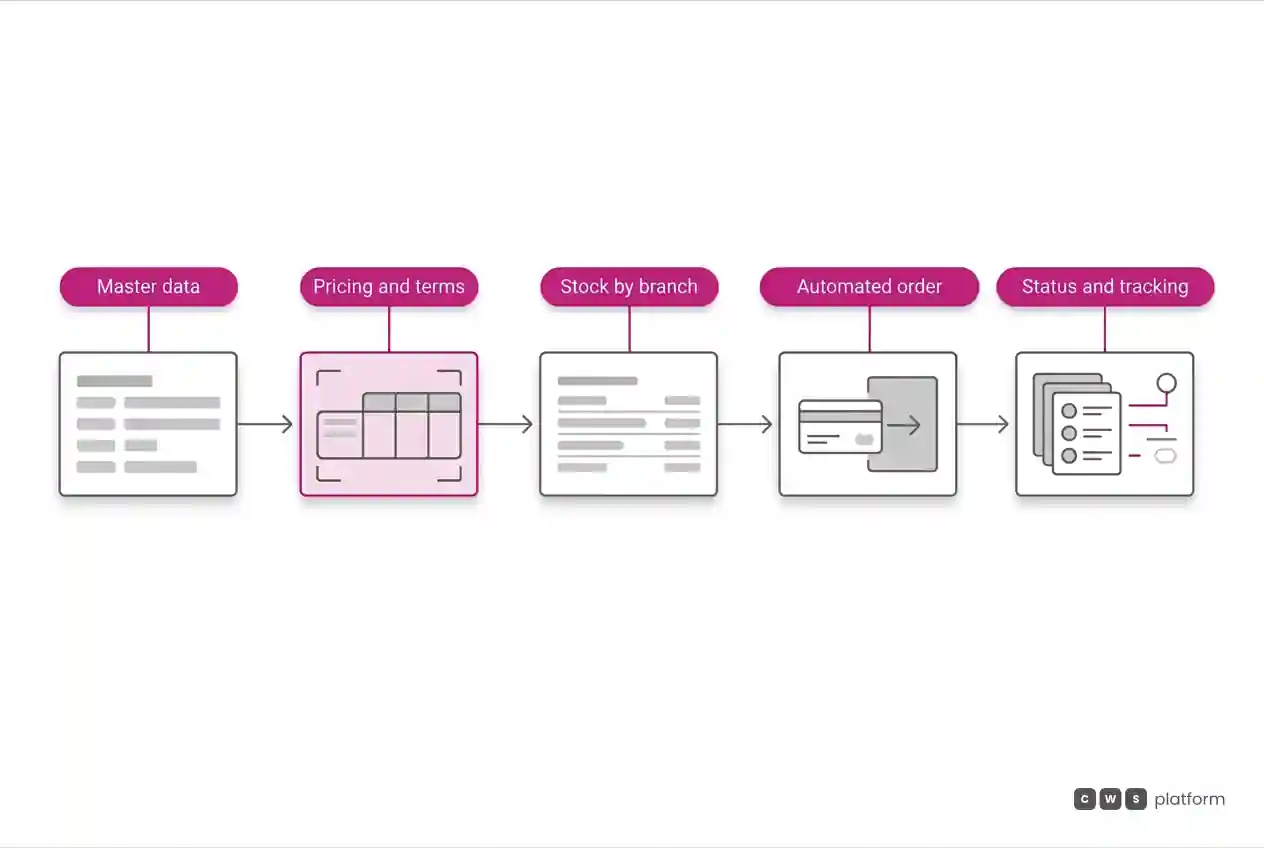
2. Pricing and terms. Contracted price lists, customer-tier discounts, payment schedules, and allowed payment methods by account. This flow generates the highest error rate during implementations, which is why testing must focus on your most complex commercial accounts rather than straightforward standard buyers.
3. Inventory. Available balances by warehouse location or distribution center, synchronized at intervals aligned with inventory turnover rates. Learn more about optimal sync cadence and architecture in real-time inventory for B2B.
4. Orders. An approved order on the commerce platform lands inside TOTVS as an open sales order, reflecting the exact line-item pricing and terms agreed upon with the customer. Zero manual re-keying.
5. Status. Order fulfillment milestones, invoices, billing documents, and shipping tracking numbers sync back from the ERP to the platform, enabling buyers to track shipments without calling support reps.
How the integration communicates with TOTVS
TOTVS ERP suites provide dedicated APIs for external integration. Choosing between direct API queries, asynchronous event webhooks, or scheduled batch syncs depends entirely on the flow. A practical framework:
- Orders and fulfillment status: event-driven webhooks or direct REST APIs, as close to real time as possible.
- Inventory levels: event-triggered updates for fast-moving items, or frequent batch syncs for standard product catalogs.
- Master data and price lists: scheduled batch syncs, supplemented by immediate event pushes for critical intra-day updates.
Across enterprise projects deployed by CWS Platform alongside ERPs like TOTVS, the phase requiring the deepest focus is rarely technical connectivity. It is data mapping: reconciling units of measure, decimal precision, payment term codes, and tax calculation rules scattered across different back-office configuration menus. For a comprehensive look at the ecosystem requirements beyond the core ERP, review essential integrations for B2B platforms.
Why you do not need to replace the ERP
Ripping out and replacing your ERP just to launch digital commerce is like swapping out an entire engine simply to upgrade the dashboard. An ERP migration is capital-intensive, high-risk, and remarkably slow. More importantly, the operational friction driving the project in the first place (orders arriving via phone calls, manual order entry, custom deals managed in rogue spreadsheets) does not live inside the ERP. It sits in the disconnect between the customer and the ERP.
A dedicated B2B commerce platform bridges this operational gap, allowing the ERP to focus strictly on what it does best. The multi-tier architecture that decouples the ERP, CRM, and transactional sales engine, while executing complex commercial logic directly at checkout, powers the B2B e-commerce platform by CWS Platform. Technical integration specifications are documented under our APIs.
Next step
Map out where every critical data point originates in your operation today: list prices, custom terms, multi-warehouse stock, credit lines, and fulfillment milestones. Pinpoint what lives cleanly inside TOTVS, what sits in spreadsheets, and what exists only in the sales team's memory. Everything outside the ERP represents what your integration architecture must resolve first, and in most wholesale operations, that begins with commercial policy.
Frequently asked questions
Can we launch B2B e-commerce without replacing TOTVS?
Yes. TOTVS continues to function as your central system of record. The B2B commerce platform integrates seamlessly via APIs and event hooks to synchronize master data, customer pricing, inventory balances, sales orders, and fulfillment updates.
Which datasets should be integrated first between the B2B platform and the ERP?
Start with product and customer master records, followed by pricing and payment terms, inventory levels, order creation, and fulfillment status updates. Pricing and payment terms consistently yield the highest risk of discrepancy and require thorough edge-case validation.
Should pricing logic be calculated in the ERP or on the commerce platform?
It depends on the complexity of your commercial policy. If the rules run smoothly and quickly inside the ERP, the platform can simply read the output. If calculations involve sales channels, regional distribution centers, dynamic promotions, and sales rep margin thresholds, it is generally far more effective to execute pricing natively on the platform using baseline tables synced from the ERP.
How long does it take to integrate a B2B platform with the ERP?
Timelines vary based on the number of automated flows, master data hygiene, and the complexity of your pricing matrices. In practice, aligning business rules, field definitions, and payment codes consumes substantially more time than establishing technical API connectivity.
Related articles
- B2B Customer Portal Launched but Nobody Uses It: Driving Post-Go-Live Adoption
- System integration in B2B sales: what to connect first and how
- ERP and B2B e-commerce integration: why the ERP was never the bottleneck (and the real costs that hit in year two)
About this publication
An educational article from the Cost of Sales blog by CWS Platform covering systems integration between core ERPs and B2B digital sales platforms. TOTVS is a registered trademark of TOTVS S.A., referenced here solely as an industry standard benchmark. This article contains no client identifiers or proprietary operating figures.
Brands mentioned in this article

Trademarks and logos belong to their respective owners. Mention does not imply partnership or endorsement.
"responsive, technically engaged, and willing to work through complex commercial rules (negotiated pricing, credit, customer-specific conditions) rather than pushing generic answers"
Is integration holding your operation back?
Request an assessment of your operation or talk straight to a specialist, whichever you prefer.
I'd rather get the next articles on ERP integration
A weekly roundup of new articles on ERP integration, only in weeks when there is one. No spam, and you can leave in one click.