The 4 Ps of B2B Marketing, Centered on the Customer
How unifying product, price, place, and promotion around buyer accounts lowers transaction costs

TL;DR
- The 4Ps of marketing (product, price, place, and promotion) remain fully relevant in B2B. What changes is the question: instead of "what do I offer," each P must answer "what does this account need to buy without friction."
- With the customer at the center, product becomes account-specific assortment and data; price becomes customer-specific terms; place becomes availability and channel access per account; promotion becomes campaigns governed by commercial policy.
- The four only work effectively when built on the same foundation: shared master data, identical price books, unified inventory, and consistent business logic across every channel.
- The return shows up in transaction costs: fewer calls, fewer manual exceptions, and less rework per purchase order.
The 4Ps of marketing in B2B are product, price, place, and promotion. When customer-centric, each element stops being a generic corporate decision pushed onto the market and becomes a tailored answer for every account: the products they are authorized to purchase with the technical data they need; their contracted price and payment terms; place defined by the distribution center and channel servicing them; and promotions strictly governed by their commercial rules. Supported by a unified platform, these four pillars actively drive down the cost of sale.
The 4Ps framework was originally conceived for consumer retail, based on a single shelf price and one mass campaign for all buyers. In B2B, every account has its own price book, payment terms, assortment, and preferred ordering channel. This reality does not make the framework obsolete. It makes it far more demanding.
Product: Customer-Specific Assortment and Technical Data
In B2B, the product is never just a standalone SKU. It is the specific assortment an account is entitled to purchase and the comprehensive documentation needed to buy without picking up the phone.
- Account-level assortment. An authorized distributor accesses one product line, an end customer sees another, and a regional branch is restricted to items their local distribution center can fulfill.
- Technical specifications. Application guides, cross-reference equivalents, specification sheets, and minimum order quantities. Professional buyers make purchasing decisions based on exact specs.
- Master data as a product feature. If a buyer cannot locate an item on your customer portal, for them, it does not exist. Explore this operational standard in B2B catalog taxonomy.
Price: Terms Configured for Each Account
In B2B commerce, price is rarely a static figure. It is an algorithmic function of price lists, tier volumes, payment terms, payment methods, sales channels, and negotiated master service agreements. Centered on the customer, the correct price is the one that appears consistently across every touchpoint, calculated by the exact same rule.
- Customer-specific price lists applied consistently across the self-service portal and the outside sales rep, as detailed in our guide to customer-specific B2B pricing.
- Documented discount tiers and approval governance, ensuring that price concessions reflect corporate margin policy rather than individual sales rep discretion.
- Payment term pricing adjustments, acknowledging that net-30, net-60, and cash terms carry real financing costs.
Place: Availability and Channel Strategy per Account
In wholesale and B2B distribution, "place" encompasses where and how an account procures and receives inventory:
- Channel mix: outside field reps, inside sales reps, self-service portals, EDI, and branch counters. Every commercial client relies on a distinct mix of channels.
- Inventory visibility: stock levels at the specific distribution center servicing that account, or visibility across the entire warehouse network paired with accurate lead times.
- Fulfillment logistics: customer pickup, dedicated fleet delivery, LTL freight, and carrier rate tables.
With the customer at the center, effective placement delivers complete visibility into what is available, from which facility, and on what schedule, without requiring a customer service inquiry.
Promotion: Rule-Governed Commercial Campaigns
B2B promotions encompass product line incentives, new equipment launch programs, vendor co-op programs, and dormant account reactivation campaigns. The primary operational risk is margin leakage: promotional discounts stacking on top of contracted matrix pricing and prompt-payment terms, driving order margins below allowable thresholds.
With a buyer-centric approach, effective B2B promotions reach targeted accounts through appropriate channels while respecting core ERP commercial controls. This is the underlying architecture of the Commerce Marketing & Promotions (Marketing Suite) on the CWS Platform.
Why the Four Pillars Require a Unified Foundation
The 4Ps frequently operate in enterprise silos: product sits in catalog master data, price lives in sales operations, place belongs to logistics, and promotion remains within marketing. Each department relies on its own spreadsheets. For the corporate buyer, this fragmentation surfaces as an ordering portal that displays parts without account pricing, marketing promos that cannot be redeemed via their procurement channel, and inventory statuses tied to the wrong regional warehouse.
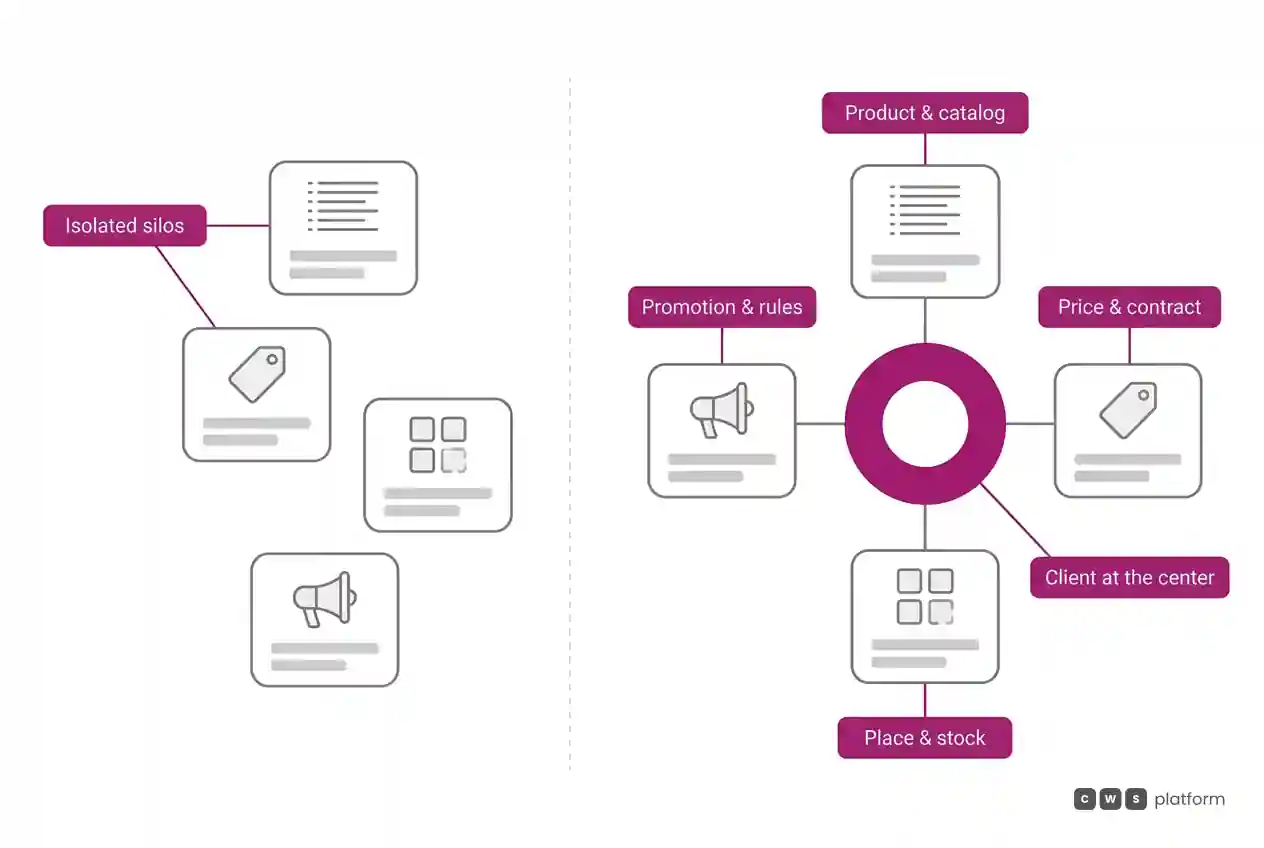
When all four pillars run on a single unified architecture (sharing identical master catalogs, price matrices, real-time inventory levels, and commercial policies across every channel), each order requires fewer manual overrides, fewer status calls, and far less administrative rework. At that point, the 4Ps framework ceases to be an academic marketing concept and becomes an engine for lowering the cost of sale. The technical execution of unifying these four pillars within a single experience is covered in B2B digital sales portals.
Next Step
Select a core customer account and audit these four operational questions: which products are they cleared to buy and where do they access technical data; what is their exact contract price and is it mirrored across all touchpoints; which distribution center fulfills their orders and under what lead times; and which promotional programs are currently applicable to them. Wherever the answer requires an internal employee to open a manual spreadsheet, you have located a P that is not yet centered on your buyer.
Frequently Asked Questions
What are the 4Ps of marketing?
Product, price, place, and promotion: the four foundational strategic decisions that govern how a business brings its offering to market.
Do the 4Ps apply to B2B?
Yes, when adapted to complex commerce: product includes account-level assortments and technical specs; price reflects custom terms and matrix pricing; place spans channel mix, warehouse routing, and logistics; and promotion must operate within strict commercial margin rules.
What does customer-centricity mean within the 4Ps?
It means configuring each P based on what an account requires to purchase efficiently without operational friction, rather than relying on a static, one-size-fits-all market offering.
How do the 4Ps impact transaction costs?
When all four elements share the same system architecture and logic across every sales channel, orders require far fewer manual inquiries, margin exceptions, and administrative corrections, significantly lowering the overall transaction cost.
Read Also
- Channel Conflict in B2B: How to Align Portal and Sales Rep Pricing
- B2B System Integration: What to Connect First and How
- B2B Fundamentals and Core Definitions
About This Publication
An article from the Cost of Sale blog by CWS Platform, covering B2B marketing and commercial sales operations. It cites no specific client identities or confidential business metrics.
"responsive, technically engaged, and willing to work through complex commercial rules (negotiated pricing, credit, customer-specific conditions) rather than pushing generic answers"
Is every order costing your operation more?
Request an assessment of your operation or talk straight to a specialist, whichever you prefer.
I'd rather get the next articles on the cost of each order
A weekly roundup of new articles on the cost of each order, only in weeks when there is one. No spam, and you can leave in one click.