Real-Time B2B Inventory: Webhooks, APIs, or Batch
How to sync multi-warehouse stock without overloading your ERP or frustrating B2B wholesale buyers.

"The customer placed the order in the portal, and the item had already run out that morning." For a B2B buyer, this is the single error that damages trust the most. They planned their replenishment, relied on the screen balance, and found out over the phone that the order cannot be fulfilled. Next time, they call before ordering. And the portal loses the exact order it was designed to streamline.
Real-time inventory in B2B is not a technical luxury. It is the core requirement for buyers to trust the digital channel.
Why the Portal Balance Lags Behind the ERP
Why does the portal show outdated inventory? Because updates occur at fixed intervals, and between sync cycles, stock moves through the sales counter, inside sales, and other channels.
Why are updates scheduled at fixed intervals? Because sending the entire catalog inventory every minute overloads the ERP, leading teams to reduce sync frequency.
Why send the entire inventory catalog? Because the integration cannot process delta changes, sending only what actually changed.
Why does the error always hit the most critical SKUs? Because fast-moving items see the most activity throughout the day, and they are precisely what customers purchase most often.
The root cause: inventory was integrated as a periodic snapshot, whereas B2B operations require every single change the moment it happens.
The Three Ways to Integrate Inventory
Via API, when the portal queries. With every search or at checkout, the portal queries the inventory system for the item balance. It is accurate, but it depends on the back-end system responding quickly to high concurrent request volumes.
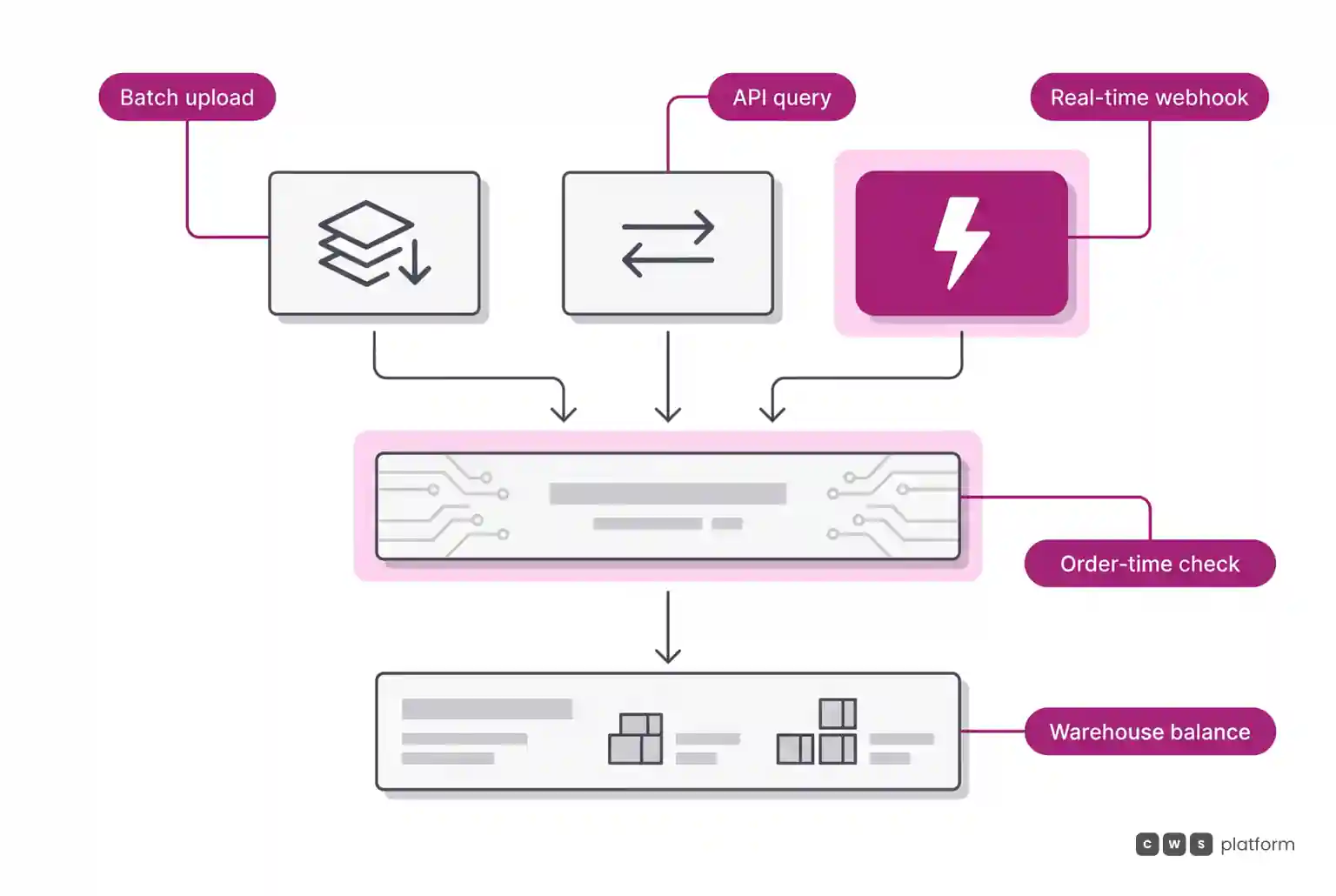
Via webhook, when inventory changes. The inventory management system notifies the portal with every movement, item by item. The portal stays up to date without constant polling, and the ERP only pushes what changed.
Via batch, on a scheduled cadence. A single batch upload updates balances across thousands of SKUs at once, through files or flat sheets. This fits initial catalog setups, periodic cycle counts, and non-integrated systems, but it should never be the sole mechanism for high-velocity SKUs.
In practice, an effective architecture combines all three: webhooks or APIs for fast-moving items, scheduled batch updates for bulk synchronization, and inventory validation at checkout to ensure orders commit against actual available quantities.
Critical Safeguards for Resilient Integrations
Idempotent updates. If the same update payload arrives twice due to network retries or timeouts, the balance must not duplicate. Without strict idempotency, engineering teams hesitate to enable high-frequency syncs.
Multi-warehouse balances, not aggregate totals. In B2B, the same SKU ships from different distribution centers, carrying distinct tax implications and freight rates. The portal needs granular balances per location to route orders accurately.
Off-peak batch jobs. Processing massive batch files mid-morning competes for database resources with live customer orders. Scheduling heavy jobs during off-peak windows protects system performance.
Inventory reservation at checkout. Displayed inventory is informative; confirmed inventory at checkout is what secures the order. We cover the financial cost of accepting orders that cannot be fulfilled in how to automate wholesale orders with credit and inventory rules.
The Value for the Buyer
Reliable inventory balances change customer behavior. Buyers stop calling reps to double-check quantities, assemble complete orders directly in the portal, and adopt self-service for routine replenishment. Sales reps stop acting as inventory lookup desks and refocus on closing deals.
On the CWS Platform, inventory updates in real time via API and webhooks, item by item, using idempotency keys that prevent duplicate records. Flat files and bulk updates are queued systematically, ideally during off-peak hours, supporting either delta adjustments or full location balance rewrites. See the technical structure on our inventory and warehouses page.
Next Step
Identify your top twenty fast-moving SKUs and compare their portal availability against your ERP balance at three different points during a regular business day. Every discrepancy you uncover represents an order that will drop back to a phone call next week.
Frequently Asked Questions
How does real-time inventory work on a B2B platform?
The inventory system notifies the platform with every stock movement, item by item, via webhook, or responds to queries in real time via API. The portal reflects updated balances and revalidates availability during checkout before routing the order to the ERP.
What is the best way to integrate inventory between an ERP and a B2B portal?
Combine webhooks or APIs for fast-moving items, scheduled off-peak batches for bulk updates, and real-time validation at checkout. The integration must be idempotent to prevent duplicate stock entries from retried requests.
Do wholesale platforms need multi-warehouse inventory tracking?
Yes. B2B orders frequently ship from multiple distribution centers, each with distinct tax jurisdictions, shipping costs, and fulfillment timelines. Multi-location tracking enables proper order routing and gives buyers complete fulfillment visibility.
Why does portal inventory drift from ERP inventory?
Inventory drifts when integrations push data on fixed schedules, while warehouse counters, inside sales, and EDI channels deplete stock between sync windows. The solution is streaming delta changes as they happen and re-checking stock at checkout.
Read Also
- When You Run on Several ERPs, Which One Is Right?
- ERP and B2B E-Commerce Integration: Why the ERP Was Never the Problem (and the Hidden Year-Two Cost)
- Where Marketplace and ERP Integrations Break Down
- ERP Integration
About This Publication
A publication by CWS Platform.
"responsive, technically engaged, and willing to work through complex commercial rules (negotiated pricing, credit, customer-specific conditions) rather than pushing generic answers"
Want to see this in your operation?
Real B2B operations already run on it.