Spryker vs SAP Commerce Cloud: what does the contract guarantee?
Through a CFO lens: what support commits to, who applies the update, and what happens when a version goes out of maintenance, on both sides.

Editorial note: CWS Platform competes with both Spryker and SAP. This comparison uses only each vendor's public documentation, with the address next to each fact and the date of each record cited.
Short answer: Spryker fits companies that want the commerce code inside their own project, with order flow and contract pricing they can adjust. SAP Commerce Cloud fits companies that already run SAP's ERP and want quotes and contract pricing tied to it. In both, read past the license: Spryker records that its SLA does not guarantee resolution times; SAP records that an unsupported version can put you in breach of contract.
Between Spryker and SAP Commerce Cloud, the CFO usually compares the license quote and the implementation budget. The question that weighs in the following years is a different one: what the contract guarantees after signing. What support commits to, who applies the updates, and what happens when a version or an extension goes out of maintenance. Those lines decide whether the implementation ends or becomes a permanent project. The overall map is in the post on the three B2B commerce platform models, the other comparisons are in the comparisons hub, and the commercetools vs Spryker comparison looks at Spryker upgrades through a CTO lens.
Spryker and SAP Commerce Cloud side by side
The table summarizes what each vendor's documentation records; where the source does not cover a point, the cell says so.
| point | Spryker | SAP Commerce Cloud |
|---|---|---|
| Platform model | Commerce code inside the project, updated through Composer; order process modeled in XML | Modular platform on public cloud (version 2211), extended through extensions and AddOns |
| Native B2B or extension | Native: Company Account with business units, roles, and permissions, plus Request for Quote | Account-based buying, customer-specific catalogs, contract rules, and multi-step approval |
| Customer and contract pricing | Merchant Custom Prices: price per merchant relation, applied to the assigned business units | Contract prices in the buyer's account; prices and discounts replicated from SAP S/4HANA or SAP ERP |
| Quotes | Request for Quote with versions, sales rep editing, and an expiry date | Quote converted to an order by the buyer; RFQ with SAP CPQ through SAP Cloud Integration |
| Credit and payment terms | Not documented | Not documented |
| ERP integration | Data Exchange API built on the Dynamic Entity API, with endpoints and mappings created in the Back Office | SAP Commerce Cloud Integration with ERP package; cloud ERP edition with connectivity managed by SAP |
| Billing model | Not documented | Blocks of 50,000 orders per year or GMV |
| Deployment | With the Code Upgrader, shipped with PaaS+ in the EU and US: one CI pipeline per project and updates opened as pull requests | Build from a Git repository and a build manifest in the Cloud Portal |
Pricing and commercial rules: what sits in the contract and what sits in the project
On Spryker, the Merchant Custom Prices feature treats the merchant relation as a price dimension, alongside mode, volume, store, and currency, and applies the price to the assigned business units. Bulk loads go through a CSV file.
On SAP Commerce Cloud, promotions are built in a rule engine that combines extensible conditions and actions, and prices can come from SAP Cloud ERP or from SAP's own engines, such as SAP Omnichannel Promotion Pricing, according to the payments and promotions page.
Commercial rules are the part of the store that changes most after go-live. Ask both vendors, in writing, how much of that upkeep is configuration done by the sales team and how much is developer work, with hours per month.
Quotes and assisted selling
On Spryker, the buyer creates a quote from the cart, and the sales rep edits prices, quantities, items, and shipping, sets the offer's expiry date, and sends back a new version, according to the Request for Quote documentation. For service, Agent Assist turns a Back Office user into an agent, and the agent's email can be recorded on the order, as the Agent Assist installation guide records.
On SAP Commerce Cloud, the agent works in the same storefront interface the customer uses, according to the Assisted Service Module documentation. Complex quotes go through SAP CPQ via SAP Cloud Integration and, once accepted, become orders in Commerce and move on to SAP S/4HANA, as the quote-to-cash integration course describes.
For the CFO, this is a contract scope question: at SAP, SAP CPQ is a product of its own, connected to Commerce through middleware; at Spryker, quoting and agents are platform features installed in the project. Ask for proposals that separate license, add-on products, and implementation hours.
ERP integration
On Spryker, APIs are split by actor, with one for the storefront and one for the back office, according to the getting started with APIs guide. The Data Exchange API handles data through GET, POST, PUT, PATCH, and DELETE in JSON and is built on the Dynamic Entity API, which lets teams create endpoints, validations, and mappings in the Back Office without code.
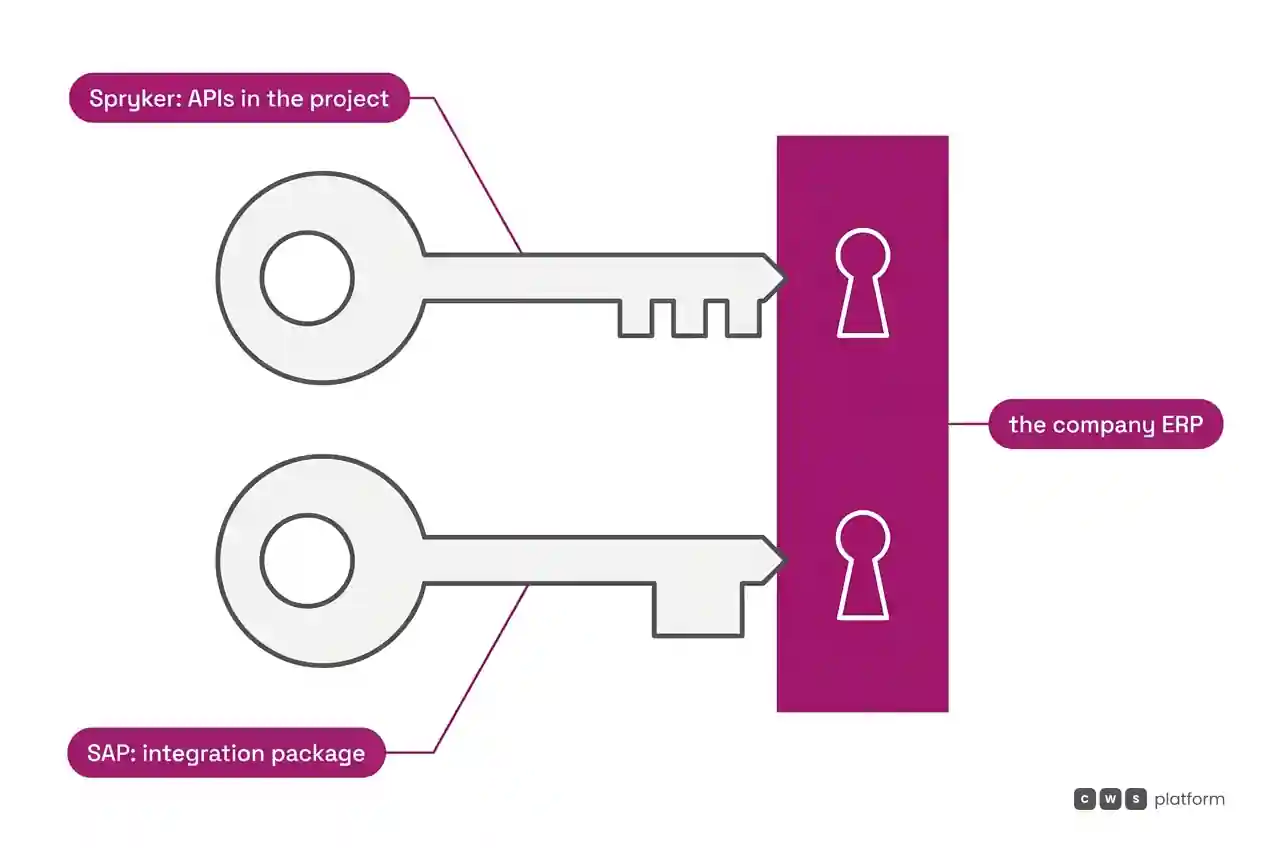
At SAP, price and discount replication from SAP S/4HANA or SAP ERP runs on SAP Cloud Integration, with the SAP Commerce Cloud Integration with ERP package, according to the price replication documentation. In the cloud ERP edition, connectivity is managed by SAP, and price, inventory, and order status are read from SAP Cloud ERP as the source of truth.
For companies on SAP's ERP, part of the integration ships as a vendor product; on Spryker, it is built on the APIs, inside the project. In both, ask who maintains the connector with each version and whether that is in the contract or in the hours budget.
Cost and billing model: what the support contract guarantees
The SAP Commerce Cloud plans and pricing page records billing in blocks of 50,000 orders per year or by GMV. In the Spryker sources used in this comparison, the billing model is not covered; the proposal has to spell it out.
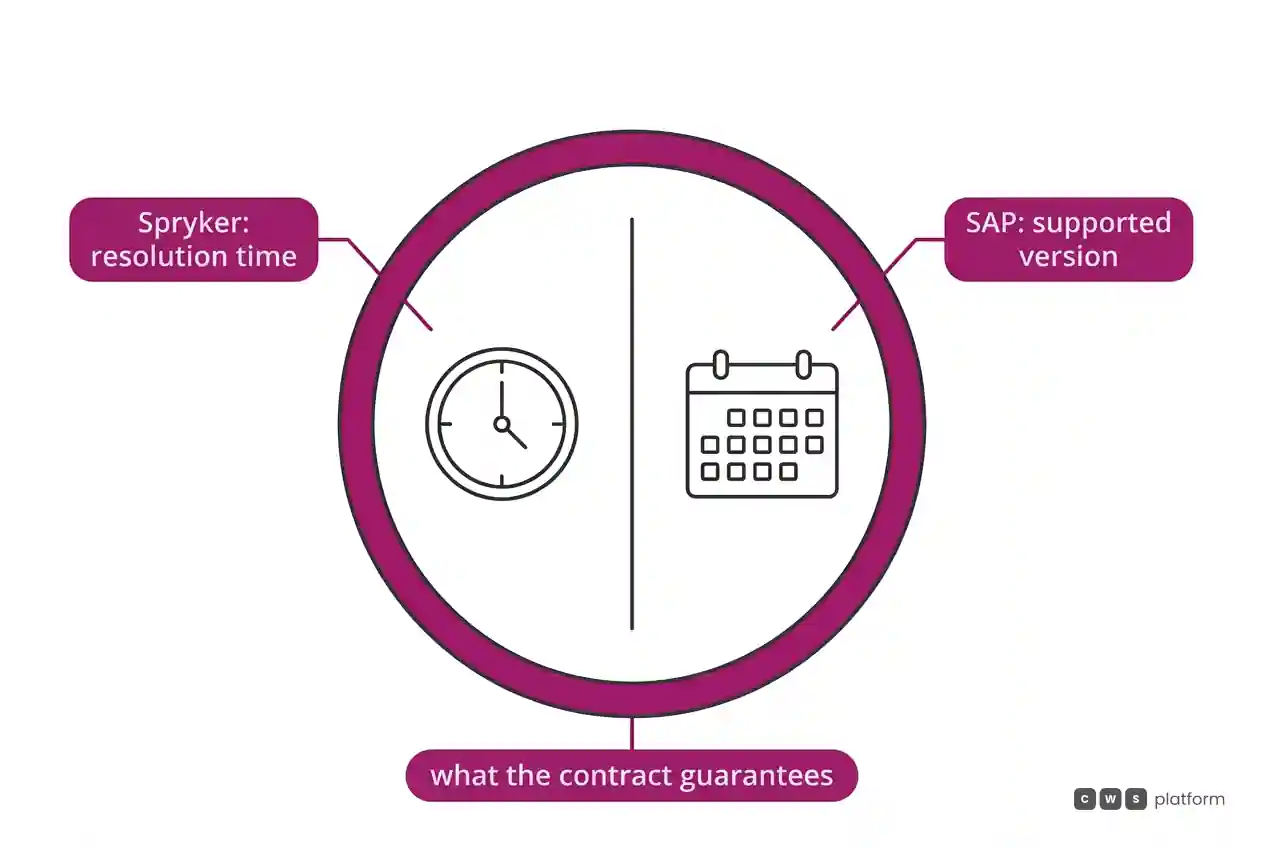
Recorded in Spryker's documentation, on a page dated September 7, 2026: the page on support SLAs states that Spryker does not and cannot guarantee resolution times for support cases ("we do not and cannot guarantee resolution times for the issues you open with us", Spryker support SLAs).
Recorded in SAP's documentation, on a page dated September 9, 2026: continuing to run an unsupported version can put the customer in breach of the SAP contract and lead to its termination ("you could be in breach of your SAP contract", SAP Commerce Cloud version maintenance policy).
One record covers what support commits to deliver; the other, what the customer commits to maintain. Ask both vendors, in writing, for response times by severity, what counts as a supported version, and how long you have to move off a version before it loses support.
Deployment and maintenance: who applies the update
On Spryker, updates arrive as code. Per the Code Upgrader documentation, the tool compares the project's composer.json and composer.lock with the latest released code, applies security releases first, and opens a pull request; major versions stay with the team, with instructions in the pull request. Recorded in Spryker's documentation, accessed on October 16, 2026: the Code Upgrader is shipped with PaaS+ in the EU and US regions ("The Upgrader is shipped with PaaS+ in the EU and US regions.", Spryker Code Upgrader). Ask whether the proposed contract includes PaaS+ and in which region the project will run.
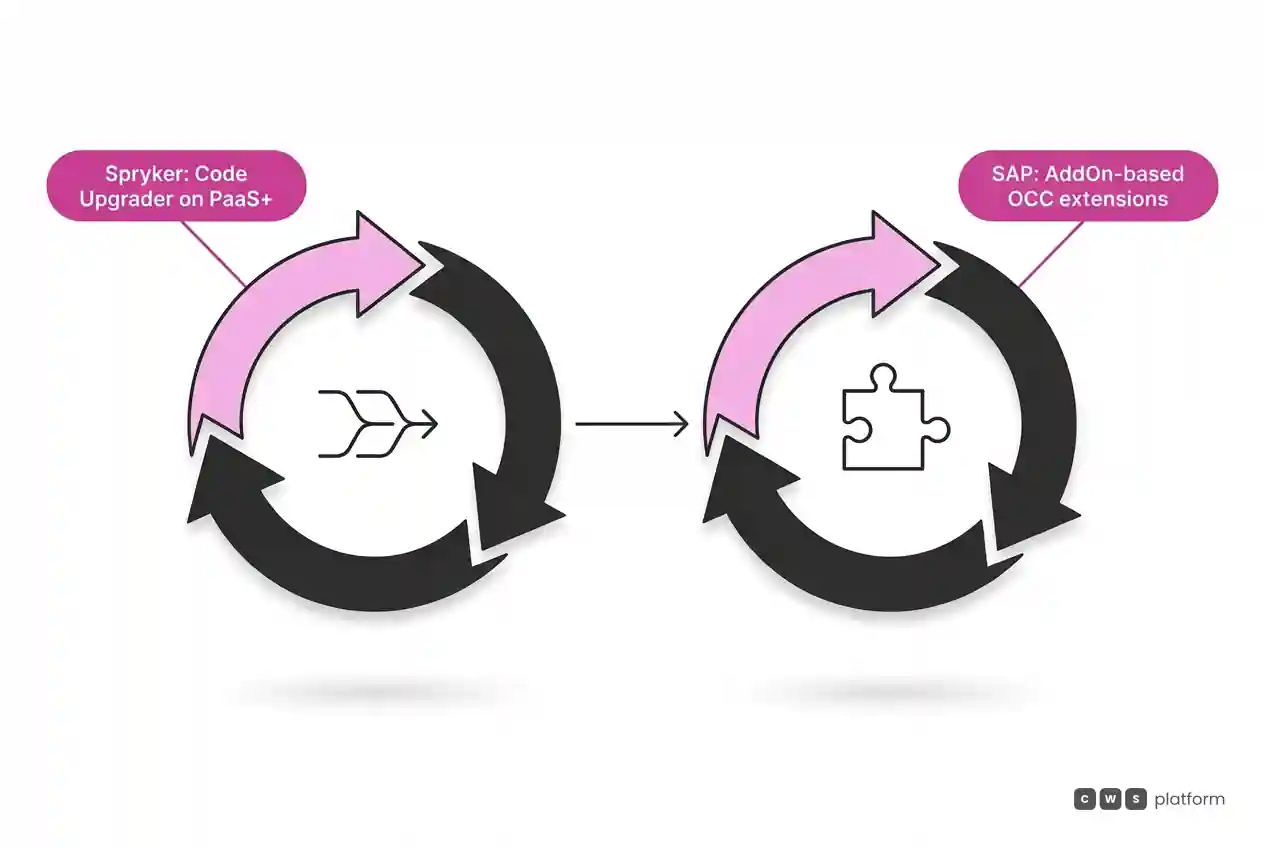
At SAP, the store is built from a Git repository and a build manifest with extensions, properties, and tests, according to the About SAP Commerce Cloud page, and commerce services are exposed over REST through Omni Commerce Connect (OCC). Recorded in SAP's documentation, on a page dated September 9, 2026: after removal, the AddOn-based OCC v2 extensions are no longer scanned for security issues and no longer receive updates ("won't be scanned for security issues nor receive updates", notes on AddOn-based OCC extensions). Ask how many of the project's extensions depend on that model and who carries out the switch.
When to choose Spryker
An order process designed by the company. Spryker's OMS models the order lifecycle as a state machine, with events triggered automatically, manually, by API, or by timeout.
Buyers who purchase from their own procurement system. The PunchOut Gateway implements OCI and cXML flows to connect the store to eProcurement systems.
Updates delivered as pull requests, on PaaS+. The Code Upgrader, shipped with PaaS+ in the EU and US regions, applies security releases first and delivers the rest in groups for the team to review.
When to choose SAP Commerce Cloud
Companies already on SAP's ERP. The cloud ERP edition has connectivity managed by SAP and reads price, inventory, and order status from SAP Cloud ERP; SAP announces a standard implementation of about 12 weeks for that edition.
Corporate buying under contract. B2B self-service brings contract prices, quotes, invoices, and multi-step approval into the buyer's account, according to SAP Commerce Cloud for ERP.
High-complexity quotes. SAP CPQ controls discounts with eligibility rules and guardrails and supports quotes with more than 10,000 lines.
When neither fits
Spryker and SAP Commerce Cloud solve B2B in opposite ways: one brings the commerce code into the project, the other ties the store to SAP's ERP. The post on the three B2B commerce platform models describes a third path: moving commercial rules into the platform.
That is the CWS Platform model. Billing is a platform license plus an integration license, with no percentage of sales or GMV. All customers run the same version. Price tables, rules, and contracts are configurable in the platform and can come from the ERP or CRM through APIs, and commercial policy is stored as parameters in the Commerce Rules Engine of the CDL Workspace: configuration instead of code. The platform has 11 modules, 6 AI Agents, and 1,029 parameters.
Each vendor is read against that model in Spryker vs CWS Platform: what goes into total cost of ownership after you sign? and in SAP Commerce Cloud vs CWS Platform: does your license scale with sales volume?. If the contract on the table still leaves open questions about what comes after signing, talk to a CWS Platform specialist before you close.
Frequently asked questions
Spryker vs SAP Commerce Cloud: which costs less after signing?
The sources in this comparison carry no prices, so the answer depends on the two proposals. SAP records billing in blocks of orders per year or by GMV, and the Spryker sources used here do not cover billing. After signing, the cost that varies most is maintenance: support, updates, and replacing extensions.
What does the support contract guarantee with each one?
Spryker records on its SLA page that it does not guarantee resolution times for support cases. The SAP sources used here do not detail the SLA, but they record the other side of the contract: running an unsupported version can put the customer in breach and lead to termination. Ask both vendors for response times by severity, in writing.
Who pays for the upgrade?
The sources in this comparison do not say who pays, for either vendor. On Spryker, the Code Upgrader, shipped with PaaS+ in the EU and US regions, opens pull requests, and major versions stay with the team. At SAP, the AddOn-based OCC v2 extensions, once removed, no longer receive updates. In both, the work needs an owner and a budget line.
What happens if the version goes out of maintenance?
At SAP, the documentation records that continuing on an unsupported version can put the customer in breach of contract and lead to termination. On Spryker, the sources in this comparison do not cover out-of-maintenance versions; they record that the Code Upgrader, shipped with PaaS+ in the EU and US regions, applies security releases first. Ask both vendors for their version policy in writing, with dates.
Brands mentioned in this article



- SAP Commerce Cloud
Trademarks and logos belong to their respective owners. Mention does not imply partnership or endorsement.
"responsive, technically engaged, and willing to work through complex commercial rules (negotiated pricing, credit, customer-specific conditions) rather than pushing generic answers"
Does your implementation never end?
Request an assessment of your operation or talk straight to a specialist, whichever you prefer.
I'd rather get the next articles on implementation
A weekly roundup of new articles on implementation, only in weeks when there is one. No spam, and you can leave in one click.