VTEX vs Adobe Commerce: which one handles the typical B2B order?
Several units, high quantities, prices with decimal places, and delivery to multiple addresses, read in each vendor's documentation.

Editorial note: CWS Platform competes with both VTEX and Adobe. This comparison uses only each vendor's public documentation, with the address next to each fact and the date of each record cited.
Short answer: VTEX fits companies that want a composable, multitenant cloud platform, with B2B assembled from B2B Suite apps, price tables per organization, and many ready-made integrations. Adobe Commerce fits companies that want B2B as an extension of the platform itself, with company accounts, shared catalogs, and quotes, and that are willing to choose between SaaS, dedicated cloud, or open source code run by their own team.
A Director of Commerce weighing VTEX against Adobe Commerce is choosing where the typical B2B order in the book of business will run: one buyer responsible for several units, a high quantity of the same item, prices carried to more than two decimal places, and delivery split across addresses. Every one of those traits that the platform does not handle as a rule becomes manual work, and the next order costs more than the last.
This piece reads both platforms through that order, without a ranking. The map of platform models is in the three B2B commerce platform models, and the other vendor readings are in the comparisons hub.
VTEX and Adobe Commerce side by side
The table sums up what each vendor's documentation says about the points that weigh on a B2B order.
| criterion | VTEX | Adobe Commerce (Magento) |
|---|---|---|
| Platform model | Composable, multitenant cloud platform with more than 750 API endpoints | Three offerings: multi-tenant SaaS, single-tenant PaaS, and Commerce Optimizer; plus Magento Open Source |
| Native B2B or extension | B2B Suite apps installed through VTEX IO; the B2B Buyer Portal is available for selected accounts | B2B extension installed and enabled on the store, which still supports B2C |
| Customer-specific pricing and contracts | Price tables per organization in the B2B Organizations app; contracts in the B2B Buyer Portal (selected accounts) | Shared catalogs with product prices per company or customer group |
| Quotes | B2B Quotes & Carts app, with quotes created from the cart and price adjustments | Quotes started by the buyer from the cart or by the seller in the Admin |
| Credit and payment terms | Customer credit among the gateway's payment methods | Company credit and Payment on Account |
| ERP integration | REST APIs; external inventory and shipping integrated by API with ERP, PIM, or WMS | REST APIs for third parties; App Builder, API Mesh, webhooks, and events, with back-office starter kits |
| Billing model | Not documented in the sources for this comparison, except custom Master Data entities, billed by document volume | Under Managed Services, a base package with consumption quotas in the sales order |
| Implementation | Apps installed through VTEX IO, with dependencies declared in the theme | From SaaS with automatic updates to open source installed with Composer |
Pricing and commercial rules: decimals and high quantities
Adobe's B2B introduction describes shared catalogs that set product prices for companies or customer groups, across one or more websites, as long as the store is set up for company accounts. On VTEX, the B2B Organizations app groups a company's users into an organization with its own price tables, payment methods, and product collections.
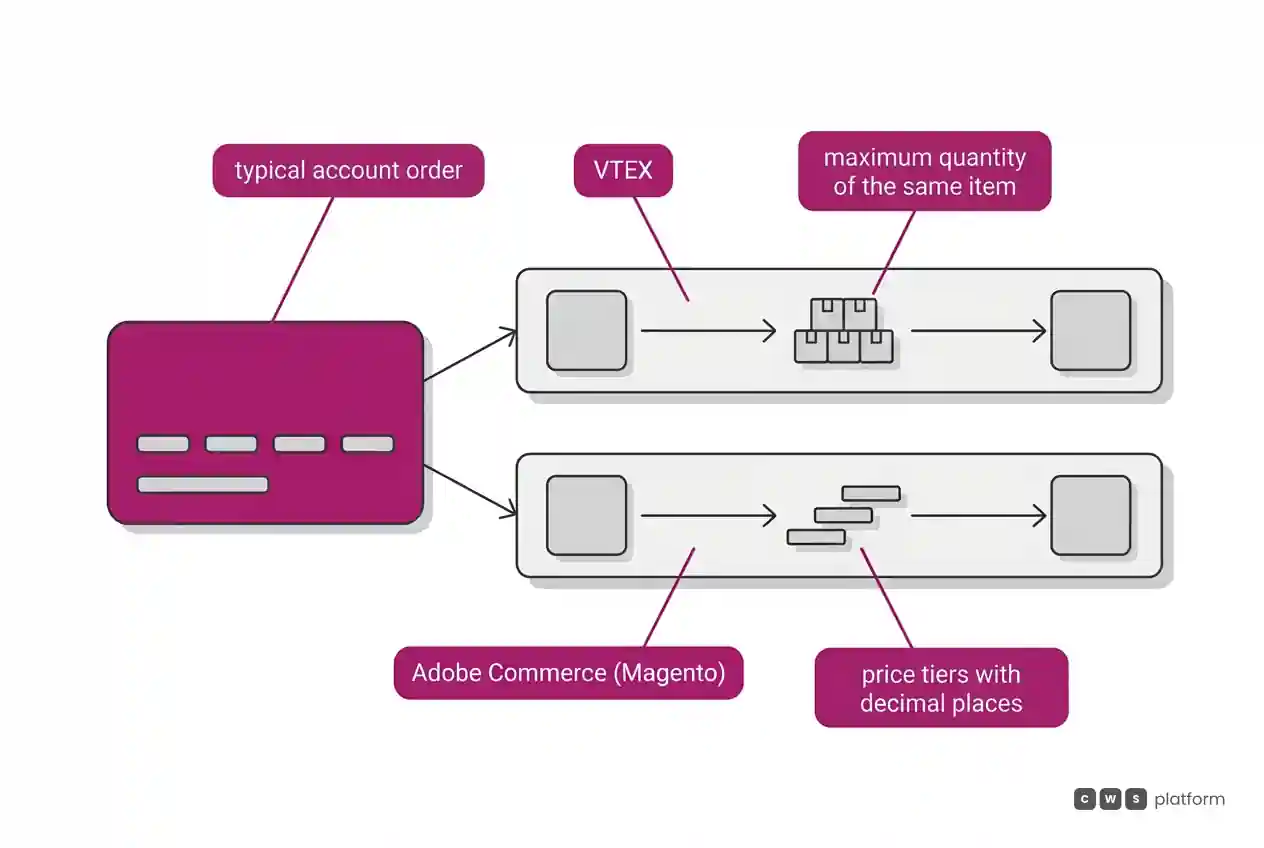
Two public records touch this order.
- On the Adobe side, recorded in Adobe's public issue tracker (magento/magento2 repository), still open as of November 5, 2026, labeled "Issue: Confirmed": the issue titled "Price tiers calculated on 2 decimals even when prices of 4 decimals are entered" describes tier prices calculated to two decimal places even when the price was entered with four (issue #15772).
- On the VTEX side, recorded by VTEX as a known issue, still open as of November 5, 2026: the maximum quantity of the same item in the cart cannot be changed by franchise accounts or by the seller portal ("The configuration of the maximum quantity of the same item in the cart cannot be changed by franchise accounts (seller whitelabel) and seller portal", VTEX known issue).
In the Adobe demo, it is worth asking how the project handles quantity tier pricing on a product sold with four decimal places. In the VTEX demo, it is worth asking whether the operation will use franchise accounts or the seller portal, and what the per-item quantity cap is in those accounts, since that is where a high-volume replenishment order hits.
Quotes, assisted selling, and the buyer with several units
The second trait of the typical order is who buys. On Adobe, the company account brings several buyers together, and the company admin sets up divisions, subdivisions, and users with roles and permissions for orders, quotes, purchases, and credit. A quote starts with the buyer, from the cart, or with the seller, in the Admin, and both sides change items, quantities, and discounts until they agree (B2B introduction).
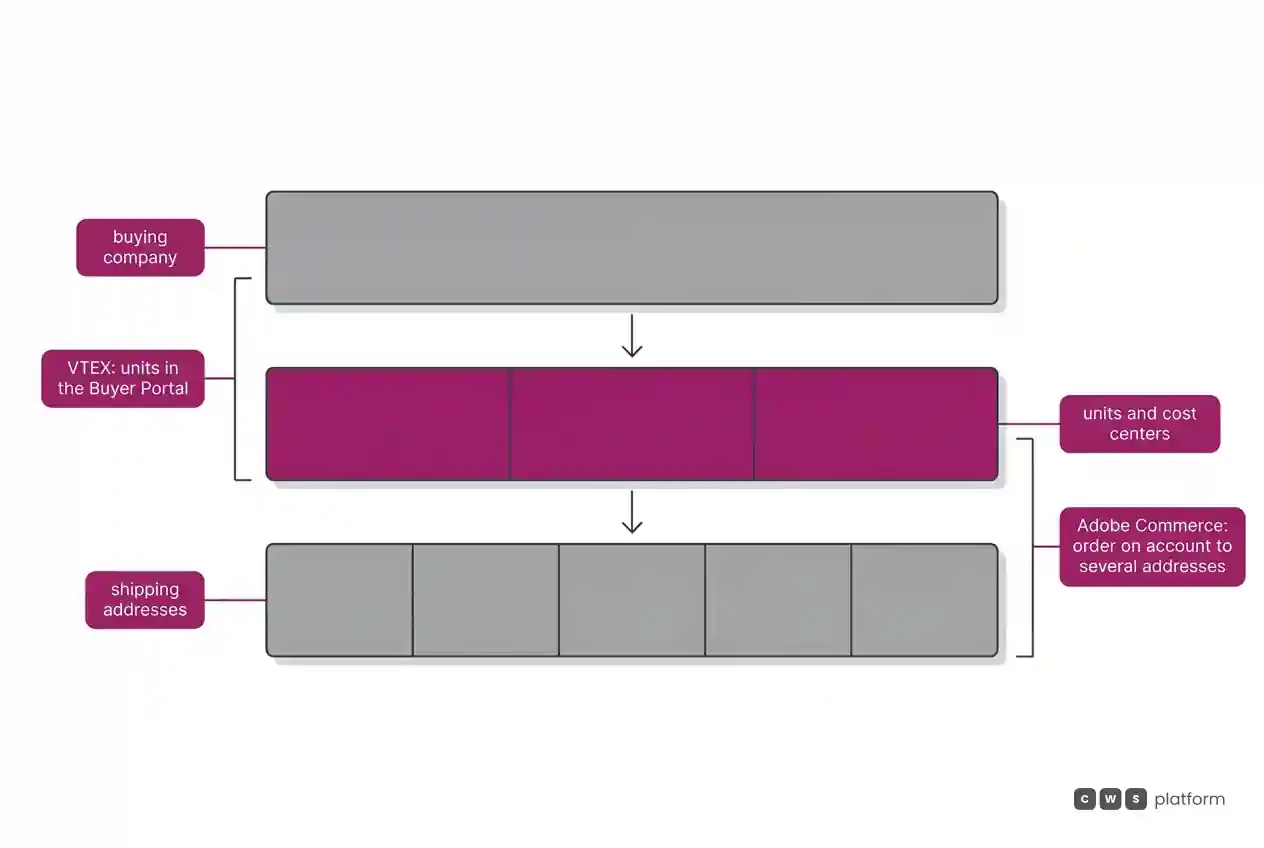
On VTEX, the B2B Quotes & Carts app stores items, quantities, and prices from the cart, and a quote can take price adjustments. The Storefront Permissions roles include the sales representative, who assists and acts on behalf of the buyer within the same cost center.
There is one record on each side.
- On the VTEX side, recorded in VTEX's documentation on March 5, 2026: organizational units, which represent the buyer's hierarchy, exist only in stores using the B2B Buyer Portal, currently released to selected accounts ("This feature is only available to stores using B2B Buyer Portal, which is currently available for selected accounts.", organizational units).
- On the Adobe side, recorded in Adobe's documentation on June 15, 2026: Payment on Account is not supported for orders with multiple shipping addresses ("not supported for orders with multiple shipping addresses", basic B2B features).
For VTEX, it is worth asking whether your account will have the B2B Buyer Portal and, if not, how the hierarchy between headquarters and branches will be represented. For Adobe, it is worth asking what happens to an order on account that ships to more than one address: whether it becomes several orders, who builds them, and how company credit is drawn down.
ERP integration: where the order's rules live
VTEX's fulfillment guide says that managing inventory and shipping externally requires API integration with the back office, whether ERP, PIM, or WMS. The platform page mentions connectivity with ERP, WMS, and carrier partners.
Adobe's pricing page describes extensions and integrations built with App Builder, API Mesh, webhooks, and events, plus starter kits for checkout, back-office, payments, tax, and shipping. The developer documentation separates GraphQL for the storefront from REST for third-party software.
The useful question is not how many connectors exist, but who writes and maintains the connector to your ERP, and where the pricing and credit rules it carries live.
Cost and billing model
The sources for this comparison say little about billing. On VTEX, the extensibility guide says that in Master Data, native entities are free and custom entities are billed monthly, in tiers, by document volume. If the project stores commercial rules in a custom entity, the volume of those rules enters the bill.
On Adobe, the Managed Services product description provides for a base package, with consumption quotas in the sales order, such as vCPU days, storage, and CDN transfer, and add-ons billed per unit.
With both, ask in writing what is in the base contract, what is an add-on, and what depends on a partner.
Implementation and ongoing support
VTEX is a multitenant cloud platform: the B2B apps are installed through VTEX IO, and B2B Organizations brings Storefront Permissions as a required dependency and must be declared in the theme manifest (B2B Organizations).
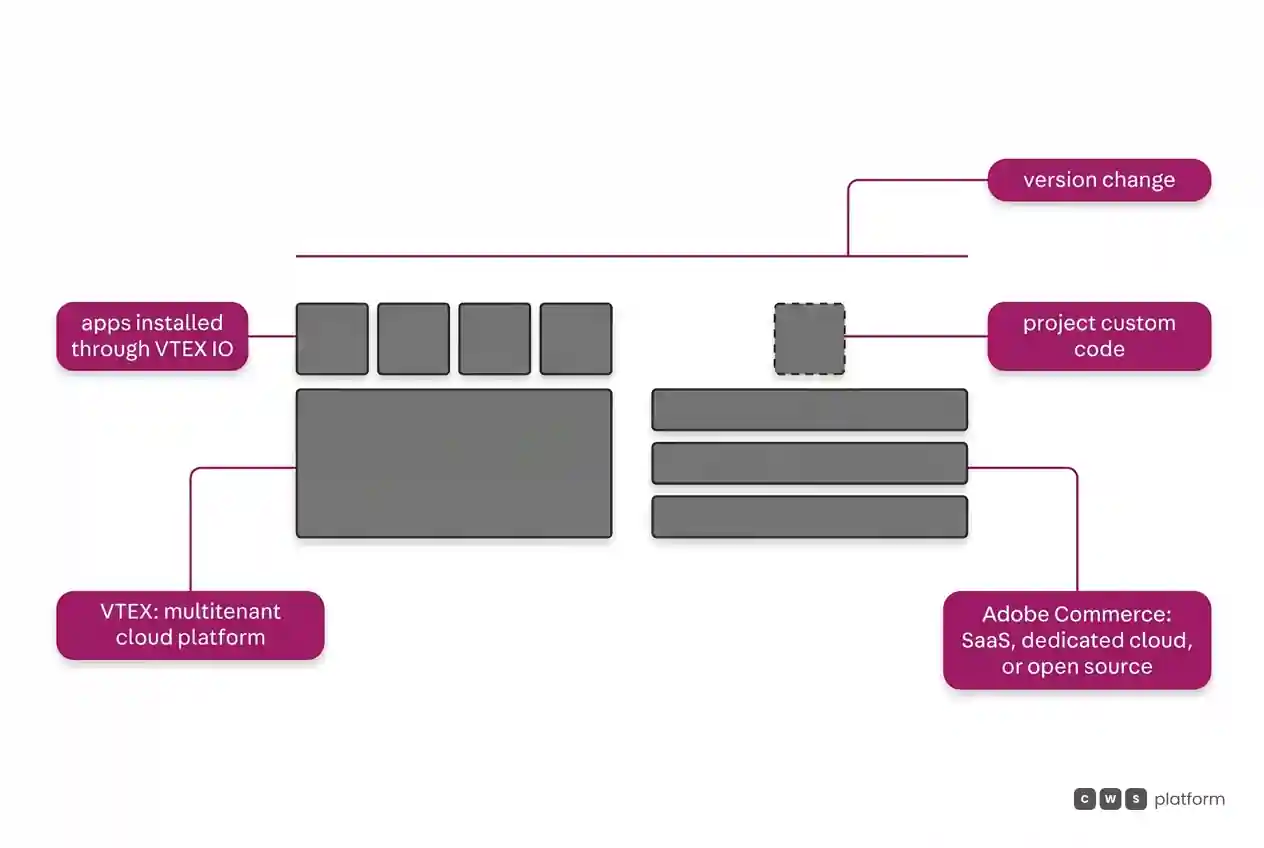
Adobe offers three paths. Cloud Service is multi-tenant SaaS with automatic feature and security updates, according to the pricing page. Under Managed Services, Adobe hosts and manages the application and infrastructure, and the customer owns the custom code. And Magento Open Source keeps its code open on GitHub, installed with Composer (Magento Open Source).
The question is the same for both: who maintains what was customized for the B2B order when the platform changes version.
When to choose VTEX
An operation already rooted in retail that wants to add B2B. VTEX unifies ecommerce, physical stores, marketplace, and B2B under the same order orchestration, with global inventory visibility, according to the VTEX Commerce Platform page.
Lots of ready-made integrations. The composability guide lists more than 750 API endpoints and more than 900 ready-made integrations with payment providers and marketplaces.
Buyers organized by organization and cost center. B2B Organizations gives each organization its own price tables and payment methods, and each cost center has its own shipping addresses.
When to choose Adobe Commerce
B2B as an extension of the same store. The B2B extension is installed on the store and runs alongside B2C, with company accounts, divisions, roles, and permissions, according to the B2B introduction.
Purchase orders with approvals. With purchase orders enabled for a company, every order is created as a PO and can go through several approval rules, according to the same B2B introduction.
A choice of operating model. SaaS, dedicated cloud, or open source run by your own team, as the pricing page and the Magento Open Source page show.
When neither fits
In some operations the typical B2B order is the rule, not the exception, and the company does not want to assemble that rule from apps or extensions. For those, there is a third model, described in the three B2B commerce platform models: bring the commercial rules into the platform.
That is the CWS Platform model. Price tables, rules, and contracts are configurable in the platform and can come from the ERP or CRM by API, and decimal places are customizable. The cart holds 250 items by default, configurable. Payment terms work with split, scheduled delivery to multiple addresses from multiple origins, and the customer's credit limit is kept in the platform. Commercial policy lives in parameters in the CDL Workspace, and every customer runs the same version. The platform brings together 11 modules, 6 AI Agents, and 1,029 parameters.
The vendor-by-vendor readings against CWS are in VTEX B2B Commerce vs CWS Platform and Adobe Commerce vs CWS Platform: end of life and architecture. If your typical order has several units, high quantities, and split delivery, it is worth talking to a CWS Platform specialist and testing that order, with your own data, before you decide.
Frequently asked questions
VTEX or Magento: which is better for B2B?
It depends on the orders your accounts place. VTEX fits companies that want a composable cloud platform, with B2B assembled from B2B Suite apps and organizations with their own price tables and cost centers. Adobe Commerce fits companies that want B2B as an extension of their own store, on SaaS, dedicated cloud, or open source.
Which one handles orders with several units and addresses?
On VTEX, each organization is split into cost centers with their own addresses, and organizational units depend on the B2B Buyer Portal, released to selected accounts. On Adobe, the company account has divisions and subdivisions, but the documentation records that Payment on Account is not supported for orders with multiple shipping addresses. Test that order in both demos.
Does VTEX B2B come ready for any account?
Not entirely. The B2B Suite apps, such as B2B Organizations and B2B Quotes & Carts, are installed through VTEX IO. Features such as organizational units and contracts belong to the B2B Buyer Portal, which VTEX describes as available for selected accounts.
Which one needs a bigger technical team?
It depends on the offering. VTEX is a multitenant cloud platform, and B2B means installing apps and adjusting the theme. On Adobe, Cloud Service is SaaS with automatic updates, Managed Services leave the custom code with the customer, and Magento Open Source is open code that your own team installs and runs.
Further Reading
Brands mentioned in this article
 VTEX
 Magento
- Adobe Commerce
Trademarks and logos belong to their respective owners. Mention does not imply partnership or endorsement.
"responsive, technically engaged, and willing to work through complex commercial rules (negotiated pricing, credit, customer-specific conditions) rather than pushing generic answers"
Is every order costing your operation more?
Request an assessment of your operation or talk straight to a specialist, whichever you prefer.
I'd rather get the next articles on the cost of each order
A weekly roundup of new articles on the cost of each order, only in weeks when there is one. No spam, and you can leave in one click.