VTEX vs. CWS Platform: what comes ready in VTEX B2B commerce?
Contracts, organizational units, and spending controls in B2B Buyer Portal, available to selected accounts, and the app-assembled B2B for everyone else: the read for whoever owns commerce.

Editorial note: an architecture comparison between VTEX and CWS Platform, written for those who answer as Director of Commerce. Every fact about VTEX comes from its public documentation, with the address next to it.
Anyone who owns commerce at a manufacturer or distributor knows the scene: the demo shows a customer contract with its own assortment and pricing, the buying company's hierarchy of purchasers, and an order that goes through approval before it ships. Everything works on screen. The question that decides the project comes later, and almost nobody asks it out loud: is what I saw in the demo what my account gets on day one, or is it where a project ends up?
In B2B, the commercial terms are the product. Price is the result of a rule that looks at who is buying, how much, on what terms, and how they pay. If the contract, the hierarchy, and the approval do not come ready, they become a development queue, and the digital channel moves at the pace of that queue.
This comparison looks at VTEX and CWS Platform from that angle only: what comes ready for B2B selling and what has to be assembled. It is not a feature ranking. The overall map is in the post on the three B2B commerce platform models, and the other vendor reads are in the comparisons hub.
What VTEX does well
According to its composability guide, it runs as a composable, multitenant cloud commerce platform built on decoupled, event-driven microservices, with more than 750 API endpoints and more than 900 ready-made integrations with payment providers and marketplaces.
The VTEX Commerce Platform page describes ecommerce, physical stores, marketplace, and B2B brought together through order orchestration, with global inventory visibility and connectivity to ERP, WMS, and carriers. Under B2B, the same page lists Buyer Organization management, request for quote, quick order, and reorder.
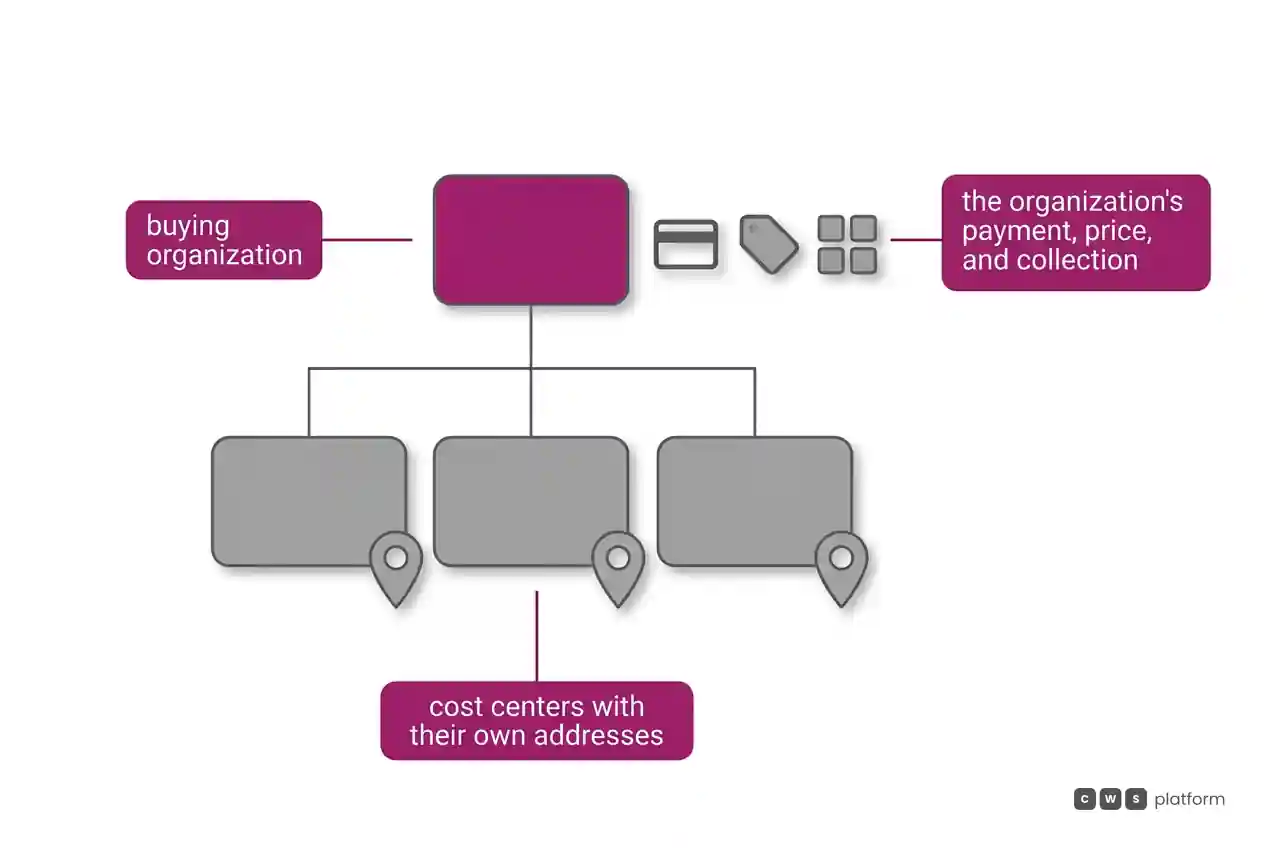
To organize business customers, the B2B Organizations app groups corporate users into organizations that share commercial rules. Each organization can have its own payment methods, price tables, and exclusive product collections, and each one is split into cost centers with their own shipping addresses, as the guide on managing B2B organizations also describes.
Where the architecture diverges
The divergence that matters to the Director of Commerce is the reach of VTEX's most complete B2B offering. Two records say where it lives and who gets it:
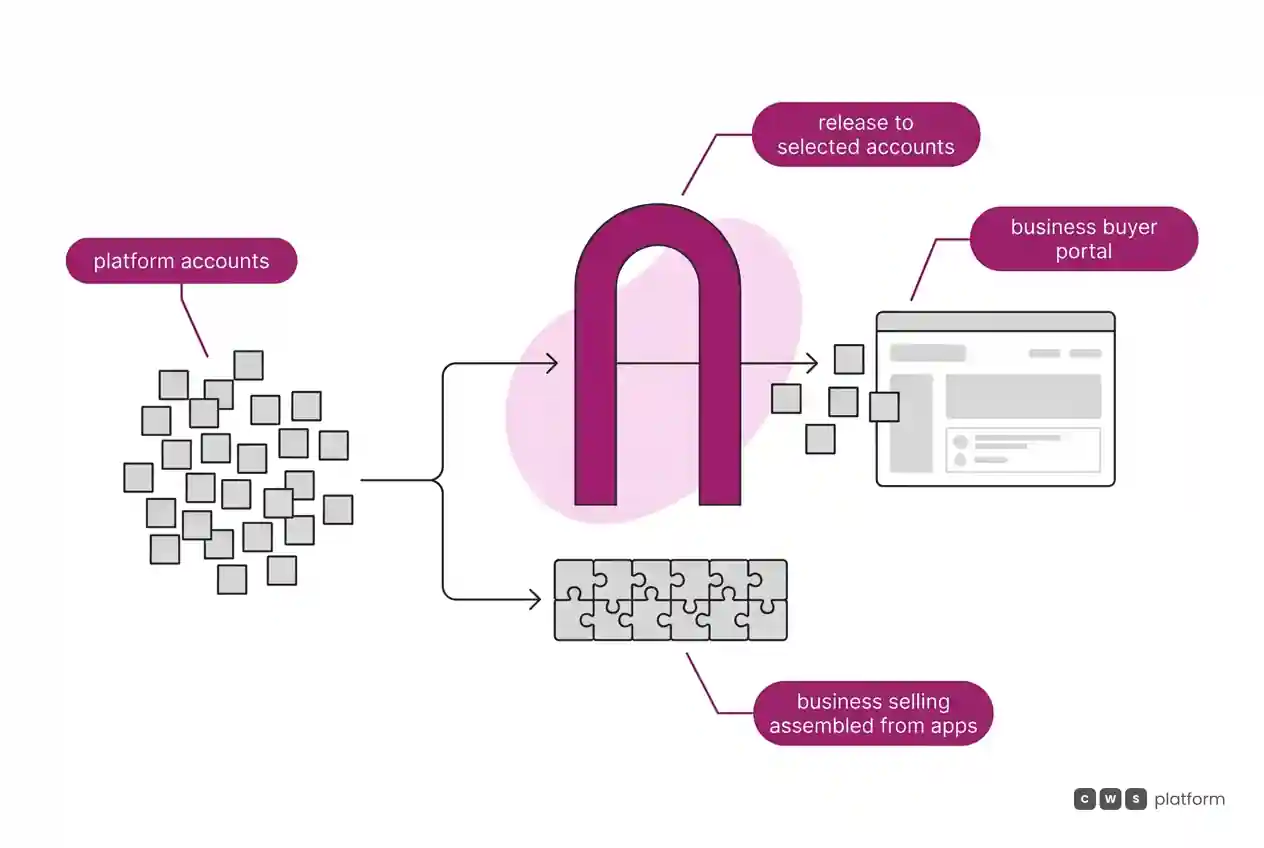
- limitation recorded in VTEX's documentation on April 24, 2026: VTEX states that B2B Buyer Portal is currently available only to selected accounts ("B2B Buyer Portal is currently available for selected accounts.", https://help.vtex.com/en/docs/tutorials/b2b-buyer-portal).
- limitation recorded on the B2B contracts page of VTEX's documentation on March 6, 2025: VTEX states that B2B contracts are only available for stores using B2B Buyer Portal, released to selected accounts ("This feature is only available for stores using B2B Buyer Portal, which is currently available to selected accounts.", https://help.vtex.com/en/docs/tutorials/b2b-contracts).
B2B Buyer Portal is the self-service storefront where the buying organization manages its own account, commercial agreements, and spending controls through contracts, organizational units, scopes, members, and roles. That is where contracts, organizational units, and spending controls live. And, as recorded above, the portal and the contracts that depend on it are released to selected accounts.
For an account outside that selection, the B2B that VTEX documents is made of apps. B2B Organizations is installed through the VTEX IO command line and brings Storefront Permissions as a mandatory dependency; showing the buyer's status in the store depends on declaring the dependency in the theme manifest and adding a block to the header; and applying payment methods and addresses per organization at checkout happens with the B2B Checkout Settings app, according to the B2B Organizations documentation. Quoting, in turn, is the B2B Quotes & Carts app, managed through its GraphQL API.
None of this rules out B2B, but it changes the decision: for an account outside the selection, what the commercial page lists becomes a set of apps to install, configure in the theme, and maintain. The question stops being "can the platform do it?" and becomes "does my account get it, and by which path?".
On CWS Platform, price tables, rules, and contracts are configurable in the platform and can come from the ERP or CRM through APIs. Commercial policy lives in parameters in the Commerce Rules Engine, in CDL Workspace, on the principle of configuration over code. And all customers run the same version of the platform.
| decision | VTEX, per the documented mechanism | CWS Platform |
|---|---|---|
| Where the B2B contract lives | In B2B Buyer Portal, available to selected accounts | Price tables, rules, and contracts configurable in the platform or coming from the ERP and CRM through APIs |
| Who gets the capability | The accounts selected for Buyer Portal | All customers, on the same version of the platform |
| How B2B is assembled outside the portal | VTEX IO apps: B2B Organizations, Storefront Permissions, B2B Checkout Settings, and B2B Quotes & Carts, with theme changes | Commercial policy in Commerce Rules Engine parameters, configuration over code |
The commerce decision is knowing, before signing, whether the account will run the B2B from the demo or the B2B assembled from apps, and who maintains each part.
What changes in operations, through the Director of Commerce lens
For whoever owns the buying experience, the difference shows up on three fronts. The first is the contract with the platform vendor. It is worth asking in writing whether the account is among those selected for B2B Buyer Portal and which items from the commercial page come through it. If the answer is no, the scope has to list which apps go in, who configures the theme, and who is responsible for each one after go-live. Before signing, that conversation costs one meeting; after, it costs the timeline.
The second is the pace of commercial policy. In a growing B2B channel, the rules change all the time: a customer group arrives with its own price table, a region's payment terms change. When the rule lives in an app and in the theme, each change tends to go through the technical team. On CWS, commercial policy lives in parameters, and thousands of promotions can run at the same time. The discount a sales rep grants goes through multi-level approval, and the customer's credit limit is kept in the platform itself.
The third is the scale of the book of business. Taking B2B digital is not opening a store; it is distributing the negotiation rule to thousands of buyers and sales reps without each of them having to know the ERP. On CWS, customer and rep use the same interface, and the cart holds 250 items by default, configurable.
When to choose VTEX
VTEX fits scenarios with these characteristics:
Consumer retail across several fronts. Choose this architecture when the center of the operation is the end consumer, with ecommerce, physical stores, and marketplace under the same order orchestration, as the VTEX Commerce Platform page describes.
A partner and integration ecosystem. Choose this architecture when the strategy depends on connecting many payment providers and marketplaces, backed by the more than 900 ready-made integrations cited in the composability guide, and on contracting extensions and partners through the Extensions Hub.
A global D2C operation. Choose this architecture when the brand sells direct to consumers in several markets and wants a multitenant cloud platform, with a headless front end and a one-click checkout option, both listed on the VTEX Commerce Platform page.
An account selected for Buyer Portal. Choose this architecture when the account already has confirmed access to B2B Buyer Portal and the B2B it needs fits that design.
When CWS Platform is the right choice in this scenario
CWS Platform is the right choice when B2B is the center of the operation and commercial policy has to be ready for every customer, not only some.
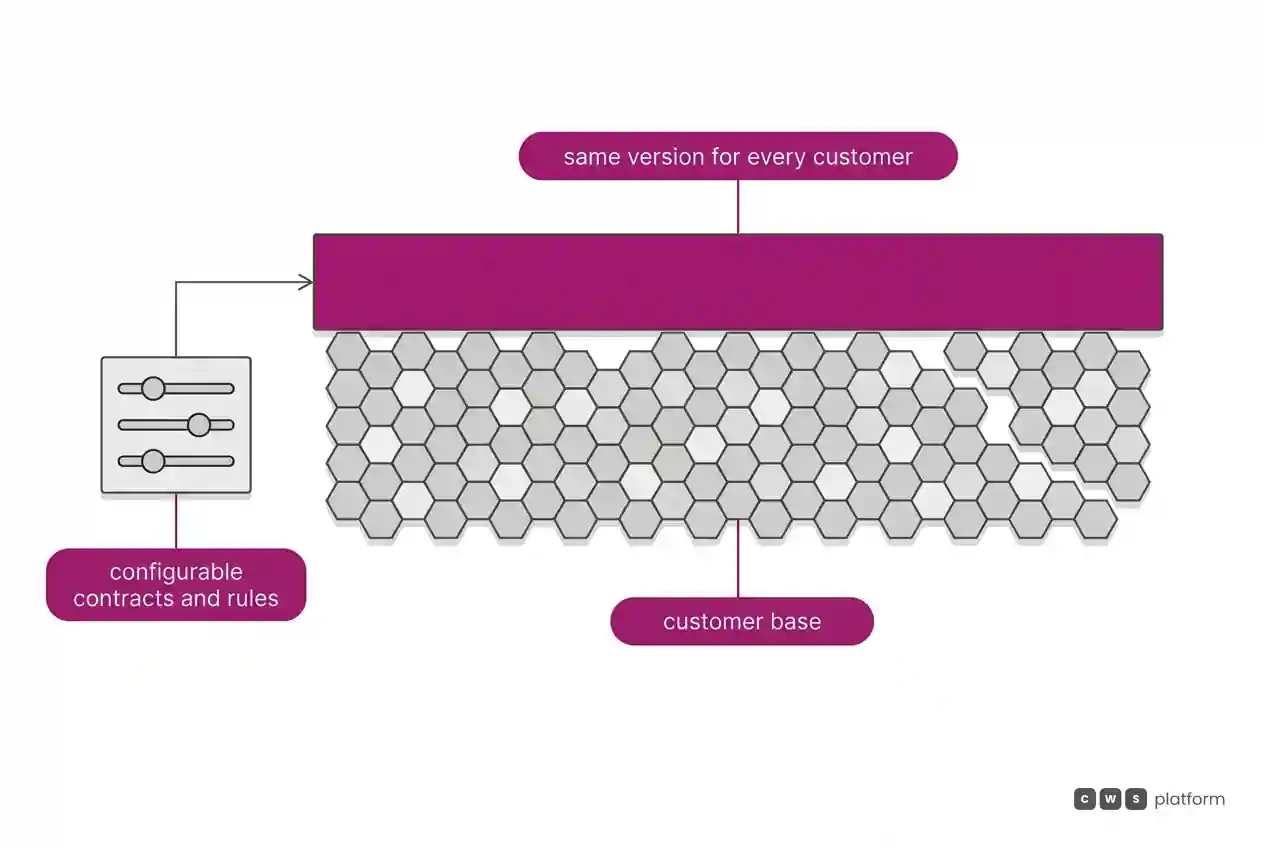
Per-customer contracts in the platform. Choose this architecture when each customer has its own price table, rules, and contract. Price tables, rules, and contracts are configurable in the platform or come from the ERP and CRM through APIs.
The same platform for everyone. Choose this architecture when the channel cannot depend on a per-account release. All customers run the same version of the platform.
Commercial rules in parameters. Choose this architecture when commercial policy changes often. The Commerce Rules Engine keeps policy in parameters, and CDL Workspace is one system for the whole ecosystem.
A large book of business and assisted orders. Choose this architecture when the sales rep takes part in the purchase. One rep serves thousands of customers, builds the cart and sends the link for the customer to close, and the order records who built the cart and who chose the payment.
Where to go from here
If the question is still which platform model fits your operation, the starting point is the three B2B commerce platform models.
If the decision depends on what your account gets on day one, it is worth talking to a CWS Platform specialist and mapping, with your real contracts and book of business, what needs to be ready before the first sale. The page When Channels Fight Each Other covers the pain behind this scenario in depth, without talking about any vendor.
Read more
- State Taxes, Exemption Certificates, and Invoicing: Managing Compliance in B2B E-Commerce
- Enterprise System Integration in B2B Sales: What to Connect First and How
- B2B Customer Portals and Self-Service Ordering
Comparisons with other vendors
To compare VTEX with other platforms, without CWS Platform in the middle:
- VTEX vs Adobe Commerce: which one handles the typical B2B order?
- VTEX vs Salesforce Commerce Cloud: can B2B and retail coexist?
- VTEX vs SAP Commerce Cloud: what can a CFO predict before signing?
- VTEX vs. commercetools: Packaged B2B Suite or Composable APIs?
- VTEX vs Spryker: which fits a B2B marketplace with sellers?
- VTEX vs Optimizely: what goes on the B2B bill?
- VTEX vs OroCommerce: what can change after an order is invoiced?
- B2B ecommerce platforms: the 9 leading options compared
Brands mentioned in this article
 VTEX



- Adobe Commerce
- Salesforce
- SAP Commerce Cloud
- Optimizely
- OroCommerce
Trademarks and logos belong to their respective owners. Mention does not imply partnership or endorsement.
"responsive, technically engaged, and willing to work through complex commercial rules (negotiated pricing, credit, customer-specific conditions) rather than pushing generic answers"
Does your implementation never end?
Request an assessment of your operation or talk straight to a specialist, whichever you prefer.
I'd rather get the next articles on implementation
A weekly roundup of new articles on implementation, only in weeks when there is one. No spam, and you can leave in one click.