VTEX vs OroCommerce: what can change after an order is invoiced?
Order changes, inventory decrements, external orders, and posted invoices: through a COO's lens, where each platform closes the order and what comes in from outside.

Editorial note: CWS Platform competes with both VTEX and OroCommerce. This comparison uses only each vendor's public documentation, with the address next to each fact and the date of each record cited.
Short answer: VTEX fits teams that want orders from several channels under one orchestration, with buyer organizations and quoting in B2B Suite apps, accepting that the platform does not subtract items from inventory automatically. OroCommerce fits teams that want quoting, payment terms, and invoices inside the product itself, with a choice of where to host it, accepting that a posted invoice can no longer be modified.
A COO comparing VTEX and OroCommerce is really choosing what happens to the order after checkout: who decrements inventory, at what point the order stops accepting changes, and how orders that started outside the portal get in. In B2B, an order rarely ships exactly as it was keyed in, and each platform documents a point of no return and a path for what comes from outside.
The map of platform models is in three B2B commerce platform models, and the other comparisons are in the comparisons hub, including VTEX vs Adobe Commerce and OroCommerce vs Magento B2B.
VTEX and OroCommerce side by side
The table sums up what each vendor's documentation records; where the source does not cover a point, the cell says so.
| criterion | VTEX | OroCommerce |
|---|---|---|
| Platform model | Composable, multi-tenant cloud platform with more than 750 API endpoints | Enterprise Edition on OroCloud, public cloud, private cloud, or on-premise |
| Native B2B or by extension | B2B Suite apps installed through VTEX IO | Customer hierarchy, quoting, payment terms, and invoices in the product |
| Customer and contract pricing | Price tables per buyer organization | Price lists combined by website, customer group, and customer |
| Quoting | B2B Quotes & Carts, with statuses and price adjustments | RFQ converted into a quote or straight into an order |
| Credit and net terms | Customer credit among the payment methods | One payment term per customer |
| ERP integration | REST APIs; external inventory and shipping integrated through APIs | Integrations described for SAP, Epicor P21, and JD Edwards; REST API |
| Billing model | Not covered in the sources used here | Not covered in the sources used here |
| Implementation | Apps installed through VTEX IO, with dependencies in the theme | OroCloud on GCP or OCI, with testing, staging, and production environments |
Pricing and the commercial rules each order carries
On VTEX, the buyer's rules live in the organization. The B2B Organizations app groups a company's users into an organization with its own price tables, payment methods, and product collections, split into cost centers with their own shipping addresses. At checkout, payment methods and addresses predefined per organization or cost center come in through the B2B Checkout Settings app.
On OroCommerce, the rules live in price lists. Per the Combined Price Lists guide, the price results from chains of lists assigned at the configuration, website, customer group, and customer levels. Terms come through the payment term, with conditions such as prepayment, payment on delivery, or net 30, and a single term per customer.
For the COO, the question is which rules the order carries with it when it leaves the portal and reaches invoicing, and who checks that they arrived intact.
Quoting, assisted selling, and the order after it closes
On VTEX, negotiation goes through the B2B Quotes & Carts app. Per the B2B Quotes GraphQL API, a quote stores the cart's items, quantities, and prices, accepts quantity changes and price adjustments, and can be applied to the cart.
On OroCommerce, the back office converts a request for quote into a quote or straight into an order, per the back-office RFQ documentation. The Login as Customer User feature lets an operator enter the storefront as a specific buyer; it is part of the Enterprise edition and is disabled by default.
Once the order closes, each vendor's documentation marks the point after which it no longer changes.
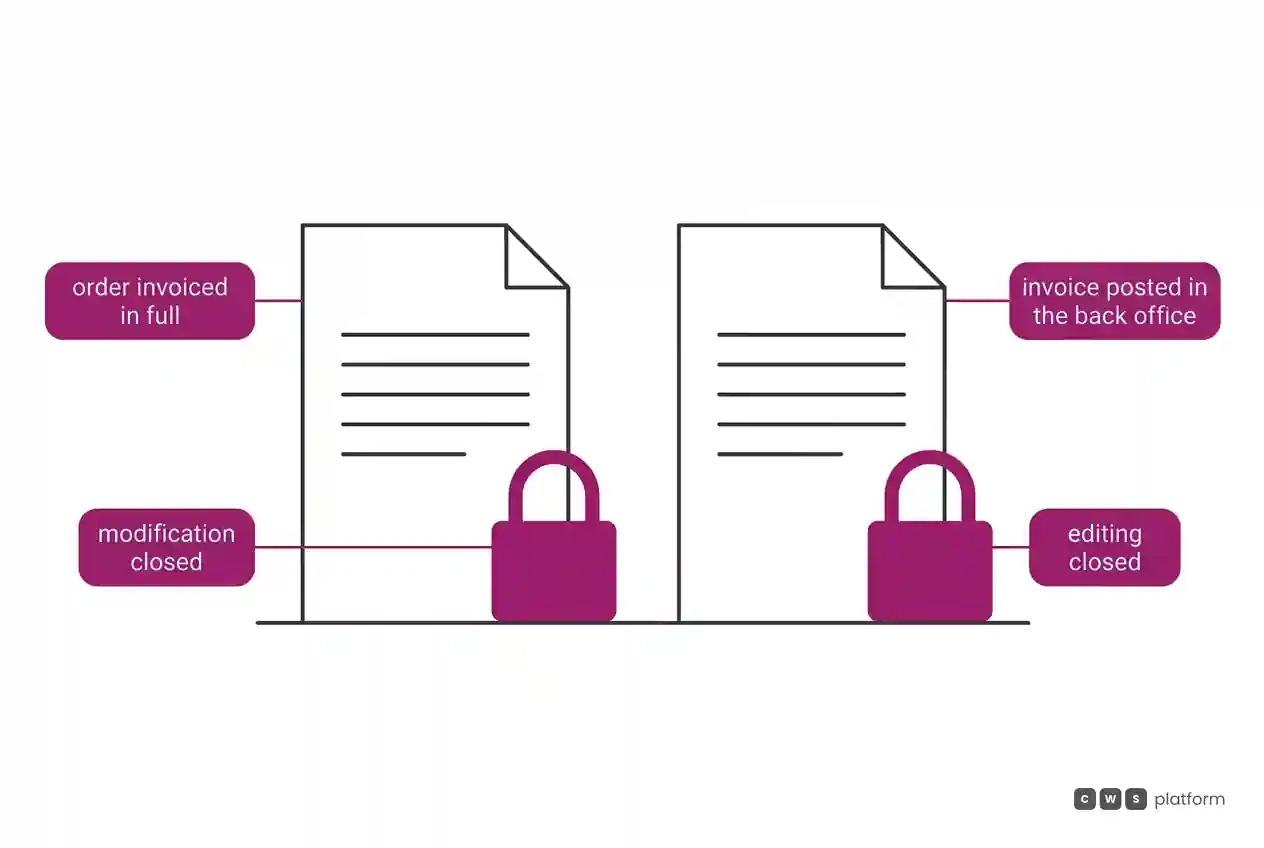
- On the VTEX side, it is recorded in VTEX's documentation, on a page dated June 11, 2025, in the order modification guide: "If the order has already been invoiced in full, it can no longer be modified." (how order modification works).
- On the OroCommerce side, it is recorded in OroCommerce's documentation, accessed on October 16, 2026, in back-office invoice management: "Keep in mind that once posted, the invoice can no longer be modified." (OroCommerce invoice documentation).
The two points are not the same document: one is the order invoiced in full, the other is the posted invoice. It is worth bringing a real order that changed after it closed, with a quantity change and an item swap, to the demo and asking which flow the platform uses from that point on and where the change is recorded.
ERP integration: inventory and orders that come from outside
On VTEX, Inventory Management ties items to warehouses, shows availability and reserved items, and accepts loads by spreadsheet or through the Inventory API. For inventory and shipping managed elsewhere, the fulfillment guide calls for API integration with the ERP, PIM, or WMS.
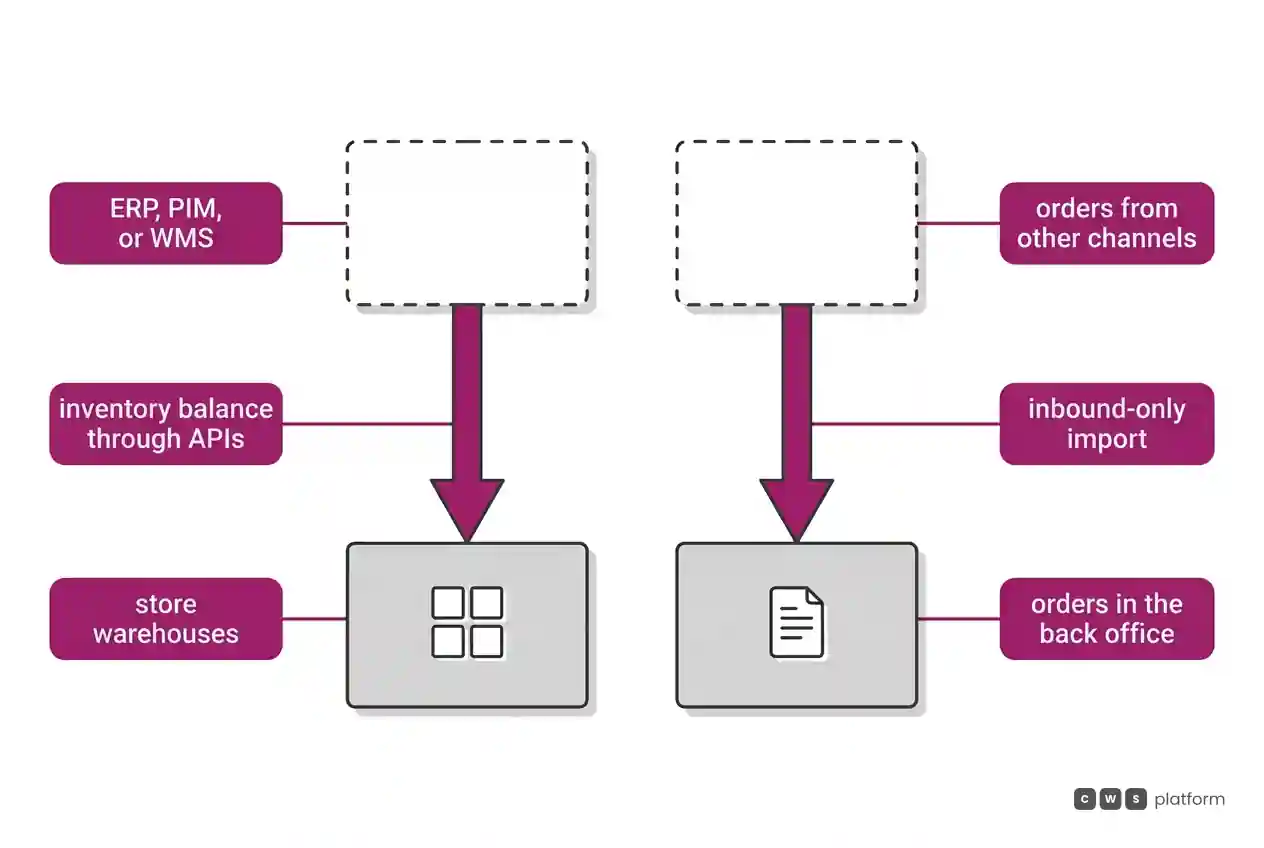
It is recorded in VTEX's documentation, on a page dated September 3, 2024, in the inventory reservation guide: "The VTEX platform does not subtract items from the inventory automatically." (how reservation works). The evaluation question is which system decrements inventory in the proposed design and how long it takes for the balance to reach the storefront again.
On OroCommerce, the edition comparison lists multi-warehouse inventory in Enterprise. The Epicor P21 integration starts by migrating historical data, such as orders and customers, and then keeps syncing: OroCommerce sends new orders and paid invoices and receives inventory levels and unshipped items. Purchase orders received as files or by email become draft orders in AI Smart Order, with uncertain fields flagged for manual validation.
It is recorded in OroCommerce's documentation, accessed on October 16, 2026, that external order import does not allow exporting legacy order data: "Export of legacy order data is not available." (external orders import documentation). It is worth asking where the history of orders from other channels lives after the import and which system operations uses to look it up.
Cost and billing model: what operations pays to keep orders straight
In the sources used for this comparison, neither VTEX nor OroCommerce has the platform's billing basis covered, which is why the table says "not covered" on both sides. The numbers come in each vendor's proposal.
On both, it is worth asking who maintains consistency between inventory, orders, and invoices after go-live, and whether that work shows up in the proposal.
Implementation and upkeep: the window when orders stop
On VTEX, B2B Organizations is installed through the VTEX IO command line, brings Storefront Permissions as a dependency, and requires declaring the dependency in the store theme.
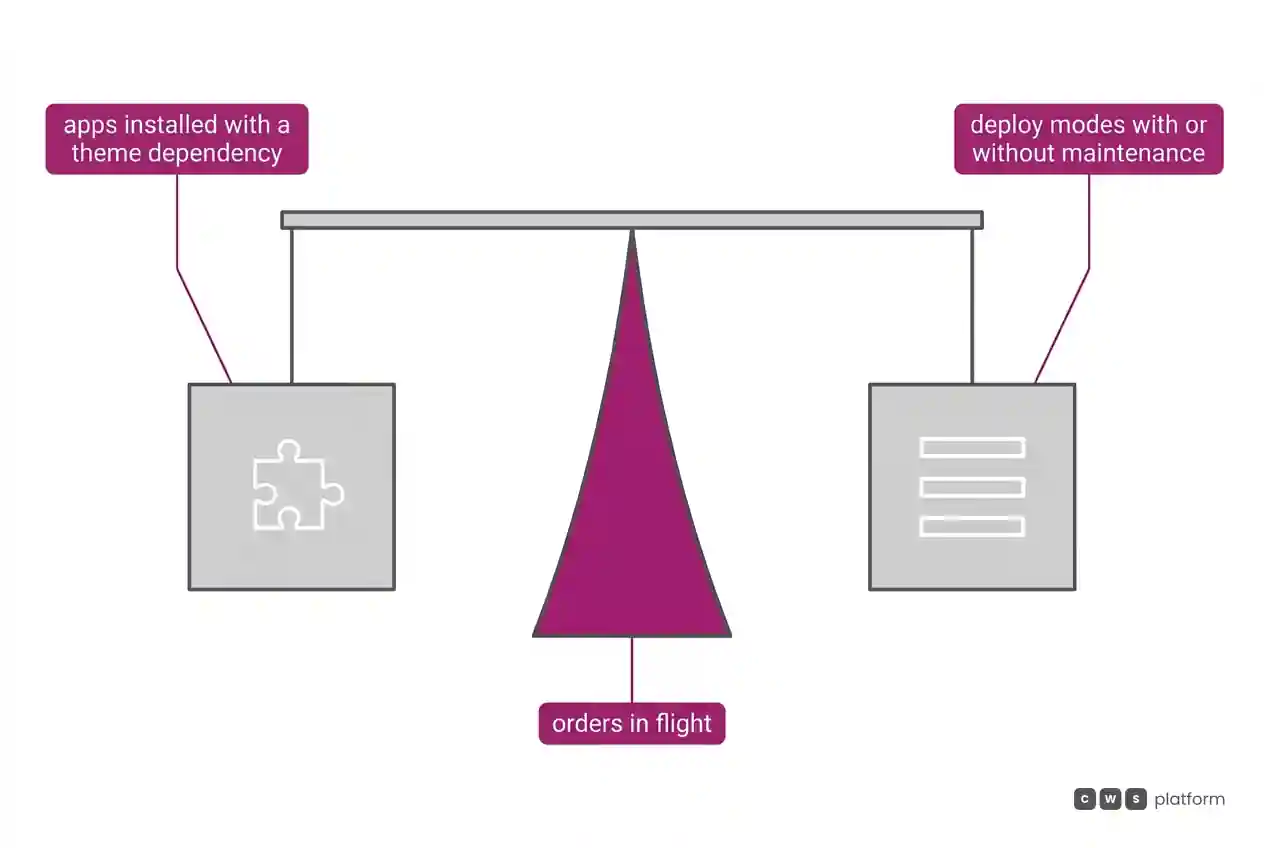
On OroCommerce, the OroCloud upgrade guide describes three deploy modes: the standard one, with maintenance mode, which pauses consumers, cron, and websocket; rolling upgrade, which keeps the application up and is safe only when the database structure does not change; and source upgrade, which updates code without running the platform update.
For operations, the question is the same on both sides: how an update affects orders in flight, and who schedules the window.
When to choose VTEX
Orders from several channels under one orchestration. Unified Commerce unifies order processing, so an order started in one channel is visible to and processed by others.
Ready-made connectors for external channels. The marketplace overview includes native connections for orders, products, prices, and inventory, and the composability guide cites more than 900 ready-made integrations.
Rules per buyer organization. B2B Organizations separates price tables, payment methods, and addresses by organization and cost center.
Several payment methods. The payments overview lists credit and debit cards, digital wallets, gift cards, and customer credit.
When to choose OroCommerce
Quotes that turn into orders. The back-office RFQ documentation covers converting a request for quote into a quote or straight into an order.
Terms and invoices in the product. The payment term sets each customer's payment condition, and the global invoice settings organize invoices in the back office.
Recurring orders. Enterprise recurring orders start from previous orders, with a frequency and start and end dates.
A choice of where to host. The infrastructure guide supports OroCloud, public cloud, private cloud, or on-premise.
When neither fits
Some operations ship the same B2B order in several deliveries, from several origins, with terms negotiated per customer. For them there is a third model, described in three B2B commerce platform models: bring the commercial rules into the platform.
That is the CWS Platform model. Commercial policy lives in parameters in the CDL Workspace, configuration instead of code, and price tables, rules, and contracts are configurable in the platform or come from the ERP and CRM through APIs. Net-terms payment supports split deliveries, scheduled, to several addresses and from several origins. The sales rep builds a cart with the items and the origin of each one and sends the link for the customer to complete, and the order records who built the cart and who chose the payment. Tax comes from the ERP or from the tax engine the company already uses. The platform has 11 modules, 6 AI Agents, and 1,029 parameters.
To read each vendor against that model, there are two comparisons: VTEX vs CWS Platform on order changes and OroCommerce vs CWS Platform on order operations after checkout.
If your order operation looks like this, it is worth talking to a CWS Platform specialist before you settle the architecture.
Frequently asked questions
VTEX or OroCommerce: which is better for B2B order operations?
It depends on where the order starts and where it closes. VTEX fits teams that want orders from several channels under one orchestration, with buyer organizations and quoting in B2B Suite apps. OroCommerce fits teams that want quoting, payment terms, and invoices inside the product, with a choice of where to host it.
Can an order be changed after it is invoiced?
VTEX records that an order invoiced in full can no longer be modified. OroCommerce records that an invoice, once posted, can no longer be modified. On both, ask which flow a change follows after that point and where it is recorded.
Who controls inventory?
On VTEX, inventory sits in warehouses in Inventory Management, and the documentation records that the platform does not subtract items from inventory automatically; inventory managed elsewhere comes in through APIs. On OroCommerce, Enterprise has multi-warehouse inventory, and the Epicor P21 integration receives inventory levels from the ERP. On both, the question is which system decrements inventory.
How does each one take in orders from other channels?
VTEX unifies order processing across channels and has native order connections with marketplaces. OroCommerce imports external orders, without exporting legacy order data, and turns purchase orders received as files or by email into draft orders.
Brands mentioned in this article
 VTEX
 Magento

- OroCommerce
- Adobe Commerce
Trademarks and logos belong to their respective owners. Mention does not imply partnership or endorsement.
"responsive, technically engaged, and willing to work through complex commercial rules (negotiated pricing, credit, customer-specific conditions) rather than pushing generic answers"
Is every order costing your operation more?
Request an assessment of your operation or talk straight to a specialist, whichever you prefer.
I'd rather get the next articles on the cost of each order
A weekly roundup of new articles on the cost of each order, only in weeks when there is one. No spam, and you can leave in one click.